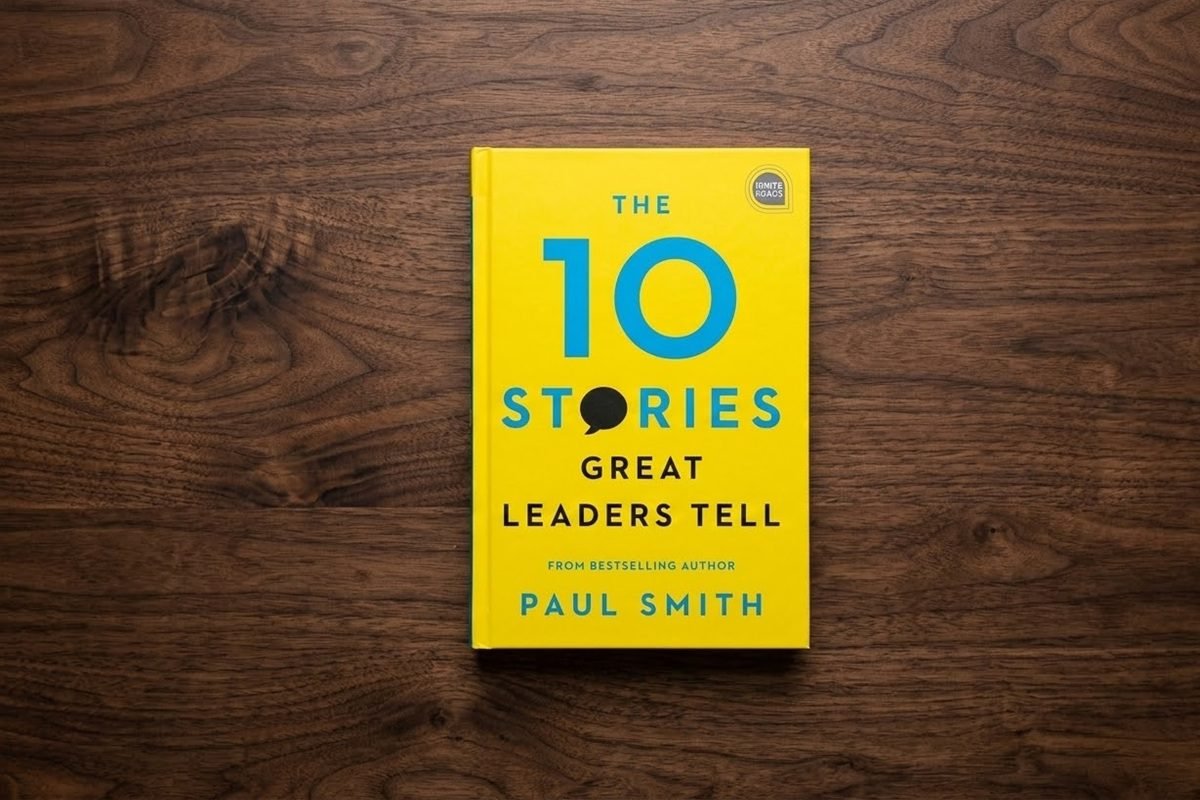
Book review: The 10 Stories Great Leaders Tell
By Paul Smith
Genres:
- Leadership
- Storytelling
The year it was published:
2019
Number of pages:
136

As an Amazon Associate, I earn from qualifying purchases.
Table of contents:
Introduction
Chapter 1: Where We Came From (A Founding Story)
Chapter 2: Why We Can’t Stay Here (A Case-for-Change Story)
Chapter 3: Where We’re Going (A Vision Story)
Chapter 4: How We’re Going to Get There (A Strategy Story)
Chapter 5: What We Believe (A Corporate-Values Story)
Chapter 6: Who We Serve (A Customer Story)
Chapter 7: What We Do for Our Customers (A Sales Story)
Chapter 8: How We’re Different from Our Competitors (A Marketing Story)
Chapter 9: Why I Lead the Way I Do (A Leadership-Philosophy Story)
Chapter 10: Why You Should Want to Work Here (A Recruiting Story)
Conclusion
Thoughts about the book:
Paul Smith has built a reputation around making storytelling practical, and this book feels like a distilled version of that mission, which is less theory, more immediate application. At its core, the book argues that great leadership is, in large part, a function of communication, and the most effective form of communication is storytelling. Smith identifies ten specific types of stories that leaders should be able to tell, from setting a vision and defining values to giving feedback and inspiring action. What I liked most was the clarity of structure. Unlike broader leadership books that wander through abstract principles, this one is sharply focused. Each chapter feels purposeful, offering a clear takeaway that can be applied almost immediately. The writing style is consistent with Smith’s other work, which is direct, conversational, and highly accessible. The book reads like a practical guide or even a workshop in print. The examples carry much of the weight, illustrating how stories function in real leadership situations. The chapters are short, the ideas are clearly presented, and the format encourages quick engagement. This is not a book that demands deep concentration or sustained analytical effort. It is designed to be picked up, used, and revisited.
If there is a weakness, it lies in the simplicity of the framework. The idea of “ten stories” is useful, but it can also feel somewhat reductive. Leadership communication is complex, and not every situation fits neatly into predefined categories. Additionally, readers familiar with Smith’s earlier books may find some overlap in themes and examples. Still, The 10 Stories Great Leaders Tell succeeds in what it sets out to do. It makes storytelling actionable. In the end, this is a focused, practical, and highly accessible book. It is easy to read, clearly written, and immediately applicable. It may not offer deep scientific analysis or groundbreaking theory, but it provides something many leaders actually need, and that is a simple way to communicate with greater clarity, purpose, and impact.
Who should read this book:
If you have ever wondered why some leaders command attention not through authority, but through the stories they tell, then The 10 Stories Great Leaders Tell by Paul Smith offers a clear and practical answer. You should read it if you are interested in leadership that resonates, and how trust is built, visions are shared, and values are lived through narrative rather than instruction. This is a book for readers drawn to leadership, communication, and human connection. It invites you to see that great leadership is not just about decisions and direction, but about the stories that give those decisions meaning and make people want to follow.
Summary of the book:
Introduction
Paul Smith opens with a simple but important idea that great leaders are great storytellers. While most books focus on how to tell stories, they talk about the structure, delivery, and drama, he argues that the more important question is what stories leaders should tell. His point is practical, even a brilliantly told story will fall flat if it doesn’t matter, while a meaningful story can still resonate despite imperfect delivery. This insight comes from years of research, including interviews with more than 300 executives across 25 countries, which led him to identify ten essential stories every leader should be ready to tell, regardless of industry or role. He also clarifies what counts as a story. It’s not a list of facts or a polished slide deck, but a narrative with a specific time and place, a central character pursuing a goal, facing an obstacle, and reaching an outcome, more like a short film than a presentation. This matters because stories work differently from data. People tend to decide emotionally first and justify those decisions logically afterward. Facts appeal mainly to logic, but stories engage both. They are also far more memorable and shareable, which is why people repeat stories but rarely pass along memos.
Chapter 1: Where We Came From (A Founding Story)
Every company begins with a reason, usually a problem someone couldn’t ignore. That moment becomes the founding story, and it’s one of the most powerful stories a leader can tell. It helps attract employees, connect with customers, and build trust with investors. Yet many companies reduce their origins to dry facts, when what really matters is the why behind them. A strong founding story centers on a pivotal moment when the founder decided something had to change. The goal is to uncover that human experience, not just the timeline. That’s what makes the CLIF Bar story effective. In 1990, Gary Erickson was on a long bike ride, exhausted and running on energy bars he could barely stomach. At one point, he realized he’d rather go hungry than eat another one. As a baker, he knew food could be better, and on the ride home, he decided to create a better energy bar. After months of experimenting, he did. The power of the story lies in that single, relatable moment. It shows a real problem, a real person, and a clear motivation, helping people understand not just what the company does, but why it exists.
Chapter 2: Why We Can’t Stay Here (A Case-for-Change Story)
A core challenge of leadership is convincing people that change is necessary. Most people resist change because it means uncertainty and letting go of what’s familiar. Leaders often rely on data, declining revenue, rising costs, and shrinking market share, but numbers alone rarely create urgency. They appeal to logic, not emotion. A case-for-change story works differently. Instead of statistics, it focuses on a real person whose life will improve or suffer, depending on whether the change happens. That human perspective makes the need for change feel immediate and real. The key is to identify who actually benefits from the change and tell their story, rather than focusing on abstract goals like efficiency or profit. That’s what makes Joey’s story so powerful. Diagnosed at ten with a rare, aggressive cancer, he endured multiple surgeries and chemotherapy with little success. His mother fought to get him access to a promising new drug, but clinical trial rules excluded children like him. Even after exhausting every option, she refused to give up, eventually finding a doctor willing to try a newly approved treatment. For a brief moment, it worked, the tumors began to shrink but it came too late. Joey died just weeks later. The impact of this story goes beyond the specifics. When a pharmaceutical company heard it, it changed how they saw their own work. Joey wasn’t their patient, and the drug wasn’t theirs, but the message was clear, delays have human consequences. The story turned abstract timelines into something tangible and urgent, giving their work a sense of purpose that no metric could match.
Chapter 3: Where We’re Going (A Vision Story)
A vision is meant to describe the future in a way that makes people want to be part of it. But most so-called visions are forgettable slogans, short, abstract, and disconnected from everyday reality. Smith argues that a real vision isn’t a phrase, it’s a story. It should be vivid enough that people can see it, feel it, and imagine themselves inside it. The difference is concreteness. A typical vision statement talks in generalities, but a vision story follows a specific person, often a customer or employee, living in that future. It shows what their day looks like and how their life is better. That’s what makes it memorable and motivating. Smith used this approach when leading a team of sales forecasters struggling with poor tools and low credibility. Instead of presenting a plan, he wrote a short story set two years ahead, following a fictional employee named Sherri through her day. In that future, she was invited to important meetings, spoke with confidence, and was valued by her colleagues. By the end of the day, she realized she actually enjoyed her job. The impact came from how tangible it felt. People could see themselves in Sherri’s position and recognize what they were working toward. Instead of an abstract goal, they had a clear, human picture of success, and that made them want to help create it.
Chapter 4: How We’re Going to Get There (A Strategy Story)
A vision shows where you’re going; a strategy explains how you’ll get there. The problem is that most strategies are buried in jargon and complexity, making them hard to understand and easy to forget. A strategy story simplifies this by using analogy, linking the strategy to something familiar so people can grasp it quickly and remember it. An analogy works because it turns abstract ideas into something concrete. Instead of explaining multiple strategic pillars, you give people a single, clear image that ties everything together. Once that image clicks, the details follow naturally. That’s what made one company’s approach so effective. Instead of presenting a new strategy in slides, employees arrived to find what looked like a future Wall Street Journal article titled “How David Beat Goliath.” It opened with the story of Vivek, an inexperienced basketball coach who led a team of beginners to success by applying relentless full-court pressure for the entire game. The article then drew the parallel that while competitors focused only on peak seasons, the company would operate with the same intensity year-round—expanding its market, rethinking its product, and constantly innovating. The result was immediate. People understood the strategy without needing a formal explanation because the analogy made it intuitive. More importantly, it made the strategy feel real and compelling, turning a complex plan into something simple, memorable, and motivating.
Chapter 5: What We Believe (A Corporate-Values Story)
Every company has a list of values such as integrity, customer focus, and innovation, but on their own, these words don’t guide behavior. Values only become real when they’re tested, when acting on them requires effort, risk, or sacrifice. That’s where stories matter. A values story shows someone making a choice under pressure, revealing what the organization truly stands for. The power of these stories is that they demonstrate values in action, rather than declaring them. Instead of telling people what matters, they show what it looks like when it matters most. That’s what makes the story of Sam Walton and Charles Butt so effective. When Butt, CEO of a competing grocery chain, visited Walmart to learn from its success, he found Walton in a store aisle helping a customer choose an ironing board cover. Even after noticing Butt, Walton finished assisting the customer before turning his attention to him. Only once she had made her purchase did he rejoin Butt, energized and excited about how many of those products they could sell. In that brief moment, multiple values come through clearly without being stated: the customer comes first, curiosity about customer needs drives insight, persistence matters, and enthusiasm fuels performance. Even respect for competitors is implied in Walton’s willingness to host and share. A single, simple story communicates far more about what the company believes than any list of values ever could.
Chapter 6: Who We Serve (A Customer Story)
Most employees know their customers through data reports, metrics, and slides. That shows what people do, but not why they do it, and it rarely creates any real connection. A customer story fills that gap. By sharing a single, vivid encounter with a real person, leaders can make the customer’s reality tangible in a way data never can. That’s why it’s important for leaders to spend time with customers and bring those experiences back as stories. One well-told example can shape how an entire organization thinks about the people it serves. Rohini, a marketing manager in India, discovered this firsthand while researching why low-income women in Chennai were buying expensive disposable hygiene products instead of using reusable cloth. In one small home, she met a mother who owned very little but had carefully arranged her daughter’s schoolbooks on the table. During their conversation, Rohini realized the woman wasn’t buying the product for herself, but for her daughter to use at school. She wanted her daughter to stay in school, build a career, and have choices she never had. In that moment, the product stopped being just a product. It became a symbol of opportunity and independence. While Rohini’s team produced a full research report, it was this one story that endured. It captured who their customer really was and why she made the choices she did, something no amount of data could fully explain.
Chapter 7: What We Do for Our Customers (A Sales Story)
Business language often hides more than it explains. Phrases like “optimising distribution channels” may sound impressive, but they leave people unclear about what a company actually does. A strong sales story replaces that vagueness with something concrete: a real example of a customer with a problem, what was done to solve it, and the result. This kind of story works because it answers practical questions naturally, without jargon. Instead of listing services, it shows value in action. That’s what Ben Koberna does when explaining his company, EASIBuy. He tells the story of a county in Florida that had been paying $250,000 a year to remove sludge from a wastewater plant. When EASIBuy introduced a reverse auction where suppliers compete by lowering their prices, the existing contractor reacted angrily, even showing up with a lawyer. But once the bidding started, his price kept dropping until he eventually bid zero. It turned out he had been reselling the sludge as fertilizer for years and was happy to collect it for free. The result was simple and memorable: the county went from paying a quarter of a million dollars a year to paying nothing. More importantly, the story reassures potential clients about concerns they might not voice, like how current suppliers will react. Instead of abstract claims, it shows exactly what the company does and why it matters.
Chapter 8: How We’re Different from Our Competitors (A Marketing Story)
In many industries, competitors look nearly identical on paper, offering similar services at similar prices. A list of features and benefits doesn’t do much to stand out because it’s often generic and easy to forget. A marketing story works differently. Instead of claiming superiority, it shows it by placing the listener inside a real situation where the difference becomes obvious. That’s what Sharad Madison does when explaining his commercial cleaning business. When his company took over the Verizon building in New Jersey, his team observed how the previous contractor worked. In one hallway over half a mile long, a cleaner was using a small household vacuum. On another floor, carpets were being cleaned with slow, basic equipment that couldn’t realistically cover the space. Even simple details were missed, shorter workers couldn’t reach the tops of tall cabinets, leaving visible half-cleaned areas. Sharad replaced all of it with industrial-scale tools and practical fixes, immediately changing the quality and efficiency of the work. The point isn’t just that his company uses better equipment; it’s that you can clearly see the contrast between poor and professional service. The story makes the difference tangible, showing not just what the company does better, but why it matters.
Chapter 9: -Why I Lead the Way I Do (A Leadership-Philosophy Story)
When leaders try to explain their leadership philosophy, they often fall back on generic, forgettable language. But people don’t follow statements, they follow individuals. What builds trust is understanding how a leader thinks, makes decisions, and behaves under pressure. The most effective way to communicate that is through a personal story. A leadership philosophy story shows the experiences that shaped how a leader operates. It sets expectations by making their behavior understandable and predictable. Mike Figliuolo does this through a story from his time as a young tank platoon leader. During a large training exercise, he was leading a formation of 400 vehicles across unfamiliar terrain. As they approached a critical decision point, he realized he couldn’t confidently identify the correct path. He had two options: stop and risk stalling the entire formation in a vulnerable position, or make a quick decision and keep moving. He chose to act, directing his tank to the left. It turned out to be the wrong choice, his tank and the next two were taken out. But the rest of the formation saw what happened, adjusted, and successfully completed the mission. The lesson is clear: in fast-moving situations, speed can matter more than perfection. Today, that experience shapes how Mike leads—he makes decisions quickly and accepts the risk of being wrong. By sharing this story, he helps his team understand what to expect from him, turning an abstract philosophy into something concrete and trustworthy.
Chapter 10: Why You Should Want to Work Here (A Recruiting Story)
Recruiting pitches often sound identical: competitive pay, strong culture, good people, career growth. The problem is that every company says the same thing, so candidates have no real basis for choosing between them. A recruiting story breaks that pattern by giving people a concrete, human reason to want to work somewhere, something specific they can remember and relate to. Instead of abstract claims, it shows a real decision, a real moment, or a real experience that reveals what the company is actually like. That’s what helps candidates move from comparing benefits to understanding fit. Paul Smith’s own experience illustrates this. While finishing his MBA, he had similar job offers from several major companies and couldn’t decide between them. To get clarity, he called a recruitment firm and asked a simple question: if he wanted to switch companies in five years, which employer would make that easiest? The recruiter immediately pointed to Procter & Gamble, explaining that people who left often said no other company matched the quality of thinking there, and that entry-level hiring meant it was a rare opportunity to join. That short conversation became the deciding factor. It wasn’t a brochure or a pitch, it was a real, practical insight that changed how he evaluated the choice. Years later, he shared the same story when recruiting others, because it gave candidates something far more useful than generic promises: a way to understand what working there actually feels like and why it might matter for their future.
Conclusions
By this point, Smith assumes you’ll have plenty of ideas for stories you could use in your own work. The final chapter is about turning those ideas into something practical and usable. First, use the story checklist in the appendix in the book. Go through the ten story types, prioritise them, identify the real people or events behind each one, and track your progress until each story is complete. Second, actively look for stories you don’t yet have. Talk to colleagues, customers, and even yourself. Run informal interviews or ask people what moments they remember most. Often, the most powerful stories are already there—you just haven’t noticed them yet. Third, shape each story using a simple structure: why should the audience listen, when and where it happened, who was involved, what they wanted, what the problem was, what actions were taken, what happened as a result, what was learned, and finally what the audience should do next. Following this sequence keeps the story clear and purposeful. Finally, start using the stories in real situations, meetings, conversations, and everyday interactions. See what resonates, refine what doesn’t, and improve through use rather than theory. The central message is simple: great leadership isn’t about perfect presentations or polished delivery. It’s about choosing the right stories and telling them honestly. A well-told story will always outlast a slide deck.