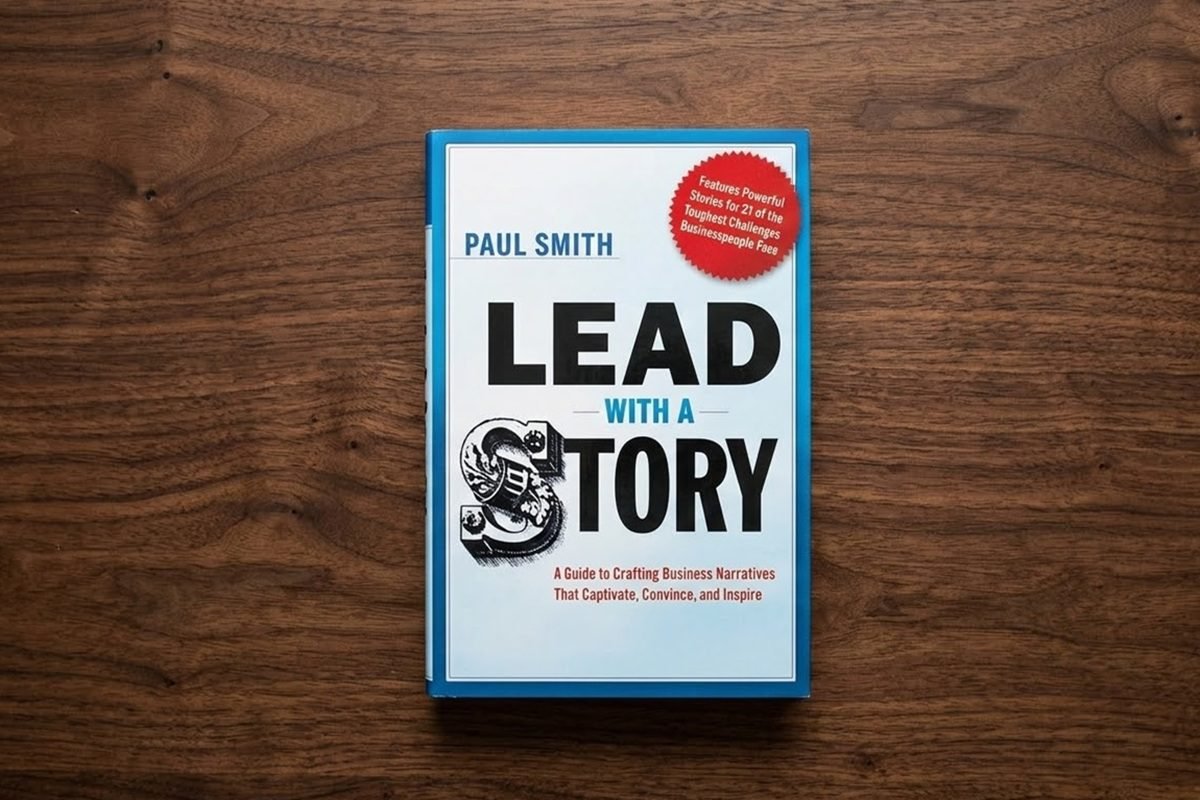
Book review: Lead With A Story
A Guide to Crafting Business Narratives That Captivate, Convince, and Inspire
By Paul Smith
Genres:
- Business Management
- Communication Skills
- Leadership
The year it was published:
2012
Number of pages:
288

As an Amazon Associate, I earn from qualifying purchases.
Table of contents:
Introduction
Chapter 1: Why Tell Stories?
Part I – ENVISION Success
Chapter 2: Set a Vision for the Future
Chapter 3: Set Goals and Build Commitment
Chapter 4: Lead Change
Chapter 5: Make Recommendations Stick
Chapter 6: Define Customer Service Success and Failure
Chapter 7: (How-To) Structure of a Story
Part II – Create an ENVIRONMENT for Winning
Chapter 8: Define the Culture
Chapter 9: Establish Values
Chapter 10: Encourage Collaboration and Build Relationships
Chapter 11: Value Diversity and Inclusion
Chapter 12: Set Policy Without Rules
Chapter 13: (How-To) Keep It Real
Chapter 14: (How-To) Stylistic Elements
Part III – Create an ENVIRONMENT for Winning
Chapter 15: Inspire and Motivate
Chapter 16: Build Courage
Chapter 17: Help Others Find Passion for Their Work
Chapter 18: (How-To) Appeal to Emotion
Chapter 19: (How-To) The Element of Surprise
Part IV – EDUCATE People
Chapter 20: Teach Important Lessons
Chapter 21: Provide Coaching and Feedback
Chapter 22: Demonstrate Problem Solving
Chapter 23: Help Everyone Understand the Customer
Chapter 24: (How-To) Metaphors and Analogies
Part V – EMPOWER others
Chapter 25: Delegate Authority and Give Permission
Chapter 26: Encourage Innovation and Creativity
Chapter 27: Sales Is Everyone’s Job
Chapter 28: Earn Respect on Day One
Chapter 29: (How-To) Recast Your Audience into the Story
Chapter 30: Getting Started
Thoughts about the book:
At its core, Lead with a Story argues that storytelling is not just a soft skill but a fundamental leadership tool. Paul Smith suggests that facts inform, but stories persuade. Whether you are trying to set a vision, motivate a team, deliver feedback, or navigate change, the ability to tell the right story at the right time can be the difference between compliance and genuine engagement. What I appreciated most about the book is its practicality. Smith does not dwell in abstraction. He provides a wide range of real-world examples with stories leaders can use in specific situations, from handling failure to reinforcing values. The structure is almost modular, since you can dip into chapters based on the leadership challenge you’re facing. This makes the book immediately applicable, which is rare in a genre often filled with vague advice. The writing style is clear, direct, and highly accessible. Paul Smith uses everyday language and a conversational tone that makes the book easy to read. There is no academic density, no unnecessary jargon. Instead, the prose mirrors the very principle the book promotes: clarity through narrative. You move quickly through the chapters, guided by examples rather than theory. However, the simplicity should not be mistaken for a lack of importance of the message. The challenge lies not in understanding the concepts but in applying them effectively and learning to craft and deliver stories with intention.
The book is informative, though not scientific in a strict sense. Smith draws on communication principles and some psychological insights, but the foundation is largely his own experience rather than research-heavy. This is not a book of studies and data, it is a book of practice and observation. If there is a limitation, it is that the book can feel somewhat repetitive in its core message, which is that stories matter, and you should use them often. While the variety of examples helps, the underlying principle remains consistent throughout. Additionally, readers looking for a deeper theoretical exploration of narrative psychology or persuasion may find the book somewhat light. Still, Lead with a Story succeeds in what it sets out to do. It demystifies storytelling and places it firmly within the toolkit of effective leadership. It is practical, accessible, and immediately useful. It may not redefine leadership theory, but it sharpens an essential skill that many leaders overlook. In the end, this is a clear, engaging, and highly usable book. It speaks in the language of everyday leadership rather than academic theory.
Who should read this book:
If you have ever felt that data alone rarely inspires action, then Lead with a Story by Paul Smith is a compelling invitation to rethink how leadership truly works. You should read it if you are interested in communication that moves people and how ideas are not just understood, but felt, remembered, and acted upon. This is a book for those who lead teams, influence decisions, or simply want their message to resonate beyond the moment it is delivered. Paul Smith is searching for the missing link between information and inspiration. His interest lies in the power of storytelling as a leadership tool, how the right story, told at the right time, can build trust, shape culture, and drive change far more effectively than facts and figures alone. He breaks down what makes a story persuasive, when to use it, and how to make it authentic rather than performative. This is a book for readers drawn to leadership, persuasion, and human connection. It invites you to see storytelling not as entertainment, but as one of the most practical and underutilized skills in business and life.
Summary of the book:
Introduction
Paul Smith opens the book with a bold claim that storytelling is one of the most powerful tools a leader can use, even more effective than bullet points, charts, or data. He traces its role from ancient cultures, where the best storytellers often became leaders, to today’s corporate world, where companies like Nike, 3M, and Procter & Gamble use storytelling as a core leadership practice. Although storytelling once fell out of favor as business communication shifted to memos, reports, and spreadsheets, it made a comeback in the 1990s when researchers and executives realized that stories are far better at helping people understand, remember, and act on ideas. The book explores 21 common leadership challenges, from setting a vision to giving feedback, and supports each with practical storytelling examples. One example highlights this clearly. A research team studying jury deliberations found that most factors, such as juror demographics or working conditions, had little impact. What mattered most was the shape of the table, round tables encouraged balanced discussion, while rectangular ones allowed a single person to dominate. However, when they presented this to the judge, he used the insight to speed up decisions rather than make them fairer, replacing round tables with rectangular ones. The researchers realized too late that they had never clarified the judge’s true objective. The story has endured because it conveys a simple but powerful lesson, and that is to always understand your audience’s real goal. As Smith emphasizes, stories make ideas far more memorable and impactful than straightforward instructions.
Chapter 1: Why Tell Stories?
Chapter 1 explores a simple but important question, why use storytelling in business at all? Paul Smith outlines ten reasons why stories are so effective. They are simple and accessible, anyone can tell one, and unlike management trends, they never go out of style. Stories resonate with all kinds of people regardless of background, spread easily, and are far more memorable than facts or slides. They also engage different types of learners and fit naturally into informal, everyday workplace interactions, where most real learning happens. Perhaps most importantly, stories respect the audience by allowing people to draw their own conclusions, which makes them more likely to change their behavior. This idea is reinforced through practical examples. In one case, the author presented to Procter & Gamble’s CEO, A. G. Lafley, after spending weeks preparing detailed slides. During the presentation, Lafley sat with his back to the screen and never once looked at them, yet still agreed with the recommendation. His reaction made it clear that what mattered was not the slides, but the message being communicated directly. In another example, a mathematician named Jim Bangel transformed his dry research memos into engaging stories with characters like “Earnest Engineer” and “Ed Zecutive.” What started as an experiment quickly gained popularity, with thousands of employees, including senior leaders, reading his work. Eventually, he became the company’s corporate storyteller. Together, these examples highlight Smith’s central point that people respond far more strongly to stories than to formal reports or presentations, making storytelling a powerful and practical leadership tool.
Chapter 2: Set a Vision for the Future
Chapter 2 focuses on one of a leader’s most important responsibilities, which is creating a clear and compelling vision of the future. Paul Smith explains that a good story helps in three key ways. It captures attention, clearly communicates the vision, and shows that the goal is achievable by pointing to similar successes. A vision cannot be vague or generic, it needs to help people see themselves in it. The most effective stories are personal and specific, often describing what a typical day in that future looks like so that people can imagine themselves succeeding within it. This idea is illustrated through several examples. In a well-known folktale, three bricklayers are asked what they are doing. One says he is laying bricks, another says he is building a wall, and the third proudly says he is building a great cathedral. Unlike the others, he understands the bigger picture and works with purpose and clarity. The story shows how a strong vision transforms not just motivation, but also the quality of work and collaboration. In another case, the author faced a disengaged team of sales forecasters with outdated tools and low morale. Instead of presenting a plan, he wrote a story about “Sherri,” a forecaster two years in the future, confidently using improved systems and succeeding in her role. By showing what a normal day could look like, he made the vision tangible and personal, prompting immediate buy-in from his team. A final example involves motivating a team working on the long-term future of a paper business. The author told the story of Nokia, which began as a paper mill in the 19th century and gradually evolved into a global telecommunications company. The story demonstrated that transformation is possible over time through smart decisions, helping the team see purpose in their work and become more engaged.
Chapter 3: Set Goals and Build Commitment
In this chapter, the author focuses on turning vague ambitions into clear, measurable goals that people genuinely care about achieving. Paul Smith explains that goals are most effective when success or failure is unmistakable, when progress can be tracked through daily or weekly milestones, and when individuals feel personally accountable for the outcome. Building real commitment also requires a sense of ownership, people need to feel responsible for results while also having a voice in shaping the goals themselves. This becomes clearer through several examples. In political campaigns, Ben LaRocco learned that every effort must be tied to concrete outcomes, since winning or losing is absolute. After losing an election by just 22 votes, he began tracking daily performance obsessively, measuring activities like calls and door visits and asking each night whether he had “won or lost” that day. The experience shows how powerful clear metrics and constant tracking can be in driving performance. A similar principle appears in a sales environment, where a financial advisor created a point system to measure daily activities such as calls and meetings. What started as a simple tracking tool became far more effective when it was turned into a competition, giving the work a sense of urgency and purpose. As a result, performance increased dramatically, demonstrating how structured goals and a clear “score” can transform motivation. Finally, the importance of accountability is captured in a lesson from West Point, where cadets are taught to take full responsibility with the phrase “no excuse, sir.” This mindset stayed with a future CEO, who later used a simple moment with his young daughter repeating the same phrase to illustrate how powerful true ownership can be. Together, these examples reinforce the chapter’s core message, which is that when goals are clear, progress is visible, and accountability is personal, people become far more committed and driven to succeed.
Chapter 4: Lead Change
In chapter 4, Paul Smith explains why leading change is so difficult. The main reason is that some people tend to fear the unknown, resist unfamiliar situations, and hold on to existing habits. So the author outlines four key strategies to overcome this problem. The strategies are to give people a clear reality check, prepare them so they feel ready, change the environment to support new behaviors, and turn obstacles into opportunities for progress. A central insight is that people don’t actually fear change itself, they fear being unprepared for it. Once they feel ready, they are far more willing to embrace change. This becomes clear through several examples. When Jack Welch visited GE’s nuclear reactor division, the team confidently projected steady growth based on past trends. Welch challenged them directly, saying they would not receive any new orders in the US. Although shocking, this forced the team to shift focus to servicing existing reactors, which led to significant growth. His honesty provided the reality check needed to spark change. Fear and preparation are illustrated through a simpler story of a young child anxious about a new school bus stop. While one child was comfortable, the other was afraid because he didn’t know what to expect. By walking him through a step-by-step rehearsal and creating a backup plan, his father eliminated the fear. Another example shows how changing the environment can drive behavior. A company struggled to stop employees from leaving sensitive documents on shared printers, despite repeated reminders. The problem disappeared when a new system required employees to enter a code before printing, forcing them to stay and collect their documents. Without changing attitudes directly, the environment made the desired behavior automatic. Finally, a negative external event can become a powerful catalyst for change. When a critical article highlighted major issues with a product, a leader chose not to ignore it but to openly acknowledge the problems and use the criticism as motivation for improvement. By reframing the setback as confirmation of needed change, he turned a potential embarrassment into a rallying point for his team. With these examples, the author shows that successful change leadership requires honesty, preparation, smart design of the environment, and the ability to turn challenges into momentum.
Chapter 5: Make Recommendations Stick
Chapter 5 focuses on one of the most common challenges leaders face, which is getting people to accept a recommendation. Paul Smith explains three storytelling techniques that make ideas stick. First, take your audience on a “discovery journey” and guide them to reach the conclusion themselves so they feel ownership over it. Second, use a single, memorable metaphor to capture your recommendation in just a few words. Third, challenge a fundamental assumption your audience holds; proving it wrong makes them far more receptive to change. These techniques are illustrated through real examples that the author included in this chapter. In one case at P&G, the author noticed that diaper sales and profits moved in lockstep from 1961 to 1982 but diverged after 1983. Instead of announcing the reason, which was market saturation, he asked the leadership team to guess what had changed. After throwing out ideas, someone concluded the market was fully developed. By arriving at the insight themselves, the team immediately embraced the new strategy. A second example shows the power of metaphor. Alltel’s CEO, Scott Ford, used a single photo of a New York taxi to explain that selling the company required a rare alignment of conditions. When all three conditions aligned, he said, you had to “get in the cab”—or risk missing the opportunity. A year later, when Verizon’s $28.1 billion offer arrived, the metaphor resonated instantly with investors and sealed the deal. Finally, challenging assumptions can make recommendations irresistible. A research team presenting a new product concept discovered that the “new” concept had already been tested three years earlier and failed. By highlighting this, they shattered the client’s assumption that the idea was novel, making their recommendation to fix the existing brand instead of launching a new one impossible to dispute. These stories show that by guiding discovery, using vivid metaphors, and questioning assumptions, leaders can make their recommendations not just heard, but adopted.
Chapter 6: Define Customer Service Success and Failure
Chapter 6 emphasizes how stories define what great customer service looks like, often more effectively than manuals or policies. Paul Smith explains that sharing both positive and negative customer experiences helps employees understand the standards they are expected to meet. Collecting these stories—+ writing them down, posting them, and sharing them is critical. If you don’t, they vanish. Even stories of poor service are valuable, as long as the lessons are clear. The difference storytelling makes is clear in these examples. At Pizza Hut, a cook named Sterling Price created a meatball sandwich for a customer whose husband was gravely ill. It became his last meal, and the story was deeply moving. Yet because Sterling only told his coworkers and didn’t record it, the lesson disappeared. By contrast, National Car Rental turned a customer problem into a lasting story. When Ray Brook arrived to rent a car with an expired license, the staff went above and beyond, driving him to the DMV, helping him navigate delays, and ensuring he could continue his travel. The manager shared this story widely, and it became a teaching tool for employees, inspiring loyalty. Ray remained a National customer for 20 years. Finally, at a bed-and-breakfast in Sedona, innkeeper Tanya went to extraordinary lengths for a guest who had left behind a $500 custom mouth guard. She retrieved it from a dumpster and returned it to the guest, who shared the story online. Nearly 1,000 future guests read it, showing both the staff and visitors the standards of care expected. These stories demonstrate that memorable customer service is reinforced through narrative, guiding behavior, and inspiring employees far more effectively than policies alone.
Chapter 7: (How-To) Structure of a Story
Chapter 7 explains the essential structure of any business story, summarized in the CAR framework – Context, Action, Result. Context sets the scene, action describes the journey, and result shows the outcome. Paul Smith then expands this into the acronym STORY – S for Subject (a relatable main character), T for Treasure (what the character wants), O for Obstacle (the challenge or villain), R for Right lesson (the takeaway for the audience), and Y for why you’re telling the story (what you want the audience to do). A common mistake is starting with action and then backtracking to explain context, the classic “let me back up” moment. Without context first, the audience can become confused and disengaged before the story truly begins. The chapter illustrates this with a case from Titleist. The company had 75% market share among skilled golfers but only 20% among average players, who made up 95% of the market. Instead of focusing on low spin and expert control, they launched the NXT ball, designed for consistency and forgiveness. The recreational golfer market share doubled from 20% to 43%. The story is told three ways in the chapter, starting with action (confusing), starting with context (better), and adding emotion and surprise (most engaging). The lesson in this chapter is clear. And that is how a story is structured determines whether it captivates or loses your audience.
Chapter 8: Define the Culture
Chapter 8 explains that company culture isn’t defined by mission statements or policy manuals, it’s defined by what people actually do and the stories they tell about those actions. Positive stories reinforce the behavior you want to see, stories of bad behavior with consequences reinforce norms, and stories of leaders ignoring rules destroy credibility faster than anything else. Unspoken norms often carry more weight than formal rules, so if you want a behavior to spread, find employees already demonstrating it and celebrate them openly. The chapter illustrates this with several examples. During the 2011 Egyptian revolution, P&G employee Rasoul Madadi and his family were trapped at Cairo airport. The company mobilized immediately, a plant manager authorized unlimited spending, HR arranged accommodations across multiple countries, and a colleague’s assistant spent her Saturday rebooking flights. After multiple cancellations, the family finally made it to Dubai, where P&G had already arranged a hotel and provided cash. Rasoul later said that how a company treats employees in a crisis is a truer measure of its culture than salary. Another example contrasts two leaders enforcing rules. Revlon’s CEO, Charles Revson, fired a receptionist who followed a company rule, sending a message that rules didn’t apply equally. In contrast, IBM’s Tom Watson insisted his own security rules were enforced, even against himself, showing that rules apply to everyone. These stories convey cultural expectations far more powerfully than memos or policy manuals. Finally, P&G showcased its flexible work policy through Silvia Porras in Costa Rica. After giving birth to triplets, she worked from home three days a week to care for her children while continuing her job. Her story, shared on the company’s internal website, made clear to thousands of employees that flexible policies were real and supported, not just written words.
Chapter 9: Establish Values
Chapter 9 emphasizes that values are meaningful only when tested in real situations. “Values-in-action” stories show what happens when someone faces a choice between the easy wrong path and the hard right one. These moments and the stories that capture them bring abstract principles like integrity, persistence, passion, and customer focus to life. No poster or bullet point can convey them as powerfully as a story. Several examples illustrate this. A supermarket CEO implemented a rule that managers must park at the far end of the lot so customers have the best spots. On a rainy day, he could have parked near the entrance, but instead, he walked through pouring rain, soaking himself. Employees immediately understood that putting customers first wasn’t just policy, it was real. In another example, Northwestern Mutual faced insolvency in 1859 after a catastrophic train accident. Two policyholders’ claims exceeded the company’s assets. Rather than delay or deny payment, the company president and trustees borrowed personally to pay both claims in full. This story has guided generations of employees, showing them how to prioritize doing the right thing even when it is difficult. Finally, Sam Walton exemplified Walmart’s values through a simple interaction with a customer. When visiting CEOs arrived to learn from him, they found Walton patiently helping a shopper choose an ironing board cover, asking thoughtful questions, and showing deep enthusiasm for meeting customer needs. That one story illustrates multiple Walmart values such as customer focus, curiosity, persistence, passion, and respect for competitors.
Chapter 10: Encourage Collaboration and Build Relationships
Chapter 10 shows that meaningful relationships aren’t built through small talk they’re built through stories that reveal who we are, where we’ve been, and what we’ve struggled with. Paul Smith explains that storytelling fosters collaboration in three ways: personal stories create emotional bonds, work stories spread knowledge across teams, and humanizing stories about leaders make them approachable and easier to work with. One example comes from a Washington State organization where a new boss joined a team that already had a long-tenured manager. The team resented the newcomer before he even arrived. During a team-building retreat, participants made magazine collages representing their past, present, and future, then shared their stories. The new boss and the existing manager discovered shared faith and family priorities, transforming initial tension into collaboration. By the afternoon, the team was working together seamlessly, exceeding the CEO’s expectations. Another example shows the power of personal storytelling. Jamie Johnson, a researcher who kept his private life separate from work, realized he never shared personal stories with colleagues. At a company anniversary, he spoke about his younger brother Steven, who had undiagnosed bipolar disorder and tragically took his own life at 19. By opening up, Jamie revealed depth and humanity to his coworkers, transforming hallway conversations from superficial topics to meaningful exchanges. The team’s performance improved measurably as trust and connection grew.
Chapter 11: Value Diversity and Inclusion
Chapter 11 demonstrates how stories bring diversity and inclusion to life in ways statistics cannot. Paul Smith explains that stories allow people to feel what it’s like to be excluded and to experience the transformation that comes from being included. They also reveal unconscious bias and show how even well-intentioned actions can make others feel invisible. One striking example is Beverly Keown, born in 1955 on a cotton plantation in Arkansas. Growing up in the Jim Crow South, she faced segregation and discrimination daily. As an adult, she spent 27 years in workplaces where she was often the only Black employee in a salaried role, sometimes facing overt hostility. When she joined P&G in 2005, she described it as “a breath of fresh air,” the first place where her race didn’t define her experience. Her pride and performance flourished, illustrating how inclusion transforms both engagement and results. Bracken Darrell tells another story about a manager, Jack, who seemed to treat everyone equally. A Black colleague, Don, noticed that while Jack joked warmly with Bracken and asked personal questions of a white female colleague, he greeted Don simply with “Hello, Don.” The difference was subtle but meaningful—revealing how unconscious bias can create unequal access to attention, opportunities, and support. Finally, a CEO who initially resisted Equal Employment Opportunity rules discovered the business value of diversity. After reluctantly hiring women and minorities, he found their perspectives improved marketing and product development. By the time legal pressure subsided, he had no reason to reverse course since diverse teams were driving stronger results.
Chapter 12: Set Policy Without Rules
Chapter 12 shows that in most organizations, stories, not written rules, actually guide behavior. People rarely read policy manuals, but they remember vivid accounts of what happens when someone breaks a rule or follows it exceptionally well. Stories set behavioral norms far more effectively than adding new rules, which often create bigger problems. Formal rules should be reserved for legal or unavoidable requirements otherwise, storytelling is a more powerful tool. At P&G, new employees learned this through the story of “Getting Polked.” Trainees were told about two former employees who repeatedly ate in a cafeteria reserved for trainees. Eventually, they were caught and fired in a memorable way. The story stuck so strongly that any questionable behavior by new employees was immediately associated with the warning: “Keep that up and you’ll get Polked.” The narrative shaped conduct far more effectively than a written policy ever could. Another example comes from Sara Mathew, CFO at Dun & Bradstreet. She discovered nearly a decade of incorrect accounting that required a $150 million restatement. Rather than ignoring or delaying, she committed to uncovering every issue within six weeks, a feat never accomplished before. Her team delivered on time, demonstrating transparency and integrity.
Chapter 13: (How-To) Keep It Real
Chapter 13 emphasizes that abstract ideas don’t stick, concrete, specific details do. Paul Smith shows that using real names, actual numbers, plain language, and tangible examples makes stories more understandable, memorable, and actionable. The chapter also advocates radical honesty: in difficult situations, vague corporate language undermines trust, while openness often builds it and leads to better solutions. One example comes from P&G’s effort to convince a Canadian retailer to focus on its best customers, called “high-potential shoppers.” The concept fell flat until Monika Jambrovic replaced the abstract term with a real name, Lisa, which was paired with a photo of an ordinary Canadian woman. Suddenly, the retailer connected with the idea, and Lisa became a touchstone for every future initiative, “What would Lisa think about this?” A second example shows how numbers become tangible. Attorney Jerry Jones needed a jury to set punitive damages. Rather than explain abstract formulas, he compared the company’s profits to a five-day snowstorm, making the potential loss concrete. The jury immediately grasped the scale and awarded the amount he intended. Finally, Andrew Moorfield, founder of a small London startup, faced a payroll shortfall. Instead of hiding details, he laid out the company’s finances transparently to all 25 employees and asked them how to allocate the limited funds. The team collaboratively decided who needed payment most urgently, showing that honesty and specificity can generate trust, engagement, and creative problem-solving.
Chapter 14: (How-To) Stylistic Elements
Chapter 14 is all about the craft of storytelling, how to tell a story, not just what story to tell. The key principle is to write as you speak. Most business writing is long, complex, and passive. Instead, aim for short sentences, simple words, active voice, and getting to the verb quickly. Great openings use one of three techniques. A surprise, a mystery that won’t be solved until the end, or a relatable character in a tough spot. The chapter also highlights three powerful literary devices, dialogue, which engages the audience, real names, which make stories credible and vivid, and repetition, which builds rhythm and anticipation. Here is a counterintuitive tip. Never apologize for telling a story, and never announce that you’re about to tell one. Just tell it. Leaders don’t ask permission to lead, they lead through action and narrative.
Chapter 15: Inspire and Motivate
Inspiration stories show people why their work matters, help them overcome distractions, and give them the resilience to face setbacks. The most powerful motivational stories feature someone in a situation the listener can relate to and highlight a choice between giving up and keeping going. One classic example is Tanzanian marathoner John Stephen Akhwari at the 1968 Mexico City Olympics. He fell during the race, badly cutting his leg and dislocating his knee. Medical personnel urged him to stop, but he refused. An hour after the gold medalist finished, Akhwari limped across the line in last place. When asked why he kept going, he said, “My country didn’t send me 5,000 miles to start this race. They sent me 5,000 miles to finish it.” Leaders use this story to inspire employees finishing a role or project to give their best until the end.
Chapter 16: Build Courage
Courage in business takes many forms such as persisting after repeated failure, attempting something daunting for the first time, and ignoring what others think. This chapter uses stories from history, folklore, and modern business to illustrate each type. One classic example is Abraham Lincoln. Told without revealing his name until the end, the story traces a lifetime of hardship, his family lost their farm when he was seven, his mother died when he was nine, he failed in business, finished poorly in early elections, and suffered a nervous breakdown. Yet at 51, he became the 16th President of the United States, preserved the Union, ended slavery, and led the nation through its greatest crisis. The delayed reveal makes his persistence far more memorable. Pringles provides a modern example of perseverance. Launched in 1971, the brand’s sales fell 60% by 1979. P&G gave it five years to recover or be sold. Through research, product improvement, pricing adjustments, and cutting ad waste, sales slowly rebounded, eventually surpassing previous peaks. The lesson, don’t stop.
Chapter 17: Help Others Find Passions for Their Work
You can’t force people to love their work, but stories can help them see it differently and find passion. This chapter highlights three approaches. Connect people to the product or service, connect them to the customer, and remove barriers that drain energy, like pointless meetings. One striking example comes from David Beré, CEO of Dollar General, which illustrates connecting to the customer. He offered to carry a shopper’s basket in exchange for feedback. One single mom drove him several miles to another, poorly stocked store near her home, explaining she chose the farther location for her family. Beré fixed the store, and a marketing executive realized that passion isn’t just about the product, it’s about making a real difference in customers’ lives.
Chapter 18: (How-To) Appeal to Emotion
Chapter 18 argues that emotion isn’t optional in storytelling, it’s essential. A story isn’t just a string of facts, it’s “a fact wrapped in an emotion that compels us to take action.” Without true emotion, what you have might be a case study or report, but not a story that sticks. The most powerful and underused emotion in business storytelling is empathy. Sympathy means feeling for someone at a distance, but empathy grows from knowing someone’s situation well enough to feel it yourself. Great stories create that connection. The chapter also explains how to find emotional content for any audience. How to figure out what they truly care about and connect your message to that. One powerful example comes from a Disney Imagineer volunteering at the Special Olympics. A 12‑year‑old girl with Down syndrome, competing in the 100‑yard dash, misunderstood the rules and stopped mid‑race, crouching as if waiting for the starting gun again. After three attempts, with cheers building in the crowd, she crossed the finish line, bursting through the ribbon and proudly exclaiming “I won!” — and everyone in the stadium knew she was right. Leaders use this story to remind people that success isn’t always defined by others’ standards, but by your own determination and meaning in achievement. Another case comes from the famous “Don’t Mess with Texas” litter‑reduction campaign. Traditional anti‑littering messages had failed, so researchers found that the biggest litterers were 18–35‑year‑old pickup‑driving men who didn’t like being told what to do. The campaign shifted the emotional appeal from a rule “don’t litter” to identity and pride, if you litter, you’re messing with Texas, something Texans care about deeply. The slogan and aligned campaign brought a dramatic 72 % drop in litter over five years by connecting with what the audience emotionally valued.
Chapter 19: (How-To) The Element of Surprise
Chapter 19 explains how surprise makes stories more powerful by capturing attention and strengthening memory. A surprise at the beginning grabs the audience and pulls them in, while a surprise at the end makes the story stick. This works because surprise triggers adrenaline, which helps the brain store memories more effectively. Even ordinary stories can become memorable by simply withholding key information until the right moment. One example shows how surprise can create an unforgettable learning experience. On the first day of a history class, masked teenagers suddenly burst in, staged a robbery, and disappeared within seconds. The shaken students were immediately asked to write down what they had seen. When their accounts were compared, they were wildly inconsistent. The shock of the moment made the lesson clear, history depends on perspective, and eyewitness accounts are often unreliable. Another example highlights the power of unexpected honesty. In a client meeting, an executive was asked to confirm that the company was “best in class.” Instead of agreeing, he said no and went further, suggesting the client wasn’t even getting full value from the service. The unexpected response broke the usual pattern of polite agreement and led to a much more productive conversation, ultimately strengthening the relationship and improving results for both sides.
Chapter 20: Teach Important Lessons
This chapter introduces two highly effective story types for teaching. “Two-roads” stories present two contrasting paths, one successful, one not, and let the audience decide which to follow. Failure stories, on the other hand, allow people to learn from someone else’s mistakes without experiencing the consequences themselves. The chapter also notes that stories can be real, metaphorical, or even invented, as long as it’s clear which type is being used. One example contrasts two very different first days in leadership. Barry, newly promoted and eager to enjoy his status, asked his assistant to get him coffee, something he had always imagined doing. While it felt like success to him, his colleagues saw it as arrogance, and his reputation never recovered. In contrast, another manager, Mike, arrived at a cramped office with no space and chose to work at a folding table in the kitchen for six months. His humility immediately earned the respect and loyalty of his team. The two stories show how small choices can define how others perceive you.
Chapter 21: Provide Coaching and Feedback
Chapter 21 focuses on how to give and receive feedback in a way that actually helps people improve. Paul Smith emphasizes that effective coaching is both practical and personal. A key principle is to begin with genuine positive feedback before offering criticism. This builds trust, keeps the listener open, and makes your feedback more credible. It also helps when working with people who struggle to see their own mistakes, and the chapter highlights that stories can often communicate feedback more effectively than direct criticism. One example shows what great coaching looks like in practice. Early in his career, the author observed a leader named Mitch who consistently inspired people while helping them improve. Years later, he applied the same approach with a high-performing manager who was burned out and considering quitting. Instead of just sympathizing, he reinforced the manager’s value, acknowledged the seriousness of the problem, offered concrete solutions, and then delivered honest, tough feedback about letting the situation go on too long. The result was not discouragement, but renewed motivation and trust.
Chapter 22: Help Everyone Understand the Customer
Chapter 22 shows that great problem-solving isn’t about working harder, it’s about thinking differently. Paul Smith explains that stories can teach people to challenge assumptions, look beyond their usual perspective, break problems into smaller parts, and even uncover problems they didn’t realize existed. One example comes from P&G’s work on Tide detergent. Chemists struggled to find a formula strong enough to remove a stubborn stain without damaging fabric. Instead of continuing to fight the trade-off, someone reframed the problem, what if the stain never stuck in the first place? By preventing soil from redepositing during the wash cycle, they created one of Tide’s most effective formulas. The insight was simple but powerful. Sometimes, the best solution is to avoid the problem entirely.
Chapter 23: Help Everyone Understand the Customer
Chapter 23 emphasizes that data creates information, but stories create true understanding. Paul Smith argues that if you want an organization to genuinely understand its customers, you have to go meet them, observe their lives, and share those stories widely. A single well-told story about a real person can stay with people for decades, while research reports are quickly forgotten. One example comes from consumer research in India for Whisper feminine pads. A researcher expected women to buy the product for their own comfort, but instead met a mother purchasing it for her daughter. For her, the product wasn’t about hygiene it was about giving her daughter a better future through education and independence. That one conversation revealed the deeper emotional and social value of the product far more clearly than any data could. Another example highlights how stories uncover real trade-offs. During research on cooking products, a woman explained that although shortening was technically healthier than lard, she still chose lard. Why? Because it allowed her to afford milk for her children. That simple explanation reframed the entire idea of “value” for low-income families, showing that decisions are often about balancing multiple needs, not just optimizing one factor.
Chapter 24: (How-To) Metaphors and Analogies
Chapter 24 explains how metaphors and analogies can communicate complex ideas instantly by linking them to something the audience already understands. Instead of building a concept from scratch, a good metaphor taps into familiar mental models and transfers meaning quickly. Metaphors can even replace full stories or make them more powerful. The chapter also suggests simple ways to create them, such as using visual prompts or asking direct comparison questions. One example shows how a single metaphor can define an entire culture. At Disney, employees are called “cast members.” This simple shift implies that everyone is part of a performance, with guests as the audience. Without needing detailed rules, employees understand that they are responsible for creating a great experience in every interaction. The metaphor does the work of extensive training by shaping how people think about their role.
Chapter 25: Delegate Authority and Give Permission
Chapter 25 explains how leaders use “permission stories” to show people that it’s okay to trust their judgment and do the right thing even when it isn’t written in the rules. These stories are especially important in organizations where employees are used to strict procedures and hesitate to act without explicit approval. The chapter also highlights that true delegation means giving authority to the right level and not taking it back under pressure, because doing so undermines trust and performance. One example illustrates the power of permission. After firing a colleague, a CEO received a call from the man’s wife saying he was devastated. Instead of sticking to standard policy, the CEO invited him back temporarily. After a few weeks, the man regained his confidence and chose to leave on his own terms. The story has been shared for years as a reminder that sometimes the most human response is the right one, even if it goes against formal rules. Another example shows what effective delegation looks like. A team working on a major manufacturing breakthrough needed approval for a large investment. During the presentation, a senior executive stopped the discussion and asked the project leader directly if the plan would work. When he confidently said yes, his boss backed him up, and the executive immediately approved the project. By placing trust in the person closest to the work, the leader created a strong sense of ownership and commitment. The team went on to deliver exceptional results.
Chapter 26: Encourage Innovation and Creativity
Chapter 26 shows that creativity isn’t just about generating new ideas, it’s often about questioning old ones and seeing them differently. Paul Smith emphasizes that leaders need to create environments where curiosity is encouraged, even when it looks unproductive at first, and where people have the space to explore ideas beyond their immediate tasks. One story illustrates how curiosity can look like wasted time. As a child, James Watt spent time playing with a boiling kettle, observing steam, and experimenting with it, while others saw it as idleness. That curiosity eventually led to the invention of the steam engine. The lesson is that breakthroughs often start with unstructured exploration, and leaders who demand immediate results may unintentionally shut that down. Another example challenges the idea that focus means working only on your job. At Blackbook EMG, employees are required to spend a significant portion of their time on outside interests. Rather than distracting from work, these activities generate new ideas and energy. In one case, an employee’s community project ended up strengthening the very relationships the company was trying to build for its clients, showing how creativity often comes from outside the core task.
Chapter 27: Sales is Everyone’s Job
Chapter 27 explains that sales isn’t just the responsibility of a sales team, almost everyone in an organization influences customers at some point. Because of that, storytelling becomes a powerful tool for handling objections, teaching effective selling behavior, and ensuring that non-salespeople support rather than undermine customer relationships. One example shows how stories can overcome objections more effectively than logic. When prospective clients resisted paying upfront fees, a business owner told the story of a successful student who was about to sign a major modeling contract but realized it wasn’t what she truly wanted. Because the fee had already been paid, the advisor had no incentive to push her forward and instead encouraged her to follow her own path. The story reframed the objection by ցույցing that upfront payment can align incentives in the client’s favor. Another story highlights how buyers can teach sellers what really matters. A long-trusted steel supplier lost ground when a new salesperson approached the relationship with data and pressure instead of understanding the customer’s needs. After seeing orders drop, he was forced to adjust his approach and rebuild trust. The lesson is clear. Strong sales relationships depend on listening and understanding, not just presenting numbers.
Chapter 28: Earn Respect on Day One
Chapter 28 explains that your reputation is shaped by the stories people tell about you, and that the early days in a new role are a unique opportunity to influence those stories. Paul Smith highlights three types of stories that help leaders quickly earn trust: ones that challenge preconceived notions, reveal who you are as a person, and explain your motivations. One example shows how to overcome negative assumptions. A new executive, already judged by his team as inexperienced and out of touch, chose not to defend himself directly. Instead, he told a story about failing as a bartender in a new city because he didn’t understand the local culture. He explained that he had to step back, observe, and learn before succeeding and that he planned to do the same in his new role. This reframed him from an outsider to a learner, earning the team’s willingness to give him a chance. Another example highlights the power of personal stories. During a major company acquisition, employees were anxious and uncertain. While other leaders presented data and reassurances, one executive began by sharing details about his own life his background, family, and interests. In just a few minutes, employees felt they knew him on a human level, which made them far more likely to trust him.
Chapter 29: (How-To) Recast Your Audience Into the Story
Chapter 29 emphasizes that the most powerful form of storytelling isn’t just telling a story it’s making your audience part of it. When people experience something themselves rather than simply hearing about it, the lesson sticks far more deeply, emotions are stronger, and action is more likely. One technique is a direct experiential “trap.” Joe Lovato, a new plant manager, told his leadership team that only certain managers would be eligible for raises. The other managers went home upset, lost sleep, and returned ready to fight. Then he revealed the “policy” was a lesson. He wanted them to feel, even for one night, what it was like for non-management employees under a similar policy. Their passionate objections immediately reframed their thinking, and they could no longer argue it was fair.
Chapter 30: Getting Started
Chapter 30 is the practical “launch pad” for leaders who want to start using storytelling immediately. Paul Smith identifies four common barriers and gives concrete ways to overcome each. The first barrier is “I don’t know where to find good stories.” The answer is to start now. Look at your own career highlights and failures. Watch for unexpected lessons in everyday work. Ask colleagues, hold storytelling contests, and search online for examples. Every story you notice is a potential teaching moment. The second barrier is “I can’t remember stories when I need them.” The answer to this is to write them down. Keep a searchable document or story matrix categorized by leadership challenges, such as motivation, problem-solving, or innovation. Many companies even publish internal storybooks to make this easier. The third barrier is “I’m not sure where to tell stories.” The answer is anywhere you’d normally give advice or direction. Meetings, emails, speeches, hallway conversations, client presentations, newsletters, and even annual reports are all opportunities to share a story instead of just a directive. The fourth barrier is the mindset of “Stories don’t belong in memos or emails.” Actually, they do. Smith shows two versions of the same email sent to P&G’s CMO: one standard memo, the other story-based. The story version got a rapid response, was forwarded to the CEO, and even received personal praise before bedtime.