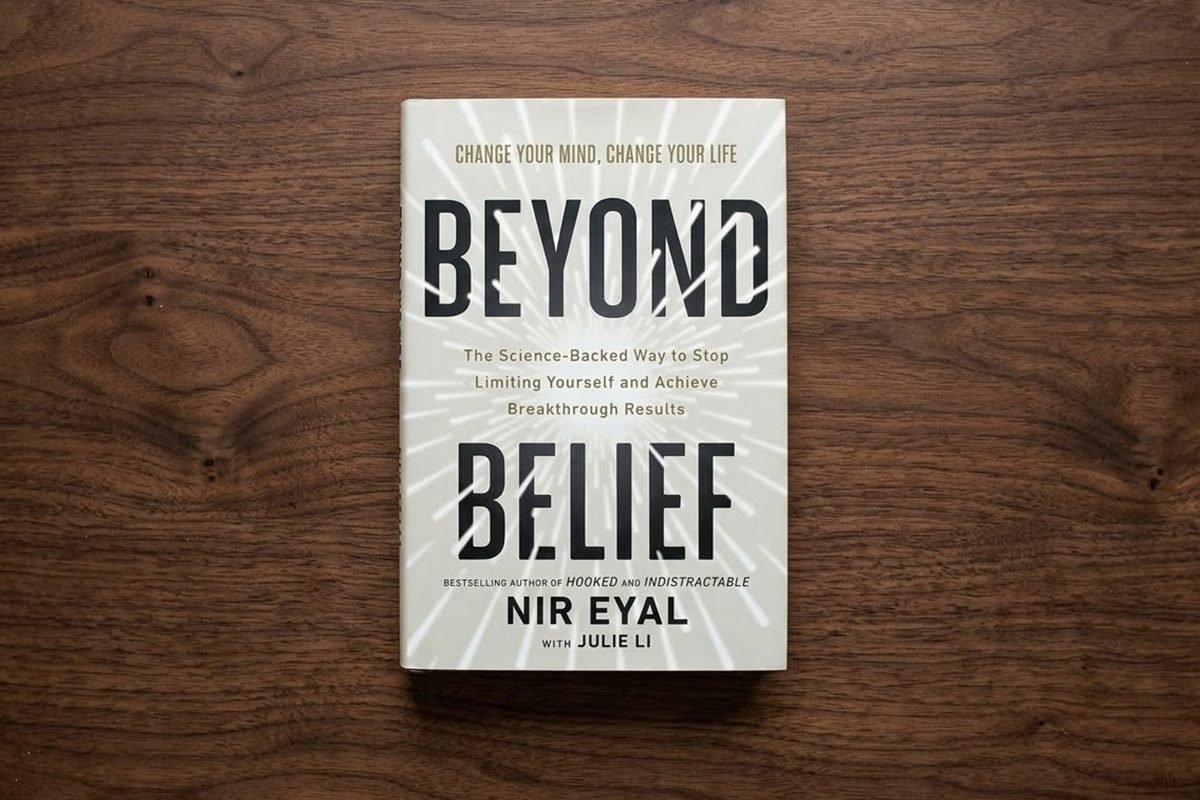
Book review: Beyond Belief
The Science-Backed Way to Stop Limiting Yourself and Achieve Breakthrough Results
By Nir Eyal and Julie Li
Genres:
- Self-Improvement
- Social Psychology
The year it was published:
2026
Number of pages:
304

As an Amazon Associate, I earn from qualifying purchases.
Table of contents:
Chapter 1: Beliefs Are Tools, Not Truths
Part I – The First Power of Belief — ATTENTION
Chapter 2: Why Believing Is Seeing
Chapter 3: The Secret to Better Relationships
Chapter 4: How to See Opportunities Others Miss
Part II – The Second Power of Belief — ANTICIPATION
Chapter 5: You Already Live in a Simulation
Chapter 6: Sickness Is in the Body; Illness Is in the Mind
Chapter 7: Living Longer, Stronger, and Smarter
Part III – The Third Power of Belief — AGENCY
Chapter 8: How to Take Control of Your Life (Even When It’s Impossible)
Chapter 9: Prayer Works, With or Without Faith
Chapter 10: Your Labels Are Your Limits
Chapter 11: Good Beliefs, Bad Beliefs
Thoughts about the book:
Beyond Belief by Nir Eyal and Julie Li feels like it arrives right when you need it after you’ve grown tired of generic “hustle harder” advice. Following Hooked and Indistractable, Eyal shifts inward, focusing on something more fundamental, which are the beliefs that are quietly shaping how you live. The core idea is simple but powerful. And that is that most limits we accept aren’t real, they’re beliefs we’ve mistaken for facts. And beliefs aren’t sacred truths instead, they’re tools. If they’re not serving you, you can change them. Eyal breaks this down through how beliefs affect what you notice, how you expect the future to unfold, and whether you take action at all. His frameworks, the Motivation Triangle and the Three Powers of Belief, give this idea structure, backed by research and real-world examples. What stood out to me most was the balance. Eyal doesn’t fall into the “just believe harder” trap. He’s clear that beliefs still need to align with reality. That nuance makes the book feel grounded. There are a few downsides. The structure can feel repetitive, especially if you read it in one go, and some examples lean a bit close to inspirational storytelling. While the science is solid, not all of it feels as definitive as the “breakthrough results” subtitle suggests. What you get is less a sudden transformation and more steady, practical progress. Eyal’s writing is clear and approachable no jargon, no fluff. It’s easy to read, but still thoughtful and well-supported. Overall, this book didn’t completely change how I think overnight, but it did shift how I question my own limits. And that’s more valuable in the long run. If you’ve ever felt stuck by the thought “this is just who I am,” this book gives you a way to challenge that.
Who should read this book:
This is a book for readers who are already fluent in self-improvement, people who have read widely, applied frameworks, and developed discipline, yet still find themselves running into limits that effort alone doesn’t seem to solve. Not a lack of strategy, but a ceiling in outcome. What begins to matter at that stage is no longer what to do, but what you assume to be true while doing it. The reader of this book is not looking for more techniques layered on top of existing ones. They are looking for leverage at a deeper level, the kind that comes from changing the operating assumptions underneath behavior itself. Eyal’s focus is belief, not as abstract philosophy, but as the hidden structure shaping attention, expectation, and action long before effort ever enters the picture. Across performance, relationships, health, and creativity, the recurring question is why knowing what to do is not enough to ensure we do it. The answer, in Eyal’s framing, lies in the quiet influence of beliefs like “this is just who I am” or “this is as far as I go.” These are not dramatic thoughts, but background constraints that determine what feels possible in the first place. They filter perception, shape anticipation, and set the boundaries of agency without ever announcing themselves as limits.
Reading this book is less about acquiring new methods and more about examining the assumptions that make existing methods work or fail. It asks what happens when effort is no longer the problem, but interpretation is. For those who suspect that their real constraint is not discipline but the beliefs organizing that discipline, this book offers a way to surface those hidden structures and begin changing them.
Summary of the book:
Chapter 1: Beliefs Are Tools, Not Truths
Chapter 1 establishes the core idea that beliefs are not fixed truths but tools we can choose based on whether they help us. Nir Eyal introduces this through his own experience with repeated diet failures, noticing that each plan initially worked not because it was objectively superior but because he believed in it. Once that belief weakened, his commitment fell apart. This led him to a broader insight that motivation depends not just on knowing what to do or why to do it, but on believing that the effort will actually lead to results. He frames this through the Motivation Triangle, where behavior and benefit are ineffective without belief, which acts as the driving force that sustains action. To clarify what belief really is, Eyal distinguishes it from facts and faith. Facts are objectively verifiable, while faith requires no evidence. Beliefs sit in between as flexible interpretations we adopt when certainty is impossible. Because most meaningful decisions happen in this uncertain space, the key is not to chase perfect truth but to adopt beliefs that are useful. Choosing to believe something empowering, even without guarantees, can produce better outcomes than holding a more pessimistic but equally uncertain view. He then introduces the three ways belief shapes our lives. Belief directs our attention, influences what we expect and feel, and determines whether we act and persist. This becomes especially clear in a striking experiment by Curt Richter, who placed rats in water to observe how long they would swim. Wild rats, despite being physically stronger, gave up quickly, while domesticated rats lasted much longer. When the wild rats were briefly rescued and then placed back in the water, they went on to swim for dramatically longer periods. The only meaningful difference was that they had learned rescue was possible. Their physical capacity had not changed, but their belief had. The implication is that limits are often psychological before they are physical, and that persistence depends less on actual ability than on whether we believe our effort can make a difference.
Chapter 2: Why Believing Is Seeing
Chapter 2 builds on the idea that beliefs are tools by showing how deeply they shape perception. While we’re taught that seeing leads to believing, Nir Eyal argues that what we see is what we already believe. The brain is constantly filtering reality, taking in an overwhelming amount of sensory data but allowing only a tiny fraction into conscious awareness. What gets through isn’t random, it’s guided by what we already think matters. This means two people in the same situation can experience entirely different realities. A single critical comment, for example, can feel like confirmation of failure if you already believe you’re inadequate, while being dismissed as minor if you don’t. This filtering process also explains why we get stuck in rumination. Instead of solving problems, the mind replays negative thoughts to reinforce existing fears, gradually expanding what counts as a “problem” even when real issues are minimal. Over time, this creates a self-reinforcing loop where the brain keeps highlighting evidence that supports the belief while ignoring anything that contradicts it. The result is a distorted but convincing version of reality that can lead to anxiety or even depression. Eyal suggests breaking this cycle by actively challenging how attention is directed. Looking for disconfirming evidence forces the brain to widen its filter, while techniques like speaking about yourself in the third person create emotional distance and reduce reactivity. Simply questioning whether a thought is useful can interrupt the automatic loop of rumination. The power of attention becomes especially clear in the example involving Daniel Gisler, who underwent ankle surgery without anesthesia by using hypnosis to focus his mind elsewhere. By directing his attention so completely away from the pain, his brain reduced its intensity to the point where he remained calm and stable throughout the procedure. This illustrates that attention doesn’t just passively observe reality, it actively shapes what we feel. The same mechanism appears in everyday situations, such as a software engineer named Maria who, after one piece of criticism, became convinced she was bad at presenting. That belief filtered out years of successful presentations and led her to avoid opportunities, reinforcing the very fear she had adopted. Only when she deliberately tracked objective evidence did her perception shift, revealing that most of her experiences had been positive all along. In both cases, the underlying pattern is the same. Change what you believe, and your mind begins to construct a different version of reality.
Chapter 3: The Secret to Better Relationships
Chapter 3 applies the idea of belief to relationships, arguing that many conflicts are less about what people actually do and more about how we interpret them. Nir Eyal illustrates this with a simple interaction with his mother, where a passing comment about wilting flowers immediately felt like criticism to him, triggering a defensive reaction. His wife, hearing the same words, interpreted them as neutral and practical. The situation itself was identical, the difference came from the beliefs each person brought into it. Over time, we build fixed mental images of people, and instead of responding to who they are in the moment, we react to those internal versions. This creates a feedback loop where expectations shape perception, and perception drives behavior, often reinforcing the original belief. This dynamic is what Eyal describes as the judgment trap. Once we label someone in a certain way, the mind starts filtering for evidence that confirms that label while ignoring anything that contradicts it. In long-term relationships, especially, this leads to what Ellen Langer calls “mindlessness,” where we stop seeing the other person clearly and instead interact with a simplified, outdated version of them. The result is a self-fulfilling pattern believing someone is inconsiderate makes us more likely to interpret their actions negatively, respond defensively, and ultimately draw out the very behavior we expect. To break this pattern, Eyal introduces a method developed by Byron Katie, which involves systematically questioning the beliefs we hold about others. By asking whether a belief is truly certain, examining how it affects our reactions, and imagining who we would be without it, we begin to loosen its grip. The process goes further by flipping the belief in different directions, revealing alternative interpretations and highlighting how our own behavior contributes to the dynamic. When Eyal applied this to his long-held belief that his mother was overly critical, he realized he couldn’t be completely certain it was true in that moment. She had, in fact, expressed gratitude before making her comment. More importantly, he saw how his own defensiveness and tendency to judge were shaping the interaction. As his belief shifted, so did his perception. He began to notice qualities in her that had always been present but previously filtered out, such as her practicality and supportiveness. The relationship improved not because she changed, but because he started seeing her differently, which in turn changed how he responded.
Chapter 4: How to See Opportunities Others Miss
Chapter 4 expands the idea of belief from perception of people to perception of opportunity, arguing that what we notice in the world is largely determined by what we already believe is possible. People who seem “lucky” aren’t encountering more opportunities they’re simply seeing more of what’s already there. Their beliefs train their attention to pick up signals others ignore. Nir Eyal illustrates this through the story of Anne Mahlum, whose success began with a small shift in perception. While running past homeless men each morning, she initially did what most people do and looked away. One day, after a brief interaction, she found herself asking why she got to be the runner while they remained stuck where they were. That question only emerged because she already believed people were capable of change, a belief shaped by watching her father rebuild his life after addiction. Because of that lens, she didn’t just see homelessness, she saw untapped potential. Acting on it, she invited the men to run with her, eventually building a large nonprofit and later turning that same ability to spot overlooked potential into a highly successful fitness business. This ability is often described as entrepreneurial alertness, a heightened sensitivity to patterns and possibilities that others miss. It isn’t a mysterious talent but a direct result of belief. When you expect opportunity, your brain becomes better at detecting it. This is closely related to research by Richard Wiseman, who found that “lucky” people don’t experience more random good events they maintain a broader, more open attention that allows them to notice and act on opportunities that others overlook. In this sense, luck is less about chance and more about perception shaped by belief and behavior. At the same time, the chapter highlights a limitation: the same beliefs that help us see opportunities can also create blind spots. Mahlum’s strong belief in relentless intensity helped her build her company, but it also made her dismiss feedback and push people too hard, eventually becoming a liability. Recognizing this, she adjusted her beliefs about what effective leadership required, stepped back from her role, and sold the company at its peak. The broader point is that beliefs don’t just open doors, if left unexamined, they can also narrow vision in ways that become costly. What you believe determines what you see, but staying flexible determines whether that vision continues to serve you.
Chapter 5: You Already Live in a Simulation
Chapter 5 introduces the second power of belief, anticipation, showing that our brains don’t simply react to reality but continuously predict it. What we expect to experience shapes what we actually feel, meaning much of our reality is constructed in advance. Nir Eyal illustrates this with the rise of Liquid Death, a company that sells ordinary spring water but frames it as edgy and rebellious. Although the product is indistinguishable from cheaper alternatives in blind tests, the branding creates a belief that changes the experience itself. People don’t just think it’s different, they genuinely feel it is. This happens because the brain operates as a prediction system, constantly generating expectations based on past experiences and beliefs, then adjusting perception to match. Eyal describes this through a simple loop. We form a belief about what something will be like, our body prepares for that expectation, we experience it through that lens, and then we reinforce the belief afterward. The result is a self-reinforcing cycle where expectations shape experience, and experience strengthens expectations. The effect is visible in controlled experiments as well. In one study, participants drank identical wine labeled with different prices. When they believed they were drinking a more expensive bottle, their brain’s pleasure centers showed stronger activation, and they reported enjoying it more. The difference wasn’t in the wine but in the anticipation. A similar pattern appeared with nearly identical cars like the Toyota Corolla and the Geo Prizm, where brand perception led owners to interpret the same driving experience in completely different ways. In each case, belief didn’t just influence opinion, it altered the sensory experience itself. The key takeaway is not that all beliefs should be challenged, but that they should be evaluated based on whether they serve us. Some beliefs enhance enjoyment, motivation, or meaning, while others create unnecessary limitations or dissatisfaction. Because our brains are constantly simulating reality through expectation, the beliefs we choose effectively shape the quality of our lived experience.
Chapter 6: Sickness Is in the Body; Illness Is in the Mind
In chapter 6, Nir Eyal begins by separating sickness, which is physical damage or disease, from illness, which is the subjective experience of symptoms. The two don’t always align, because pain is not simply a signal from the body but something the brain actively constructs. When the body sends signals, the brain interprets them based on context, memory, and expectation, deciding how much danger is present and how much pain to generate. This means belief plays a direct role in how intensely we suffer. This becomes especially important in what’s known as neuroplastic pain, where the brain continues producing pain even after an injury has healed. Instead of reflecting damage, the pain is maintained by a cycle of expectation and fear: anticipating pain increases anxiety, which heightens the brain’s threat response, which in turn amplifies the pain itself. Over time, the brain essentially learns that certain movements or situations are dangerous, even when they are not. A powerful example of how this can change comes from someone like Simon, who lived with chronic pain for years, structuring his life around avoiding anything that might make it worse. His symptoms were real, but they were sustained by the belief that his body was fragile and under constant threat. After encountering a different perspective and trying pain reprocessing techniques, he began approaching his sensations with curiosity instead of fear, gradually teaching his brain that the signals were not dangerous. As his expectations shifted, the pain diminished to the point where it no longer controlled his life. A similar pattern appears in the experience of Sophie Hawley-Weld, who developed chronic pain during intense touring. After months of reinforcing the belief that movement would trigger pain, a spontaneous moment in dance rehearsal broke the pattern when she moved in a way she expected to hurt and felt nothing. Repeating that experience provided direct evidence that her body was safe, weakening the learned association between movement and pain. The same principle helps explain why placebos can work even when we know they are placebos. Research by Ted Kaptchuk shows that the act of taking a treatment can trigger real physiological responses because the brain has been conditioned to associate the ritual with relief. This suggests that belief doesn’t have to be unconscious to be effective, the body can still respond to signals that something helpful is happening. Eyal extends this idea beyond physical pain to everyday behavior, particularly procrastination. Avoidance is often driven by the expectation that a task will feel uncomfortable, and that expectation amplifies the perceived difficulty. By changing how we interpret discomfort, seeing it as temporary, useful, or even a sign of progress, we can reduce its intensity and make action easier. Across all these examples, the pattern is consistent: the brain predicts what an experience will feel like, and that prediction helps create the experience itself. Change the expectation, and you can begin to change the reality that follows.
Chapter 7: Living Longer, Stronger, and Smarter
Chapter 7 explores how belief influences physical health, performance, and even lifespan, while making an important distinction: beliefs don’t directly change biology through sheer willpower, but they shape behavior in ways that produce real biological effects. Nir Eyal illustrates this with examples like older athletes who maintain remarkable strength and agility, not because of unusual genetics, but because they believe their bodies can continue improving. That belief leads them to train consistently, which then creates the physical results. At the same time, the chapter pushes back against exaggerated claims in the mind-body space. Some famous studies suggesting we can simply “think ourselves younger” haven’t held up under replication. The real mechanism is more grounded but still powerful: belief influences expectations and actions, which then influence measurable outcomes. When people expect improvement, they tend to engage more, persist longer, and push harder, and those behaviors drive change. This dynamic is especially clear in research by Becca Levy, who found that individuals with more positive views of aging lived significantly longer than those with negative beliefs. The difference wasn’t due to belief alone, but to the behaviors those beliefs encouraged, such as staying active, socially connected, and mentally engaged, all of which contribute to better long-term health. Belief can also unlock abilities that were already present but suppressed by doubt or hesitation. In sports, for instance, expectations can directly affect performance. Serena Williams experienced this before Wimbledon when her coach told her she was highly successful at the net, even though the statistic wasn’t accurate. Believing this, she approached those moments with greater confidence and frequency, quickly improving her actual performance until the claim became true. The shift wasn’t technical but psychological, altering how she anticipated the outcome and how her body responded. A similar pattern appears in placebo-based performance studies, where participants who believed they were taking performance-enhancing substances trained harder and achieved real strength gains despite receiving no active compounds. In these cases, belief didn’t magically increase muscle mass it changed effort, persistence, and willingness to push limits, which then produced tangible results.
Chapter 8: How to Take Control of Your Life (Even When It’s Impossible)
Chapter 8 introduces the third power of belief, agency, which determines whether we act or give up when facing difficulty. Nir Eyal argues that persistence is not simply about willpower or toughness but about whether we believe our actions can make a difference. The counterintuitive insight from modern psychology is that helplessness is not something we learn over time, it is the brain’s default response. When faced with uncertainty or repeated setbacks, the brain naturally shifts toward passivity. What must be learned instead is agency, the expectation that effort matters. This idea builds on classic research by Martin Seligman and Steven Maier, who showed that animals exposed to uncontrollable situations eventually stopped trying to escape, even when escape later became possible. What newer findings reveal is that this shutdown response is automatic, while active engagement requires a learned override. In practical terms, this means resilience is not about eliminating difficulty but about training the belief that action is still worthwhile within it. Eyal connects this to the concept of locus of control, which reflects whether people see outcomes as driven by their own actions or by external forces like luck or fate. Those with a more internal locus of control tend to experience better outcomes across health, work, and relationships, not because their circumstances are easier, but because they consistently direct effort toward what they can influence. Agency grows through experience. Small wins build evidence that effort matters, focusing on controllable factors prevents wasted energy, and reframing setbacks as temporary keeps action moving forward. Systems and routines also play a role, reducing reliance on moment-to-moment motivation. The power of this mindset is captured in the story of Dashrath Manjhi, who spent over two decades carving a path through a mountain after his wife died because medical help was too far away. He could not change the larger circumstances of his life, but he focused on the one action available to him and repeated it daily. Over time, that consistent effort reshaped the landscape itself. His story illustrates the core principle of agency, and that is while we rarely control everything, acting on what is within reach, again and again, can produce outcomes that initially seem impossible.
Chapter 9: Prayer Works, With or Without Faith
Chapter 9 argues that practices like prayer and ritual are effective not because of supernatural intervention, but because of how they shape the mind. Nir Eyal reflects on his own childhood habit of praying, which brought him calm during a chaotic time, and contrasts it with his later skepticism. What draws him back isn’t faith, but evidence, that regular prayer and ritual are associated with lower stress, better emotional regulation, and even measurable changes in the brain. The key point is that these benefits don’t depend on believing in a higher power. They come from the structure of the practice itself. Across different traditions, Eyal finds common mechanisms at work. Ritual creates stability through repetition, grounding attention, and reducing anxiety. It encourages reflection, helping people process internal states rather than trying to control external outcomes. It also often involves community, which provides social support and a sense of belonging. Even practices that involve discomfort, like fasting or prolonged focus, can build resilience by pairing effort with meaning. Though the language and symbols differ, these elements appear consistently across religions, suggesting a shared psychological function. For people who don’t hold literal religious beliefs, Eyal proposes a flexible approach, instead of rejecting these practices entirely, reinterpret them in a way that aligns with your worldview. Concepts like “prayer” can become structured reflection, and “divine will” can be understood as acceptance of reality. The effectiveness comes from engaging in the practice, not from committing to a specific doctrine. This idea is illustrated by the example of Garrison Benson, who created his own ritual to cope with the stress of dealing with difficult customers. By performing a symbolic “spell” before work, he gave himself a mental buffer that helped him take negativity less personally. He didn’t believe the ritual had any supernatural power, but it changed how he anticipated and interpreted interactions, which in turn changed his emotional response. Like traditional prayer, the ritual worked because it directed attention, created meaning, and reshaped expectation. Across both religious and secular contexts, the pattern is the same: consistent, intentional practices influence how we feel and respond, regardless of whether we attribute them to something beyond ourselves.
Chapter 10: Your Labels Are Your Limits
Chapter 10 explores the darker side of belief, showing that just as positive expectations can improve experience, negative expectations can actively create harm. Nir Eyal introduces the nocebo effect, where anticipating something bad leads the body to produce real symptoms, from nausea to increased pain and stress responses. These effects are not imagined, they involve measurable biological changes. What we expect to happen can shape how our body reacts, sometimes in ways that make a harmless situation feel dangerous or distressing. This influence becomes even more powerful when it spreads socially. In one case, a wave of illness swept through students after exposure to a fictional disease portrayed in the media, despite no physical cause being found. The shared expectation of illness was enough to produce real symptoms across a large group. The same mechanism operates on a more personal level through the labels we use to describe ourselves, especially medical or psychological diagnoses. Eyal highlights how labels can shift from being useful descriptions to restrictive identities. When someone moves from “I’m experiencing anxiety” to “I am an anxious person,” they risk what psychologists call identity foreclosure, locking into a narrow definition of themselves. This shift can subtly reduce motivation and reinforce the very patterns the label describes, turning it into a self-fulfilling cycle. Diagnoses can provide clarity and direction, but when they become a fixed identity, they limit the sense of what is possible. The physiological power of belief is captured in the case of a patient who believed he had overdosed on medication and developed severe symptoms, only to recover rapidly once he learned the pills were inert. His body had fully activated a stress response based on expectation alone, and just as quickly reversed it when that expectation changed. On a longer timescale, this pattern can shape identity, as seen in someone like Thomas, who initially found relief in a diagnosis but gradually began to define himself entirely through it, narrowing his behavior and reinforcing his struggles. The broader lesson is that labels should function as tools, not conclusions. They are most useful when they guide action, help us seek support, and point toward change. But when they begin to define who we are, they can quietly limit growth. Because belief influences both perception and physiology, the way we describe our challenges can either expand our capacity to respond to them or confine us within them.
Chapter 11: Good Beliefs, Bad Beliefs
Chapter 11 brings the book to a close by separating beliefs that drive meaningful action from those that merely feel good in the moment. Nir Eyal argues that optimism alone can be misleading when it replaces effort with imagination. While visualizing success can create comfort, it often reduces motivation because the brain partially registers the goal as already achieved, leaving less drive to act and less preparation for difficulty. The result is a cycle where positive fantasies lead to disappointment rather than progress. As an alternative, Eyal introduces mental contrasting, a method developed by Gabriele Oettingen. Instead of focusing only on desired outcomes, mental contrasting pairs those goals with the real obstacles that stand in the way. This combination prevents unrealistic optimism from becoming complacency and instead turns obstacles into cues for action. When the brain connects difficulty with response rather than avoidance, effort becomes more consistent and purposeful. This idea is grounded in the story of David Fajgenbaum, whose life shifted from expected death to long-term remission after he abandoned passive hope in expert solutions and began actively investigating his own condition. Faced with a rare and poorly understood disease, he stopped waiting for answers and instead treated uncertainty as something he could work with. By analyzing his own data and connecting patterns that others had missed, he identified a potential treatment already available and, with no alternatives left, tried it. The drug worked, not because of luck alone, but because a belief in active agency led to persistent investigation and unconventional thinking. The broader lesson is that effective belief is not about imagining success in isolation, but about holding both vision and friction at the same time. Mental contrasting engages attention by forcing honesty about obstacles, shapes anticipation by preparing for difficulty, and strengthens agency by turning planning into action. Across the book’s examples, the same pattern appears when people do not change their lives through certainty, but through iterative action that produces evidence, which then strengthens belief, which fuels further action. Belief is not a static mindset but a cycle that expands possibility through engagement with reality rather than escape from it.