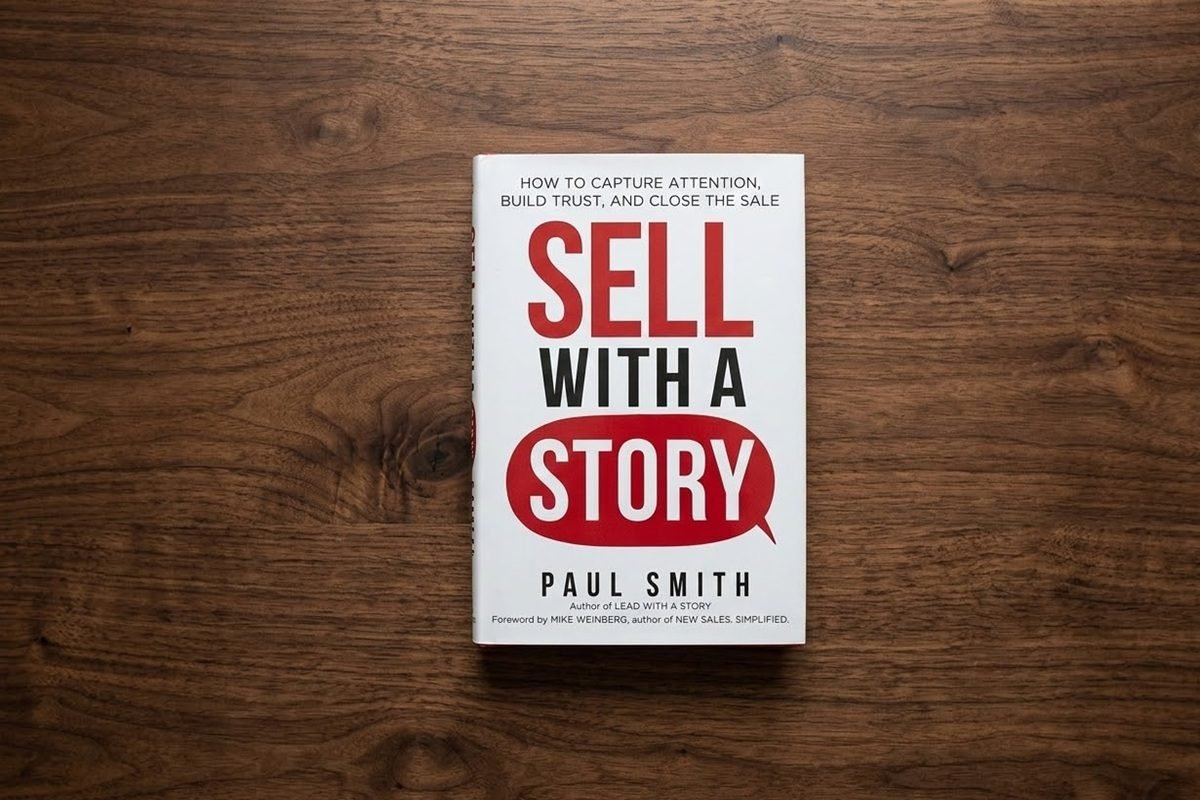
Book Review: Sell With A Story
How to Capture Attention, Build Trust, and Close the Sale
By Paul Smith
Genres:
- Storytelling
- Communication Skills
- Sales
The year it was published:
2016
Number of pages:
304

As an Amazon Associate, I earn from qualifying purchases.
Table of contents:
Introduction
Chapter 1: What Is a Sales Story?
Chapter 2: Why Tell Sales Stories?
Part I – What Sales Stories You Need and When to Tell Them
Chapter 3: Introducing Yourself
Chapter 4: Stories You Tell Yourself
Chapter 5: Getting Buyers to Tell Their Story
Chapter 6: Building Rapport
Chapter 7: The Main Sales Pitch
Chapter 8: Handling Objections
Chapter 9: Closing the Sale
Chapter 10: Storytelling After the Sale
Part II – How to Craft Sales Stories
Chapter 11: Elements of a Great Story
Chapter 12: Choosing the Right Story to Tell
Chapter 13: Story Structure
Chapter 14: The Hook (Transition In)
Chapter 15: Context
Chapter 16: Challenge, Conflict, Resolution
Chapter 17: Lesson and Action (Transition Out)
Chapter 18: Emotion
Chapter 19: Surprise
Chapter 20: Dialogue, Details, and Length
Chapter 21: Delivery
Chapter 22: Telling Stories with Data
Chapter 23: Stretching the Truth
Chapter 24: Finding Great Stories
Chapter 25: Practicing and Saving Your Stories
Chapter 26: Getting Started
Thoughts about the book:
At its core, Sell with a Story argues that the most effective salespeople are not those with the best data, but those who can translate that data into meaningful narratives. Buyers don’t remember product specs, they remember stories that make those specs relevant. Smith reframes selling as a communication challenge, one that is best solved not with pressure, but with clarity and connection. What I liked most about the book is its practicality. Much like his earlier work, Smith organizes the content around specific situations, like how to build trust, differentiate your product, handle objections, or close a deal. For each scenario, he provides concrete story examples that sales professionals can adapt and use. This makes the book highly actionable. It doesn’t just tell you that stories matter, it shows you exactly how to use them. Smith uses everyday language and a conversational tone, making the book easy to read and easy to apply. There is no academic complexity here, no dense theory to unpack. Instead, the ideas are delivered through examples, short explanations, and practical advice. It is the kind of book you can read quickly but revisit often.
However, as with many practical books, the real challenge lies in execution, and crafting authentic, relevant stories that resonate with real clients is far more difficult than simply understanding the idea. The book is informative, though not scientific in a rigorous sense. Smith draws on communication principles and some elements of psychology, but the foundation is primarily experiential. If there is a criticism, it is that the book can feel somewhat repetitive in its central message that storytelling is powerful, and you should use it in nearly every aspect of selling. While the variety of examples keeps things engaging, the core idea remains consistent throughout. Additionally, readers looking for advanced negotiation theory or deep behavioral science may find the book somewhat light. That said, Sell with a Story succeeds in reframing sales as a human, narrative-driven process. It moves away from pressure tactics and toward connection, which feels both modern and effective. Smith’s strength lies in making storytelling feel practical rather than abstract.
Who should read this book:
You should read Sell with a Story by Paul Smith if you are interested in moving beyond scripts, pitches, and product features, and toward communication that genuinely persuades. This is not about manipulation, it is about connection. It is for those who want to understand how stories can build trust, overcome objections, and make ideas stick in a way that data alone rarely can. Paul Smith is searching for the deeper mechanics of influence in sales. His interest lies in how real-world stories like the ones about customers, challenges, failures, and successes can bridge the gap between skepticism and belief. He explores how stories make value tangible, differentiate offerings, and create emotional engagement in moments where logic often falls flat. This is a book for anyone involved in selling, negotiating, or influencing, whether in business or everyday life. It invites you to see sales not as a process of pushing information, but as an act of guiding someone through a narrative they can understand, trust, and ultimately say yes to.
Summary of the book:
Introduction
The book opens with the author visiting an art fair with his wife, where they notice a photograph of a swimming pig taken by underwater photographer Chris Gug. At first, he dismisses it as odd and uninteresting, but his perspective changes when Gug explains the story behind it. The photo was taken on a remote Bahamian island called Big Major Cay, or “Pig Island,” where pigs were once left without a food source. Over time, a nearby restaurant began dumping scraps into the water, and the pigs learned to swim out to eat. This behavior continued across generations, and eventually the pigs began associating boats with food, eagerly swimming out to visitors. Hearing this story transforms the image from a strange picture into something meaningful, prompting the author to immediately buy it. This example illustrates the book’s central idea: stories add value, emotion, and meaning to otherwise ordinary things. Throughout the book, similar case studies show how storytelling can be used effectively across the entire sales process, from first contact to building long-term customer relationships.
Chapter 1: What Is a Sales Story?
Chapter one answers a deceptively simple question, “What actually counts as a story?” In business, the term is often used loosely to describe things like presentations, mission statements, or marketing strategies, but the author makes it clear that these are not stories. A true story has a specific structure. It includes a clear time and place, a main character, a goal, an obstacle, and events where something actually happens. Without these elements, it’s not a story. A sales story, then, is any story told during the process of winning or keeping a customer. To illustrate this, the author presents several examples. A typical toothpaste advertisement, for instance, is not a story because nothing happens and there is no character or conflict, just a product claim. Similarly, a co-merchandising pitch for toothbrushes and toothpaste may be persuasive, but it still lacks a character, a struggle, and a sequence of events. In contrast, a real sales story includes all the key elements. One example follows Dave Neild at the University of Leeds, who faced serious issues with copyright violations and virus-infected student computers. The situation threatened the university’s network until a security product, TippingPoint, resolved the problem and restored bandwidth. Another example tells of a man trying to impress his neighbor with an expensive bike, only to have her ignore it and instead compliment his wooden watch. In both cases, there is a clear character, a goal, an obstacle, and a sequence of events, making them true stories. These examples reinforce the chapter’s main point: a story is defined not by intent, but by structure and action.
Chapter 2: Why Tell Sales Stories?
This chapter explains why storytelling is so effective in sales. Unlike traditional pitches, which often cause buyers to disengage, stories feel natural and conversational, making people more willing to listen. They also build trust more quickly by creating a sense of familiarity, which is often the deciding factor when buyers choose between similar options. Stories work because they engage the emotional part of the brain, where decisions are made, while facts alone are less memorable. Research shows people remember stories far better than statistics, and even simple information becomes easier to recall when presented as a narrative. Stories can also increase perceived value, as shown in an experiment where inexpensive thrift store items sold for dramatically higher prices after being paired with stories. In addition, stories help highlight key ideas, are easy to retell, and allow salespeople to stand out since personal experiences cannot be copied. Buyers also want more of them, yet most sales conversations lack meaningful examples. Ultimately, storytelling makes selling more engaging and natural, turning scripted pitches into genuine interactions.
Chapter 3: Introducing Yourself
This chapter focuses on the first and often wasted opportunity to tell a story, and that is answering the question, “What do you do?” Most salespeople respond with vague, jargon-filled explanations that fail to engage. Instead, the author suggests using two types of simple stories. The first is a short, fictional scenario that illustrates a typical customer problem. By walking someone through a relatable situation, the explanation becomes clear and interesting. For example, instead of describing his role in technical terms, one expert explains it through a story about transporting perishable chickens and the risks involved if something goes wrong. This makes his work immediately understandable and memorable. The second type is a real example of how you have helped a customer, designed to spark interest and lead to further conversation. One case describes a sourcing expert who, during a brief meeting, shared a story about helping a luxury fashion brand evaluate a surprisingly low bid from a new supplier. By running a reverse auction and providing clear market data, his company helped the client make a confident decision and gain influence internally. The story was so compelling that the prospect requested a full meeting before their short introductory session had even ended.
Chapter 4: Stories You Tell Yourself
This chapter shifts focus from stories told to buyers to the stories you tell yourself before a sales call. These internal narratives shape your mindset, confidence, and ultimately your performance. Research by Adam Grant illustrates this clearly. In a university fundraising call center, callers who read stories about how their work helped students more than doubled their results, while those who read other types of information saw no improvement. The key difference was purpose, stories that connected their work to a meaningful impact made them more motivated and effective. A similar idea appears in the example of a biotech sales rep who stays driven by recalling a moment when a patient thanked her for changing her life. That story becomes her personal source of motivation, pushing her to go the extra mile even when it would be easier to stop. The chapter also suggests using stories to manage stress. By telling yourself that you do not need any single deal, you shift from a desperate mindset to that of a confident advisor. This subtle change affects how you speak and behave, making you more persuasive. The main takeaway is that the stories you repeat to yourself directly influence how you show up in every sales interaction.
Chapter 5: Getting Buyers to Tell Their Story
Chapter five emphasizes that before telling your own stories, your first goal in a sales conversation should be to hear the buyer’s stories. Just as a doctor would not build trust by talking only about themselves, a salesperson should not dominate the conversation. Understanding the buyer starts with listening. There are three types of stories to look for: personal stories that reveal who they are, stories about their biggest problems that show what they truly need, and stories about their favorite suppliers, which define what they consider excellent service. One example comes from Microsoft, where a sourcing director shares a story about a travel partner during a volcanic eruption that stranded executives across Europe. The supplier focused entirely on getting people home—chartering flights, organizing complex travel plans, and delaying any discussion of fees. This story is used to show what real partnership looks like: prioritizing people, acting with urgency, and building trust. To encourage buyers to share their own stories, the chapter suggests a few simple techniques. Staying quiet often prompts the other person to fill the silence. Asking open-ended questions that require more than a short answer naturally leads to storytelling. Noticing personal items can spark meaningful conversations, and getting buyers out of the office can make them more open. Finally, sharing a story yourself often encourages the other person to respond with one of their own. The main idea is that the more you understand the buyer’s story, the more effectively you can position your solution.
Chapter 6: Building Rapport
In chapter six, the author focuses on how to build rapport by sharing the right kinds of stories once you understand the buyer. These stories help establish trust, credibility, and authenticity. The first type explains why you do what you do. Buyers can quickly sense whether your motivation is genuine, and a strong personal story makes that clear. One example is a professional who walked away from a nearly secured partnership in accounting to join a startup because he believed in its vision and culture. That story immediately captured attention and helped build a strong relationship with a future client. Another important story shows that you are willing to admit when you are not the right fit. Buyers trust sellers more when they demonstrate honesty, even at the cost of a sale. Similarly, sharing a real example of a past mistake and how you handled it builds credibility far more than simply claiming integrity. A fourth type shows that you will advocate for the customer. In one case, an account manager challenged his own company after it tried to unfairly raise prices, ultimately protecting the client. Stories like this signal loyalty and reinforce trust. There are also moments when you need to reshape how buyers perceive you. Instead of directly addressing doubts or rumors, one salesperson used a personal story about settling into a new community to subtly show long-term commitment. In addition to personal stories, company stories also play a key role. A founding story helps buyers understand the values and purpose behind the business, making it more relatable than a list of facts. Another type highlights how the company is different from competitors. Rather than making generic claims, one cleaning company used detailed stories about improving inefficient operations in large buildings to demonstrate its expertise. This made its capabilities tangible and helped it stand out in a crowded market. The main idea is that trust is not built through claims, but through specific, believable stories that show who you are, how you act, and what buyers can expect from working with you.
Chapter 7: The Main Sales Pitch
In this chapter, the author explains how to use storytelling during the main sales pitch, highlighting five types of stories that make products and ideas more compelling. The first is the invention or discovery story, which explains how a product came to be. Instead of listing features, this approach shows the real problem that led to its creation. For example, a writing guide became successful because it was built around the most common issues students faced, making its value immediately clear to educators. Problem stories are another powerful tool. These describe a relatable frustration or failure, helping buyers see the gap in their current approach. One banker, for instance, shares a story about a late-night fraud alert handled poorly, illustrating how rigid policies can damage customer relationships and setting up the need for a better solution. Customer success stories show how others have solved similar problems. A well-known example is Febreze, which initially failed because it targeted odor problems people no longer noticed. Once repositioned as a finishing touch after cleaning, it became a massive success. Stories like this demonstrate insight and credibility while making the lesson memorable. “Two roads” stories compare two possible futures, one where the buyer sticks with the current option and one where they choose the better solution. By showing the long-term consequences in a real-life context, these stories make abstract benefits tangible and easier to act on. Finally, value-adding stories help explain complex offerings in a simple, human way. Instead of presenting dry details, one seller describes the real-life situations behind certain financial products, making them easier to understand and more appealing. Overall, the chapter’s message is that the most effective sales pitches do not just explain value—they show it through clear, relatable stories.
Chapter 8: Handling Objections
This chapter explains how to use storytelling to handle objections, emphasizing that most objections are really stories in the buyer’s mind. Because of that, facts alone are rarely enough, so one story must be replaced with a more compelling one. A common example involves a buyer questioning whether a solution is worth the investment. Instead of arguing with numbers, one salesperson shares a story about a similar organization that had the same concern, only to realize that saving time would allow them to focus on their most important source of revenue. This reframes the objection, helping the buyer see the hidden cost of doing nothing. Stories are also effective in price negotiations. When prospects resist paying upfront, one business owner tells the story of a talented young client who ultimately chose a different life path. Because the company had no financial stake in forcing a deal, they were able to give honest advice. The story demonstrates that upfront payment aligns incentives with the client’s best interests, turning a point of resistance into a reason for trust. Another strategy is to address objections before they are raised. For instance, when clients worry about how suppliers will react to a certain process, one seller openly acknowledges the concern and shares a vivid story of a supplier reacting badly, only for the situation to ultimately benefit the client. By doing this, the objection is disarmed early and reframed as part of the value.
Chapter 9: Closing the Sale
This chapter shows how storytelling can be used to close a sale, especially in situations where traditional techniques fall short. One approach is to create urgency. Instead of pressuring the buyer, a salesperson shares a story about a company that delayed implementation, only to face unexpected growth that overwhelmed their team. The message is clear, waiting can turn a manageable situation into a costly problem. Another approach is equipping your internal champion with a story they can retell. Since final decisions are often made when the seller is not in the room, giving the buyer a compelling, relatable example helps them advocate more effectively. In one case, a superintendent was inspired by a story about a similar school that achieved major improvements, making it easier for him to push the decision forward with confidence and emotion, not just data. A third approach addresses a hidden barrier to closing, the difficulty of leaving an existing supplier. Instead of applying pressure, one salesperson shares stories of how other clients handled similar transitions, like what to expect, how to respond to last-minute concessions, and how to manage the relationship professionally. By guiding the buyer through this process, the emotional resistance to change is reduced. The main idea is that closing is not about forcing a decision, but about helping the buyer clearly see the consequences of waiting, feel confident advocating internally, and navigate any obstacles to moving forward.
Chapter 10: Storytelling After the Sale
In this chapter the author explains that storytelling remains important even after the sale, helping strengthen relationships, guide customers, and reinforce value. One use is sharing “what’s worked well in the past” stories to influence customer decisions without directly telling them what to do. For example, instead of discouraging a customer from choosing an overly difficult option, a guide might tell a story about someone similar who succeeded by adjusting their approach. This allows the customer to make a smarter choice without feeling judged. Stories also help build long-term loyalty through memorable service experiences. In one case, a hotel employee went far beyond expectations by lending a guest his own clothing in a moment of need. Stories like this highlight what exceptional service looks like and make customers far more likely to stay loyal. Finally, storytelling is useful for reflecting on and summarizing experiences. Salespeople often share “war stories” about deals that went wrong to teach lessons and improve future performance. One example shows how a poorly tested idea backfired in front of a buyer, becoming a reminder to always think through how a strategy will play out in reality.
Chapter 11: Elements of a Great Story
This chapter outlines what makes a story truly effective, especially in a sales context. At its core, every strong story has a relatable hero, a meaningful challenge, and a genuine struggle between the two, along with a clear lesson the audience can apply. The hero should be someone the listener can identify with, the obstacle should matter to them, and the outcome should provide a useful takeaway. The author also highlights common mistakes. One is the “Superman problem,” where stories feature extraordinary figures or companies that feel impossible to relate to, making them less useful for buyers. Another is telling stories where everything works perfectly without struggle, and there is nothing to learn or replicate. Finally, many stories fail because they hide the real conflict, especially internal struggles. Showing the hesitation, doubt, or difficult decision-making behind an action makes the story more authentic and impactful.
Chapter 12: Choosing the Right Story to Tell
This chapter explains how to choose the right story by following a simple four-step process. First, define your objective, what you want the audience to think, feel, or do. Next, look for a relevant example, whether it is a success, a failure, or a moment of realization that clearly illustrates your point. If no real example exists, you can create a fictional but realistic scenario, as long as it is clearly presented as such. Finally, compare your options and choose the one with the most relatable character, relevant challenge, and engaging struggle. A powerful example comes from a hospital fundraiser explaining the need for trauma social services. Instead of using data, he asks donors to imagine receiving a call that their child has been in an accident and arriving at the hospital alone, scared, and without support. He then contrasts that with having a dedicated counselor guiding them through the experience. The story makes the need immediate and personal, leading people to respond emotionally and take action.
Chapter 13: Story Structure
This chapter presents a simple, practical structure for telling effective sales stories, expanding beyond the basic “beginning, middle, end” into seven clear steps. A strong story starts with a hook that gives the listener a reason to pay attention, followed by context that sets the scene, introduces the main character, and explains their goal. Then comes the challenge, the moment when something changes, and the conflict, where the character takes action to deal with the obstacle. After that, the story moves to the resolution, showing how things turned out, and then to the lesson, which highlights the key takeaway. Finally, the story ends with a recommended action, connecting the lesson directly to what the buyer should do next. To make this easy to apply, the author offers a simple “story spine” that guides the flow. Start by introducing an example, set the time and place, describe the turning point, walk through what happened, explain the outcome, share what was learned, and end by linking it to the current situation. The main idea is that a clear structure makes stories more engaging, easier to follow, and more persuasive.
Chapter 14: The Hook (Transition In)
This chapter focuses on the hook that is the opening line of a story, which, despite being just one sentence, often determines whether people pay attention or tune out. Many salespeople weaken their stories by starting the wrong way. Apologizing, asking for permission, or announcing “I’m going to tell you a story” all reduce credibility and create resistance. Similarly, revealing the ending upfront removes any sense of curiosity or impact. Instead, the hook should feel natural and relevant to the conversation. The most effective approach is to transition smoothly from what was just said. For example, if responding to a question, you might say, “The best example I’ve seen of that was…” or, when building on your own point, “Let me show you how one of my customers used that…” Simple phrases like “That reminds me of a time when…” also work well.
Chapter 15: Context
This chapter explains the importance of context, which answers four key questions of where, when, who, and why. Although it should be brief, it is essential, without it, the audience struggles to follow the story and loses engagement. Many business storytellers skip this step because they assume the details are obvious, but that often leads to confusion. Effective context is short but complete. In just a sentence or two, it should clearly set the scene, introduce the main character, and explain what they are trying to do. Using real names instead of job titles helps make the story more human, and choosing a relatable character makes it easier for the audience to connect. Whenever possible, the buyer should be positioned as the hero of the story, rather than the seller or the product. The main idea is that clear, concise context helps the listener quickly understand the situation so they can fully engage with what happens next.
Chapter 16: Challenge, Conflict, and Resolution
This chapter focuses on the core of any story, which is the challenge, the conflict, and the resolution. The challenge is the turning point, the moment something changes and sets the story in motion. It is usually brief but essential, as it introduces the problem or opportunity that drives everything else. The conflict is the most important and often the longest part of the story. This is where the struggle happens, and where the audience becomes emotionally engaged. A good story does not make things too easy; it shows the difficulty and tension the character faces. To keep stories engaging, the author խորհուրդs getting to the interesting part quickly and avoiding unnecessary details, focusing only on what moves the story forward. The resolution brings the story to a close by showing how everything turned out. It should make it clear how the audience is meant to feel about the outcome, removing any ambiguity. The main idea is that a strong story depends on a clear turning point, a meaningful struggle, and a satisfying conclusion that ties everything together.
Chapter 17: Lesson and Action (Transition Out)
This chapter explains how to end a story effectively using the lesson and action, also called the transition out. Once the story is finished, there are three main options. First, you can clearly state the lesson, often starting with “What I learned from that was…”. This helps the audience understand the takeaway without feeling lectured and signals that the story has ended. Second, if the story is part of a sales conversation, you can move directly into a recommended action, guiding the buyer toward what they should do next. Third, sometimes the most powerful choice is simply to stop talking. Silence allows the listener to process the story and often leads them to reach the intended conclusion on their own, which makes the message more persuasive. The chapter introduces a “Story Clinic” example involving a VP named Bob who gives his business card to an upset customer during a sales call. What seems like a helpful gesture backfires when the customer bypasses the sales team entirely, leading to lost revenue and Bob’s dismissal. The example is later used to show how weak structure, poor context, and lack of emotional clarity can undermine a story. The main idea is that a strong ending should either clarify the lesson, prompt action, or leave space for the audience to conclude it themselves.
Chapter 18: Emotion
This chapter explains that emotion is not optional in decision-making, it is essential. Neuroscience shows that people without emotional processing abilities struggle to make even basic decisions, proving that logic alone is not enough. As E.M. Forster illustrates, a sequence of events becomes a story only when emotion is added. To make stories more emotionally powerful, the author outlines five techniques. First, you can simply state the emotion directly, though this is the weakest approach. Second, you can show emotion through behavior, such as actions or reactions that imply how someone feels. Third, you can make the audience feel the emotion by placing them in the character’s situation. Fourth, you can build connection by helping the audience get to know the characters, since people care more when they understand who is involved. Finally, using dialogue allows emotions to come through naturally and powerfully through what characters say. A fundraising example from Children’s Hospital Los Angeles illustrates this in practice. Instead of telling a typical success story, a speaker described a quiet, private moment: a mother pulling into a hospital parking lot, breaking down in tears behind her minivan, then regaining composure before helping her sick child. The story resonated deeply because it captured an authentic, unspoken emotional reality that the audience could immediately understand. As a result, it proved far more persuasive than a standard outcome-focused story.
Chapter 19: Surprise
This chapter explains how surprise makes stories more engaging and, importantly, more memorable. Research shows that memory strengthens during the period after an event, and surprise triggers an adrenaline response that helps lock information in. Because of this, a well-placed surprise, especially at the end of a story, can significantly increase how well the audience remembers the lesson. Surprise can be used at different points in a story. At the beginning, it grabs attention. In the middle, it keeps the audience curious and engaged. At the end, it has the strongest impact, reinforcing the message and making it stick. The author outlines several techniques for creating surprise. One starts with the most unexpected moment and then flashes back to explain it. Another is using parallel plot lines, where the more surprising thread is introduced first. A third is intentionally leaving out parts of the context so the audience pieces the story together themselves. Finally, delaying a key detail until the end can completely change how the story is understood. A classroom example illustrates this effect clearly. On the first day of school, a teacher is seemingly attacked by masked intruders who steal his belongings in front of the class, leaving students shocked. Moments later, he reveals it was staged and asks students to record what they observed. Their accounts differ dramatically, highlighting how unreliable perception can be. He then delivers the lesson: history is shaped by the perspective of those who record it. The surprising setup ensures the lesson is remembered decades later.
Chapter 20: Dialogue, Details, and Length
This chapter focuses on three elements that make sales stories more effective: dialogue, details, and length. Dialogue is the most powerful way to bring a story to life. It makes the story feel immediate and natural, and it allows emotion to come through without explanation. The author distinguishes between outer dialogue (what characters actually say) and inner dialogue (what they are thinking but not saying). Inner dialogue is especially useful because it reveals hidden motivations and adds depth to the story. Details are important for credibility and visualization, but they must be used carefully. Unnecessary descriptions weaken the story, while specific, relevant details strengthen it. Effective details clarify motivation, replace vague language with precise descriptions, and help the audience see and feel what is happening. Length is also critical in a sales context. The ideal sales story is short, about one to three minutes, since attention is limited during sales conversations. The best storytellers prepare multiple versions of the same story so they can adapt depending on the situation. The chapter highlights that even very short stories can be powerful if they include all essential elements, showing that effectiveness depends on structure, not length.
Chapter 21: Delivery
This chapter explains that delivery matters far less than most people think. A strong story with average delivery will still work, but even perfect delivery cannot save a weak story. Substance always comes first. The key principle is to stay conversational rather than polished. Stories should feel natural, as if you are telling them for the first time, not reciting something memorized. Good storytelling should also be invisible if it feels like a performance or draws attention to the storyteller, it loses its impact. Ideally, the audience should focus entirely on the story itself, not on how it is being told. The same applies to written stories. They should be written in a simple, conversational style that mirrors speech, using short sentences, active voice, and plain language. The goal is clarity and ease of reading rather than complexity, making the story feel natural and effortless to understand.
Chapter 22: Telling Stories with Data
This chapter explains how storytelling can make data more powerful without replacing it. Instead of presenting numbers on their own, you can embed them into a narrative that helps people understand and feel their meaning. The first technique is the “how we got here” story, where data is revealed step by step to show a developing situation. In one example, a startup founder facing a payroll crisis brings his team together and walks them through the company’s financial reality using simple calculations on a whiteboard. By visually showing the gap between available funds and payroll obligations, the data becomes an undeniable story that leads employees to voluntarily adjust their own pay. The second technique is the “discovery journey” story, where data is used to guide the audience toward insight. Instead of presenting conclusions directly, you reveal patterns and ask questions that lead others to discover the answer themselves. In one case, historical performance data in the diaper market is used to prompt discussion, allowing the audience to realize on their own that the market had shifted from growth to maturity. Because they arrive at the conclusion themselves, they are far more likely to accept and act on it.
Chapter 23: Stretching the Truth
This chapter addresses how far you can stretch a story without losing its integrity. The author explains that it is acceptable to create entirely fictional stories, as long as the audience is clearly informed through cues like “imagine” or “let’s say.” The key is transparency about what is real and what is illustrative. When it comes to embellishment, accuracy is important, but exact precision is less critical. Slight variations in numbers or minor details are acceptable as long as the core meaning of the story remains intact. The true measure of honesty is whether the events, lessons, and outcomes reflect what actually happened, not whether every detail is perfectly exact. The author offers a simple ethical test. That is if someone who experienced the story firsthand would feel misrepresented or if you would feel uncomfortable telling it, then the story has gone too far. Certain elements should never be changed, including the central events, the main challenge, the actions taken, the resolution, and the lesson. However, there is flexibility in supporting details such as names, exact locations, and precise figures, especially when these do not affect the meaning of the story.
Chapter 24: Finding Great Stories
This chapter focuses on how to systematically find strong sales stories by building a “story wish list” for each stage of the sales process and actively collecting examples to fill it. The author outlines 14 practical ways to find stories. These include reflecting on your own experiences, challenging yourself to explain your work without relying on data, and keeping an ongoing story journal. Other sources include customer reviews, conversations with colleagues and customers, internal interviews, and regular “story hunts” where you simply ask people for memorable experiences. Stories can also be gathered through follow-ups with clients, company testimonials, conferences, staff meetings, group sharing sessions, mentoring relationships, and even storytelling contests that incentivize sharing real experiences. Effective interviewing is also key. The most important skill is listening rather than talking, asking open-ended questions that prompt specific memories, and encouraging people to recall concrete moments in time. Preparing questions in advance and, when appropriate, recording conversations helps capture details accurately. The chapter also emphasizes the importance of always getting permission before using someone’s story publicly.
Chapter 25: Practicing and Saving Your Stories
This chapter explains that effective storytelling comes from practice and preparation, not memorization. When salespeople recite stories word for word, their delivery becomes scripted and unnatural, which quickly signals to buyers that they are being pitched. Instead, the goal is to internalize only the key anchor points, the hook, the transition, and any essential phrases while allowing the rest of the story to flow naturally in conversation. To build this skill, the author suggests several practice methods. One is to walk and talk through stories out loud as if speaking to someone, which helps maintain a natural tone. Another is practicing with a colleague or friend who can provide feedback. Recording yourself either through audio or video can also reveal issues with pacing, filler words, or unnatural phrasing, though video should be used carefully to avoid overthinking your performance. The chapter also emphasizes the importance of storing your stories in an organized system rather than relying on memory. Whether through bullet-point templates, documents, presentations, or databases, the key is to make stories easy to access and refine over time. The main idea is that great storytelling is built through repetition, feedback, and a well-maintained library of stories, not memorization.
Chapter 26: Getting Started
The final chapter provides a simple action checklist for putting storytelling into practice. It begins with creating a story wish list to identify the types of stories needed across the sales process, then actively searching for and prioritizing which ones to develop first. Each story should be built using a structured framework and stored in a central system so it can be easily accessed and improved over time. As stories are developed, they should become part of the team’s culture through practices like story sharing sessions, peer learning, and regular discussion in meetings. Finally, storytelling improves through use by telling stories in real conversations and reflecting afterward on what worked and what did not. The author closes with a surprising but practical recommendation: spend time with your company’s procurement team. These professionals hear more sales pitches than almost anyone and have a clear sense of what is effective and what is not. By engaging them, sharing your stories, and asking for their honest feedback and experiences, salespeople can gain invaluable insight.