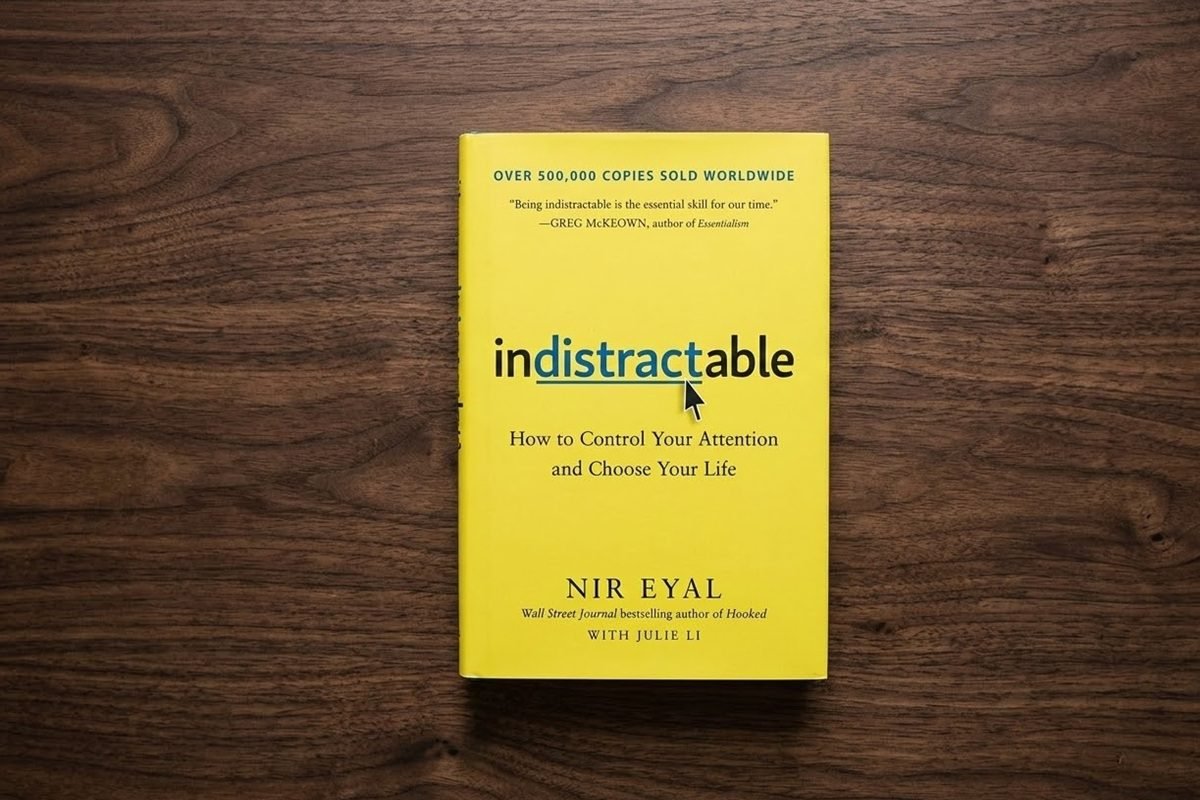
Book review: Indistractable
How to Control Your Attention and Choose Your Life
By Nir Eyal
Genres:
- Leadership
- Time management
The year it was published:
2019
Number of pages:
290

As an Amazon Associate, I earn from qualifying purchases.
Table of contents:
Introduction: From Hooked to Indistractable
Chapter 1: What’s Your Superpower?
Chapter 2: Being Indistractable
Part I – MASTER INTERNAL TRIGGERS
Chapter 3: What Motivates Us, Really?
Chapter 4: Time Management Is Pain Management
Chapter 5: Deal with Distraction from Within
Chapter 6: Reimagine the Internal Trigger
Chapter 7: Reimagine the Task
Chapter 8: Reimagine Your Temperament
Part II – MAKE TIME FOR TRACTION
Chapter 9: Turn Your Values into Time
Chapter 10: Control the Inputs, Not the Outcomes
Chapter 11: Schedule Important Relationships
Chapter 12: Sync with Stakeholders at Work
Part III – HACK BACK EXTERNAL TRIGGERS
Chapter 13: Ask the Critical Question
Chapter 14: Hack Back Work Interruptions
Chapter 15: Hack Back Email
Chapter 16: Hack Back Group Chat
Chapter 17: Hack Back Meetings
Chapter 18: Hack Back Your Smartphone
Chapter 19: Hack Back Your Desktop
Chapter 20: Hack Back Online Articles
Chapter 21: Hack Back Feeds
Part IV – PREVENT DISTRACTION WITH PACTS
Chapter 22: The Power of Precommitments
Chapter 23: Prevent Distraction with Effort Pacts
Chapter 24: Prevent Distraction with Price Pacts
Chapter 25: Prevent Distraction with Identity Pacts
Part V – HOW TO MAKE YOUR WORKPLACE INDISTRACTABLE
Chapter 26: Distraction Is a Sign of Dysfunction
Chapter 27: Fixing Distraction Is a Test of Company Culture
Chapter 28: The Indistractable Workplace
Part VI – HOW TO RAISE INDISTRACTABLE CHILDREN
Chapter 29: Avoid Convenient Excuses
Chapter 30: Understand Their Internal Triggers
Chapter 31: Make Time for Traction Together
Chapter 32: Help Them with External Triggers
Chapter 33: Teach Them to Make Their Own Pacts
Part VII – HOW TO HAVE INDISTRACTABLE RELATIONSHIPS
Chapter 34: Spread Social Antibodies Among Friends
Chapter 35: Be an Indistractable Lover
Thoughts about the book:
At its core, Indistractable is about control. Eyal argues that distraction is not primarily a technology problem, but a behavioral one. External triggers, such as phones, notifications, and endless feeds, are only part of the story. The deeper issue lies in internal triggers such as discomfort, boredom, anxiety, and the human tendency to escape them. This reframing is one of the book’s strongest contributions. It shifts responsibility from the environment to the individual, without entirely dismissing the role of technology. What I appreciated most is the practicality of the framework. Eyal offers clear, actionable strategies that include managing internal triggers, making time for traction, hacking back external triggers, and preventing distraction with pacts. These ideas are structured in a way that feels usable rather than abstract. The writing style is clean, direct, and highly accessible. Eyal uses everyday language and avoids academic density, making the book easy to engage with. Personal anecdotes and case studies are woven throughout, giving the material a human dimension without overwhelming the core ideas. In terms of difficulty, it is an easy read. The concepts are clearly explained, and the structure guides the reader step by step. You can move through the book quickly, but the real value lies in pausing to reflect and implement the strategies. The book is informative and grounded in psychology, but it is not deeply scientific in an academic sense. In the end, this is a clear, accessible, and highly usable book. It is easy to read, grounded in behavioral insight, and focused on real-world application.
Who should read this book:
If you feel that your attention is constantly being pulled in a dozen directions and that your time is no longer fully your own then Indistractable by Nir Eyal is a book that speaks directly to that tension. You should read it if you are searching for control, not over the world, but over your own focus. This is for those who are interested in productivity, deep work, and the psychology of distraction, yet suspect that the problem is not simply external devices, but something more internal. It is for readers who want to understand why they get distracted even when they know better, and how to regain the ability to do what truly matters. Nir Eyal is searching for the root causes of distraction. His interest lies in the uncomfortable truth that distraction often begins within us our discomfort, our desire to escape effort, boredom, or uncertainty. Rather than blaming technology outright, he explores how internal triggers and external environments interact to shape our behavior. This book will help you build a system for focus. It offers practical strategies to manage internal triggers, redesign your environment, and make intentional choices about your time. Reading Indistractable challenges you to stop reacting and start choosing, moment by moment, where your time and energy truly belong.
Summary of the book:
Introduction: From Hooked to Indistractable
Nir Eyal originally showed tech companies how to design habit-forming products that keep people coming back in his previous book Hooked. While he believed these techniques could be used to build helpful habits, he later recognized their downside when he became overly attached to his own devices and saw how they were taking time away from the people he cared about. Indistractable is his response, offering a practical guide for regaining control of attention in a world designed to distract. The book centers on four key strategies, which are understanding and managing internal triggers like boredom or anxiety, making time for traction by planning around what truly matters, reducing the impact of external triggers such as notifications and interruptions, and using precommitments to prevent distraction before it starts. Together, these ideas form a system for intentionally choosing how to spend your time rather than reacting to whatever demands your attention.
Chapter 1: What’s Your Superpower?
In chapter 1, Nir Eyal sets the tone for the book. While playing a game with his young daughter, Nir Eyal misses her answer to a question about superpowers because he is distracted by his phone, and by the time he looks up, she has walked away. What makes this moment more significant is that it reflects a pattern, not a one-off mistake. Even after trying extreme fixes like switching to a basic phone, avoiding digital news, and using outdated tools to limit internet access, he still found ways to distract himself. This leads to a key realization that the problem isn’t technology but the internal urge to escape discomfort. Devices are just convenient outlets for that impulse. Another parent’s similar experience reinforces this point, when his daughter says she wishes she could talk to animals so she’d have someone to talk to while her parents are busy on their computers. Together, these moments show that distraction starts from within and has real consequences, not just for productivity but for relationships. Living the life we want requires not only doing what matters, but also recognizing and resisting the behaviors that pull us away from it.
Chapter 2: Being Indistractable
Chapter 2 introduces the core idea of what it means to be indistractable by distinguishing between traction and distraction. Traction refers to actions that move you toward what you truly want, while distraction pulls you away from those goals. Both are driven by the same sources, which are internal triggers like boredom or anxiety and external triggers like notifications or interruptions, but in the end, the outcome depends on how you respond to them. Building on the earlier insight that distraction starts from within, Eyal explains that these triggers are unavoidable, but our reaction to them determines whether we stay on track. He uses the myth of Tantalus to illustrate his point. Being indistractable, then, is not about eliminating distractions entirely but about consistently doing what you intend to do. It means recognizing triggers, choosing actions that align with your goals, and accepting that while distractions will always exist, managing them is ultimately your responsibility.
Chapter 3: What Motivates Us, Really?
Chapter 3 challenges the idea that we are mainly driven by pleasure and rewards, arguing instead that most of our behavior is motivated by a desire to escape discomfort. This builds on the earlier insight that distraction starts internally, shifting the focus from what we do to why we do it. Eyal explains this through the difference between proximate causes and root causes. For example, compulsively checking a phone may seem like a technology problem, but the real driver is usually something deeper, like boredom, anxiety, or loneliness. An example of this comes from Zoë Chance, who became intensely fixated on a fitness pedometer, walking excessive hours even late at night to earn points. What seemed like an obsession with the device was actually a response to personal stress, as she was dealing with a failing marriage and career uncertainty. The pedometer gave her a sense of control and relief when other parts of her life felt unstable. Once those underlying issues were addressed, the behavior faded on its own. The broader point is that if a behavior helps us escape discomfort, we’re likely to repeat it, regardless of the form it takes. Focusing only on the distraction misses the real issue. To become indistractable, we have to understand and address the discomfort driving our actions, rather than blaming the tools we use to cope.
Chapter 4: Time Management Is Pain Management
Chapter 4 explains that our constant urge to reach for something like our phones, distractions, or the next task is rooted in how the brain is wired. We are not built for lasting satisfaction, instead, we are driven by a persistent sense of discomfort that once helped humans survive and progress. This idea builds directly on the previous chapter. If behavior is driven by the need to escape discomfort, then understanding that discomfort becomes essential. Eyal highlights four forces behind this restlessness. We struggle with boredom and find stillness surprisingly uncomfortable, to the point where people will seek almost any stimulation to avoid it. Our negativity bias makes us dwell more on problems than positives, while rumination keeps those negative thoughts looping in our minds. At the same time, hedonic adaptation ensures that even good experiences quickly lose their impact, returning us to a baseline level of dissatisfaction. Together, these forces mean that discomfort is constant, and so is the temptation to escape it. Rather than trying to eliminate these feelings, Eyal argues they should be accepted and redirected. The same dissatisfaction that fuels distraction is also what drives creativity, innovation, and progress. Learning to manage attention, then, is less about removing discomfort and more about using it intentionally instead of reacting to it.
Chapter 5: Deal with Distraction from Within
Chapter 5 argues that the instinct to fight distraction directly often backfires. Suppressing an urge tends to intensify it, a phenomenon shown in studies where trying not to think about something only makes it more persistent. Instead of relying on willpower, Eyal introduces an approach based on Acceptance and Commitment Therapy, which involves noticing urges without judgment and allowing them to pass rather than resisting them. This idea builds on the earlier insight that discomfort drives behavior. If urges are simply attempts to escape that discomfort, then reacting to them aggressively only amplifies the problem. A study on smokers illustrates this well. Flight attendants reported fewer cravings when they knew smoking was impossible than when it was just within reach, showing that cravings are shaped as much by perception as by physical need. When something feels unavailable, the urge weakens, but when it feels accessible, it grows. The takeaway is that managing distraction starts with how we respond internally. By observing urges with curiosity instead of resisting them, we reduce their power. Rather than trying to eliminate discomfort, the goal is to sit with it briefly and let it pass, giving us more control over whether we act on it.
Chapter 6: Reimagine the Internal Trigger
Chapter 6 turns the idea of managing internal triggers into a practical process. Instead of reacting automatically to discomfort, Eyal suggests slowing down and examining it. The first step is simply noticing the feeling that comes right before distraction—whether it’s boredom, anxiety, or overwhelm—followed by writing it down to create awareness and interrupt the habit loop. From there, the goal is to explore the sensation with curiosity, paying attention to how it feels in the body rather than immediately trying to escape it. Techniques like imagining thoughts as leaves floating past help create distance from the urge. This approach is especially useful during “liminal moments,” the small gaps between activities where distractions easily take hold, like waiting in line, switching tasks, or pausing for a few seconds. These brief windows often trigger automatic phone-checking that spirals into longer distractions. To counter this, Eyal recommends the ten-minute rule, which recommends allowing the urge but delaying acting on it. In most cases, the impulse fades on its own. The broader point is that by observing urges instead of reacting to them, you regain control. Discomfort doesn’t need to dictate behavior, if you can sit with it briefly, it often loses its grip, allowing you to choose your next action more intentionally.
Chapter 7: Reimagine the Task
Chapter 7 builds on the idea of managing internal triggers by shifting focus to the task itself, arguing that distraction often comes from how we approach our work rather than the work itself. Instead of trying to motivate ourselves with rewards or artificial incentives, Eyal suggests that engagement comes from attention. Drawing on the insight that fun doesn’t have to feel pleasurable but simply needs to hold our focus, he explains that even seemingly dull tasks contain elements of variability, challenge, and mystery if we look closely enough. This means reframing work as something to explore rather than endure. Just as a barista refines a perfect brew or an enthusiast fine-tunes a machine, tasks become engaging when we treat them as problems to solve or systems to understand. A simple example is mowing the lawn, what appears monotonous can become interesting when approached as a puzzle, with attention to patterns, constraints, and small improvements. By creating this kind of “mental playground,” the task reveals more depth and becomes easier to focus on. The key idea is that sustained attention comes from how deeply we engage. Instead of escaping discomfort through distraction, we can channel that same mental energy into the task, turning it into something that captures our interest and keeps us on track.
Chapter 8: Reimagine Your Temperament
Chapter 8 challenges the idea that willpower is a limited resource that gets depleted over the course of a day. The common belief in “ego depletion” suggests that after enough effort, people simply run out of self-control and are more likely to give in to distraction or bad habits. However, more recent research questions this assumption and suggests that what we believe about willpower plays a major role in how it actually functions. Eyal draws on findings associated with Stanford psychologist Carol Dweck, showing that people who view willpower as unlimited tend to sustain it, while those who believe it is finite are more likely to feel exhausted and give up. In other words, self-control is not just a biological limit but is shaped by mindset. This extends to how we respond to setbacks as well. When people treat mistakes with self-criticism, they often become more stressed and more likely to seek distraction as a way to escape those negative feelings. In contrast, self-compassion responding to lapses with understanding builds resilience and makes it easier to get back on track. This idea is reinforced by studies of addiction recovery, where belief in one’s inability to resist cravings strongly predicts relapse, sometimes even more than physical dependence itself. Those who see themselves as powerless are more likely to act accordingly, while those who believe they can exert control are more likely to succeed in resisting urges. The broader message is that how we talk to ourselves shapes how we behave. Treating yourself with the same understanding you would offer a friend makes it easier to recover from distraction and continue moving toward your goals.
Chapter 9: Turn Your Values into Time
Chapter 9 introduces timeboxing as a way to turn values into action by assigning them real space in your calendar. Without a structured plan for time, everything competes equally for attention, which makes distraction more likely because there is no clear sense of what should come first. By deciding in advance what you will do and when, you reduce the mental load of constant decision-making. A key distinction in this chapter is between goals and values. Goals are things you complete, while values are ongoing ways of living. Instead of aiming only to “get fit,” for example, a value would be to see yourself as someone who prioritizes health. Values don’t end once achieved, they guide repeated choices over time, which is why they need to be reflected in how time is spent. To make this practical, Eyal suggests organizing life into three main areas. Time for yourself, including health and personal development, time for relationships, such as family, friends, and partners, and time for work and professional responsibilities. By creating a weekly schedule that allocates space to each of these domains and adjusting it over time, you build a structure that reflects what matters most rather than reacting to whatever comes up. The central idea is that if important activities are not scheduled, they are easily displaced by less important ones. Timeboxing is not about rigidity, but about ensuring that your priorities consistently have a place in your life.
Chapter 10: Control the Inputs, Not the Outcomes
Chapter 10 emphasizes the importance of prioritizing yourself by focusing on what you can control rather than the results you hope to achieve. Eyal reflects on how he used to sacrifice sleep, exercise, and meals in order to get more work done, only to find that it ultimately made him less effective. When he began scheduling time for his own well-being first, his overall productivity and stability improved rather than declined. A central idea in this chapter is the distinction between inputs and outputs. Inputs are the actions you take, such as showing up to work, going to bed at a set time, and sitting down to write, while outputs are the results you can’t directly control, such as being inspired, falling asleep immediately, or producing high-quality work on demand. The key shift is realizing that effort and consistency are within your control, but outcomes are not. Eyal illustrates this with his experience of waking up at 3 a.m. and struggling to fall back asleep. The more he worried about losing sleep, the more awake he became. Once he adopted the mindset that the body will get the sleep it needs, the anxiety eased and sleep improved naturally. The broader lesson is that focusing on forcing outcomes often creates resistance, while focusing on simply showing up creates the conditions for those outcomes to happen. The main takeaway is that you don’t need to control results to make progress. What matters is consistently taking the actions within your control, because not showing up guarantees failure, while showing up at least gives you the possibility of success.
Chapter 11: Schedule Important Relationships
Chapter 11 highlights how relationships at work often suffer not from lack of effort, but from lack of structure and clarity. Eyal points out that colleagues and managers are frequently left guessing about availability, priorities, and expectations, which creates unnecessary stress and constant responsiveness. Much of the resulting distraction comes from uncertainty rather than actual urgency. To address this, he recommends syncing a timeboxed schedule with your manager so that both sides agree on what matters most and when it will be done. This simple act of transparency reduces the need for constant checking and reacting, because priorities and availability are clearly defined in advance. Rather than signaling inflexibility, it builds trust by making work patterns visible and intentional. This is illustrated through April, a sales executive who felt overwhelmed by meetings and messages and assumed she simply needed to work harder. After creating a structured schedule and sharing it with her manager, it became clear she was spending significant time on low-value tasks without realizing it. Once this was visible, her manager helped remove unnecessary meetings, allowing her to focus on core sales work and regain personal time. The broader message is that clarity reduces distraction. When expectations are aligned, there is less need for constant communication and more space for focused, meaningful work.
Chapter 12: Sync with Stakeholders at Work
A lot of workplace stress doesn’t come from the workload itself, but from uncertainty. People are often left guessing about how responsive they need to be after hours, which meetings they can safely skip, and which requests actually require immediate attention. Without clear expectations, it becomes easy to slip into constant email checking, reactive work, and a general sense of always being behind. A practical way to fix this is to align your timeboxed schedule with your manager and key stakeholders. By laying out how you intend to spend your time, you create an opportunity for feedback and alignment on what truly matters. This isn’t about asking for permission to work, it’s about making priorities visible so both sides understand what “good work” looks like. When expectations are explicit, a lot of the background anxiety that drives distraction starts to disappear. This approach also builds trust rather than weakening it. Sharing your schedule signals that you’re intentional with your time and focused on the right things, not just staying busy. It reduces misunderstandings about availability and helps filter out tasks that don’t meaningfully contribute to your core responsibilities. A clear example of this is April’s experience. She was a sales executive who felt constantly overwhelmed, spending most of her time in meetings and reacting to messages instead of focusing on closing deals. She assumed the problem was her own productivity. When she introduced a timeboxed schedule and reviewed it with her manager, David, it became clear that much of her time was being consumed by low-priority meetings he hadn’t realized were affecting her work. Once they talked through it, David actively helped remove or reduce those commitments. With fewer distractions, April was finally able to concentrate on her sales work, her performance improved noticeably, and she regained control over her personal time.
Chapter 13: Ask the Critical Question
This chapter introduces a simple but powerful way to evaluate any external trigger, such as a notification or interruption “Is this trigger serving me, or am I serving it?” The idea is to pause and consider whether the interruption is actually helping you move forward with something you already intended to do, or whether it is pulling you away from your plan. If it supports your goals, it can be useful. If it diverts your attention, it becomes a distraction. The chapter also highlights that many of these triggers are not neutral. Tech companies intentionally design notifications, alerts, and pings to capture attention and create a sense of urgency. That feeling of “this needs to be answered now” is often engineered rather than truly necessary. A message, email, or update may feel important simply because it arrived at the top of your attention stack, not because it actually deserves immediate action. By consistently asking the critical question, you start to shift control back to yourself. Instead of reacting automatically to every prompt, you begin choosing which ones are worth your focus. This small mental habit helps reclaim agency over your attention in an environment that is constantly competing for it. The key takeaway is that every notification is essentially asking for your attention, but not all of them deserve it. Before responding, it helps to ask whether engaging with it right now is actually serving your priorities. If it isn’t, it’s not just harmless to ignore it, it’s often better for your focus to remove or defer it entirely.
Chapter 14: Hack Back Work Interruptions
This chapter looks at one of the most common sources of lost focus at work, interruptions from other people. Much of this is baked into modern office design, especially open-plan offices, which were intended to improve collaboration but often end up doing the opposite. Instead of more spontaneous teamwork, they tend to produce constant distractions, fragmented attention, and more difficulty getting meaningful work done. A practical way to address this is to make your need for focused time visible and unmistakable to others. Rather than relying on subtle cues like headphones, the idea is to use a clear signal that communicates when you should not be interrupted. The author describes a simple “screen sign” that says something like, “I need to focus right now, but please come back soon.” The key is clarity, it removes ambiguity so colleagues don’t have to guess whether it’s okay to interrupt you. The underlying principle is that interruptions are not harmless. Each one increases the likelihood of mistakes and slows down cognitive work more than people realize. Creating explicit boundaries around focus time is not about being unavailable or antisocial, it’s about making sure work gets done with fewer errors and less friction for everyone involved. A powerful example of this comes from healthcare. Nurse Becky Richards at Kaiser Permanente was dealing with a serious and hidden safety issue nurses administering medication were being interrupted five to ten times during a single task. Across hospitals, this contributed to hundreds of thousands of medication errors each year. To address it, she introduced a simple visual signal — nurses wore bright orange vests while dispensing medication, clearly indicating “do not interrupt.” The idea initially felt awkward and even unpopular, with some nurses describing the vests as uncomfortable or “cheesy,” but the impact was dramatic. Medication errors dropped by 47% in the initial rollout, and as the practice spread more widely, a multi-hospital study later found reductions of up to 88% over three years. A simple, visible cue was enough to protect focused attention in one of the highest-stakes work environments.
Chapter 15: Hack Back Email
Email is framed in this chapter as one of the biggest sources of modern workplace overload, often described as “the curse of the modern worker.” The scale alone makes it difficult to manage. An average office worker receives around 100 emails per day. If each one takes just a couple of minutes to read and respond to, that quickly adds up to over three hours of the workday. On top of that, studies suggest that nearly half of these messages aren’t even necessary for the recipient, meaning a large portion of this effort is avoidable from the start. The chapter introduces a simple way to think about the problem total email time is the number of emails multiplied by the time spent on each one. That means reducing email overload comes down to changing one or both of those factors. Either you reduce how many emails you receive, or you reduce how long you spend on each one. A major lever is reducing incoming email in the first place. One overlooked driver is reciprocity, because every email you send tends to generate a reply, which often turns into a chain of additional messages. By being more selective about what you send, you naturally reduce what comes back. Another strategy is to set up structured “office hours,” where colleagues know they can bring questions to you at specific times instead of relying on constant back-and-forth messages throughout the day. A third tactic is to delay sending replies even after you’ve written them, scheduling them for later so conversations are less reactive and don’t turn into rapid-fire exchanges. On the other side of the equation, reducing time spent per email comes from changing how you process them. Instead of reacting immediately to every message, each email can be tagged based on when it actually needs a response, such as “Today” or “This Week.” That simple categorization allows email to be handled in batches during dedicated time blocks, rather than continuously interrupting the flow of work. The key takeaway is that email only becomes overwhelming when it is treated as constantly urgent. By processing it in scheduled batches and being more intentional about what you send, you reduce both the volume and the urgency. In practice, the most powerful shift is often the simplest sending fewer emails leads directly to receiving fewer emails.
Chapter 16: Hack Back Group Chat
Group chat tools like Slack or WhatsApp are presented here as one of the most underestimated sources of constant distraction at work. While they are designed to improve communication, in practice, they often behave more like an “all-day meeting with no agenda,” where conversations never fully start or end. Even the CEO of Basecamp, the company behind a popular group chat tool, has warned against relying on group chat as the main way an organization communicates, since it tends to fragment attention rather than support focused work. The chapter suggests a few simple rules to make group chat healthier and less disruptive. The first is to treat it like a sauna you go in, do what you need to do, and then leave, rather than staying inside all day passively watching messages come in. The goal is to avoid “lurking,” which keeps your attention tethered to the tool even when you’re not actively participating. Another rule is to schedule when you check it, instead of responding continuously. By designating specific times during the day to review messages, you regain control over when your attention is interrupted, rather than letting the app dictate it in real time. A third principle is to be selective about who is included in each conversation. Many group chats become noisy simply because too many people are added by default. Keeping groups tight ensures that only those who truly need to be involved are exposed to the ongoing stream of messages. Finally, the chapter emphasizes using group chat selectively rather than universally. For sensitive, complex, or important topics, it is often better to switch to a written document or an actual conversation. This helps avoid misunderstandings and prevents important discussions from being lost in a fast-moving stream of messages. The key takeaway is that group chat becomes harmful when it is treated as a constant background presence. By using it intentionally, checking it at set times, limiting participation, and choosing better formats for deeper work, it can remain a useful tool without taking over your attention.
Chapter 17: Hack Back Meetings
This chapter argues that many meetings exist not because they are the best way to solve a problem, but because they allow people to avoid the harder work of thinking through the problem in advance. When meetings are used as a substitute for preparation, they tend to become inefficient, unfocused, and draining for everyone involved. To address this, the chapter proposes raising the bar for when a meeting can even be called. Before scheduling one, the organizer should be required to provide two things, a clear written agenda explaining what problem needs to be discussed, and a short document outlining their best proposed solution. If there is no agenda or no initial thinking, there is no meeting. This shifts the effort upstream, ensuring that meetings are used for refining ideas rather than generating them from scratch. Once a meeting does happen, the environment itself becomes important. The chapter strongly recommends making meetings device-free. When participants have phones or laptops open, attention fragments easily, and people mentally drift in and out of the discussion. This reduces the quality of engagement for everyone in the room. In most cases, a single device for presenting or taking shared notes is sufficient, while everything else becomes a distraction. The key takeaway is that meetings should not be where thinking begins, they should be where thinking is refined, and decisions are finalized. By requiring preparation before a meeting and removing digital distractions during it, meetings become shorter, more focused, and far more effective.
Chapter 18: Hack Back Your Smartphone
Smartphones are essential tools, but they are also one of the biggest sources of distraction. The chapter outlines a simple four-step process to take back control and make your phone work for you rather than against your attention. First is remove delete apps that you no longer need or that don’t align with your goals and values, such as low-value games or news apps that constantly trigger unnecessary alerts. This reduces both clutter and temptation. Next is replace move highly addictive apps like social media or YouTube off your phone entirely and access them only on a computer at planned times. Small habits also help, like using a watch so you’re not repeatedly opening your phone just to check the time. Then comes rearrange, which dictates you should keep only essential and truly useful apps on your home screen. Anything that encourages mindless checking should be moved to secondary screens, adding a small barrier that makes you more intentional about opening it. Finally, reclaim, which recommends that you review notification settings for every app, and turn off anything that doesn’t require immediate attention. Only truly important apps should be allowed to interrupt you. The key takeaway is that it doesn’t take long to make your smartphone far less distracting, often less than an hour. But it requires active intention. App designers won’t optimize for your focus, so taking control is something you have to do yourself.
Chapter 19: Hack Back Your Desktop
A cluttered desktop is more than just visually messy, it actively reduces your ability to focus. Research from Princeton shows that visual clutter competes for attention and makes concentration harder. On a computer, this includes icons, open tabs, and constant notifications, all of which pull your mind in different directions. The solution is to simplify your digital workspace. A practical step is to clear your desktop completely by moving everything into a single folder, so you start with a clean screen each day. Alongside this, all desktop notifications should be turned off, and “Do Not Disturb” should be kept on by default to prevent constant interruptions. The key idea is to reduce visual and digital noise so your attention is not fragmented before you even begin working. A clean screen makes it easier to focus on one task at a time without unnecessary distractions.
Chapter 20: Hack Back Online Articles
The internet is designed to pull you from one link to another, making it easy for open tabs to multiply and for hours to disappear without much to show for it. The rule suggested here is simple, don’t read articles directly in your web browser. Instead, save anything interesting to a read-later app like Pocket. This removes the immediate temptation to click and read, keeps your browser clean, and helps you stay focused on your current task. Those saved articles can then be consumed later in a more intentional context. One effective approach is listening to them during workouts, using a strategy called temptation bundling, where you pair something enjoyable with something you already need to do. In this case, exercise becomes more engaging, and reading becomes more structured. The result is a kind of “triple win”, you get your workout done, you learn from the content, and you keep work time free from distraction. The key takeaway is to separate discovery from consumption. Use a read-later tool to capture interesting content instead of reading it immediately, and pair that content with healthy routines like exercise to turn distraction-prone media into a productive habit.
Chapter 21: Hack Back Feeds
Social media feeds like Facebook, Twitter, and YouTube recommendations are intentionally designed to keep you scrolling. Features such as infinite scroll are not accidental they are built to maximize engagement and hold your attention for as long as possible. A practical way to counter this is to remove or heavily modify those feeds. Browser extensions can help you strip away the most distracting elements while still keeping the useful parts of each platform. For example, tools like News Feed Eradicator replace the Facebook feed with something neutral, such as a quote, while DF Tube removes recommended videos and other distractions on YouTube. This allows you to use social media more intentionally. Instead of being pulled through an endless stream of content, you go directly to what you need and avoid the default engagement traps. The key takeaway is that social media feeds are engineered to keep you hooked. By removing or disabling them with simple tools, you can keep the functionality without the endless distraction.
Chapter 22: The Power of Precommitments
A precommitment is a decision made in advance that restricts your future options in order to protect you from impulsive behavior later. The idea is to “bind” your future self to a course of action when you are thinking clearly, so you don’t have to rely on willpower in the moment when distractions or urges are stronger. A classic example comes from Homer’s Odyssey. Ulysses (Odysseus) knew he would be unable to resist the Sirens’ song when his ship passed them, so he had himself tied to the mast before reaching them and instructed his crew not to release him under any circumstances. This kind of self-binding, often called a “Ulysses pact,” removes the option to act impulsively later on. In everyday life, precommitments are already common. Retirement accounts with penalties for early withdrawal prevent short-term financial decisions from undermining long-term goals. Health-care directives ensure decisions are respected even if someone becomes incapacitated. Marriage vows similarly formalize commitments made at a moment of clarity to guide future behavior. The key takeaway is that precommitments are powerful because they eliminate the need for constant self-control in the moment. They work best once internal triggers are understood, time has been structured for focused work, and external distractions have been reduced, allowing them to reinforce an already intentional system rather than compensate for a lack of it.
Chapter 23: Prevent Distraction with Effort Pacts
An effort pact is a strategy that makes unwanted behaviors slightly harder to perform, so that small barriers interrupt impulsive actions before they happen. The idea is not to rely on willpower, but to introduce just enough friction that distractions lose their appeal. Simple tools can do this effectively. For example, a timed lockbox like kSafe can physically store your phone so it is inaccessible during focused work periods. Apps like Forest use a similar principle in digital form, you commit to staying off your phone while a virtual tree grows, and leaving the app causes the tree to die. The added friction or even mild guilt created by breaking the pact is often enough to stop the impulse. Effort pacts can also be social. Working alongside another person creates a layer of accountability that discourages distraction. The author describes using a co-working partner and services like Focusmate, where you are paired with a stranger for a scheduled virtual work session, making it harder to drift away from your task unnoticed. The key takeaway is that distraction doesn’t always need to be fought with willpower. Often, it is enough to make the distracting behavior slightly inconvenient or socially unacceptable, so that the impulse fades before it turns into action.
Chapter 24: Prevent Distraction with Price Pacts
A price pact is a commitment device where you put money on the line to reinforce your intentions. If you fail to follow through on what you said you would do, you lose money. The effectiveness of this approach comes from loss aversion, the psychological tendency for people to feel the pain of losing money much more strongly than the pleasure of gaining the same amount. The author applied this strategy while writing the book by pledging $10,000 to a friend if he didn’t complete a first draft by a specific deadline. He also used a “burn or burn” setup during exercise, placing a $100 bill next to his workout plan. Each day, he either completed his workout and “burned calories” or failed and literally burned the money. Over three years, he never chose to burn the cash. However, price pacts are not universally appropriate. They work best for short, clearly defined goals where you have control over the environment. They are less effective for behaviors tied to unavoidable external triggers, and they may be unsuitable for people who already struggle with excessive self-criticism or for commitments that stretch over very long periods. The key takeaway is that adding a financial consequence makes distraction more costly in the present moment. When used carefully, price pacts can be a powerful way to reinforce focus for specific tasks where behavior is fully within your control. A striking example comes from a smoking cessation study published in the New England Journal of Medicine. One group of smokers received information and nicotine patches, and only 6% quit. Another group was offered an $800 reward for quitting, increasing success to 17%. But the most effective group had to deposit $150 of their own money upfront, which they would only get back, plus an additional $650, if they successfully quit. In that group, 52% quit smoking. The possibility of losing their own money proved far more motivating than the promise of a larger reward, clearly demonstrating the power of loss aversion.
Chapter 25: Prevent Distraction with Identity Pacts
An identity pact is a form of precommitment that works by shifting focus from what you do to who you believe you are. Instead of committing to a specific behavior, you commit to an identity, and then act in ways that are consistent with that self-image. Research shows this is often more effective because people are strongly motivated to behave in alignment with how they define themselves. One study illustrates this effect clearly when people were asked how important it was to them to be a “voter,” they were significantly more likely to actually vote than those asked how important voting was to them. The difference is subtle but important. The noun “voter” activates identity, while the verb “vote” only refers to an action. Once identity is engaged, behavior tends to follow more naturally. This pattern also appears in everyday habits. People who identify as someone who “doesn’t eat junk food” are more successful at resisting temptation than those who simply say they “can’t eat junk food.” The identity removes the need for constant internal negotiation. Instead of debating each choice, the decision becomes consistent with who they believe they are. The chapter encourages adopting the identity of being “indistractable.” This means more than just trying to avoid distraction, it means seeing yourself as someone who values focus and acts accordingly. Reinforcing this identity can include telling others, maintaining consistent routines, and using systems like scheduled time blocks and Do Not Disturb mode as part of how you operate by default. The key takeaway is that behavior follows identity. When you see yourself as indistractable and consistently act in line with that belief, focus becomes less about willpower and more about simply being who you already think you are.
Chapter 26: Distraction Is a Sign of Dysfunction
This chapter challenges the common assumption that workplace distraction is mainly caused by technology. While digital tools can amplify the problem, the deeper cause is often a dysfunctional work environment. In many cases, distraction is a symptom rather than the root issue. Two workplace conditions are especially linked to stress, disengagement, and constant distraction. The first is high job strain, where employees are expected to meet demanding or urgent requests but have little real control over priorities or outcomes. This mismatch between pressure and autonomy creates constant tension and makes it difficult to focus on meaningful work. The second is effort-reward imbalance, where employees invest significant effort but receive little recognition, feedback, or reward in return. Over time, this disconnect erodes motivation and makes work feel unrewarding, even when people are putting in a lot of energy. Both conditions share a common thread a lack of control. When people feel powerless in their work environment, they often turn to small, immediate sources of relief or stimulation. This can show up as compulsive email checking, frequent app switching, or social media scrolling, behaviors that temporarily restore a sense of activity or escape, even if they reduce productivity. The key takeaway is that persistent distraction in the workplace is often a sign of deeper organizational issues. When employees are constantly distracted, the problem is not simply technology use, but a work culture that creates stress, low autonomy, or misaligned rewards.
Chapter 27: Fixing Distraction Is a Test of Company Culture
This chapter argues that reducing distraction at work is not just about tools or policies, but about company culture, especially psychological safety. Coined by Harvard researcher Amy Edmondson, psychological safety refers to an environment where employees feel safe to speak up, raise concerns, admit mistakes, and question existing norms without fear of punishment or judgment. Research from Google’s two-year study found that psychological safety was the most important factor in determining team effectiveness, more than individual talent or team composition. Teams with high psychological safety performed better overall, generated more revenue, had lower turnover, and were consistently rated as more effective. In such environments, people are more willing to surface problems early instead of silently struggling or disengaging. The key idea is that distraction often signals unspoken issues in the workplace. When employees feel unable to openly discuss problems like constant interruptions or technology overload, those frustrations tend to manifest as stress, disengagement, or compulsive digital behavior. Creating a space where these issues can be discussed directly often reveals that the root causes are fixable. A practical example comes from the Boston Consulting Group. The firm had a demanding “always-on” culture where employees were expected to respond to emails and calls at all hours. Instead of trying to ban devices or impose strict rules, Harvard researcher Leslie Perlow introduced a small experiment, where each team was given one predictable night off per week. The real impact came not just from the policy itself, but from the process of figuring out how to make it work. Teams held regular discussions about obstacles and adjustments, which opened up broader conversations about workload, expectations, and communication norms. As employees felt more heard and involved in shaping their environment, engagement improved significantly, and the distraction problem largely resolved itself. The approach proved successful enough that it was eventually rolled out across the company. The key takeaway is that fixing distractions is ultimately a reflection of company culture. When organizations create psychological safety and allow open discussion about how work actually happens, many distraction problems reveal themselves as solvable structural issues rather than individual failings.
Chapter 28: The Indistractable Workplace
This chapter examines Slack as an example of a company that might be expected to struggle with distraction, given that it builds communication tools used for constant messaging. In practice, however, Slack has cultivated a culture where employees typically leave the office by early evening, avoid messaging each other after hours, and report high levels of job satisfaction. The guiding principle is summed up in their motto “Work hard and go home.” A key factor behind this culture is leadership behavior. Senior executives actively model focused work habits by scheduling specific times for email, attending meetings without devices, and demonstrating that it is acceptable to be offline outside of work hours. This signals to employees that focus and boundaries are not only allowed but expected. The company also builds structured channels for communication and feedback. Employees can raise concerns through dedicated spaces, including an “ask me anything” channel for executives and a #beef-tweets channel designed for product criticism. Importantly, feedback is acknowledged openly, often with simple emoji responses that confirm employees have been heard, even if full answers come later. This keeps communication flowing without requiring constant reactive messaging. The key takeaway is that indistractable workplaces are shaped less by rules and more by culture. When leaders model focused behavior, create clear channels for feedback, and treat distraction as a shared organizational issue rather than an individual failing, they build environments where people can work deeply without being constantly pulled away.
Chapter 29: Avoid Convenient Excuses
This chapter questions the popular belief that smartphones are the primary cause of declining mental health in children. While concerns about screen time are understandable, the research is more complex than many headlines suggest. Evidence shows that negative effects are mainly associated with extreme use, typically more than five hours a day, while moderate use, around two hours or less, shows little to no harm and, in some cases, is linked to slightly better well-being. The broader point is that society has often gone through similar cycles of concern with new technologies. Books, radio, and television were all once blamed for harming children, even though over time they became accepted parts of everyday life. The current wave of concern about digital devices may reflect a similar pattern of “techno-panic,” where visible technologies are blamed for deeper issues. Rather than dismissing concerns entirely, the chapter encourages looking more carefully at root causes. When children struggle, the explanation is often more complex than screen time alone and may involve unmet psychological or social needs that deserve attention. The key takeaway is that devices are rarely the fundamental problem. Focusing only on restricting screens can miss the underlying issues. A more durable approach is to help children develop the skill of becoming indistractable, so they can navigate digital environments thoughtfully throughout their lives rather than relying solely on external control.
Chapter 30: Understand Their Internal Triggers
This chapter draws on self-determination theory from researchers Richard Ryan and Edward Deci, which suggests that human well-being depends on three core psychological needs, much like the body depends on essential nutrients. These needs are autonomy, competence, and relatedness. Autonomy is the feeling of having control over your own choices. Competence is the sense that you are capable, improving, and able to master skills. Relatedness is the feeling of being connected to other people who matter to you. When these needs are met, people tend to feel more satisfied and grounded in their daily lives. The chapter argues that when children don’t get enough of these needs met in the real world at school, at home, or in social settings, they often seek them elsewhere. Digital environments, especially video games and social media, are highly effective at providing simulated versions of all three. Games offer autonomy through player choice, competence through leveling up and progress systems, and relatedness through online interaction with peers. From this perspective, excessive screen use is less about the devices themselves and more about unmet psychological needs. Simply restricting access does not address the underlying motivation that draws children back to these environments. The key takeaway is that overuse of screens is often a signal of unmet needs. Instead of focusing only on restriction, a more effective approach is to increase real-world opportunities for autonomy, skill development, and meaningful connection.
Chapter 31: Make Time for Traction Together
This chapter argues that children, like adults, benefit from a timeboxed schedule, but the key difference is that it should be created with them rather than imposed on them. When children are involved in shaping their own schedule, they are far more likely to follow it. The focus shifts away from strict rules and punishment toward a shared conversation about values, priorities, and trade-offs. A major emphasis is also placed on the importance of unstructured play. This is a time when children are not directed by adults and are free to explore, interact, and create their own activities. Research consistently shows that this kind of free play is essential for developing focus, emotional resilience, and social skills. It is not wasted time, but a critical part of healthy development. The key takeaway is that children learn best when they have a role in designing their own time. Involving them in scheduling, setting aside regular family meals and shared activities, and protecting space for unstructured play helps build ownership and responsibility. Even when they fail to follow their own plans, those experiences become part of the learning process rather than something to simply avoid. A clear example comes from internet safety educator Lori Getz. During a family vacation, her daughters became increasingly absorbed in their phones. Instead of reacting with punishment or strict rules, she called a family discussion. Together, they talked about what they actually wanted from the vacation more connection, shared experiences, and quality time together. Once those goals were clear, it became obvious that excessive screen use was getting in the way. The daughters themselves proposed a solution devices would only be used after everyone was fully ready for the day’s planned activities. Because they were part of creating the agreement, there was no power struggle, and the new rule was more willingly followed.
Chapter 32: Help Them with External Triggers
This chapter uses a simple analogy to explain readiness for digital devices giving a child a smartphone before they are ready is like letting them jump into a pool before they can swim. The desire to use the device is not enough to justify giving it to them, just as wanting to swim is not the same as being able to do it safely. Readiness, in this sense, is practical and observable. A useful test is whether the child can manage the device’s basic tools for controlling attention. Can they activate features like Do Not Disturb? Can they put the phone away during family time without constant reminders? If they struggle with these behaviors, it suggests they need more gradual practice before gaining more freedom or access. The chapter also highlights several practical ways to reduce unnecessary external triggers. Keeping televisions and devices out of children’s bedrooms, especially at night, helps protect sleep, which is foundational for attention and emotional regulation. Ensuring consistent, sufficient rest is part of creating an environment where focus can develop naturally. At the same time, when children are engaged in scheduled activities or focused play, they should not be repeatedly interrupted, as this undermines their ability to sustain attention. The key takeaway is that external triggers are not only digital, they also include adult behavior. Parents themselves can become sources of distraction when they interrupt children’s focused time unnecessarily. Supporting indistractability means respecting their time, protecting their environment, and only giving children devices when they are developmentally ready to handle them responsibly.
Chapter 33: Teach Them to Make Their Own Pacts
This chapter emphasizes that even young children are capable of making and following their own commitments, as long as they are given appropriate guidance and ownership of the process. Instead of imposing strict rules on screen time, the idea is to involve children in setting their own boundaries so they understand both the reasoning and responsibility behind them. The author describes a personal example of sitting down with his five-year-old daughter to discuss how much screen time she thought was reasonable each day. While he expected an answer like “all day,” she made a more moderate choice about two shows per day, roughly 45 minutes. She also chose to use a kitchen timer herself to keep track of it. Over time, as she grew older, she adjusted the limits, but the key point remained the rule was always something she had created and agreed to. This approach works on several levels. It introduces media literacy by helping children understand that digital platforms are intentionally designed to capture attention. It also builds self-regulation by giving them repeated practice in setting and keeping commitments. At the same time, it strengthens autonomy because children feel they are in control of their own decisions rather than simply complying with imposed restrictions. The key takeaway is that children are more likely to follow rules they have helped create. When they are entrusted with setting their own boundaries around screen time, within a supportive framework, they develop the lifelong skill of self-regulation rather than dependence on external control.
Chapter 34: Spread Social Antibodies Among Friends
Distraction is highly contagious in social settings. When one person at a table picks up their phone, it often signals to others that it is acceptable to do the same, gradually breaking the shared focus of the group. Over time, this weakens the quality of in-person interactions without anyone explicitly intending it. The chapter suggests that, much like smoking indoors became socially unacceptable over time, phone use norms can also shift through gradual cultural pressure rather than formal rules. A useful concept here is “phubbing,” which combines “phone” and “snubbing” to describe the act of ignoring someone by looking at a device. Naming the behavior makes it easier to recognize and gently address. One simple way to respond is with a calm, non-confrontational question such as, “I see you’re on your phone—is everything OK?” This gives the other person a chance to either handle something urgent or consciously return their attention to the group without embarrassment or escalation. The key takeaway is that social groups can develop what the author calls “social antibodies,” shared norms that protect attention and make constant distraction less acceptable. By naming the behavior and reinforcing the expectation of presence, groups can help each other stay more engaged in shared time. A helpful comparison comes from the decline of smoking in public spaces. In 1965, more than 40% of American adults smoked, and it was common to do so indoors, even around children or at work. Today, that behavior is largely restricted not just by law but by strong social norms, lighting a cigarette in someone’s living room would generally be seen as inconsiderate. This shift happened primarily through cultural change, where people collectively decided what behavior was acceptable in shared spaces. The same kind of shift can occur with phone use if individuals actively reinforce new norms in their own social circles.
Chapter 35: Be an Indistractable Lover
The book closes where it began, with the author reflecting on how distraction had quietly affected his most important relationship. He and his wife had developed a habit of spending their evenings in bed on their devices until late at night, too tired to talk or connect meaningfully. Over time, this routine began to erode their sense of closeness and intimacy. Their first attempt to fix the issue, removing phones from the bedroom, did not fully work. When the urge to check devices appeared, it simply shifted to a laptop instead. The underlying issue hadn’t been addressed the internal triggers driving the behavior. Once they acknowledged and worked on those urges directly, they were able to put more effective structures in place, including a 10-minute delay rule before using any device in the evening and a router timer that automatically turned off internet access at 10 p.m. Together, these changes gradually restored their evenings and improved their connection. The key takeaway is that even our closest relationships are vulnerable to distraction. Protecting them requires a combination of strategies, managing internal triggers, scheduling intentional time together, reducing external triggers, and using precommitments to support the boundaries we set. The final story returns to the author’s daughter, who earlier in the book had been asked what superpower she would want. After realizing he had not been fully present in that moment, he asked her again. Her answer was simple to always be kind to others. That response left a lasting impression, reinforcing the idea that both kindness and indistractability are not extraordinary abilities, but choices that are available to anyone willing to practice them.