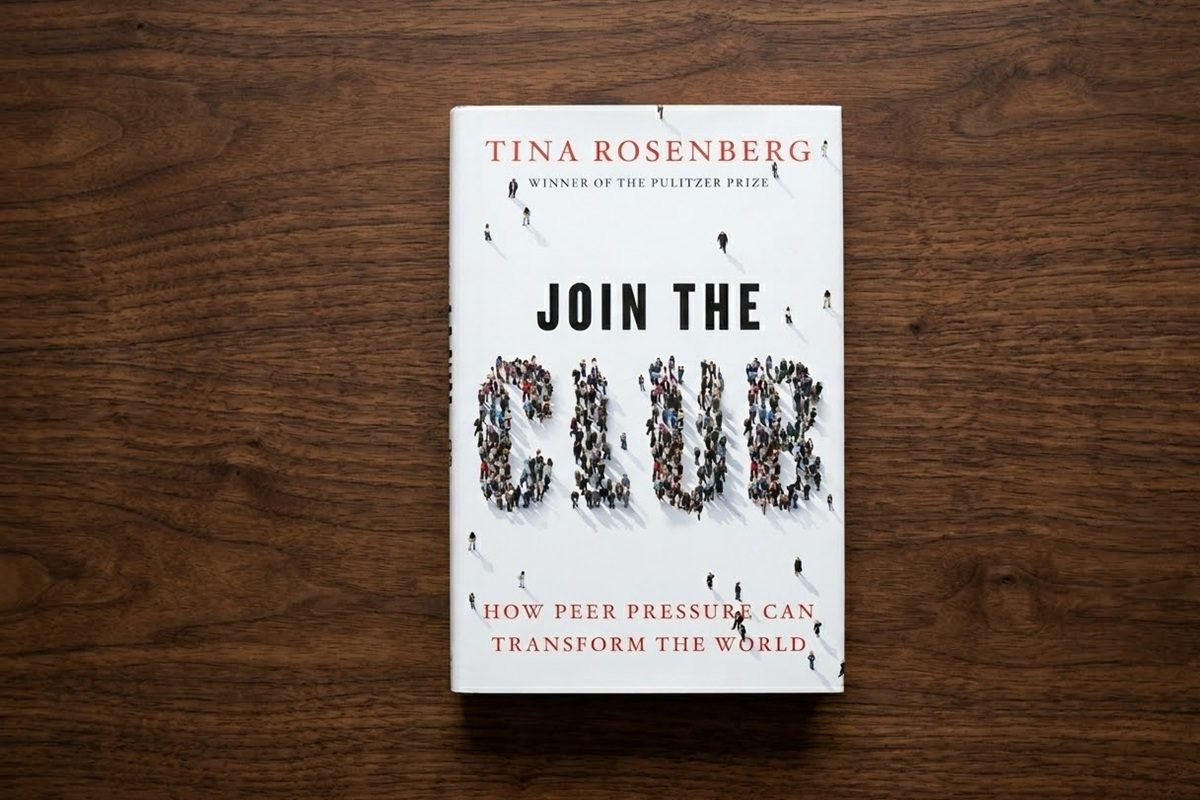
Book review: Join The Club
How Peer Pressure Can Transform the World
By Tina Rosenberg
Genres:
- Political Advocacy
- Sociology
- Behavioral Science
The year it was published:
2011
Number of pages:
432

As an Amazon Associate, I earn from qualifying purchases.
Table of contents:
Introduction: Join the Club
Chapter 1: Turning Positive
Chapter 2: The Empire of Irrationality
Chapter 3: Righteous Rebels
Chapter 4: Corporate Tools
Chapter 5: The Calculus Club
Chapter 6: Angels of Change
Chapter 7: A Problem That Has No Name
Chapter 8: The Party
Chapter 9: The Judo of Fear
Chapter 10: Next
Thoughts about the book:
At its core, Join the Club argues that peer influence is not just a negative force to be resisted, but it can be harnessed for social good. Tina Rosenberg illustrates how collective norms, accountability, and social pressure can improve public health, encourage ethical behavior, and even drive large-scale social change. The book emphasizes the mechanisms behind influence and how behaviors ripple through networks, how reputation matters, and how social norms create powerful incentives that often outweigh laws or formal rules. What I particularly liked is Rosenberg’s combination of storytelling and research. She grounds her arguments in compelling case studies, such as communities that reduced smoking rates, cities that improved sanitation, and schools that adopted better practices through positive peer influence. These examples make abstract social science tangible, and they show the reader exactly how peer pressure operates in real-world contexts. The writing style is clear, engaging, and highly readable. Rosenberg has a journalist’s gift for narrative: she balances vivid anecdotes with analytical insights. The language is everyday and accessible, never burdened with heavy academic jargon. Complex ideas about networks, norms, and social contagion are explained in ways that feel natural and intuitive. This makes the book enjoyable without sacrificing intellectual substance. The book is easy to read, though it occasionally demands reflection. It is informative and based on scientific research, drawing from sociology, psychology, and behavioral economics, but it is not a technical manual. The science is presented through story rather than equations, experiments, or heavy statistics, which makes it highly digestible.
If there is a drawback, it is that the optimism can sometimes feel slightly overextended. Rosenberg focuses on the positive potential of peer influence, and while she does acknowledge misuses, the examples of negative influence are less emphasized. For some, this might make the narrative feel slightly one-sided. Additionally, while the breadth of examples is impressive, some chapters revisit similar themes, which can create a sense of repetition. Overall, Join the Club succeeds beautifully in reframing a familiar concept in a transformative light. It is engaging, thoughtful, and backed by research, yet written in a style that is accessible to everyday readers. Rosenberg shows that peer pressure is not merely a force to resist, but is a tool for shaping better behavior, both individually and collectively. The book leaves you with a renewed appreciation for the subtle forces that shape our choices and our world.
Who should read this book:
If you are fascinated by the power of human behavior, social influence, and the hidden forces that shape our decisions, then Join the Club: How Peer Pressure Can Transform the World by Tina Rosenberg is a book you should explore. You should read it if you are interested in how change really happens, not through mandates or rules, but through the subtle, persistent pressure of peers. Rosenberg dives into the ways social networks, group norms, and community influence can drive behaviors that range from the mundane to the monumental, showing that peer influence is not just coercive but also a powerful force for good. She is searching for the mechanisms behind collective action. Her interest lies in understanding how human beings are wired to follow, emulate, and sometimes challenge one another, and how this dynamic can be harnessed to solve social, political, and environmental problems. This book is for readers curious about psychology, sociology, and behavioral science, and for anyone who wants to understand how ordinary people, through everyday interactions, can collectively achieve extraordinary change. It invites you to reconsider the role of influence in your own life and to see that peer pressure, when directed wisely, can transform the world.
Summary of the book:
Introduction: Join the Club
In the introduction, the author presents the book’s central concept, which is the “social cure.” This idea suggests that people can change their behavior, even deeply ingrained and harmful habits, not through lectures, information, or fear, but by joining a new peer group that offers them a different identity and a new way of seeing themselves. Most traditional efforts to change behavior, such as anti-smoking campaigns, AIDS-prevention ads, and anti-drug programs, rely on providing information or using fear as motivation. However, the author argues that these approaches often fail, especially when the behavior is deeply rooted. What truly drives change, she suggests, is a sense of belonging. When people become part of a close-knit group that models and expects different behavior, they begin to transform not just their actions, but their sense of who they are. The social cure does not instruct people to change directly. Instead, it gives them a new group to belong to, and change happens naturally as individuals adopt the norms and expectations of that group. The introduction includes several case studies that illustrate this idea. In Jamkhed, India, women from the “Untouchable” caste, one of the most marginalized groups in society, were recruited as village health workers. Through a strong sense of sisterhood built on weekly training and shared support, these women transformed both themselves and their communities. One example is Babai Sathe, who had never attended school and had experienced abuse, yet eventually became the mayor of her village. At Willow Creek Church in Illinois, a wealthy suburban megachurch found that traditional small groups were not deepening members’ faith. However, when people formed neighborhood-based groups and began sharing everyday life by jogging, eating, and supporting one another, a deeper transformation took place, and members experienced genuine personal change.
Chapter 1: Turning Positive
In chapter one, the author explores loveLife, a major AIDS-prevention program for teenagers in South Africa, to show why traditional behavior-change strategies often fail and what works more effectively. By the late 1990s, South Africa faced a severe AIDS epidemic, with a 15-year-old having over a 50 percent chance of eventually dying from the disease. Teenagers were already aware of AIDS, so the issue was not a lack of information, but a lack of hope and motivation to protect their future. Traditional campaigns relied on lectures, billboards, and fear-based messaging, which largely failed. Teenagers found them irrelevant and disconnected, and many who were HIV-positive did not even see themselves as at risk. loveLife took a different approach by presenting itself as a lifestyle brand inspired by youth culture. It focused on what teenagers cared about, such as fitting in, being cool, and believing in their future. The program used elements like music, fashion, media, and social spaces, with messaging designed to feel exclusive and youth-oriented. A key part of the program was peer educators called groundBREAKERS, young people who had been shaped by loveLife and shared their personal experiences with others. Their relatability made their message far more powerful than traditional authority figures. One example is Sibu Sibaca, who grew up in Langa, lost both parents to AIDS, and struggled with self-destructive behavior. Through loveLife, she gained a sense of purpose, became a groundBREAKER, and later worked as a corporate manager. She also inspired a teenage girl to leave a risky relationship, and that girl later pursued law school. The program had strong results, reaching 80 percent of South African youth aged 15 to 24. Participants were significantly less likely to contract HIV, condom use increased sharply, and new infections among 18-year-olds dropped by over 50 percent between 2005 and 2008. The chapter also examines why many people preferred traditional healers, known as sangomas, over medical treatment. These healers provided emotional comfort and familiarity, even when their methods were ineffective. The key lesson is that successful behavior-change efforts must address both emotional needs in the present and long-term health outcomes.
Chapter 2: The Empire of Irrationality
This chapter explains why people often behave irrationally, such as continuing to smoke, refusing life-saving treatment, or ignoring serious risks. It argues that understanding these patterns is essential for seeing why the social cure works. The author introduces the idea of ego defenses, the mental strategies people use to avoid uncomfortable truths. These include rationalization, where people justify harmful behavior with acceptable-sounding reasons, denial, where they refuse to accept reality, and cognitive dissonance, where conflicting beliefs are resolved by choosing the option that causes less disruption to one’s life. A key example comes from a 1950s study by psychologist Leon Festinger, who infiltrated a doomsday cult that predicted the world would end on December 21, 1954. When the prophecy failed, members did not abandon their beliefs. Instead, they became even more convinced, claiming their faith had saved the world. This shows how strongly people protect beliefs they have already invested in. The chapter also emphasizes the power of group influence. Experiments by Solomon Asch showed that people often conform to group opinions even when they are clearly wrong. Similarly, Stanley Milgram’s experiments revealed that people will obey authority figures to the point of harming others, but are far more likely to resist if a peer does so first. These findings highlight that behavior is shaped less by information or fear and more by social norms and expectations. The chapter returns to the example of women from the lowest castes in rural India to show how culture can trap people in harmful patterns. Surekha Sadafule endured repeated violence in her marriage but did not seek help because she believed suffering was part of her culture. Lalenbai Kadam carried the memory of being punished as a child for crossing caste boundaries for decades. Babai Sathe, after years of abuse and abandonment, considered suicide. Despite this, these same women later transformed their lives and their communities. The chapter ends on a hopeful note, showing that the human need to belong, which can reinforce harmful norms, can also be the key to breaking free from them.
Chapter 3: Righteous Rebels
In chapter three the author explores why most behavior-change campaigns fail, using teen anti-smoking efforts as a key example, and introduces a more effective approach: offering teenagers a more appealing form of rebellion than smoking. Traditional anti-smoking campaigns were largely ineffective because they were designed from an adult perspective rather than a teenager’s. They relied on fear, logic, or moralizing, all of which tend to push teens away. Examples included messages about death rates, graphic health consequences, or attempts to make smoking look foolish. Instead of discouraging smoking, these efforts often backfired, making it seem like a forbidden and therefore attractive adult behavior. The core issue is that teenagers often smoke to feel rebellious and to appear cool. When adults tell them not to smoke, it reinforces that image and unintentionally increases its appeal. A different approach is illustrated by the campaign Rage Against the Haze in South Carolina. At events like high school football games, student volunteers engaged their peers through games, giveaways, and social interaction, while also sharing a different message: smoking is not rebellious, but rather a way of being manipulated by tobacco companies. Created by an advertising agency in collaboration with teens, the campaign was intentionally designed to feel edgy and even slightly irritating to adults. It avoided telling teens what to do and instead reframed smoking as something uncool and conformist. By doing so, it offered an alternative identity, a group of “righteous rebels” who rejected manipulation. The success of the campaign came from creating a peer-driven movement that teenagers genuinely wanted to join. It was fun, social, and aligned with their desire for independence, showing that effective behavior change comes not from instruction, but from belonging to the right group.
Chapter 4: Corporate Tools
Chapter four explores how California and Florida used tobacco settlement funds to create highly effective anti-smoking campaigns, and what these efforts reveal about how the social cure can draw from commercial advertising. In California, a 1989 ballot measure introduced a cigarette tax to fund anti-smoking efforts. Advertising executive Paul Keye shifted the message away from “smoking kills” to exposing how tobacco companies were driving the epidemic. His campaign portrayed Big Tobacco as the villain, with ads showing executives calculating how many new smokers were needed to replace those who had died. This reframing turned the issue into a conflict between corporations and the public, rather than smokers versus health authorities. Florida built on this idea with its “truth” campaign, funded by a major tobacco lawsuit settlement. These ads featured teenagers exposing and mocking tobacco companies through pranks, public stunts, and confrontations. Importantly, the campaigns were created with direct input from teens, making them more authentic and effective. Alongside the media campaign, Florida launched SWAT (Students Working Against Tobacco), a statewide network of peer groups. These groups reinforced the campaign’s message in real life, while the ads made the movement feel larger and more visible. Together, they created a powerful feedback loop between media and peer influence. The results were significant. Middle school smoking rates dropped sharply within a year, and high school smoking declined dramatically over the following decade, showing the impact of combining identity, messaging, and peer networks. The chapter concludes by examining what the social cure can learn from business. Successful campaigns use branding to create a sense of pride and belonging, identity marketing to shape how people see themselves, word of mouth to spread through peer networks, and shared experiences to make that identity feel real. As an example, the chapter highlights Harley-Davidson’s Harley Owners Group, which built a strong community around its brand. By turning customers into members of a shared identity, the company created loyalty so deep that some people even tattoo the brand on their bodies.
Chapter 5: The Calculus Club
In this chapter, the author shares the story of Uri Treisman’s calculus program at UC Berkeley, showing that the social cure can be effective even in areas like academic performance. In the 1970s, Black and Latino students at Berkeley were consistently failing calculus, despite having strong academic backgrounds and high test scores. Common explanations, such as lack of ability or motivation, did not hold up. Treisman closely studied two groups of students over 18 months and found a simple but important difference. Chinese-American students tended to study together, regularly meeting to discuss problems, share ideas, and support one another. In contrast, Black students often studied alone, separating their academic and social lives. When they struggled, they were more likely to assume they lacked ability, rather than recognizing that the material itself was challenging. To address this, Treisman created the Emerging Scholars program, where students worked in small groups on difficult problems and learned collaboratively. Instead of giving answers, instructors guided students with questions, encouraging discussion and shared problem-solving. This approach helped build both academic skills and a sense of community. The results were striking. Before the program, only 22 percent of Black students earned top grades in calculus. Afterward, 54 percent of participants achieved As or Bs. Students in the program with lower math SAT scores performed as well as peers with significantly higher scores. The author also introduces the concept of stereotype threat, where awareness of negative stereotypes can harm performance. Research showed that simply framing a test as a measure of intelligence could lower results for Black students. The group-based structure of Emerging Scholars helped counter this by normalizing struggle and encouraging participation. Broader cultural signals could also have an impact. For example, increased visibility of Barack Obama was shown to improve test performance by reducing stereotype threat. Despite its success, the program did not spread widely. Many universities failed to adopt or sustain similar initiatives due to political resistance, lack of support, and institutional inertia. The contrast between universities that maintained such efforts and those that abandoned them highlights how much implementation depends on commitment rather than constraints.
Chapter 6: Angels of Change
In chapter six, the author shows how the social cure can be applied to poverty by using social networks, local trust, and peer accountability to overcome hidden barriers. One example is microcredit through Grameen Bank, founded by Muhammad Yunus in Bangladesh. He realized that poor women were not lacking ability, but access to credit. His solution was group lending, where small groups of women approved and supported each other’s loans. Because their reputations depended on repayment, they monitored one another closely. This system proved highly effective, with repayment rates around 98.5 percent, eventually making formal enforcement unnecessary. Peer pressure and social ties replaced traditional banking safeguards. Another example comes from Jamkhed in rural India, where village health workers were recruited from the most marginalized women in society. With minimal training and ongoing support, they returned to their communities and gradually built trust by successfully treating patients. Over time, they became leaders, organizing women’s groups that launched businesses, improved sanitation, and developed local infrastructure. One such worker, Sarubai Salve, transformed her village over decades. Married as a child, she went on to deliver babies, eliminate diseases, plant thousands of trees, and help build a road connecting her village to public transport. Her motivation came not from pay, but from the respect she earned by helping others. The chapter also highlights the DOTS strategy for treating tuberculosis, which requires patients to take medication for several months. Many patients stop early once they feel better, leading to dangerous drug resistance. The solution was simple, have a peer or community member observe each dose. This approach significantly improved cure rates in countries like Ukraine and China, showing how accountability within social relationships can succeed where medical systems alone often fail. Overall, the chapter demonstrates that effective solutions to poverty and public health challenges often come not from external aid alone, but from activating the social structures and mutual responsibility that already exist within communities.
Chapter 7: A Problem That Has No Name
This chapter applies the idea of the social cure to suburban loneliness and spiritual emptiness, focusing on efforts at Willow Creek Community Church to build real community among affluent but isolated Americans. Willow Creek grew rapidly by allowing people to attend anonymously and without pressure, eventually attracting more than 18,000 weekly attendees. However, a 2004 survey revealed that many members, especially the most committed, felt spiritually stuck. Their small groups were not helping them grow because they remained too superficial, meeting infrequently and avoiding deeper connection or accountability. Pastor Randy Frazee proposed a more radical approach based on the idea that real community comes from proximity. Instead of meeting occasionally with distant groups, he encouraged people to build relationships with their neighbors by sharing meals, supporting each other, and being present in daily life. He described this as “doing life together,” inspired by his own experience of unexpectedly forming a close bond with a neighbor. The chapter places this effort in the broader context of growing American isolation. Since the 1970s, people have become less connected, joining fewer groups and spending more time alone due to factors like long commutes, dual-income households, and suburban design. Research shows that social connection is a major driver of happiness, often more important than financial gain. One example is Michele Auch, who joined a neighborhood-based group while going through a personal and spiritual crisis. Through regular interaction and support from her community, she gradually regained a sense of faith and stability. While some groups achieved deep and meaningful transformation, many participants found the commitment too demanding. Cultural habits of privacy and busyness made it difficult to sustain this level of involvement, and the program was eventually discontinued. Still, it demonstrated how powerful close, consistent social ties can be in addressing loneliness and personal struggle.
Chapter 8: The Party
In this chapter, the author tells the story of Otpor (“Resistance”), the Serbian student movement that helped overthrow dictator Slobodan Milosevic, showing how the social cure can mobilize an entire population. By 1998, Serbia was exhausted from a decade of Milosevic’s rule. While most people wanted change, 64 percent believed it was impossible. Opposition parties were divided, young people felt trapped between dead-end jobs and crime, and apathy was the norm. Eleven students founded Otpor with two key strategies, no single leader, to avoid government targeting, and making activism appealing through humor, style, and branding. Their logo, a clenched fist designed by an artist nicknamed Duda, was painted on walls and printed on black T-shirts that became highly coveted symbols of insider status. As founder Ivan Marovic said, “Our product is a lifestyle. The movement isn’t about the issues — it’s about my identity. It’s about being cool. We’re trying to make politics sexy.” Otpor used creative street actions instead of mass marches. For example, they painted a barrel with Milosevic’s face and charged people to hit it, staged empty-box stunts during police raids, and made a birthday cake shaped like Yugoslavia to mock the dictator. Each act forced a dilemma for authorities: respond and look foolish, or ignore and give Otpor a win. Either way, Otpor gained visibility and influence. Rade Milic, an archaeology student, exemplified the social cure in action. After witnessing police violence, he joined Otpor, becoming press officer and later a full-time activist. His first arrest turned into a moment of fame: he gave a live radio interview from jail, was cheered by a crowd upon release, and inspired friends to join. In Otpor, even arrest became a badge of honor, and belonging to the movement became a mark of identity, demonstrating the power of peer-driven social change.
Chapter 9: The Judo of Fear
In this chapter, the author shows how Otpor turned its biggest threat, arrest and repression, into a strategic advantage, ultimately contributing to Milosevic’s fall. Otpor trained activists to treat arrests as opportunities. Every action had a backup person whose job was to stay out of trouble and mobilize media, lawyers, and supporters. When arrests occurred, crowds gathered outside police stations with music, games, and chalk drawings. Arrested members became celebrities, and young people competed to be taken in, with one activist arrested 17 times. The tactic built momentum and drew new supporters. Otpor also worked to win over the police. Instead of antagonizing them, activists cheered them at demonstrations, brought cookies on national holidays, and treated them with respect. Gradually, officers began to question their loyalty, asking whether they would keep their jobs after Milosevic’s regime ended. In September 2000, Milosevic called early elections. The opposition united behind a single candidate, and Otpor ran massive campaigns to boost turnout and build confidence in victory. Youth voter turnout reached 86 percent. When Milosevic attempted to force a runoff, the country staged a general strike. On October 5, 2000, at least half a million people gathered at Parliament, pushed past barricades, and peacefully took control of power. Only two people died, one from a heart attack and one in an accident. Opposition leader Vojislav Koštunica declared, “Good evening, liberated Serbia.” Otpor’s tactics inspired later movements, including the Rose Revolution in Georgia and the Orange Revolution in Ukraine. Its founders established CANVAS (Center for Applied Nonviolent Action and Strategies), which has since trained democracy activists in more than 50 countries, showing the global impact of peer-driven social movements.
Chapter 10: Next
The final chapter presents a blueprint for applying the social cure across a wide range of challenges. Having shown its effectiveness in diverse contexts, the author asks where else this approach could make a difference. The book organizes examples into families of solutions. The loveLife/SWAT family addresses temptation such as risky sex, smoking, drinking, overeating, and overspending by replacing peer pressure to indulge with peer pressure to resist. The DOTS family targets adherence to taking medicine, studying, exercising, and eating well through accountability and support. The Emerging Scholars family tackles difficult learning situations, such as language acquisition, medical training, and early reading, by reducing isolation through small-group collaboration. The Jamkhed family focuses on underserved communities, training marginalized people to provide services with ongoing support and fellowship. Case studies illustrate urgent applications. Prisoners and gang members often leave their environments with no positive connections. At Delancey Street in San Francisco, a four-year residential program teaches ex-prisoners skills and relies on peer teaching rather than paid staff. About 75 percent of participants go on to productive lives, compared to 25 to 40 percent for nonparticipants. In Washington DC’s Benning Terrace, former gang members created the “Concerned Brothers and Sisters of Benning Terrace,” building community projects and maintaining a truce that lasted 13 years. The social cure can even counter radicalization. Suicide bombers often emerge from tightly bonded peer groups of alienated youth. STREET, a London program led by Abdul Haqq Baker, combines sports, job training, and social support with theological counter-messaging delivered by mentors who share participants’ background and identity. The motto is “For you, from people like you.” Officials in multiple countries have studied STREET’s model. Finally, the author imagines using the social cure to fight systemic corruption, such as in Mexico, by creating a youth-driven movement modeled on Otpor. Using humor, dilemma actions, and peer networks, the movement would redefine social norms, giving people a new identity. The chapter concludes that whether addressing health, education, crime, radicalization, or governance, the social cure works by offering people a new peer group, a new identity, and a new way of belonging, changing behavior from the inside out.