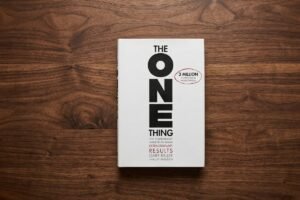
Book review: The One Thing
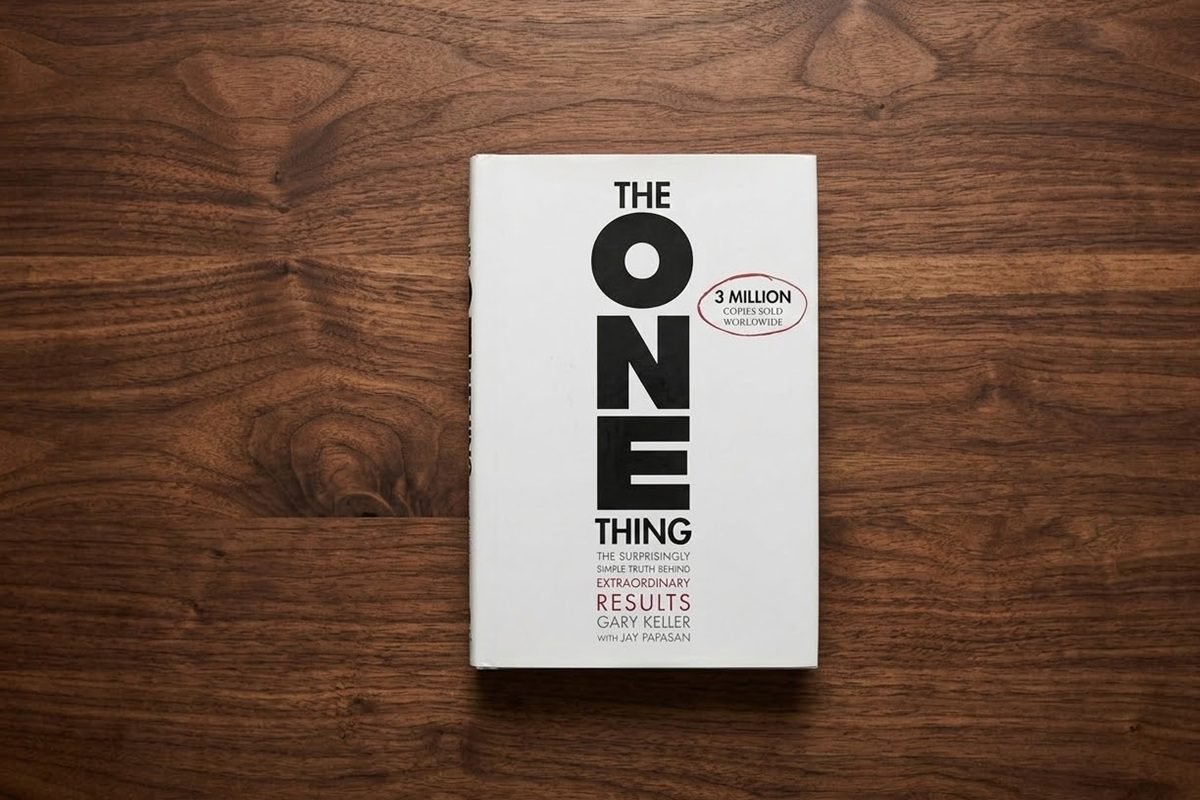
The Surprisingly Simple Truth About Extraordinary Results
By Gary Keller & Jay Papasan
Genres:
- Self-Improvement
- Time management
The year it was published:
2013
Number of pages:
240

As an Amazon Associate, I earn from qualifying purchases.
Table of contents:
Chapter 1: The ONE Thing
Chapter 2: The Domino Effect
Chapter 3: Success Leaves Clues
Part I – THE LIES — They Mislead and Derail Us
Chapter 4: Everything Matters Equally
Chapter 5: Multitasking
Chapter 6: A Disciplined Life
Chapter 7: Willpower Is Always on Will-Call
Chapter 8: A Balanced Life
Chapter 9: Big Is Bad
Part II – THE TRUTH — The Simple Path to Productivity
Chapter 10: The Focusing Question
Chapter 11: The Success Habit
Chapter 12: The Path to Great Answers
Part III – EXTRAORDINARY RESULTS — Unlocking the Possibilities Within You
Chapter 13: Live with Purpose
Chapter 14: Live by Priority
Chapter 15: Live for Productivity
Chapter 16: The Three Commitments
Chapter 17: The Four Thieves
Chapter 18: The Journey
Thoughts about the book:
In the book The One Thing, Gary Keller argues that extraordinary results come from narrowing focus to the most important task at any given moment. Keller’s central question, “What’s the one thing I can do such that by doing it everything else becomes easier or unnecessary?” serves as the backbone of the entire book. What I liked most about the book is its clarity and consistency. The emphasis on prioritization, time blocking, and saying no to distractions is practical and immediately applicable. The many examples from business success to personal productivity help ground the concept in real-life scenarios. The writing style is highly accessible and motivational. The language is everyday, direct, and conversational. It reads like a coaching manual rather than an academic work. In terms of difficulty, it is very easy to read. The structure is straightforward, the chapters are digestible, and the key idea is consistently reinforced. You can move through it quickly, and the simplicity is part of its appeal. However, that simplicity also means the book rarely challenges the reader intellectually. The book is informative in a practical sense as it draws loosely on research in productivity and psychology, but it does not engage deeply with empirical studies or formal theory. The arguments are based more on experience, observation, and logical reasoning than on rigorous scientific validation. The downside of the book is the repetition and narrowness of the central idea. While the “one thing” philosophy is powerful, the book sometimes stretches it across scenarios where nuance might be needed. Real-world productivity often involves balancing multiple priorities, and the book’s focus on singularity can feel slightly idealized. Still, The One Thing succeeds in its primary mission to simplify focusing on the correct thing that will improve your life.
Who should read this book:
If you feel pulled in too many directions, and you always feel busy, productive on the surface, yet unsure if you are making real progress, then the book The ONE Thing by Gary Keller is the one you should pick up, as it will help you cut through that noise with unusual precision. This is a book for people who are searching for focus. Not more tools, not more hacks, but clarity about what truly matters. It speaks to those interested in productivity, success, and personal effectiveness, yet who sense that doing more is not the answer and may, in fact, be the problem. Keller is searching for the principle that drives extraordinary results. His interest lies in the idea that success is not built on balance, multitasking, or constant motion, but on identifying the single most important task, the “one thing” that makes everything else easier or unnecessary. From that insight, he builds a philosophy of prioritization that challenges the modern obsession with doing everything at once. In the book, Gary Keller teaches you how to narrow your focus, align your actions with your highest priorities, and create momentum by consistently working on what matters most. Instead of scattering effort, it shows how concentrated attention produces disproportionate results.
Summary of the book:
Chapter 1: The ONE Thing
Chapter 1 introduces the central idea that extraordinary results come from focusing on one thing that matters most, rather than trying to do everything at once. Gary Keller explains that this insight changed both his business and his approach to work. Early on, his company was struggling despite a lot of effort, until a coach pointed out that instead of fixing many problems, he only needed to solve one, and that is hiring the right people for key roles. Keller stepped away from his CEO duties and focused entirely on finding those hires, and within a few years, the business began growing rapidly. This idea of narrowing focus, what he calls “going small” runs through the chapter. It doesn’t mean other things aren’t important, but that one priority should come first because it makes everything else easier or even unnecessary. Keller began applying this thinking more broadly, asking himself and his team a simple question, what’s the one thing we can do right now that will have the biggest impact? By consistently identifying and acting on that priority, their results improved. The concept is summed up through a reference to the movie City Slickers, where a cowboy says the secret to life is “one thing,” but leaves it up to each person to figure out what that is.
Chapter 2: The Domino Effect
Chapter 2 builds on the idea of focusing on one thing by explaining why it works. Success happens in sequence, not all at once. Instead of trying to tackle everything simultaneously, progress comes from identifying the right first step and taking it. Once that step is completed, it makes the next one easier, and over time, these small, focused actions build into much larger results. Keller compares this to a line of dominoes, where each one knocks over the next. The key is choosing the right first domino, because that’s what sets everything else in motion. This isn’t something life organizes for you, you have to decide each day what action will have the greatest impact and start there. The power of this approach comes from how results compound. Like in experiments where each domino can knock over another one 50% larger, a small starting point can eventually lead to surprisingly large outcomes if the sequence continues. What looks like modest progress at the beginning can grow into something significant, as long as each step builds on the last.
Chapter 3: Success Leaves Clues
Chapter 3 argues that the idea of focusing on one thing isn’t just a strategy, it’s a pattern that shows up again and again in successful people and organizations. Keller’s point is that success leaves clues, and when you look closely, you see that behind most big achievements there’s a clear priority that mattered more than everything else. He illustrates this through examples across business and life. Companies often become known for one defining focus, KFC built its identity around a single chicken recipe, Google around search, and Apple repeatedly centered its success on one key product at a time, from computers to the iPhone. Even something like Star Wars follows the same pattern, where the movies are the core driver that makes everything else, like merchandise, possible. The same principle applies to individuals. Bill Gates’ path can be traced through a chain of focused steps, an early passion for computers, developing programming skills, partnering with the right person, and acting on a single opportunity that led to Microsoft. Keller also shows how this idea can shape a life in more personal ways, like in the story of Gilbert Tuhabonye, whose dedication to running helped him survive a traumatic event and later became the foundation of his career and charitable work. Across all these examples, the message is consistent, success isn’t about doing everything well, but about identifying what matters most and building everything else around it.
Chapter 4: Everything Matters Equally
Chapter 4 challenges the common assumption that everything on your to-do list matters equally. Keller argues that this is one of the biggest mistakes people make, because in reality, a small number of actions drive most results. When you treat all tasks the same, you end up reacting to what feels urgent instead of focusing on what actually moves you forward, leading to a lot of activity but little real progress. This is where the idea behind the 80/20 principle comes in, a minority of efforts produces the majority of outcomes. Whether it’s clients, tasks, or opportunities, a few key inputs tend to generate most of the value. The goal, then, is not to do more, but to identify those high-impact actions and prioritize them. Keller pushes this further by suggesting you keep narrowing your focus, taking a long list, cutting it down step by step, until you’re left with the single most important task. He contrasts this with how most people use to-do lists. While they’re useful for capturing everything you need to do, they often become overwhelming “survival lists” that keep you busy but don’t lead to meaningful results. A better approach is a short, prioritized “success list” built around what matters most. This idea shows up in different contexts. In business, quality expert Joseph Juran built his reputation by identifying the “vital few” causes behind most problems, proving that focusing on the right issues can create an outsized impact. Keller experienced the same principle personally when learning a guitar, focusing on a single scale unlocked a wide range of skills, and when his company brainstormed dozens of growth ideas, narrowing it down to writing one book ended up producing far greater results than spreading effort across many initiatives.
Chapter 5: Multitasking
Chapter 5 argues that multitasking isn’t a strength, it’s an illusion. What we call multitasking is really just rapid task-switching, where the brain jumps back and forth between activities rather than handling them at the same time. Each switch comes with a cost, because the brain has to reset and refocus, which takes time, drains energy, and reduces the quality of work. Keller explains that this habit leads to lower productivity, more mistakes, and higher stress. Instead of getting more done, people who try to juggle multiple tasks end up doing everything less effectively. The problem is that constant switching creates a kind of mental clutter, making it harder to think clearly or stay focused on what matters most. Research supports this. Studies have shown that people who consider themselves good multitaskers actually perform worse when it comes to filtering information, shifting between tasks, and maintaining concentration. The same pattern appears in real-world situations, like driving, where even small distractions significantly reduce attention and increase risk. The broader point is that focus is a limited resource. When it’s divided, performance drops. By contrast, giving full attention to one task at a time leads to better results, less stress, and more meaningful progress.
Chapter 6: A Disciplined Life
Chapter 6 challenges the idea that success requires constant discipline in every area of life. Keller argues instead that you only need enough discipline to build one key habit. Once that habit is established, it begins to run automatically, reducing the need for ongoing effort and making progress much easier to sustain. The focus shifts from trying to be disciplined all the time to being disciplined in the right place. This is what he calls “selected discipline”, choosing the one behavior that matters most and committing to it long enough for it to stick. On average, that process takes about two months, but once the habit is formed, it becomes part of your routine and no longer requires the same level of willpower. An important idea here is that one habit can trigger others. When you consistently follow through on something meaningful, it often creates a ripple effect, improving focus, reducing stress, and influencing other decisions in a positive way. Instead of trying to fix everything at once, you create momentum through a single change. This pattern is reflected in examples like Michael Phelps, who didn’t rely on discipline across every aspect of life, but applied it intensely to one area, swimming. By training every day, even when others rested, he built a consistent habit that gave him a long-term advantage. Over time, that single commitment became the foundation for extraordinary results, showing how focused discipline, applied in the right place, can have an outsized impact.
Chapter 7: Willpower Is Always on Will-Call
Chapter 7 explains that willpower isn’t something you can rely on endlessly, it’s a limited resource that gets used up over the course of the day. Keller compares it to a battery, it starts full in the morning and gradually drains as you make decisions, resist distractions, and deal with stress. As it gets depleted, you’re more likely to fall back on easy, automatic behaviors instead of doing what’s most important. This has a simple but powerful implication, your most important work should happen early, when your willpower is strongest. If you spend that energy on minor tasks or decisions first, you have less left for the one thing that actually matters. Even factors like food play a role, since the brain requires energy to maintain focus and self-control, and when that energy drops, so does your ability to make disciplined choices. Research supports this pattern. In studies like the famous marshmallow experiment, children who were able to delay gratification tended to have better outcomes later in life, showing how self-control compounds over time. Other research, like analyses of judicial decisions, shows that as people become mentally fatigued, they default to the easiest or safest choice rather than carefully evaluating each situation. Even small mental loads like trying to remember more information can reduce self-control and lead to poorer decisions. The overall message is that willpower should be treated as a resource to manage, not something to depend on constantly. By protecting it and using it early on what matters most, you give yourself a much better chance of making meaningful progress.
Chapter 8: A Balanced Life
Chapter 8 challenges the idea that you can keep every part of your life perfectly balanced at all times. Keller argues that this kind of balance isn’t realistic and isn’t even necessary for success. Instead, meaningful progress requires periods of intense focus, where some areas naturally receive less attention while you concentrate on what matters most. The alternative he offersis “counterbalancing.” Rather than trying to divide your time evenly every day, you shift your focus depending on priorities, then adjust before anything important is neglected for too long. In your work, this often means going all in for extended periods to achieve something significant. In your personal life, it means making sure you don’t ignore relationships, health, or well-being for too long, even when work demands more attention. The idea is that life isn’t about holding everything steady, but about constant adjustment. Like someone maintaining balance through small corrections, you move your focus as needed instead of trying to keep everything equal. The chapter also emphasizes the risk of waiting too long to return to what matters. People often assume they can delay personal priorities and make up for them later, but some moments can’t be recovered. Time moves forward whether you’re paying attention or not, so while focus is necessary, it has to be paired with awareness of what can’t be postponed indefinitely.
Chapter 9: Big Is Bad
Chapter 9 challenges the common fear that thinking too big is unrealistic or dangerous. Keller argues that many people unconsciously limit themselves by setting modest goals they believe are more achievable, but in doing so they also limit their potential outcomes. Instead, big goals push people to grow into the kind of person capable of achieving them, making personal development part of the process itself. The chapter’s core idea is that you don’t actually know your limits in advance, so there’s little advantage in aiming low. Smaller goals may feel safer, but they tend to produce smaller results. Larger goals, even if not fully achieved, still raise the ceiling of what you can accomplish because they demand more effort, learning, and adaptability along the way. This is supported by research on mindset. People with a growth mindset tend to take on bigger challenges and recover more effectively from setbacks than those with a fixed mindset, who assume their abilities are limited. The difference in belief shapes the scale of what people attempt and ultimately achieve. Keller also highlights how “big thinking” shows up in real-world success stories. Entrepreneurs like Sabeer Bhatia pursued ambitious ideas long before they had the resources to back them up, while leaders at Apple deliberately built teams around people willing to take on enormous challenges, leading to transformative products like the iPhone. Even outside business, individuals like Ryan Hreljac and Derreck Kayongo show that large goals don’t require large starting resources only a willingness to think beyond immediate constraints.
Chapter 10: The Focusing Question
Chapter 10 introduces the central tool of the entire book, the Focusing Question. Keller argues that the quality of your life depends on the quality of the questions you ask yourself, because the wrong question leads to the wrong actions. The Focusing Question is designed to cut through complexity and consistently point you toward the most important and highest-impact action you can take. The question works in both big and small contexts. On a long-term level, it helps clarify direction in life, while on a daily level, it helps identify exactly what you should be working on next. It can be applied to any area, be it career, health, relationships, or personal goals by narrowing attention to a single, meaningful priority. The question itself is “What’s the ONE Thing I can do, such that by doing it, everything else will be easier or unnecessary?” Each part is intentional. It forces you to choose one action, not many. It requires that the action have a clear cause-and-effect impact, and it acts as a filter to ensure you’re focusing on the task that creates the most leverage. The idea is supported by advice from historical figures who emphasized focus over dispersion. Andrew Carnegie advised concentrating your efforts in one direction rather than scattering them, while Mark Twain highlighted the importance of breaking overwhelming goals into a single starting step. Keller brings these ideas together into a practical daily question that helps you consistently identify where to begin and what matters most.
Chapter 11: The Success Habit
Chapter 11 explains how to turn the Focusing Question into a daily habit that consistently guides your decisions. Keller argues that real success doesn’t come just from knowing the right question, but from using it so often that it becomes automatic. When it becomes part of your routine, it starts to shape what you pay attention to and what actions you take without needing constant effort or reflection. The idea is to apply the question across all major areas of life be it work, health, relationships, finances, and personal growth, so that each area is guided by a clear priority. Instead of trying to improve everything at once, you repeatedly ask what single action in each domain would create the greatest impact or make other actions easier. Over time, this practice becomes more natural. By consistently starting your day with the question and returning to it whenever you need direction, it gradually shifts from a deliberate tool into an instinctive way of thinking. Simple reminders and repetition help reinforce it until it becomes a stable habit, usually over the course of a couple of months. The overall message is that the power of the Focusing Question doesn’t come from using it occasionally, but from making it a default way of thinking, one that keeps bringing you back to what matters most, regardless of distractions or competing demands.
Chapter 12: The Path to Great Answers
Chapter 12 explains that strong questions only produce strong results when they’re paired with strong answers. Keller argues that most people stop at “good enough” answers, but extraordinary results require pushing beyond what you already know and looking for possibilities that stretch your thinking. A key idea in this chapter is that effective goals and questions need to be both big and specific. If a goal is too small, it won’t drive meaningful change, and if it’s too vague, it won’t lead to clear action. The most powerful combination is a goal that is ambitious but also clearly defined, because it forces your thinking to become more focused and creative at the same time. To help structure this thinking, Keller breaks questions into four types based on size and clarity, showing that only big and specific questions reliably lead to breakthrough results. These kinds of questions push you to think beyond incremental improvement and toward meaningful change. Once you have a strong question, the next step is finding a strong answer. Keller suggests two main approaches. First is looking at what the best performers are already doing so you can understand the current standard of excellence. Second is paying attention to where those best practices are evolving so you can anticipate what might work in the future rather than just copying the present. Together, these steps shift problem-solving from routine thinking to intentional exploration, where you’re not just asking what is possible, but what could become possible if you think further ahead.
Chapter 13: Live with Purpose
Chapter 13 explains that everything in life ultimately depends on having a clear purpose. Keller argues that without a sense of why you’re doing something, it becomes impossible to choose priorities, and without priorities, productivity loses direction. Purpose acts as the foundation that gives meaning to decisions and keeps effort aligned over time. At its core, purpose answers the question of why you’re pursuing your goals in the first place. When daily actions are connected to that deeper reason, work and life feel more focused and meaningful. Keller emphasizes that fulfillment doesn’t come simply from achievement or accumulation, but from being engaged in something that feels personally significant. Material gains or accomplishments may bring short-term satisfaction, but they don’t provide lasting direction on their own. He suggests that purpose doesn’t need to be grand or abstract. It can start simply as the one thing you want your life or work to revolve around, and it can be refined as you grow and gain clarity. What matters most is having a “Big Why”, a core reason that motivates action, especially when things become difficult or uncertain. The chapter reinforces this idea through stories that show how purpose shapes behavior and satisfaction. In the example of Ebenezer Scrooge, a life centered on money leads to emptiness, while a shift toward caring for others transforms both his priorities and his sense of happiness. Similarly, the parable of the begging bowl illustrates how endless desire without purpose leads to constant dissatisfaction, because there is no natural limit to what is enough. The overall message is that purpose is what gives direction and limits to ambition. Without it, effort becomes scattered or insatiable, but with it, choices become clearer and life becomes more focused and meaningful.
Chapter 14: Live by Priority
Chapter 14 explains how to turn long-term purpose into concrete daily action through a process Keller calls “Goal Setting to the Now.” The main idea is that big goals only matter if they guide what you do today. Without that connection, even clear ambitions stay abstract and rarely influence behavior. Keller also emphasizes that “priority” was originally meant to be the one most important thing at a given moment. The modern idea of having multiple priorities weakens focus, because at any point in time, there is only one action that matters most. The challenge is identifying and acting on that consistently. The “Goal Setting to the Now” method creates a direct chain from long-term vision to immediate action. You start with a long-term “someday” goal, then work backward step by step: what must happen in five years, this year, this month, this week, today, and ultimately right now. Each level informs the next, ensuring that present actions are always aligned with long-term direction. This process helps counter natural psychological biases. People tend to overvalue immediate rewards and underestimate future benefits, which often leads them to choose short-term comfort over meaningful long-term progress. They also tend to misjudge how much they can realistically accomplish in a given time. Breaking goals down into a step-by-step chain helps correct both of these tendencies by making planning more grounded and action more intentional. Research supports the power of clarity and accountability. Studies show that people who write down their goals and share progress with others are significantly more likely to achieve them. This reinforces the idea that success is not just about setting goals, but about consistently translating them into focused, present-day actions that stay connected to a larger purpose.
Chapter 15: Live for Productivity
Chapter 15 introduces the practical system that supports everything in the book: time blocking. Keller argues that productivity isn’t about working longer hours, but about protecting focused time for your most important work. The key is to deliberately set aside uninterrupted blocks of time for your ONE Thing and treat them as non-negotiable appointments with yourself. He suggests that the most effective approach is to reserve at least four hours each day for deep, focused work, ideally in the morning when energy and willpower are highest. The rest of the day is then used to handle other responsibilities, but the priority work gets the best conditions and attention first. To make time blocking work effectively, Keller outlines three types of blocks. The first is time off, which is scheduled first to ensure rest and recovery are built into life. The second is the ONE Thing block, where you protect your most important daily work. The third is planning time, where you regularly step back to align daily actions with long-term goals. Protecting these blocks requires intentional boundaries. That might mean physically isolating yourself, removing distractions, or clearly communicating availability so others know when you cannot be interrupted. The idea is to create an environment where focus is not constantly under threat. The chapter reinforces this with examples of highly productive individuals who structure their lives around focused time. Writers like Stephen King dedicate consistent morning hours to their craft, showing how routine focus leads to sustained output over decades. Simple systems like Jerry Seinfeld’s “don’t break the chain” method demonstrate how daily consistency builds momentum over time, turning discipline into a habit. Even in workplace settings, people who initially struggle with protected time blocks often find that others adapt quickly, and their productivity rises significantly once uninterrupted focus becomes the norm.
Chapter 16: The Three Commitments
Chapter 16 lays out the mindset required to fully support the habits and systems from the rest of the book. Keller argues that success with the ONE Thing depends not just on tools like time blocking, but on three ongoing commitments that shape how you approach your work and growth. The first is the commitment to mastery. Instead of treating success as a final destination, you treat it as a continuous process of improvement. You keep refining your ONE Thing over time, always trying to get better rather than simply becoming “good enough.” Mastery is built through long-term, deliberate practice, where consistent focus over years leads to expertise. The second commitment is moving from an “E” approach to a “P” approach. The “E” mindset relies on natural talent and effort, while the “P” mindset looks for better systems and methods when progress slows. When results plateau, the goal is not to quit, but to step back, learn, and improve how you’re working so you can keep progressing. The third commitment is accountability. This means taking full responsibility for outcomes rather than blaming circumstances or other people. Setbacks are treated as feedback, not failure, and become information that helps you adjust and improve. These ideas are reinforced through examples that show the difference between people who continue to grow and those who stop. One manager responds to challenges by taking ownership and searching for solutions, while another avoids responsibility and becomes stuck. Similarly, figures like Jigoro Kano, the founder of judo, demonstrate that even at the highest level of achievement, the mindset of a beginner is essential for continued growth. The overall message is that long-term success depends on staying committed to learning, adapting, and owning your results at every stage.
Chapter 17: The Four Thieves
Chapter 17 identifies four common “thieves” that can undermine your productivity even when you know your ONE Thing and have time blocked for it. These aren’t abstract problems, they’re everyday habits and conditions that quietly pull you away from what matters most. The first is the inability to say no. Every yes to something less important is a no to your priority work. Constantly agreeing to requests, meetings, or distractions spreads your attention thin and leads to average results. Protecting your focus requires being selective with your commitments. The second is fear of chaos. When you concentrate deeply on one priority, other areas of life or work can temporarily become messy. Emails pile up, smaller tasks are delayed, and things feel out of control. The key idea is that this disorder is temporary and part of the process of focusing on what matters most, which will eventually resolve the chaos. The third thief is poor health habits. Energy, not just time, determines productivity. Without proper sleep, nutrition, and exercise, your ability to focus and make good decisions drops significantly. Maintaining physical and mental energy is essential for sustaining high performance. The fourth is an unsupportive environment. The people around you and your physical surroundings can either reinforce or undermine your priorities. Negative influences, constant interruptions, and distracting spaces make it harder to stay focused, while supportive people and structured environments make success more likely. To counter these thieves, Keller emphasizes maintaining a daily energy routine that supports all areas of life: spiritual practices like meditation or reflection, physical care through sleep, diet, and exercise, emotional connection with others, mental clarity through planning, and focused execution on your ONE Thing. The examples in this chapter show how powerful these forces are in real life. In one study, even students preparing to help others often failed to stop when they were under time pressure, showing how urgency can override values. In business, leaders like Steve Jobs demonstrated that saying no to hundreds of products was essential to creating focus and success. Research on social networks further shows that the people around you strongly influence your behavior, reinforcing the importance of choosing your environment carefully.
Chapter 18: The Journey
Chapter 18 brings everything in the book together into a simple final message. Live with intention, focus on what matters most, and begin now. Keller emphasizes that extraordinary results don’t come from a single dramatic moment, but from starting with one clear priority and letting progress build step by step over time. Success is created by momentum, one action leading to the next, like a chain of dominoes falling in sequence. A central idea in this chapter is the internal choice between fear and faith. Fear leads to hesitation, avoidance, and inaction, while faith leads to clarity, commitment, and movement forward. The outcome of your life depends largely on which mindset you consistently reinforce through your choices and attention. The chapter closes by focusing on the idea of regret. Reflections from people at the end of life consistently show that the deepest regrets are not about failure, but about inaction, not living authentically, working too much at the expense of relationships, holding back emotions, losing touch with others, and not allowing themselves to be happier. The message is that time and opportunity are finite, and waiting for the “right moment” often leads to missed moments entirely. Two short stories reinforce this idea. In one, a father creates a puzzle from a world map to keep his son busy, only to discover the child quickly solves it by focusing on the image of a person on the other side. The lesson is that when you get the “inner piece” right, your purpose and priorities the external world becomes much easier to organize. In another story, the “two wolves” inside every person represent fear and faith. Whichever one you feed becomes dominant, shaping your actions and ultimately your life. The final takeaway is simple… focus on your ONE Thing, act on it consistently, and choose the mindset that moves you forward rather than holding you back.