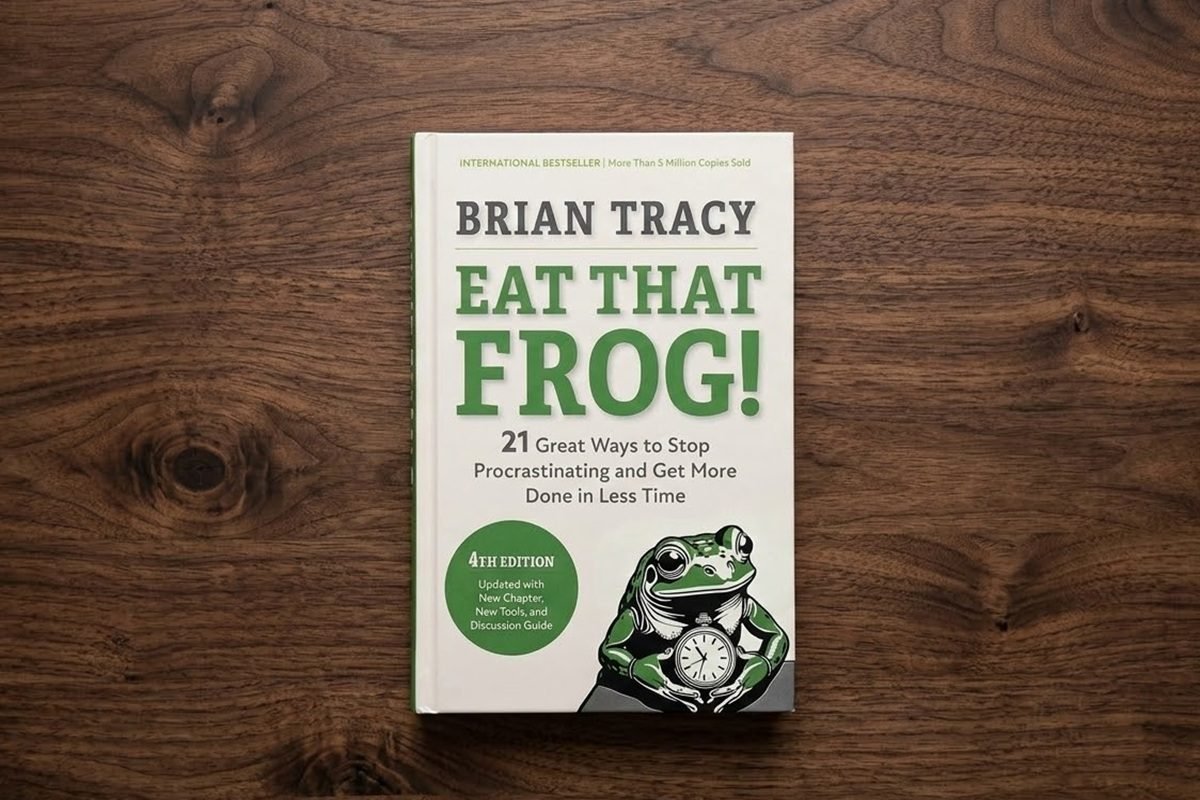
Book review: Eat That Frog!
Fourth Edition: 21 Great Ways to Stop Procrastinating and Get More Done in Less Time
By Brian Tracy
Genres:
- Time management
- Self-Improvement
- Leadership
The year it was published:
2025
Number of pages:
144

As an Amazon Associate, I earn from qualifying purchases.
Table of contents:
Chapter 1: Set the Table
Chapter 2: Plan Every Day in Advance
Chapter 3: Apply the 80/20 Rule to Everything
Chapter 4: Consider the Consequences
Chapter 5: Practice Creative Procrastination
Chapter 6: Use the ABCDE Method Continually
Chapter 7: Focus on Key Result Areas
Chapter 8: Apply the Law of Three
Chapter 9: Prepare Thoroughly Before You Begin
Chapter 10: Take It One Oil Barrel at a Time
Chapter 11: Form New Habits, Become a New Person
Chapter 12: Upgrade Your Key Skills
Chapter 13: Identify Your Key Constraints
Chapter 14: Put the Pressure on Yourself
Chapter 15: Motivate Yourself into Action
Chapter 16: Make Technology Work for You
Chapter 17: Focus Your Attention
Chapter 18: Slice and Dice the Task
Chapter 19: Create Large Chunks of Time
Chapter 20: Develop a Sense of Urgency
Chapter 21: Single Handle Every Task
Thoughts about the book:
At its core, Eat That Frog! is about prioritization and discipline. The central metaphor is simple, if you start your day by “eating a frog” which is doing your most difficult, important task first, everything else becomes easier. Tracy builds from this idea into a set of 21 practical strategies for overcoming procrastination, improving focus, and maximizing productivity. What I liked most about the book is its clarity and simplicity. Tracy does not attempt to impress with complexity. Instead, he focuses on direct, actionable advice for example, to plan your day in advance, apply the 80/20 rule, break large tasks into smaller steps, and consistently tackle high-value activities first. The book is structured in short chapters, each centered on a single principle, which makes it easy to absorb and apply. The writing style is extremely accessible. Tracy uses everyday language, motivational tone, and straightforward explanations. There is no academic density, no theoretical abstraction, and very little jargon. It reads like a personal coach speaking directly to the reader. This makes the book highly approachable, especially for those new to productivity systems or self-management literature. In terms of difficulty, it is very easy to read. The ideas are simple, clearly stated, and frequently repeated for reinforcement. You can move through the book quickly, and many readers will find themselves immediately applying its suggestions rather than analyzing them deeply. The book is informative in a practical sense, but it is not scientific in any rigorous way. Tracy does not rely on behavioral research, controlled studies, or formal psychological theory. Instead, the advice is based on professional experience, observation, and widely accepted productivity principles. The lack of academic grounding is not necessarily a weakness, but it does mean the book functions more as a guide than an evidence-based analysis. If there is something bad to say about the book, it is the simplicity itself. For experienced readers of productivity literature, many of the ideas will feel familiar. Actions like prioritization, time management, focus on high-value tasks, and avoiding distraction are things that are discussed in almost every time management books.
Who should read this book:
Eat that frog! by Brian Tracy is for people who are searching for control over their time and clarity in their priorities. It speaks to those who are interested in productivity, time management, and personal effectiveness, but who are tired of complex systems that still leave them overwhelmed. At its core, it is for anyone who suspects that the real problem is not lack of time, but avoidance of what matters most. Tracy is searching for simplicity in execution. His focus is on identifying the small number of high-impact tasks that drive results and building the discipline to face them first. The “frog” in the title is the hardest, most important task of your day, and his argument is simple, if you tackle that first, everything else becomes easier or less necessary. What this book offers is not theory, but behavioral clarity. It helps you understand why procrastination happens, how priorities get distorted by urgency, and how small shifts in discipline can produce disproportionate results over time. The methods are direct, structured, and intentionally uncomplicated. Reading Eat That Frog! is an invitation to stop negotiating with distraction and start building a habit of decisive action. For readers who value productivity not as busyness, but as meaningful progress, this book provides a clear, practical way to regain focus and momentum in both work and life.
Summary of the book:
Preface & Introduction
Brian Tracy’s main idea is simple, success comes from focusing on your most important task and finishing it. He calls this your “frog” the task you’re most likely to avoid, but that has the biggest impact. If you do it first each day, everything else feels easier. He emphasizes that you’ll never get everything done, so the goal isn’t to be busy but to work on what truly matters. Many people stay stuck doing easy, low-value tasks while avoiding the difficult ones that actually drive results. To change that, you need a clear decision to improve, the discipline to act, and the determination to keep going until it becomes a habit. Completing important tasks also reinforces this behavior, since your brain rewards you with a sense of satisfaction. Tracy’s own story reflects this approach. Starting with a few advantages, he improved by copying the habits of top performers. By consistently focusing on the right tasks, he quickly rose from struggling salesman to leading a large team. His message is that success isn’t about talent, it’s about doing the right things consistently.
Chapter 1: Set the Table
Productivity starts with clarity. If you’re not clear about what you want, it’s easy to procrastinate or stay busy with things that don’t matter. When your goals are specific and written down, your mind naturally starts focusing on how to achieve them. Tracy emphasizes thinking on paper. Most people keep goals in their heads, which keeps them vague, but writing them down turns them into a real commitment. People who do this consistently tend to achieve far more than those who don’t, even with similar abilities. He outlines a simple process in which you first have to decide exactly what you want, write it down, set a deadline, list the steps, organize them into a plan, start immediately, and then make daily progress. The key isn’t perfection, it’s momentum and consistency. This works because written goals give your mind direction. Like a built-in GPS, they guide your choices and keep you focused. When you review them regularly, you start each day with clarity and a stronger sense of purpose, making it easier to follow through on what matters most.
Chapter 2: Plan Every Day in Advance
Planning your day in advance is one of the simplest ways to become more productive. Even a few minutes of planning the night before can save hours the next day by reducing confusion and wasted effort. In fact, this small habit can significantly increase your output because it keeps you focused on what matters instead of constantly deciding what to do next. The idea is that planning has an extremely high return. A short amount of time spent organizing your day can save you far more time later by preventing distractions and indecision. It’s one of the most efficient uses of time you can make. Tracy suggests working with four levels of lists. A master list captures everything you might need to do in the future. From that, you create a monthly list, then a weekly list, and finally a daily list that becomes your clear plan for the next day. This daily list is especially important because it turns your intentions into a concrete set of actions, and checking off tasks creates momentum and motivation as you progress. This works because writing tasks down removes mental clutter and makes it easier to focus. Each completed task also gives a small sense of reward, which builds energy and keeps you moving forward. In practice, people who plan this way tend to perform better even if they aren’t the most skilled. A simple example is a manager who spent a short time each week planning ahead and ended up consistently outperforming more talented colleagues who worked without structure. With his week already organized, he started each day with clarity instead of reacting to problems.
Chapter 3: Apply the 80/20 Rule to Everything
The 80/20 Rule, or Pareto Principle, says that a small number of actions create most of your results. In many cases, about 20% of what you do is responsible for 80% of your outcomes. This means a few key tasks matter far more than everything else on your list. This pattern shows up everywhere like for example, a small portion of customers generates most sales, a small number of products produce most profit, and a small set of tasks creates most of your value. The challenge is that people often ignore these high-impact tasks because they are harder, and instead spend time on easier, less important work. That leads to the common trap of feeling busy but not being effective. It’s easy to fill your day with emails, small tasks, and meetings, but still avoid the few actions that actually move your goals forward. Time management, in this sense, is really about choosing what to do next and prioritizing correctly. To apply this idea, you simply review your task list and ask which one or two items would make the biggest difference if completed today. Those are your most important tasks, and they should come first. Everything else is secondary and can often be delayed or removed. A typical example is a manager who worked long hours and stayed constantly busy but failed to perform well because most of his time went to low-value tasks. He focused on routine work instead of the few responsibilities that truly defined his role, such as leading his team and closing major deals. As a result, he was seen as hardworking but not effective.
Chapter 4: Consider the Consequences
The key idea in this chapter is that every task should be judged by its long-term consequences. Important tasks are the ones that significantly affect your future, while low-value tasks have little lasting impact. The simplest way to decide what matters is to ask what difference it will make in a month, a year, or longer if you do it or don’t do it. Research by Dr. Edward Banfield at Harvard supports this idea. He found that the strongest predictor of long-term success is having a long-term perspective. People who regularly think ahead and make decisions based on future outcomes tend to outperform those who focus only on immediate comfort or short-term results. This connects to what Tracy calls the law of forced efficiency, where you never have time for everything, but you always have time for what is truly important. When something becomes urgent, you find a way to do it, so the goal is to treat important tasks as urgent before they become crises. To apply this thinking, there are three useful questions. First, ask what your highest-value activities are, those that contribute the most to your goals and responsibilities. Second, ask what only you can do that would make the biggest difference, since some tasks cannot be delegated or ignored. Third, continually ask what the most valuable use of your time is at any given moment, especially when deciding what to do next. The difference between effective and ineffective people often comes down to this mindset. Some choose activities that provide short-term comfort, like distractions or minor tasks, while others consistently choose the actions that move their goals forward, even when they are difficult. A simple example is a salesperson who prioritizes making calls early in the day despite discomfort, while others avoid them and stay busy with easier tasks. Over time, the one focused on high-impact actions consistently achieves better results.
Chapter 5: Practice Creative Procrastination
The key idea here is that you will always procrastinate on something, so the real skill is deciding what to delay or eliminate. Instead of trying to do everything, you deliberately put low-value tasks aside so you can focus on what matters most. This is what Tracy calls creative procrastination. To do this well, you need to think in terms of both priorities and “posteriorities.” Priorities are the tasks you choose to do first and focus on more. Posteriorities are the tasks you intentionally do later, less often, or not at all. Progress comes not just from adding important work, but from removing or delaying unimportant work. A key part of this is learning to say no. Many people overcommit by saying yes to requests that don’t really matter. But every time you agree to something unimportant, you reduce the time and energy available for things that truly do. Even successful people rely heavily on saying no to protect their focus. Another useful tool is zero-based thinking, where you ask whether you would still choose to do a task or commitment if you were starting fresh today. If the answer is no, then it’s a sign you should stop or reduce it. This helps you clear out old habits and obligations that no longer make sense. A simple example is someone who enjoyed golf and played frequently, but kept the same habit after taking on a demanding job and family responsibilities. As the pressure built, he realized the activity was taking time from what mattered more. By cutting back to once a week, he didn’t give up golf, but he stopped letting it interfere with his work and relationships, and everything else improved as a result.
Chapter 6: Use the ABCDE Method Continually
The ABCDE Method is a simple way to prioritize your work so you always focus on what matters most. Before starting your day, you label every task as A, B, C, D, or E, and then you work strictly in order, starting with A-1 before anything else. A tasks are the most important and come with real consequences if they are not done. If you have more than one, you rank them in order of importance and always start with the highest. B tasks are useful but not critical, and should never be done while an A task is still unfinished. C tasks have little to no impact either way and are mostly optional or routine activities that don’t move your goals forward. D tasks are things you should delegate whenever possible so you can free up time for higher-value work. E tasks are those that add no real value at all and should be eliminated completely, even if they are habitual. The method works because it forces clarity. Instead of vaguely deciding what feels important in the moment, you are required to evaluate every task in advance. Most people naturally avoid the hardest tasks, but this system removes that option by making priorities explicit and guiding you to start with what truly matters. In practice, this often leads to a major increase in productivity because it reduces hesitation and prevents time from being spent on lower-value work before the most important tasks are completed.
Chapter 7: Focus on Key Result Areas
Every job can be broken down into a small number of Key Result Areas, usually five to seven, which are the core outcomes you are responsible for delivering. These are the things that truly define success in your role, and if you are weak in even one of them, it limits your overall performance no matter how strong you are in the others. This is based on the idea that performance works like a chain it is only as strong as its weakest link. You might excel in most parts of your job, but if one essential area is weak, it becomes the bottleneck that holds everything else back. To improve, you first need to clearly identify your Key Result Areas and then honestly assess how well you are performing in each one. Once you see where your weakest area is, that becomes your priority for improvement. Tracy suggests asking a simple but powerful question what one skill, if improved, would make the biggest positive difference in your career? Focusing on that skill often leads to the fastest growth. A major reason people procrastinate is that they avoid tasks where they feel unskilled or uncertain. Instead of avoiding those areas, the solution is to improve competence. As you get better at something, it becomes easier and more enjoyable, and procrastination naturally decreases. For example, in management, delegation is often a key result area. A manager may be strong in planning or communication, but if they cannot delegate properly, they end up overloaded and limit what their team can achieve. Improving that one skill can unlock the performance of everything else they are already good at.
Chapter 8: Apply the Law of Three
The Law of Three says that a very small number of activities, usually three, create most of the value you contribute in your job. In many cases, these three tasks account for around 90% of your results, while everything else is supporting work that can often be delegated, reduced, or eliminated. To find your top three, you simply ask which single activity produces the most value in your role. Then you repeat the question to identify the next two most important tasks. These become your core focus, and everything else becomes secondary. The idea is that productivity isn’t about doing more tasks, but about doing the right few tasks consistently well. When you focus on your highest-value activities, you often get better results in less time, rather than working longer hours on lower-impact work. Tracy also emphasizes that the purpose of being more efficient at work is not to increase workload, but to free up time for life outside of work. Most long-term happiness comes from relationships, so the goal is to work in a way that allows you to be more present at home. An example from the book illustrates this clearly. A client who was overwhelmed with long hours identified her three most valuable tasks and focused her role around them, delegating the rest. After aligning her work this way, she significantly increased her output, doubled her income, and reduced her working hours, allowing her to spend more time with her family.
Chapter 9: Prepare Thoroughly Before You Begin
The main idea is that starting is often the hardest part of any important task, and good preparation removes much of that resistance. When you set everything up in advance your workspace, materials, and first step you make it much easier to begin and stay focused. Simple environmental changes make a big difference. A clear desk with only what you need for the task, along with all required documents and tools ready, signals to your brain that it’s time to work. Even small details like lighting and posture help shift your mindset into action mode. Tracy also stresses not waiting for perfect conditions. Getting something roughly right and improving it as you go is far more effective than delaying action in search of perfection. Starting imperfectly is still progress, while waiting is just procrastination. Your physical posture also influences your mental state. Sitting upright and adopting a confident, engaged posture can help you think and behave more productively, making it easier to stay focused once you begin. The importance of preparation is illustrated with a historical example from the planning of the D-Day invasion. While the final plan changed in execution, the real value came from the preparation process itself, which forced careful thinking, resource gathering, and problem-solving ahead of time. In the same way, thorough preparation before starting any task makes execution smoother and more effective, even when things don’t go exactly as expected.
Chapter 10: Take It One Oil Barrel at a Time
The key idea is that big goals don’t need to be seen or solved all at once. You only need to focus on the next small step. When a task feels overwhelming, breaking it down into simple, manageable actions makes it easier to start and continue. Tracy uses the example of crossing the Sahara Desert, where travelers couldn’t see the full route ahead. Instead, they only needed to reach the next oil barrel placed within sight. Each barrel made the journey manageable, because the focus was never on the entire distance, only the next short segment. Progress came from repeatedly reaching one point and then the next. The same principle applies to any large project, whether it’s building a career, finishing a degree, or creating something new. Instead of trying to plan or control everything at once, you simply identify the smallest possible next action and complete it. Once that step is done, the next one becomes clear. Over time, this creates momentum. Small, consistent actions build on each other, making even large goals achievable. Most major achievements in life are not the result of one big effort, but of many small steps taken steadily over time.
Chapter 11: Form New Habits, Become a New Person
The main idea is that your habits shape almost everything in your life, your health, income, relationships, and performance. The encouraging part is that habits are learned, which means they can also be changed. Once a habit is formed, it becomes automatic, so the goal is to deliberately build better ones that eventually run on autopilot. Tracy explains that building a new habit requires intention and repetition. It starts with clearly deciding what you want to change and believing you can actually do it. Writing the habit down as if it’s already part of your identity helps reinforce it, along with identifying the benefits so you stay motivated. It also helps to understand your current starting point, set a clear deadline, and break the process into measurable steps. A key part of success is anticipating obstacles in advance and planning how to deal with them. Support from others also helps, especially when you make your commitment known. From there, the focus is on action starting immediately, staying consistent, and reinforcing the behavior through daily repetition and visualization. Most importantly, you commit in advance not to quit, even when it becomes difficult. The chapter emphasizes that progress doesn’t come from dramatic change, but from small, repeated actions over time. New habits gradually replace old ones through consistency, usually over a few weeks of daily practice. The idea of “just for today” makes it easier to stay on track by focusing only on the present day rather than the entire journey.
Chapter 12: Upgrade Your Key Skills
A major cause of procrastination is a lack of skill. When you don’t feel confident in a task, you tend to avoid it. The solution is to improve your ability until the task feels manageable. As your skill increases, your fear and hesitation decrease, and the work becomes easier to start and complete. This creates a direct link between competence and productivity. The better you become at something, the less you delay it, and the more naturally you engage with it. For this reason, continuous learning is essential in any field where you want to succeed. Tracy suggests three simple ways to build expertise. First, read regularly in your field so your knowledge steadily compounds over time. Second, attend courses or seminars to deepen understanding and stay current with new ideas. Third, use otherwise idle time, such as driving, to learn through audio programs, turning everyday moments into learning opportunities. The idea is reinforced by Tracy’s own experience. When he began writing, he was a slow typist, which made the task feel overwhelming. Instead of avoiding it, he committed to practicing typing every day for a short period. Within a few months, he became fast and efficient, which allowed him to write and publish extensively. A single improved skill opened the door to long-term productivity and success. Overall, the chapter shows that upgrading your skills is one of the most effective ways to reduce procrastination and increase confidence.
Chapter 13: Identify Your Key Constraints
Between you and any goal, there is usually one main bottleneck that slows everything down. This limiting factor is the weakest point in the system, and improving it often produces a much bigger impact than working on anything else. A constraint can take many forms. In business, it might be pricing, marketing, production speed, or delivery. For an individual, it could be a missing skill, a habit, a mindset issue, or a personal limitation. The key is that it is usually just one main factor at any given time that matters most. Tracy applies the 80/20 principle to this idea by pointing out that most constraints are internal rather than external. In other words, the biggest things holding people back are usually within their own habits, skills, or thinking. This means progress often starts with taking responsibility and looking inward rather than blaming outside circumstances. To find your constraint, you break your process into steps and ask which single part, if improved, would create the biggest overall improvement. That becomes your focus. Most people fail here because they spread their effort across everything instead of targeting the one bottleneck that actually limits results. A business example shows the importance of this thinking. A company experiencing declining sales assumed the problem was poor performance from their sales team and invested heavily in training and restructuring. The real issue turned out to be incorrect pricing caused by an earlier mistake. Once that was fixed, performance improved quickly. The lesson is that solving the wrong problem is costly, so identifying the real constraint is essential before taking action.
Chapter 14: Put the Pressure on Yourself
The main idea is that high performers don’t wait for external pressure to get things done, they create it themselves. Instead of relying on managers, deadlines, or urgency from others, they set their own standards and hold themselves accountable. Tracy points out that only a small group of people can consistently work well without supervision. These are the individuals who naturally take ownership of their responsibilities and behave like leaders. The important point is that this is not an innate trait but something that can be developed through practice and discipline. A key advantage of this mindset is reputation. People who consistently deliver high-quality work quickly become known as reliable and capable. This reputation leads to greater trust, more responsibility, and better opportunities. It is built simply by repeatedly doing what you say you will do, often sooner and better than expected. One way to build urgency internally is to create imaginary deadlines. For example, if you suddenly had to leave for a month starting tomorrow, you would immediately see which tasks truly matter. This mental exercise helps strip away distractions and reveals your real priorities, making it easier to focus and act without delay.
Chapter 15: Motivate Yourself into Action
The main idea is that motivation is something you generate yourself. No one else can consistently give it to you, so your ability to manage your inner dialogue becomes a key driver of productivity and performance. Tracy explains that most people have a naturally negative internal voice, often doubting their abilities or focusing on difficulty and failure. This kind of self-talk drains energy and reduces confidence. High performers deliberately replace it with more constructive and positive statements that support action and momentum. A key influence on performance is optimism. Research shows that optimists consistently achieve better results in many areas of life. They tend to look for something useful in setbacks, focus on what can be done rather than what went wrong, and keep their attention on goals and future possibilities instead of past mistakes. This mindset helps them recover faster and stay engaged even when things go wrong. Another important habit is avoiding complaints. Complaining reinforces a negative focus and keeps attention on problems rather than solutions. It also tends to attract more negativity and discourages productive thinking. High performers instead direct their energy toward solving problems and moving forward. Overall, the chapter emphasizes that changing how you think and talk to yourself is one of the most direct ways to change how you act.
Chapter 16: Make Technology Work for You
The main idea is that technology should support your work, not control it. When used intentionally, it can improve productivity and organization, but when used passively, it becomes a constant source of distraction that fragments attention and reduces deep focus. A major issue is smartphone overuse. Many people check their phones dozens of times a day, often without realizing it. This constant checking trains the brain to expect frequent stimulation, which makes it harder to concentrate for long periods on meaningful work. This behavior is partly driven by dopamine, the brain’s reward chemical. Each notification or message creates a small reward, which reinforces the habit of checking your phone again and again. Over time, this can become a cycle that resembles mild addiction and steadily reduces focus and productivity. To counter this, Tracy suggests setting clear rules for technology use. Email should be checked at specific times rather than constantly throughout the day, which alone can save significant time and mental energy. Digital environments should also be simplified by turning off notifications and closing unnecessary apps when working. In addition, focused work should be scheduled in advance, treating it like an important appointment that cannot be interrupted. A practical example shows the impact of these changes. An executive overwhelmed by constant email interruptions shifted to processing messages in batches at set times and eliminated low-value communication. By regaining control over when he engaged with technology, he moved from a reactive, distracted work style to a focused and structured one, significantly improving his productivity and reducing stress.
Chapter 17: Focus Your Attention
The main idea is that high performance depends on sustained focus. Every interruption, even a small one like a notification, breaks your concentration and pulls you out of a deep mental state. Getting back into full focus can take around 15–20 minutes, so frequent interruptions dramatically reduce real productivity. This is why multitasking doesn’t actually work. What people call multitasking is really rapid switching between tasks. Each switch comes with a cost of lost time, reduced accuracy, and mental fatigue. Over time, this constant shifting makes it harder to do deep, meaningful work. One of the most damaging habits is checking email or messages first thing in the morning. It immediately puts you into reactive mode, where you respond to other people’s priorities instead of focusing on your own most important task. Tracy recommends delaying email until after you’ve completed your first major piece of work. To improve focus, he suggests structuring your day around uninterrupted work blocks. A simple approach is to begin the day by identifying your most important task, then working on it for a long, focused period without distractions. After a break, you repeat the process with another key task. Only after this focused work do you check messages or emails. This method works because it protects your attention during the most productive part of the day. By reducing interruptions and avoiding constant task switching, you preserve mental energy and significantly increase both output and quality of work.
Chapter 18: Slice and Dice the Task
A major reason people procrastinate is that tasks look too big at the start. The solution is to break them down into very small, manageable pieces and focus only on the next step. Once you start, it becomes much easier to continue. One way to do this is the “salami slice” approach. Instead of trying to complete an entire project, you break it into many small steps and complete just one at a time. You don’t think about the whole task, only the next small slice that can be finished right now. Another approach is the “Swiss cheese” method, where you don’t aim to complete anything specific at first. Instead, you simply work on the task for a short, fixed amount of time, even just a few minutes. This lowers resistance because the goal is only to begin. Often, once you start, you naturally continue beyond the planned time. This works because of the Zeigarnik effect, which is the tendency for the mind to stay focused on unfinished tasks. Once you begin something, your brain creates a natural pull to complete it, which helps carry you forward. A simple example is writing. Many authors avoid big writing goals, so instead they commit to writing just a small amount each day, like a page or even a paragraph. Over time, these small, consistent efforts build into a finished book without the pressure of tackling it all at once.
Chapter 19: Create Large Chunks of Time
The main idea is that meaningful work requires uninterrupted time. Most important tasks can’t be completed in short gaps between meetings or with constant interruptions. When your day is broken into small fragments, you spend more energy restarting your focus than actually doing the work. Deep, high-quality work only happens when you have sustained periods of concentration. That’s why successful people deliberately schedule large blocks of time for their most important tasks and protect them as seriously as any other commitment. To do this, you set aside specific blocks in your calendar, typically one to three hours, and treat them like fixed appointments. During these periods, you remove distractions completely by turning off notifications, avoiding email, and focusing only on one key task. Tracy also points out that early mornings or quiet environments at home can be especially productive because they reduce interruptions. Similarly, travel time or waiting periods can be used effectively if you prepare in advance and use them for focused work instead of passive activities. Even small gaps in the day can be valuable if used intentionally. Short waiting periods or transitions between meetings can be used to complete small parts of larger tasks, which gradually adds up to significant progress over time. Overall, the chapter emphasizes that productivity improves dramatically when you protect and intentionally structure your time into longer, focused blocks instead of relying on scattered moments.
Chapter 20: Develop a Sense of Urgency
High performers stand out because they act quickly. They don’t wait for motivation or perfect conditions, they start fast, keep moving, and finish what they begin. This sense of urgency isn’t natural talent, it’s a habit that can be developed. When you focus deeply on important work, you can enter a mental state called flow, where everything feels easier and more automatic. In this state, you work faster, make fewer mistakes, and often produce higher-quality results. The key to reaching it is starting quickly and staying engaged without unnecessary breaks. Momentum plays a big role in productivity. Getting started is the hardest part, but once you begin, continuing becomes easier. Each productive session builds on the last, making future work feel less difficult. For this reason, the best approach is to start immediately, even if the first step is imperfect, and keep moving forward. Tracy also suggests using simple mental triggers like “do it now” to overcome hesitation. These phrases help interrupt procrastination and shift your attention back to action before delay takes over. Over time, people who consistently act quickly and deliver results develop a reputation for speed and reliability. In any field, this combination of fast execution and strong performance leads to greater trust, responsibility, and opportunity.
Chapter 21: Single Handle Every Task
The main idea is that once you start your most important task, you should continue working on it without stopping until it is fully finished. This approach, called single handling, reduces wasted time and can significantly speed up completion because it eliminates constant interruptions and restarts. Each time you stop and return to a task later, you lose time re-reading, re-focusing, and rebuilding momentum. These repeated restarts add up and can make a task take far longer than necessary. In contrast, working on a task continuously allows you to build momentum, improve focus, and become more efficient as you progress. As you stay with a task, your performance naturally improves during that session. But if you break away, you lose that progress and have to start over. For this reason, sticking with one task until it is complete is one of the most effective ways to increase productivity. Tracy emphasizes that self-discipline is at the core of this habit. The ability to do what needs to be done regardless of how you feel is what separates high performers from everyone else. Each time you stay focused and finish a task without distraction, you strengthen this discipline. A simple example comes from work studies showing that completing one task or unit from start to finish is more efficient and produces better results than switching between multiple partial tasks. Focused, continuous effort builds skill and speed, while scattered attention slows everything down. Overall, the chapter concludes that productivity improves dramatically when you commit to finishing what you start without interruption, making single handling the foundation of high performance.