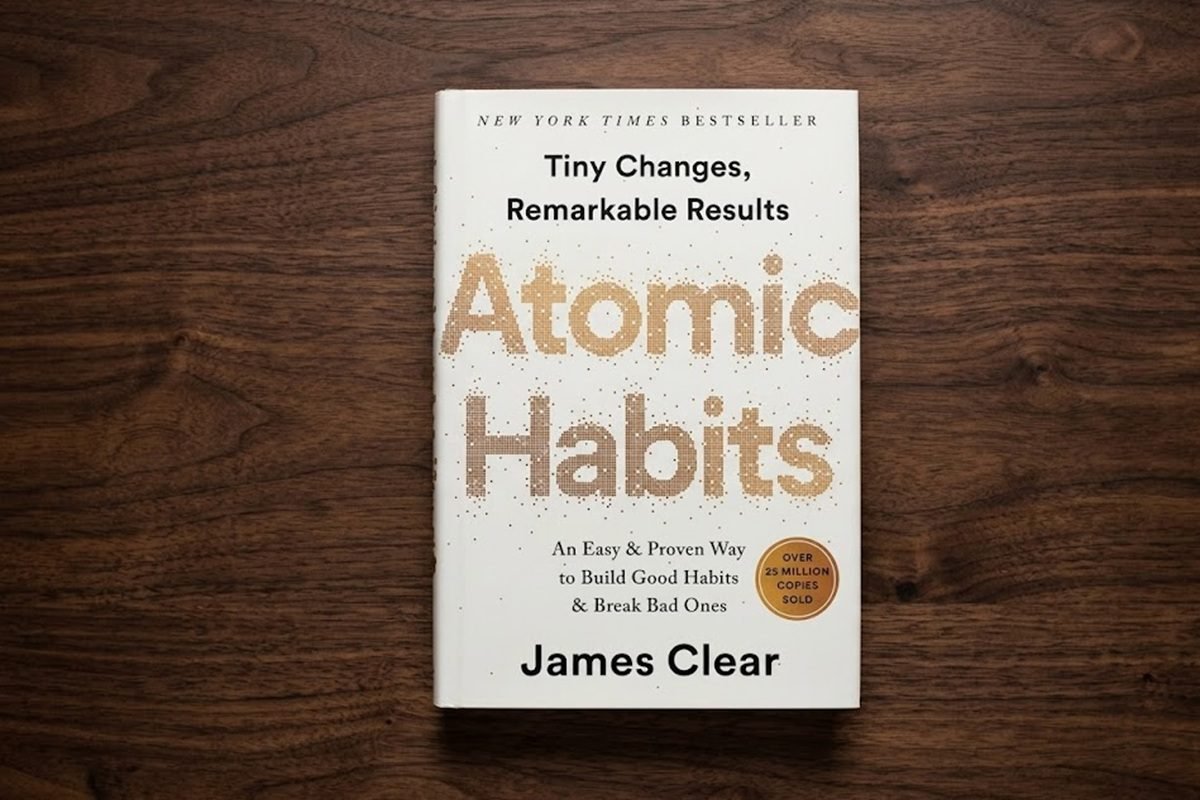
Book review: Atomic Habits
An Easy & Proven Way to Build Good Habits & Break Bad Ones
By James Clear
Genres:
- Self-Improvement
- Social Psychology
The year it was published:
2018
Number of pages:
320

As an Amazon Associate, I earn from qualifying purchases.
Table of contents:
Introduction: My Story
Part I – The Fundamentals: Why Tiny Changes Make a Big Difference
Chapter 1: The Surprising Power of Atomic Habits
Chapter 2: How Your Habits Shape Your Identity (and Vice Versa)
Chapter 3: How to Build Better Habits in 4 Simple Steps
Part II – The 1st Law: Make It Obvious
Chapter 4: The Man Who Didn’t Look Right
Chapter 5: The Best Way to Start a New Habit
Chapter 6: Motivation Is Overrated; Environment Often Matters More
Chapter 7: The Secret to Self-Control
Part III – The 2nd Law: Make It Attractive
Chapter 8: How to Make a Habit Irresistible
Chapter 9: The Role of Family and Friends in Shaping Your Habits
Chapter 10: How to Find and Fix the Causes of Your Bad Habits
Part IV – The 3rd Law: Make It Easy
Chapter 11: Walk Slowly, but Never Backward
Chapter 12: The Law of Least Effort
Chapter 13: How to Stop Procrastinating by Using the Two-Minute Rule
Chapter 14: How to Make Good Habits Inevitable and Bad Habits Impossible
Part V – The 4th Law: Make It Satisfying
Chapter 15: The Cardinal Rule of Behavior Change
Chapter 16: How to Stick with Good Habits Every Day
Chapter 17: How an Accountability Partner Can Change Everything
Part VI – Advanced Tactics: How to Go from Good to Truly Great
Chapter 18: The Truth About Talent
Chapter 19: The Goldilocks Rule: How to Stay Motivated
Chapter 20: The Downside of Creating Good Habits
Conclusions: The Secret to Results That Last
Thoughts about the book:
At its core, James Clear argues that meaningful change does not come from dramatic transformations, but from small, consistent improvements compounded over time. Clear’s central thesis is simple yet powerful, which is that you do not rise to the level of your goals but you fall to the level of your systems. Habits, not motivation or willpower, are the true drivers of long-term outcomes. What I liked most about the book is its structure and clarity. The author organizes the material around a coherent framework that instructs you to make your new habit obvious, attractive, easy, and satisfying. This structure gives the book a strong sense of order and makes it highly usable. The numerous examples, from athletes to entrepreneurs to everyday routines, help translate abstract behavioral principles into concrete actions. The writing style is simple, precise, and avoids unnecessary complexity, so it is very easy to read. The chapters are short, well-structured, and designed for incremental learning. The book is informative and grounded in behavioral science, but it is not deeply scientific in an academic sense. Clear draws on psychology research, particularly habit formation studies, cognitive behavioral principles, and environmental design, but presents them in a simplified, application-focused way. The science supports the framework, rather than dominating the narrative. One of the downsides of the book is that the framework is powerful, but it can feel overly universal, as if all behavior change neatly fits into four laws. Human psychology is more complex and context-dependent than the model sometimes suggests. Additionally, seasoned readers of productivity literature may find some ideas familiar, though perhaps more clearly organized here than elsewhere. Still, Atomic Habits succeeds remarkably well in its purpose to distill behavioral science into a practical system that is easy to understand and apply. It does not aim to be revolutionary in theory, but rather transformative in practice, and to its readers it offers a simple, repeatable system for improving behavior one small step at a time.
Who should read this book:
If you have ever felt that real change should be simple but somehow never is, then Atomic Habits by James Clear is a book that speaks directly to that gap between intention and execution. This is a book for readers who are searching for consistency. Not a dramatic transformation, but reliable progress. It is especially relevant for those interested in productivity, self-improvement, health, and performance, but who find that motivation fades, systems collapse, and good intentions rarely survive contact with daily life. Clear is searching for the mechanics of lasting behavior change. His focus is on how habits are formed, how they are reinforced, and most importantly, how they can be redesigned. Instead of relying on willpower or inspiration, he breaks behavior down into small, repeatable units that compound over time. His core idea is deceptively simple, and that is that you do not rise to the level of your goals, you fall to the level of your systems. What this book helps you do is shift from thinking in terms of outcomes to thinking in terms of identity and systems. It shows how tiny changes in what James Clear calls “atomic habits” can accumulate into significant transformation when structured correctly. The emphasis is not on doing more, but on making better actions easier and bad habits harder. Reading Atomic Habits is an invitation to stop relying on bursts of motivation and start building an environment where good behavior becomes automatic. For anyone who wants lasting change without constant struggle, this book offers a clear, practical, and deeply usable framework for making progress inevitable rather than accidental.
Summary of the book:
Introduction: My Story
James Clear opens with a personal experience that shaped his ideas about habits. In high school, he was seriously injured when a baseball bat struck his face, leaving him with multiple fractures, a brain injury, and requiring a long hospital recovery that included a medically induced coma. The aftermath was difficult as he dealt with vision problems, lost basic physical abilities for a time, and spent months relearning everyday skills. When he eventually returned to baseball, he was cut from the varsity team and barely played, which felt like a major setback at the time. Instead of letting that define him, he focused on rebuilding his life through small, consistent improvements. When he started college at Denison University, he committed to simple daily habits like sleeping early, keeping his space organized, training regularly, and studying steadily. Over time, these small routines added up in a powerful way. He eventually became the university’s top male athlete and earned a spot on the ESPN Academic All-America Team, an honor given to only a small number of student-athletes nationwide. His experience leads to the main idea of the book, which is that meaningful change doesn’t come from sudden breakthroughs, but from small habits repeated consistently. These gradual improvements compound over time, eventually producing results that look dramatic from the outside. This insight later shaped his writing career, where he explored the science of habits on his website before expanding it into the book.
Chapter 1: The Surprising Power of Atomic Habits
In this chapter, James Clear talks about how small habits, repeated consistently, lead to big results over time. James Clear uses a simple example to show this. If you improve by just 1% each day for a year, you don’t just end up slightly better, you become many times better. But if you decline by 1% each day, the opposite happens, and your performance gradually collapses. The point is that small changes compound, even when they feel insignificant in the moment. He compares habits to compound interest. Just like money in a savings account grows slowly at first and then accelerates, habits also seem to have little effect early on. Because of this, people often get discouraged and quit before the results appear. This leads to what he calls the plateau of latent potential, where effort builds up without visible results until a critical point is reached. He illustrates this with an ice cube in a cold room where raising the temperature from 25 to 31 degrees seems to do nothing, but at 32 degrees the ice suddenly melts. The change was always happening, just not visible until it crossed a threshold. This is why progress is often misunderstood. We expect improvement to be immediate and obvious, but most of the work happens beneath the surface. The challenge is staying consistent long enough to reach the point where the results become clear. James Clear then contrasts goals and systems. A goal is a result you want to achieve, like running a marathon. A system is the set of habits that gets you there, like training on specific days each week. He argues that people tend to focus too much on goals, but goals alone are not enough. Different people often share the same goals, but only those with better systems succeed. Goals also create a false sense of completion that, once achieved, there is no direction left unless the underlying habits change. Systems, on the other hand, keep you improving continuously. The main idea is that you don’t rise to the level of your goals, you fall to the level of your systems. This idea is illustrated by the British cycling team. For over a century, they were largely unsuccessful, with no Tour de France wins and even a reputation so poor that suppliers avoided working with them. When Dave Brailsford became coach, he focused on what he called the aggregation of marginal gains, looking for small improvements in every possible area. This included obvious changes like bike design and training methods, but also unusual details like improving handwashing techniques, using specific recovery routines, and even painting the inside of team trucks white so that tiny dust particles could be noticed and removed. Each improvement was small on its own, but together they created a massive overall advantage. Within a few years, the team went from underperforming to dominating international cycling, winning most gold medals at the Olympics and multiple Tour de France titles.
Chapter 2: How Your Habits Shape Your Identity (and Vice Versa)
Most people try to change their habits by focusing on results, like losing weight or finishing a book, but James Clear argues that this approach often fails. Real change works better when it starts with identifying the kind of person you believe you are, because behavior naturally follows what you believe about yourself. He breaks habit change into three levels. The first is outcomes, which are the results you want, like losing weight or completing a project. The second is process, which is what you actually do each day, like exercising or writing. The third and deepest level is identity, which is your belief about who you are, such as “I am a healthy person” or “I am a writer.” Most people try to change from the outside in by focusing on outcomes first, but the more effective approach is the opposite. To make this idea clearer, he compares two responses to being offered a cigarette. One person says they are trying to quit, while the other says they don’t smoke. The first still sees themselves as a smoker resisting temptation, while the second has already adopted a non-smoker identity. Because of that, the second person finds it much easier to stay consistent without relying on willpower. James Clear explains that every action you take is like a small vote for the type of person you want to become. Going to the gym is a vote for being a fit person, while skipping it is a vote in the opposite direction. One decision doesn’t define you, but over time, repeated actions shape your identity based on the majority of those “votes.” The key idea is to focus less on what you want to achieve and more on who you want to become, then use your habits as proof of that identity. Small actions like reading a page or putting on running shoes may seem minor, but they reinforce the identity you are building. This is illustrated by a story about Brian Clark, who struggled with nail-biting for years. He was able to stop briefly through sheer effort, but the lasting change came after a manicure, when he was told his nails were actually healthy. That moment shifted how he saw himself. Instead of focusing on stopping a bad habit, he began to see himself as someone who takes care of his appearance. Once that identity changed, the behavior no longer made sense to him, and the habit disappeared without constant effort.
Chapter 3: How to Build Better Habits in 4 Simple Steps
This chapter explains how habits work as a simple four-step loop that runs automatically in the brain. James Clear describes every habit as following the same cycle, which goes as follows, a cue that triggers the behavior, a craving that creates motivation, a response that is the actual action, and a reward that reinforces it. For example, when your phone buzzes, that sound acts as a cue. You then feel a craving to know what it is, you pick up the phone, and you get a small reward from seeing the message. This cycle repeats so often that it becomes automatic over time, slowly shaping your behavior like grooves forming in a record. A key insight is that people don’t really crave the habit itself, but the change in feeling it provides. You don’t scroll social media because you want scrolling itself, but because you want relief from boredom or distraction. You don’t drink coffee because of the drink alone, but because you want alertness. This matters because it means different behaviors can satisfy the same underlying craving, which explains why habits can be replaced rather than simply removed. James Clear turns this into a practical framework called the Four Laws of Behavior Change, which describe how to build good habits or break bad ones. To build a good habit, you make the cue obvious, the craving attractive, the response easy, and the reward satisfying. To break a bad habit, you do the opposite, make the cue invisible, the craving unattractive, the response difficult, and the reward unsatisfying. These four principles form the structure for the rest of the book. He illustrates the habit loop with early psychological research by Edward Thorndike. Thorndike placed cats in puzzle boxes where they could escape by pulling a lever that opened the door to food. At first, the cats acted randomly, but after accidentally triggering the lever and receiving a reward, they gradually learned the connection. Over repeated trials, they escaped more quickly each time. This led to the conclusion that behaviors followed by satisfying outcomes are more likely to be repeated.
Chapter 4: The Man Who Didn’t Look Right
Before you can change a habit, you first have to notice it, because most habits operate automatically without conscious awareness. James Clear shows that once a behavior becomes habitual, it slips into the background of the mind and runs on autopilot, which is why people often don’t realize what they’re doing in the moment. He illustrates this with examples of how deeply ingrained patterns can take over behavior. Experts in fields like medicine, aviation, and analysis develop an almost instinctive ability to recognize patterns that others miss entirely, even if they can’t fully explain how they do it. Their brains have simply absorbed so many repetitions that recognition becomes automatic. The same mechanism applies to everyday habits, which is why they can feel invisible once established. James Clear also shares everyday cases where habits override intention. A retail worker once accidentally cut a customer’s credit card in half because his routine of cutting up used gift cards triggered the wrong action. A former preschool teacher continued reminding adults to wash their hands after using the bathroom without thinking. A retired lifeguard found himself yelling “Walk!” at children in a grocery store. These moments show how deeply habits are embedded, often surfacing in the wrong context without awareness. To regain control, James Clear suggests starting with awareness through what he calls the Habits Scorecard. The idea is to write down your daily routines from morning to night and label each one as positive, negative, or neutral. The goal is not judgment, but clarity, since you cannot change behaviors you are not aware of. He then introduces a technique called pointing-and-calling, used in Japanese railways to reduce mistakes. Train operators physically point at signals and verbally announce them out loud, such as confirming a light or speed setting. This forces attention onto actions that would otherwise be automatic, significantly reducing errors. In practice, the method has been shown to dramatically lower accident rates in real railway systems. The same principle can be applied personally by verbalizing your actions in moments of temptation or habit. Saying out loud what you are about to do creates a pause between impulse and action, making unconscious behavior conscious again. This awareness is the first step toward changing it, because once a habit is seen clearly, it becomes much easier to adjust.
Chapter 5: The Best Way to Start a New Habit
Most habit problems come from being too vague. Saying things like “I’ll exercise more” or “I’ll eat better” is really just an intention, not a plan. James Clear explains that habits stick when they are made specific and tied to a clear moment in time and space. One way to do this is through implementation intentions, which is simply deciding exactly when and where you will perform a habit. Instead of leaving it open-ended, you fill in a clear plan, such as “I will meditate for five minutes at 7 a.m. in my kitchen,” or “I will read for twenty minutes at 9 p.m. in my bedroom.” Studies show that people who make this kind of specific plan are far more likely to follow through because they remove uncertainty and decision-making in the moment. An even more effective approach is habit stacking, which links a new habit to something you already do. Instead of choosing an arbitrary time, you use an existing routine as the trigger. For example, after pouring your morning coffee, you might meditate for a minute. After sitting down for dinner, you might say something you’re grateful for. After getting into bed, you might read a page. Over time, you can even build chains of habits where one naturally leads into the next, creating a smooth sequence of routines. Clear supports this with a study on exercise behavior. Researchers tested different groups to see what helped people stick to exercising. One group simply tracked their activity, another read motivational information, and a third also made a specific plan using the format “I will exercise at [time] in [place].” The results were striking, while the first two groups saw modest participation, the group that made a concrete plan was more than twice as likely to exercise. The lesson was that motivation alone isn’t enough, clarity about when and where makes the difference. He also connects this idea to the habit of stacking through a historical example known as the Diderot Effect. The philosopher Denis Diderot experienced a chain reaction of purchases after receiving a new robe, where one upgrade led to another because each new item made the old ones feel out of place. This natural tendency for behaviors to trigger related behaviors is exactly what habit stacking uses intentionally. Instead of letting habits spiral randomly, you can design them so that one good habit naturally leads into the next, creating structure instead of chaos.
Chapter 6: Motivation Is Overrated; Environment Often Matters More
This chapter argues that motivation and willpower matter far less than people think, and that your environment has a much stronger influence on your behavior. Instead of relying on discipline, your surroundings quietly push you toward certain actions every day, often without you noticing. James Clear shows how easily behavior is shaped by what is physically present. If food is left on the counter, you are more likely to eat it even when you are not hungry. If your phone is within reach while you work, you will check it more often. If a guitar is stored in a closet, you are far less likely to practice. In each case, the decision is not really about motivation but about what your environment makes easiest and most visible. To make good habits easier, James Clear suggests deliberately designing your surroundings so the right cues are obvious. If you want to take vitamins, leave the bottle somewhere you cannot miss, like on your dinner table. If you want to read more, place a book on your pillow so it is waiting for you at night. If you want to drink more water, keep bottles in visible places around your home. If you want to practice an instrument, leave it out where you will see it often. The goal is to make the desired behavior the most convenient option in the moment. He also explains that spaces tend to become linked with specific behaviors, which is why mixing too many activities in one place can weaken habits. When a single space is used for many different things, like working, eating, and relaxing all on the same couch, the brain doesn’t associate it strongly with any one behavior. But when each space has a clear purpose, habits become more automatic. A desk becomes a place for work, a bed becomes a place for sleep, and a couch becomes a place for rest. This separation reduces friction and makes behavior easier to repeat. New environments are especially powerful because they remove old cues that trigger past habits. This is why moving to a new place or even rearranging a room can make it easier to start fresh routines, since you are no longer surrounded by the same triggers as before. James Clear supports this idea with a study from a hospital cafeteria. Without telling anyone to change their diet, researchers simply rearranged how drinks were displayed, placing water in more visible and accessible locations. Over time, soda sales dropped while water consumption increased significantly. The only change was visibility, showing how strongly environment alone can influence choices. A similar pattern appeared in Dutch homes during an energy study. Houses with electricity meters placed in hidden locations used more power than identical homes where meters were placed in visible areas like hallways. When people could easily see their energy use, they naturally reduced it. These examples reinforce the main point of the chapter: small changes in environment often have a greater impact on behavior than motivation or self-control ever could.
Chapter 7: The Secret to Self-Control
This chapter challenges the common belief that self-control is mainly about willpower. James Clear argues that people who seem highly disciplined usually don’t rely on resisting temptation very often. Instead, they structure their environment so that temptation rarely appears in the first place. The main idea is that it is much easier to avoid a temptation than to resist it once it is present. The moment you see a cue for a bad habit, the craving has already been triggered, which means you are already in a fight against yourself. A more effective strategy is to remove the cue entirely so the habit never gets activated. This leads to simple but powerful adjustments in everyday life. If you want to stop spending too much time on your phone, leaving it in another room removes the constant trigger to check it. If you eat too much junk food, not keeping it at home makes it far less likely you will consume it. If you watch too much television, unplugging it after each use adds enough friction to interrupt the habit. If social media is a problem, removing the apps eliminates the easiest access point. If drinking is an issue, keeping alcohol out of immediate reach reduces automatic use. In each case, the goal is not to resist temptation but to prevent it from appearing in the first place. James Clear connects this back to the earlier idea of the First Law of Behavior Change, instead of making good habits obvious, you make bad habits invisible. Once a habit is well established, even a small cue can trigger the entire behavior automatically, so the safest approach is to eliminate those cues whenever possible. He supports this with a striking example from the Vietnam War. A large number of U.S. soldiers became addicted to heroin while serving, which created concern that there would be a massive addiction crisis after they returned home. However, research tracking these soldiers showed something unexpected, most of them did not relapse once they returned. Addiction rates dropped dramatically compared to typical heroin users. The key difference was environment. In Vietnam, soldiers were surrounded by easy access to drugs, high stress, and peers who were also using, which constantly triggered the habit loop. When they returned home, those cues disappeared almost completely, and the addiction largely faded with them. This showed that even severe habits are often strongly tied to context rather than being fixed traits of personal weakness.
Chapter 8: How to Make a Habit Irresistible
This chapter explains that the more attractive a behavior feels, the more likely it is to become a habit, and James Clear explores how attraction can be intentionally designed rather than left to chance. He begins with the idea of supernormal stimuli, where exaggerated versions of natural signals trigger stronger reactions than the real thing. In nature, animals respond to cues like size or color in predictable ways, but when those cues are artificially intensified, their responses become even stronger. For example, some birds will prefer sitting on oversized fake eggs over their own because their instinct interprets “bigger” as better. Humans are no different, and many modern habits take advantage of this. Junk food is engineered to be more rewarding than natural foods, social media delivers constant social validation far beyond normal interaction, and video games provide more stimulation and feedback than everyday activities. These enhanced experiences are powerful, but they can also pull behavior away from healthier choices. James Clear connects this to dopamine, a brain chemical involved in motivation and desire. What matters most is not just the reward itself, but the anticipation of it. Dopamine rises when you expect something enjoyable, which is why cravings feel so strong even before you act. This means habits are driven more by the feeling of “wanting” than the actual experience of the reward, and building good habits often means making the anticipation itself more appealing. One way to do this is through temptation bundling, which involves pairing something you need to do with something you already want to do. For example, you might only watch your favorite show while exercising, only listen to a podcast while doing chores, or only allow yourself to check enjoyable content after finishing a task. By linking pleasure to productive behavior, the habit becomes more attractive and easier to repeat. James Clear illustrates this with the example of an engineering student, Ronan Byrne, who struggled to exercise consistently but loved watching Netflix. He created a system that only allowed him to stream shows while he was pedaling a stationary bike at a certain speed, and the video would pause if he slowed down. By combining exercise with entertainment, he made the habit far more engaging and effectively turned a difficult routine into something he looked forward to. This example shows how pairing temptation with necessary actions can reshape motivation and make good habits feel naturally rewarding.
Chapter 9: The Role of Family and Friends in Shaping Your Habits
This chapter explains that habits are strongly shaped by the people around us, often more than by individual willpower. Because humans are social, we naturally copy behaviors, adopt group norms, and look to others for cues on how to act. James Clear identifies three social influences. The first is the close circle, meaning family and friends, whose habits we tend to absorb directly. The second is the broader group, where cultural or community norms define what feels normal and expected. The third is the powerful, where we imitate people with status or success because their behavior seems worth copying. A practical takeaway is to join environments where your desired habit is already normal. If you want to read more, join a book club. If you want to exercise, join a gym class or running group. When a behavior is standard in your group, it requires far less effort because you are simply fitting in rather than resisting yourself. This is shown through the Polgar family. László Polgár raised his daughters in a home where chess was a normal part of everyday life. Surrounded by books, games, and constant practice, chess became part of their identity rather than something they had to force. As a result, all three daughters reached elite levels, including world champion and record-breaking grandmaster status. Their success shows how powerful it is when an environment and social group make a behavior feel like the natural way of life.
Chapter 10: How to Find and Fix the Causes of Your Bad Habits
This chapter explains that every bad habit is driven by a deeper need, not just the surface behavior. For example, checking your phone might seem like a simple urge, but the underlying need could be reducing anxiety or uncertainty. Clear’s point is that if you want to change a habit, you need to understand what need it is actually serving and then find a better way to meet that same need. He describes several universal human motives behind behavior, such as conserving energy, seeking connection, gaining approval, reducing uncertainty, and achieving status. Bad habits often persist because they provide a quick but imperfect way to satisfy one of these needs. Smoking may reduce stress, but so can exercise. Scrolling social media may relieve boredom, but so can talking to a friend. The need is valid, but the method is replaceable. A key strategy is reframing how you see your habits. Instead of thinking “I have to go to the gym,” you can shift to “I get to go to the gym,” which changes the experience from obligation to opportunity. You can also reframe challenges within habits themselves, seeing distractions during meditation as chances to practice focus rather than failures. Another tool is creating a positive ritual before a difficult habit, which helps your brain associate the behavior with something enjoyable, making it easier to start over time. This idea is illustrated with Allen Carr’s approach to quitting smoking. Instead of relying on willpower, his method changes how people think about cigarettes by breaking down the beliefs that make smoking seem valuable. If smoking no longer feels useful for stress relief or social connection, the desire to continue fades naturally. The habit becomes unattractive once the mental associations behind it are removed, showing that changing beliefs about a behavior can be more powerful than trying to resist it directly.
Chapter 11: Walk Slowly, but Never Backward
This chapter highlights the difference between simply being in motion and actually taking action. Motion includes things like planning, researching, and preparing, which can feel productive but do not produce real results. Action is the actual execution of the task, which is what leads to progress. People often stay in motion because it feels safer than acting, since it avoids the risk of failure, but no real change happens without doing the work. James Clear then explains that habits are built through repetition, not through the passage of time. Each time you repeat a behavior, the neural pathways behind it strengthen, making the action easier and more automatic. Like a path in a forest that becomes clearer the more it is walked, habits become stronger the more they are practiced. The focus should not be on how long it takes to form a habit, but on how many times you repeat it. This shifts the mindset from asking how long something will take to how often you are doing it. The key idea is consistency of action rather than duration or planning. This is illustrated with a photography experiment by professor Jerry Uelsmann. He split his students into two groups, one graded on quantity, where success depended on producing many photos, and another graded on quality, where students only had to produce one perfect image. Surprisingly, the highest-quality work came from the quantity group. By taking more photos, they learned through repetition, made more mistakes, and improved faster, while the quality group spent most of their time planning the perfect shot without enough practice. The lesson is that repetition and action lead to mastery far more effectively than planning for perfection.
Chapter 12: The Law of Least Effort
This chapter explains that people naturally follow the Law of Least Effort, meaning we tend to choose the option that requires the least energy or resistance. This isn’t laziness but an efficient survival mechanism. Because of this, habits are strongly shaped by friction, the more effort a behavior requires, the less likely we are to do it, and the easier it is, the more automatic it becomes. James Clear emphasizes that friction is the main barrier to good habits. Even small obstacles between intention and action can significantly reduce follow-through, while removing those obstacles makes behavior much more likely to happen. The goal is to design your environment so that good habits require as little effort as possible. To reduce friction, you can simplify the steps needed for positive habits. Choosing a gym that is on your daily route makes it easier to go regularly. Preparing healthy food in advance removes the effort of deciding and cooking in the moment. Laying out workout clothes the night before lowers resistance in the morning. Keeping tools like a meditation cushion or a book in visible places makes starting easier because the cue is always present. At the same time, increasing friction helps weaken bad habits. Unplugging the TV after use makes watching less automatic. Not keeping junk food at home removes easy access. Leaving your phone in another room adds effort to checking it constantly. Logging out of distracting websites creates a small barrier that interrupts impulsive behavior. James Clear also introduces the idea of environment priming, where you prepare your space so the next action is easier. Cleaning your desk before bed makes starting work the next day smoother. Packing your gym bag in advance removes morning resistance. Placing a book on your pillow encourages reading at night. Each action reduces friction for the behavior you want to perform next. This principle is illustrated through Japanese lean manufacturing, especially at companies like Toyota. Instead of relying on more effort or longer hours, they focused on removing wasted steps in production. Workspaces were redesigned so employees could complete tasks with minimal movement and no unnecessary effort. Over time, these small reductions in friction led to massive gains in efficiency, with Japanese factories outperforming American ones not by working harder, but by making each step simpler and smoother.
Chapter 13: How to Stop Procrastinating by Using the Two-Minute Rule
This chapter focuses on overcoming procrastination by making habits so easy to start that you can’t avoid beginning them. James Clear explains that the hardest part of any habit is not doing the work itself, but getting started. Once you begin, momentum usually takes over and continuing becomes much easier. He introduces the Two-Minute Rule, that is when starting a new habit, it should take less than two minutes to begin. The idea is not to complete the entire habit in two minutes, but to scale it down into a version that removes resistance to starting. Reading becomes reading one page, yoga becomes simply taking out the mat, studying becomes opening your notes, running becomes putting on your shoes, and meditation becomes sitting down for a couple of minutes. These small actions make starting almost effortless, which is the real barrier to most habits. The purpose is to build consistency first, not intensity. James Clear summarizes this as “standardize before you optimize,” meaning it is better to show up regularly in a small way than to try to do a lot inconsistently. Once the habit of starting is established, it naturally grows over time. He also explains the idea of decisive moments, which are small choices that determine the direction of the rest of your time. For example, deciding to put on workout clothes after work makes exercise more likely, while sitting on the couch first makes it harder. These moments shape behavior far more than long-term planning, and the Two-Minute Rule helps you win them by making the right choice the easiest one. This is illustrated by choreographer Twyla Tharp, who built a daily creative routine around a small starting ritual, hailing a taxi to the gym. She described this moment as the true trigger of her habit, because once she committed to the cab ride, everything else followed automatically. The small act of starting removed the need for further decision-making. Another example comes from a reader who lost over 100 pounds by applying the same principle to exercise. He told himself he only had to spend five minutes at the gym each day. Because the commitment was so small, he rarely skipped a day. Over time, showing up became the habit, and once it was established, he naturally began staying longer and increasing intensity. The lesson is that consistency begins with making the start so easy that it becomes unavoidable, and progress builds from there.
Chapter 14: How to Make Good Habits Inevitable and Bad Habits Impossible
This chapter explains that one of the most effective ways to build good habits is to make them inevitable in advance, so you don’t have to rely on willpower in the moment. James Clear shows that when you make decisions while you are clear-headed, you can design your future behavior in ways that protect you from later temptation or fatigue. He introduces commitment devices, which are choices made in advance that limit your future options. The idea is to use your motivated present self to control your less disciplined future self. For example, you can ask for half your restaurant meal to be boxed before it arrives to avoid overeating, voluntarily exclude yourself from gambling environments if that’s a risk, leave credit cards at home to reduce impulse spending, or use tools like internet timers that shut off access at a set time to enforce healthier routines. Each of these removes the need for in-the-moment self-control by making the better choice the only available option. Jamees Clear then expands this idea into automation, which takes commitment devices further by making good habits happen automatically. This includes setting up systems like automatic savings so money is transferred before you can spend it, using auto-pay for bills to avoid missed payments, or removing distracting apps so that the behavior is no longer easily triggered. The more a behavior can be automated, the less it depends on motivation or discipline. The chapter illustrates this principle with Victor Hugo, who was struggling to meet a writing deadline in 1830. To force himself to focus, he removed all of his clothes from his home except for a single shawl, making it impossible for him to leave the house. With no way to go outside, he eliminated distraction entirely and spent his time writing. This extreme form of self-imposed restriction helped him finish The Hunchback of Notre Dame ahead of schedule. The example shows that when you remove options for bad behavior, you make good behavior the default without needing constant self-control.
Chapter 15: The Cardinal Rule of Behavior Change
This chapter explains that the final piece of building habits is making them satisfying, because what gets rewarded immediately is what gets repeated. James Clear calls this the cardinal rule of behavior change, behaviors that feel good right away tend to stick, while those that feel unpleasant are avoided, regardless of their long-term consequences. The problem is that many good habits work on delayed rewards, while bad habits provide instant gratification. Exercise, studying, or saving money often feel difficult now but pay off later, while junk food, scrolling, or spending give immediate pleasure but create future costs. Since the brain naturally prioritizes immediate outcomes, it tends to favor bad habits unless something is done to rebalance the experience. James Clear suggests solving this by adding immediate rewards to good habits and small immediate costs to bad ones. These don’t need to be large, even subtle reinforcement is enough to influence behavior. For example, after working out, you might enjoy a relaxing bath or other small treat. You can also make progress more visible, such as transferring saved money into a separate account tied to a meaningful goal, which creates a senseđ of reward. Even small sensory pleasures, like using enjoyable soap or toothpaste, can make a habit feel more satisfying and easier to repeat. At the same time, rewards should support your long-term goals rather than conflict with them. Rewarding healthy habits with junk food or saving efforts with spending undermines progress. The key is to reinforce the identity you are trying to build, not contradict it. This principle is illustrated by a public health study in Pakistan, where researchers introduced a more pleasant, premium soap into communities with poor sanitation. Although people already knew handwashing was important, the new soap made the act more enjoyable due to its scent and feel. As a result, handwashing rates increased significantly, and illnesses like diarrhea, pneumonia, and skin infections dropped sharply. Even more importantly, the behavior persisted long after the intervention ended. A small increase in immediate satisfaction was enough to create a lasting habit.
Chapter 16: How to Stick with Good Habits Every Day
This chapter explains that one of the simplest ways to stick with habits is to make your progress visible. Tracking creates a visual reminder of what you’ve done so far, which makes it easier to continue. Whether it’s crossing off days on a calendar, moving paper clips, or marking an X each day, seeing progress builds a sense of momentum that encourages repetition. James Clear explains that habit tracking works in three ways. First, it makes habits obvious, because the visual record reminds you whether you’ve done the behavior or not. Second, it makes them more attractive, since watching a streak grow creates motivation and a “don’t break the chain” effect. Third, it makes them satisfying, because checking off a task or moving an item provides a small immediate reward that reinforces the behavior. However, habits are never perfectly consistent, so the goal is not perfection but recovery. James Clear introduces the “never miss twice” rule, missing one day is a mistake, but missing two days in a row is the start of a new, unwanted habit. The important thing is to return to the behavior as quickly as possible. One missed action is normal, but repeated misses are what cause habits to break down over time. He also warns about tracking the wrong thing. According to Goodhart’s Law, when a measure becomes the target, it stops being a good measure. Focusing only on a single metric can distort behavior, like dieting too aggressively just to lower scale weight or writing low-quality work just to hit a word count. Tracking should support the habit, not replace its deeper purpose. This idea is illustrated with Trent Dyrsmid, a young stockbroker who used a simple paper clip system to track daily sales calls. Each morning he moved paper clips from one jar to another with every call he made, aiming to empty the jar by the end of the day. This visible system kept him consistent, and over time he became one of the top performers in his field, showing how simple tracking can drive extraordinary consistency. A similar example is Benjamin Franklin, who tracked his behavior using a small booklet where he recorded daily adherence to personal virtues. By marking his mistakes and focusing on one virtue at a time, he created a continuous feedback system that helped shape his discipline over many years. Both examples show that making progress visible turns habits into something you can see, measure, and continue more easily.
Chapter 17: How an Accountability Partner Can Change Everything
This chapter explains that habits become much stronger when they carry social consequences. When other people can see whether you followed through or not, your behavior feels more real and harder to ignore. James Clear focuses on making bad habits immediately unsatisfying by adding external pressure, which strengthens the final law of behavior change, reward makes habits repeat, but pain or embarrassment helps stop unwanted ones. One of the most effective tools is an accountability partner, someone who knows your goals and checks whether you actually follow through. Because people naturally care about how they are perceived, the awareness that someone is watching makes you far less likely to skip a habit. Even simple situations, like meeting a friend at the gym, create enough social pressure to increase consistency. A stronger version of this idea is a habit contract, where you formally write down your commitment and the consequences for breaking it. This makes the agreement more concrete and increases the psychological cost of failure, especially when another person signs it and holds you accountable. The key idea is that breaking a visible, agreed-upon promise feels uncomfortable enough to discourage the behavior. James Clear illustrates this with Bryan Harris, who created a detailed contract with his wife and trainer after wanting to improve his health. It included daily habits like tracking food and weighing himself, along with penalties for missing them. Over time, he even increased the consequences to keep himself accountable. The structure of the contract, especially because it was signed and shared, helped him stay consistent and achieve his goals, showing how formal accountability can prevent early relapse into old habits. Another example is entrepreneur Thomas Frank, who built an automated system to enforce accountability for waking up early. If he failed to wake up at his target time, a scheduled tweet would publicly shame him and even offer money as a penalty. The combination of embarrassment and financial cost created strong external pressure, making it far more likely that he would follow through. By automating accountability, he removed the need for willpower entirely and ensured that consequences would trigger automatically if he failed.
Chapter 18: The Truth About Talent
This chapter explains that genes do matter, but not in a deterministic way. Instead of deciding your fate, they reveal where your natural advantages are. The key idea is not to force yourself into habits that fight against your nature, but to build habits that align with your strengths so they feel easier and more sustainable over time. James Clear argues that habits stick best when they fit your personality and natural abilities. This doesn’t mean avoiding difficulty, but being strategic about where you invest effort. When a habit matches your tendencies, it requires less friction and feels more rewarding, which makes consistency much easier. He connects this to the Big Five personality traits, openness to experience, conscientiousness, extroversion, agreeableness, and neuroticism. These traits influence how people naturally behave and which environments or routines feel comfortable. For example, an extroverted person may find social or group-based habits easier, while a highly conscientious person may naturally excel with structured routines. The idea is to design habits that fit your personal psychology rather than trying to copy someone else’s system. James Clear then suggests that if you can’t find a perfect fit, you can create your own niche by combining multiple skills. Being above average in two different areas can be more powerful than being exceptional in just one, becausđe the combination is rare. Success often comes from finding a unique overlap of abilities rather than competing directly in a crowded field. This is illustrated with athletes Michael Phelps and Hicham El Guerrouj, who have very different body structures suited to their sports. Phelps’ long torso and shorter legs make him ideal for swimming, while El Guerrouj’s long legs and lighter upper body make him perfect for distance running. If they swapped sports, neither would perform at an elite level. The point is that success is not just about effort, but about choosing environments and habits that match your natural advantages, allowing hard work to compound more effectively.
Chapter 19: The Goldilocks Rule: How to Stay Motivated
This chapter explains that the biggest challenge in maintaining habits is not failure, but boredom. Once a behavior becomes familiar, it stops feeling exciting, and many people lose motivation not because the habit is too hard, but because it no longer feels engaging. James Clear introduces the Goldilocks Rule, which says that humans are most motivated when working on tasks that are right at the edge of their abilities. If something is too easy, it becomes boring, if it is too difficult, it feels overwhelming and leads to quitting. The ideal level of challenge is somewhere in between, where you are constantly stretched just enough to stay engaged and improving. As habits become more automatic, they naturally shift toward routine, and routine often feels dull. The key difference between people who succeed and those who don’t is how they respond to that boredom. Professionals continue showing up and following their system even when it no longer feels exciting, while amateurs often stop or change direction in search of something more interesting. Consistency, especially during periods of boredom, is what separates long-term success from short-term effort. James Clear illustrates this with Steve Martin’s early career in comedy. Before becoming famous, Martin spent nearly two decades performing in small clubs, often to very small or unresponsive audiences. He slowly refined his material, starting with short sets and gradually building up to longer performances as his skills improved. He carefully studied what worked, adjusted his routines, and kept practicing even when progress felt slow or unremarkable. Over time, this steady improvement led him to become one of the most successful comedians in history. His story shows that mastery is built through sustained repetition and discipline long after the work stops feeling exciting.
Chapter 20: The Downside of Creating Good Habits
This chapter explains that while habits are essential for making progress automatic, they also come with a hidden risk, once a behavior becomes routine, you stop thinking about it. That lack of awareness can lead to small mistakes going unnoticed and performance stagnating, even while you believe you are improving. James Clear makes an important distinction between habits and mastery. Habits are what allow you to perform consistently without effort, but they are not enough on their own to reach elite levels. To improve beyond your current abilities, you also need deliberate practice, focused, conscious effort aimed at refining and pushing your limits. Real mastery comes from combining automatic habits with intentional improvement. He also warns about the downside of identity when it becomes too rigid. Strong identities like “I am an athlete” or “I am a CEO” can provide motivation, but they can also become fragile if circumstances change. When identity is tied too tightly to a role, setbacks like injury or failure can feel like personal collapse. A more flexible identity, such as being someone who values challenge or creation, allows you to adapt and continue growing even when specific roles change. To prevent habits from becoming mindless repetition, Clear recommends regular reflection and review. Periodically stepping back to evaluate what is working, what is not, and whether your habits still align with your goals helps keep improvement intentional rather than automatic drift. This is illustrated with the Los Angeles Lakers under coach Pat Riley. After an unexpected playoff loss in 1986, Riley introduced the Career Best Effort system, which tracked detailed player performance and encouraged each athlete to improve by just one percent. Players were evaluated not only on obvious stats but also on effort-based contributions like defensive hustle. By turning performance into a measurable feedback loop and encouraging continuous small improvements, the team developed greater consistency and focus. This structured reflection helped transform a talented team into back-to-back NBA champions, showing that even high-level success requires ongoing adjustment beyond habit alone.
Conclusions: The Secret to Results That Last
The conclusion brings the book’s main idea together using the Sorites Paradox, which asks how small changes add up to a meaningful transformation. A single coin does not make someone rich, but as coins accumulate, there eventually comes a point where the person clearly is rich. No single step creates the result on its own, yet the accumulation is what matters. The same principle applies to habits. One workout does not make you fit, one meditation session does not make you calm, and one page of reading does not make you knowledgeable. But repeated consistently over time, these small actions compound into significant change. The transformation happens so gradually that it is easy to miss the exact moment it occurs, but the results become undeniable. Clear emphasizes that the four laws of behavior change are not a one-time formula, but an ongoing system for continuous adjustment. When a habit breaks down or fails to stick, the solution is to revisit the laws and identify where improvement is needed, whether in clarity, attractiveness, ease, or satisfaction. Habits are not something you perfect once, but something you continually refine. The central message is that success is not a final destination but a process of ongoing improvement. Progress comes from consistency, not intensity, and from small actions repeated long enough to compound. The key is persistence, simply not stopping. Atomice Habits ends by summarizing the four laws. Make good habits obvious by designing your environment around visible cues. Make them attractive by linking them to enjoyable experiences and social groups. Make them easy by reducing friction and simplifying the start. And make them satisfying by adding immediate rewards and tracking progress. Together, these principles form a system for continuous, compounding improvement that leads to long-term results.