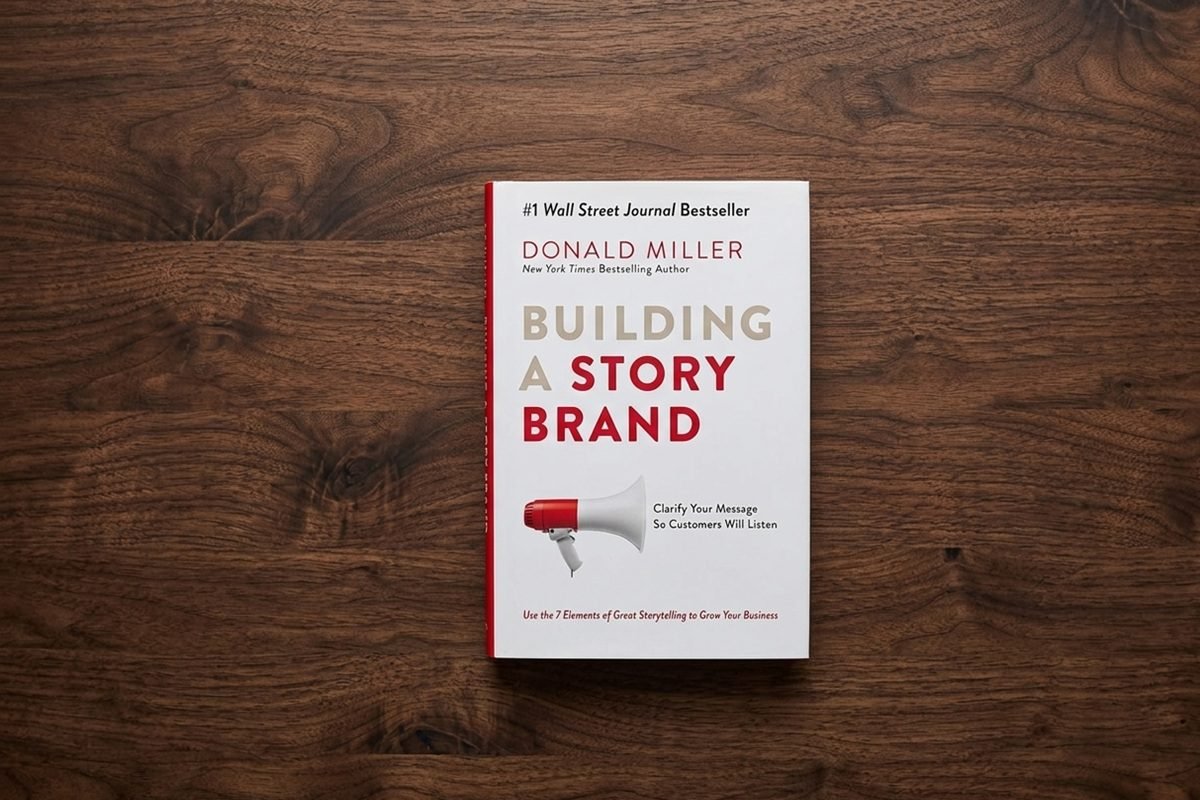
Book review: Building a StoryBrand
Clarify Your Message So Customers Will Listen
By Donald Miller
Genres:
- Communication skills
- Sales & Selling
- Marketing
The year it was published:
2017
Number of pages:
240

As an Amazon Associate, I earn from qualifying purchases.
Table of contents:
Introduction
Section I – Why Most Marketing Is a Money Pit
Chapter 1: The Key to Being Seen, Heard, and Understood
Chapter 2: The Secret Weapon That Will Grow Your Business
Chapter 3: The Simple SB7 Framework
Section II – Building Your StoryBrand
Chapter 4: A Character — The Customer Is the Hero
Chapter 5: Has a Problem — Three Levels of Conflict
Chapter 6: And Meets a Guide — Empathy and Authority
Section III – Implementing Your StoryBrand BrandScript
Chapter 7: Who Gives Them a Plan
Chapter 8: And Calls Them to Action
Chapter 9: That Helps Them Avoid Failure
Chapter 10: And Ends in a Success
Chapter 11: People Want Your Brand to Participate in Their Transformation
Chapter 12: Building a Better Website
Chapter 13: How StoryBrand Can Transform a Large Organization
Marketing Roadmap
Thoughts about the book:
At the heart of the book is the “StoryBrand Framework,” a seven-part structure that positions the customer as the hero and the business as a guide. This inversion is the key insight. Instead of companies talking about themselves, they should speak directly to the customer’s problem, clarify their stakes, and present a clear path to resolution. It is marketing reframed through the lens of narrative structure. What I liked most about the book is its clarity and usability. The framework is easy to remember, easy to apply, and immediately useful for websites, branding, and messaging. The many examples, ranging from small businesses to large organizations, help illustrate how vague messaging can be transformed into something focused and compelling. The writing style is highly accessible. Miller uses everyday language, conversational tone, and frequent storytelling to reinforce his points. There is no academic complexity, no technical marketing theory, and very little jargon. The chapters are short, the ideas are repetitive in a deliberate way, and the structure is straightforward. You can move through it quickly and still retain the core framework. It is clearly designed for business owners, marketers, and entrepreneurs who want usable tools rather than theoretical depth. The book is informative, as Miller does not rely on empirical research or formal marketing theory. Instead, his arguments are grounded in experience, observation, and widely accepted principles of communication and psychology. While the StoryBrand model is powerful, it can sometimes feel like a universal solution applied broadly across all communication problems. Real-world marketing is often messier and more nuanced than the structure suggests.
Who should read this book:
If you have ever felt that your message, whether in business, leadership, or marketing, gets lost in the noise, then Building a StoryBrand by Donald Miller is a book that speaks directly to your frustration. This is a book for people who are searching for clarity in how they communicate, how they position their product or idea, and how they connect with others in a world overflowing with competing messages. It is especially relevant if you are interested in marketing, branding, entrepreneurship, or leadership but feel that traditional approaches are too complex, too noisy, or too focused on the wrong things. Miller is searching for simplicity in communication that actually converts attention into action. His central insight is that most brands fail because they make themselves the hero of the story, rather than the customer. He reframes messaging through a narrative structure rooted in storytelling where the customer is the hero, the brand is the guide, and success comes from clearly defining the problem, the solution, and the transformation. What this book will help you do is strip away confusion. It gives you a practical framework to clarify your message so that people instantly understand what you offer, why it matters, and what they should do next.
Summary of the book:
Introduction
The introduction establishes the central idea of the book, and that is it is not about telling your company’s story, but about understanding your customer’s story and positioning them as the hero. Customers are not primarily interested in your business they are focused on their own lives, challenges, and goals. Once you accept this shift in perspective, your marketing becomes significantly more effective. Miller then introduces a seven-part structure known as the SB7 or StoryBrand Framework, designed to help any business, from small solo ventures to large global brands, clarify their message so customers pay attention, engage, and ultimately take action.
Chapter 1: The Key to Being Seen, Heard, and Understood
Chapter 1 explains that most businesses don’t fail to get attention because their products are weak, but because their messaging is confusing. The real issue is not what companies are offering, but how they explain it. Miller draws on insights from behavioral scientist Mike McHargue (“Science Mike”), who identifies two main reasons marketing doesn’t work. First, businesses often talk about things that don’t help customers survive or thrive, such as company history or design details. Since the brain is focused on information that improves safety, saves time, or increases well-being, it tends to ignore anything that doesn’t feel immediately useful. Second, messages are often too complex, forcing the brain to expend unnecessary mental effort, which leads people to disengage. At the core of effective communication are ideas tied to survival and thriving, such as saving time and money, gaining status, building community, or finding meaning. Marketing that connects to these priorities is far more likely to be noticed. Story becomes the key solution because it organizes information in a way the brain can easily understand without effort. The StoryBrand framework applies this natural storytelling structure to business messaging. The central principle is simple, if you confuse people, you lose them. This is illustrated through the example of an industrial painting company whose website was overloaded with links, images, and irrelevant details. It failed to clearly communicate what the business actually did. When the message was simplified to a straightforward visual and a single clear call to action, essentially stating what they do and how to get a quote the confusion disappeared, making it far more likely that customers would engage.
Chapter 2: The Secret Weapon That Will Grow Your Business
Chapter 2 explains why a story is such a powerful tool for communication and business growth. Story is described as something almost “self-sustaining” in its ability to hold attention, similar to how music naturally engages the brain while random noise does not. Both use sound, but music follows patterns the brain can easily process and remember, which is why a good song stays with you while background noise is quickly forgotten. Most branding fails because it feels like noise rather than music. To make story practical, Miller breaks it into a simple structure that almost all effective stories follow. A character wants something, but faces a problem. They meet a guide who gives them a plan and challenges them to take action. That action helps them avoid failure and leads to success. This framework becomes the foundation of the StoryBrand method. To test whether a message works, Miller introduces the idea that a customer should be able to understand it within seconds, almost instinctively, answering what you offer, how it improves their life, and what they need to do next. If it takes more effort than that, people will likely leave without engaging. All of this is captured in the StoryBrand BrandScript, a simple one-page tool that organizes a business message around the seven elements of story. This becomes clear in the example of Apple’s early marketing failure with the Lisa computer, which relied on dense technical advertising that failed to connect with customers. After Steve Jobs embraced storytelling principles, Apple shifted away from product-focused messaging to customer-focused identity, using simple ideas like “Think Different” and positioning users as the heroes rather than the products themselves, which helped transform Apple into a global leader. A similar transformation happened with photographer Kyle Shultz, who initially earned modest success teaching photography online. After applying the framework, he simplified his messaging, removed technical jargon, and focused on the emotional outcome customers actually wanted, such as capturing meaningful family moments. By changing nothing about the product but everything about the story, he dramatically increased sales in a single launch, allowing him to leave his previous job and build a full-time business.
Chapter 3: The Simple SB7 Framework
Chapter 3 introduces the full SB7 Framework as a simple map of how effective communication works, before each part is explored in more detail later. The idea is to give an overview of how a customer-centered story is built from beginning to end. It starts with a character, meaning the customer, not the brand. The business must identify what the customer wants, which creates a sense of anticipation and curiosity about how that desire will be fulfilled. Next, the character has a problem, and every problem has three layers. There is the external issue they are dealing with, the internal frustration it causes, and the deeper belief that it is unfair or wrong. While many businesses only focus on the external problem, customers are usually more driven by the internal emotional struggle. The customer then meets a guide, which is where the brand comes in. Instead of positioning itself as the hero, the brand takes the role of a mentor, like Yoda to Luke Skywalker, showing both empathy for the customer’s situation and credibility in solving it. That guide then provides a clear plan, usually broken into a few simple steps that remove confusion and reduce the fear of making the wrong decision. The customer is also given a clear call to action, because people rarely act without being directly encouraged. This includes both direct actions like buying or booking, and smaller, low-pressure steps that help them move forward. To create urgency, the story also highlights the risk of failure, showing what the customer stands to lose if they do nothing, though this should be used carefully so it does not overwhelm the message. Finally, the story ends with a vision of success, clearly showing what life looks like after the problem is solved, so the customer can imagine the positive outcome for themselves. All of these elements are brought together in the StoryBrand BrandScript, a single-page tool that becomes the foundation for all marketing, from websites to emails and advertisements, ensuring every message stays clear and consistent.
Chapter 4: A Character — The Customer Is the Hero
Chapter 4 explains that every story begins with a clear understanding of what the hero wants, and in marketing, the hero is always the customer. A brand’s job is to define one specific desire that matters most to its audience and connect it to their deeper need to survive or thrive. When this desire is clearly stated, it creates what Miller calls a “story gap” between the customer’s current situation and where they want to be. That gap naturally pulls attention, because the brain wants to resolve it. Just like an unfinished melody, people keep paying attention until the missing piece is filled. The key is to keep this desire simple and focused. Instead of listing everything a business offers, it should concentrate on one core want that represents the customer’s main motivation. Other needs can be addressed in separate campaigns, but the primary message should stay narrow and clear. These desires often connect to basic human drives such as saving money or time, building relationships, gaining status, finding meaning, or accumulating resources. Examples make this clearer. A financial advisor might focus on giving people a clear retirement plan, a landscaping company might promise a yard that looks better than the neighbor’s, a fine-dining restaurant might offer a memorable experience, a leadership coach might help someone become a leader people respect, and a resort might focus on rest and luxury. This becomes especially clear in the example of a luxury resort that originally presented itself through images of its building, staff, and facilities. While visually appealing, the message centered on the business rather than the guest’s experience. After applying StoryBrand principles, the focus shifted to how guests would feel, using imagery of relaxation and comfort and a simple message about finding luxury and rest. This not only clarified the marketing but also aligned the entire organization around delivering that single promised experience.
Chapter 5: Has a Problem — Three Levels of Conflict
Chapter 5 explains that problems are what drive a story forward, and the more clearly a brand talks about the customer’s problems, the more attention it earns. Every effective story begins with a problem, and that problem is usually rooted in a villain, which is the source of frustration or difficulty. This villain doesn’t need to be a person it can be anything that consistently creates the issue, as long as it feels specific, relatable, and clearly identifiable. These problems exist on three levels. The external problem is the practical issue the customer can easily describe, such as a broken system, a messy space, or a confusing process. This is what most businesses focus on, but it is only the surface. Beneath that is the internal problem, which is how the situation makes the customer feel, such as stress, frustration, insecurity, or embarrassment. This is usually the most powerful motivator, because people make decisions based on emotions tied to these experiences. At the deepest level is the philosophical problem, which is the broader sense of what is wrong about the situation, such as unfairness or the idea that something should be better than it is. This gives meaning and moral weight to the customer’s struggle. Strong brands address all three levels together, creating a complete sense of resolution. The idea is that a great solution doesn’t just fix the practical issue, but also relieves emotional tension and resolves the deeper sense of injustice. This is illustrated through the example of National Car Rental, which succeeded not by focusing on cars, but by addressing the customer’s discomfort with forced small talk and awkward interactions at the counter. By removing that emotional friction, they connected with the internal problem, which made the experience feel dramatically better. A similar approach is seen with CarMax, which built its success not by advertising vehicles, but by focusing on the fear and distrust people feel when buying used cars. By promising transparency, no haggling, and no hidden issues, they directly addressed the emotional anxiety of being cheated, which allowed them to stand out in an industry known for low trust and ultimately build a massive business.
Chapter 6: And Meets a Guide — Empathy and Authority
Chapter 6 explains that every story needs a guide, and this is the role a brand must take if it wants to be effective. The guide is not the main character but the experienced helper who has already faced similar challenges and now helps the hero succeed, like Yoda with Luke or Gandalf with Frodo. In marketing terms, the customer is always the hero, and the brand must support them, not compete with them. A common mistake is for brands to present themselves as the hero, focusing on how great or dominant they are. This backfires because customers already see themselves as the hero of their own story, and they are not looking for another competing hero. When a brand tries to take that position, it creates distance instead of connection. To be seen as a guide, a brand needs to show two things clearly. The first is empathy, meaning it understands the customer’s struggle and frustration. This builds trust by showing the customer they are understood and not alone. The second is authority, meaning the brand is capable of solving the problem. This is not done through self-praise, but through proof such as testimonials, results, awards, or recognizable clients. The importance of getting this right is illustrated through the example of Tidal, the music streaming service launched with high-profile artists presenting it as a platform to support musicians. While the intention was to position artists as heroes, it failed to address what customers actually cared about. Instead of focusing on the user’s experience, it centered on the needs of the creators, which led to public backlash and poor adoption. The key issue was that the message did not position the service as a helpful guide solving the customer’s problem, but rather as a platform benefiting someone else.
Chapter 7: Who Gives Them a Plan
Chapter 7 explains that even when customers trust a brand, they still hesitate to buy unless they clearly understand how to move forward. Uncertainty creates friction, so the brand’s job is to reduce that uncertainty by showing a simple, safe path. Miller compares this to crossing a rushing creek, where the customer can see what they want on the other side, but they need stepping stones to get there without falling in. There are two main types of plans that help do this. The first is a process plan, which lays out the exact steps a customer will go through when working with the business. This is usually kept simple, with three to six steps, such as booking a service, receiving a customized solution, and then following through with implementation. The purpose is to make the journey feel clear and easy to follow, so the customer knows exactly what to expect. The second is an agreement plan, which is especially important in industries where people feel unsure or distrustful. This type of plan focuses on reducing fear by clearly stating what the customer will and will not experience, such as transparent pricing or no hidden conditions. Giving this plan a name also helps make it feel more structured and valuable. The effectiveness of this approach is illustrated through CarMax, which built its entire customer experience around a clear agreement rather than traditional car advertising. Instead of focusing on vehicles, it focused on removing common fears like haggling, dishonest sales tactics, and hidden defects. By clearly defining what customers could expect, CarMax removed the uncertainty that usually surrounds used-car buying and became the market leader in its category.
Chapter 8: And Calls Them to Action
Chapter 8 explains that people rarely take action on their own, even when they are interested. They usually need to be clearly and confidently asked to move forward. In storytelling, the hero only acts when something forces a decision, and the same is true in marketing. Many businesses actually underperform not because they are too aggressive, but because they are too passive and fail to create enough urgency or clarity. There are two types of calls to action. A direct call to action is a straightforward request for the next step, such as buying a product, booking a service, or making a call. These should be obvious, repeated, and easy to find, because customers often need to be told exactly what to do. The second type is a transitional call to action, which offers something free or low-risk in exchange for attention, such as a guide, video, or trial. This helps build trust and keeps potential customers engaged even if they are not ready to buy yet. It also positions the brand as helpful and knowledgeable rather than pushy. The difference between the two approaches is shown in the example of two presentation design companies. One had visually impressive content but no clear direction, leaving visitors unsure how to proceed. The other was simpler but much clearer, offering a free resource and a direct way to schedule a consultation. That clarity made it easy for Miller to engage, trust them, and eventually hire them, showing that clear next steps matter more than polished design when it comes to converting interest into action.
Chapter 9: That Helps Them Avoid Failure
Chapter 9 explains that every story only becomes meaningful when something is at risk. Without the possibility of failure, there is no tension, and without tension, there is no reason for the audience to pay attention. In marketing, this means clearly showing customers what they stand to lose if they do nothing. This idea is supported by the concept of loss aversion, identified by Daniel Kahneman, which shows that people are significantly more motivated to avoid loss than to gain something of equal value. In practice, losing money or missing an opportunity feels much stronger than the pleasure of gaining it. Using this insight in marketing is not about manipulation, but about honestly communicating the cost of inaction. The key is to use this type of messaging carefully. A small amount of urgency helps clarify importance, but too much can feel overwhelming or manipulative. The goal is simply to make the stakes visible so the customer understands why the decision matters. Miller outlines a simple structure for doing this effectively. First, the customer must understand that they are vulnerable to a specific problem. Next, they are encouraged to take action to reduce that risk. Then, a clear solution is offered that addresses the issue. Finally, they are directly challenged to act. This is illustrated through the Allstate Mayhem campaign, which uses humorous but exaggerated scenarios to show how easily unexpected problems can occur. By highlighting situations like accidents or damage in everyday life, the campaign makes the risk feel real and relatable. In one highly publicized stunt, Allstate demonstrated how easily personal belongings can be exposed when people overshare online, reinforcing the idea that small actions can lead to significant consequences. By combining entertainment with clear examples of risk, the campaign made insurance feel more immediate and necessary, showing how effective messaging becomes when it clearly communicates what is at stake.
Chapter 10: And Ends in a Success
Chapter 10 explains that customers will only follow a brand if they clearly understand where it is taking them. Businesses often assume people can imagine the outcome on their own, but in reality, the end result needs to be spelled out clearly, specifically, and repeatedly. People don’t just buy products they buy a destination for their lives. Miller describes three main ways stories end, which also shape how brands can define success for their customers. The first is gaining status or recognition. Many people are motivated by respect, visibility, and a sense of elevation in society. Brands can support this by creating a sense of exclusivity, achievement, or identity, helping customers feel more important or recognized. The second is achieving a sense of completeness or relief. In this case, customers are looking for something that reduces stress, saves time, or brings comfort and stability. This is less about prestige and more about feeling balanced and at ease in everyday life. The third is self-realization, where a product or brand helps people understand or become their best selves. This is often tied to deeper meaning or personal growth, where the customer feels more aligned with who they want to be or how they see themselves. The example of Dove’s “Real Beauty” campaign shows this clearly. Instead of focusing on soap or product features, Dove focused on how women perceive themselves. By highlighting the difference between self-perception and how others see them, the campaign helped many people reconsider their own sense of beauty. Rather than selling a product, it offered a message of acceptance and self-worth, which created a much deeper emotional connection and made the campaign widely successful and widely shared.
Chapter 11: People Want Your Brand to Participate in Their Transformation
Chapter 11 explains that at the heart of every purchase is a desire for transformation. People don’t just want products or services they want to become a better version of themselves, more confident, capable, respected, or at peace. A brand, whether intentional or not, is always participating in that transformation. This is where the idea of an aspirational identity becomes central. The key question for any business is not only what problem it solves, but who the customer becomes after using it. When this identity is clearly defined, the product stops being just a solution and becomes a step toward becoming someone new. Different industries support this shift in different ways. A pet food brand can turn a customer into a more caring, responsible pet owner. A financial advisor can help someone move from feeling uncertain and overwhelmed to feeling capable and in control. Even something as simple as a shampoo brand can support a shift from feeling tired or self-conscious to feeling confident and refreshed. Story structure reinforces this idea because guides don’t just help heroes succeed, they also recognize and affirm their transformation at the end. The role of the guide is to acknowledge that change has happened and make it visible to the hero. This is shown clearly in the example of Dave Ramsey and his Financial Peace University program. His entire message is built around identity change, combining a clear rejection of debt with a vision of financial independence and dignity. The program culminates in a public “Debt-Free Scream,” where participants celebrate their transformation in front of others. This ritual doesn’t just mark a financial achievement—it solidifies a new identity, making the change real and memorable.
Chapter 12: Building a Better Website
Chapter 12 explains that even the best BrandScript is only valuable if it is actually applied, and the most important place to apply it is the website, since that is where most customers first interact with a business. The first requirement is a clear offer above the fold. The top part of the website should immediately communicate what the business does, what problem it solves, and what outcome the customer can expect. If a visitor cannot understand this within a few seconds, they are likely to leave. Next, the website must include obvious calls to action that are easy to find and repeat throughout the page. These should stand out visually and guide the user toward the next step, whether that is making a purchase or taking a smaller action like signing up for a free resource. The third element is images that show success. Instead of focusing on buildings, tools, or internal processes, the website should show people who have benefited from the product or service, since this helps customers imagine themselves in the same positive outcome. The fourth element is a simple breakdown of what the business offers. If there are multiple services or products, they should be organized clearly so customers can quickly understand their options without having to search for them. Finally, the website should use as few words as possible. People tend to scan rather than read, so clarity and simplicity matter more than detailed explanations. Short statements and bullet points are more effective than long paragraphs. This is illustrated through the example of an online cooking school that initially confused visitors with unclear messaging and unnecessary detail. Although the program itself was valuable, users struggled to understand what it offered. Only after it became clear that the service was essentially about guiding beginners to become confident cooks did the value become obvious. This shows that clarity at the very top of a website can determine whether customers stay or leave.
Chapter 13: How StoryBrand Can Transform a Large Organization
Chapter 13 explains that StoryBrand is not only a marketing tool but also a way to unify how a company functions internally. When employees don’t understand the company’s story, they lose clarity about their purpose, which leads to disengagement and fragmentation across teams. Miller describes this breakdown as a “Narrative Void,” a situation where there is no shared story guiding the organization. In this state, departments begin to operate independently, decisions become inconsistent, and even well-written mission statements lose their impact because they are not actively used in daily work. In contrast, when a clear and living story is present, one that is reflected in meetings, onboarding, communication, and recognition, it aligns everyone in the same direction. This connects to the idea of the “Thoughtmosphere,” which is the shared environment of beliefs and assumptions inside a company. When this environment is clear and aligned around a common story, employees understand not only what they are doing but why it matters, which leads to higher motivation and productivity. When it is unclear or fragmented, performance suffers even among talented teams. Research from Gallup highlights the scale of the problem, showing that only a small portion of employees are actively engaged at work, costing the economy hundreds of billions annually. The implication is that engagement is less about perks or benefits and more about clarity of purpose and shared meaning. This is demonstrated through the example of a fast-growing fast-food chain that had stalled despite strong products and capable staff. As the company expanded, its internal clarity weakened, and growth slowed significantly. After applying StoryBrand principles internally, the company reinforced a unified narrative across leadership communication, events, and employee engagement efforts. The result was not a change in product or personnel, but a renewed sense of shared purpose that led to a dramatic increase in growth over a short period.
Marketing Roadmap — Five Practical Steps to Grow Your Business
Once a BrandScript is in place and the website has been clarified, Miller outlines a simple five-step roadmap that turns the framework into a practical marketing system. The focus is not on expensive tactics, but on consistent, clear communication that can be implemented by almost any business. The first step is to create a one-liner, a short statement that explains what the business does and why it matters. It combines the customer, their problem, the solution, and the result in a single sentence that is easy to remember and repeat. This becomes the core message used across all communication. The second step is to create a lead generator, which replaces the idea of asking people to “sign up for a newsletter” with something genuinely useful, like a free guide or resource. In exchange, the business collects email addresses and builds an audience of interested potential customers. This simple approach can become a major source of growth. The third step is to set up an automated email sequence that keeps in touch with these leads over time. The goal is to stay helpful and relevant, alternating between useful information and occasional offers, so the business remains present when the customer is ready to make a decision. The fourth step is to collect and share customer transformation stories. Instead of simple praise, these stories should show the journey from problem to solution, helping future customers see themselves in the same situation and outcome. This makes testimonials far more persuasive and relatable. The fifth step is to build a referral system that encourages satisfied customers to share the business with others. While word of mouth already happens naturally, this step makes it intentional by giving people simple ways to recommend the product or service, sometimes supported by incentives or shareable materials. Together, these five steps turn the StoryBrand framework from a messaging tool into a complete, repeatable marketing system.