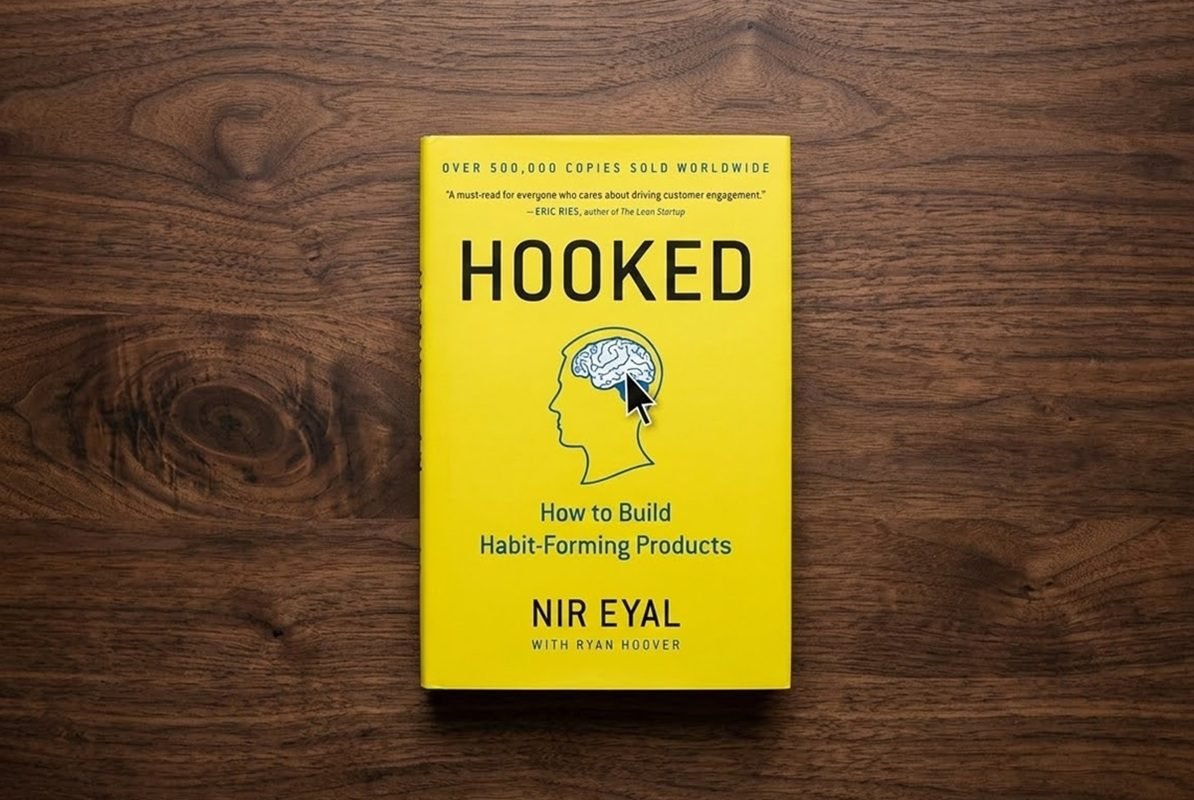
Book review: Hooked
How to Build Habit-Forming Products
By Nir Eyal
Genres:
- Consumer Behavior
- Marketing
- Psychology
The year it was published:
2014
Number of pages:
256

As an Amazon Associate, I earn from qualifying purchases.
Table of contents:
Introduction: Why Habits Matter in Business
Chapter 1: The Habit Zone — When Habits Become Competitive Advantages
Chapter 2: Trigger — The Spark That Starts the Habit
Chapter 3: Action — Making It Easy to Act
Chapter 4: Variable Reward — The Power of Unpredictable Outcomes
Chapter 5: Investment — How Using a Product Makes It More Valuable
Chapter 6: What Are You Going to Do With This? — The Ethics of Habit Design
Chapter 7: Case Study — The Bible App (YouVersion)
Chapter 8: Habit Testing and Finding Opportunities
Thoughts about the book:
In the book Hooked, Nir Eyal introduces what he calls the “Hook Model,” a four-step process that contains the following elements trigger, action, variable reward, and investment, which is designed to create habit-forming products. The premise is straightforward. The most successful products are not those that merely solve problems, but those that become part of users’ routines. What I found most compelling is the clarity of the framework. Eyal has a talent for distilling complex behavioral principles into a model that feels intuitive and actionable. The structure gives product managers, designers, and entrepreneurs a clear lens through which to think about user engagement. The examples that are drawn from social media, gaming, and everyday apps make the concepts concrete and immediately recognizable. The writing style is one of the book’s strongest assets. It is clear, direct, and highly accessible. Eyal uses everyday language, avoids heavy jargon, and explains psychological concepts in a way that feels approachable rather than academic. The tone is engaging without being overly casual, and the pacing keeps the reader moving. This is a book that can be read quickly, but still leaves a lasting impression.
I very much liked that the ideas are broken down into manageable sections, and the framework provides a natural structure that guides the reader through the argument. There is no need for prior knowledge in psychology or design. The book is informative and grounded in behavioral psychology, but it is not deeply scientific in a strict academic sense. Eyal references research and draws on established principles such as conditioning, reward systems, and habit formation, but the emphasis is on application rather than rigorous analysis. What might seem as a downside is that the concept of the book can feel somewhat simplified. Human behavior is complex, and reducing habit formation to a four-step loop risks overlooking nuance.
Who should read this book:
Reading Hooked is an invitation to see habits not as accidents, but as carefully constructed systems and to decide whether you want to be shaped by them, or learn how to shape them yourself. You should read Hooked if you are interested in the psychology behind habits, how behaviors are formed, reinforced, and ultimately automated. This is not merely a book about products or technology, it is about human behavior. It speaks to entrepreneurs, designers, marketers, and anyone curious about why we return to certain apps, services, or routines without conscious thought.
Summary of the book:
Introduction: Why Habits Matter in Business
Hooked explains how some of the most successful technology companies, such as Instagram, Facebook, Twitter, and Pinterest, design their products to keep users coming back almost automatically. Nir Eyal draws on years of research to show why certain products become part of everyday routines while others are quickly forgotten. At the core of the book is the Hook Model, a four-step process: Trigger, Action, Variable Reward, and Investment, which each chapter explores in detail. Habits are defined by cognitive psychologists as automatic behaviors triggered by cues, requiring little conscious thought. For example, when people feel bored, they often reach for their phones without really deciding to do so. For businesses, creating these kinds of behaviors is essential. Simply gaining users is no longer enough, instead long-term success depends on how often people return on their own. Companies that succeed are those that become “first-to-mind” by linking their products to internal feelings like boredom or curiosity, so that when those emotions arise, users instinctively think of their product before any competitor. This process can be seen in a typical user experience like for example, when someone might come across a photo on Facebook that leads them to Pinterest, where they begin browsing a stream of engaging and unpredictable content. As they interact by saving images, the platform learns their preferences and improves future recommendations. Later, notifications draw them back in, reinforcing the cycle. In this way, a simple external trigger leads to an action, followed by a rewarding experience and a small investment, which together create a repeating loop of engagement. Eyal acknowledges that designing habit-forming products involves an element of manipulation, but he argues that these techniques can be used responsibly. The aim is not just to capture attention, but to build products that genuinely improve people’s lives while fostering meaningful, lasting engagement.
Chapter 1: The Habit Zone — When Habits Become Competitive Advantages
In the first chapter, Eyal explains why habits are such a powerful driver of business success. Not every product needs to become a habit, but when it does, it creates a lasting competitive advantage. At the center of the chapter is the idea of the “Habit Zone,” a simple way to evaluate whether a product has the right balance of frequency and usefulness to become part of a user’s routine. A habit is any behavior performed with little or no conscious thought. The brain builds habits as a way to conserve effort, turning repeated actions into automatic responses to familiar situations. For businesses, habits lead to several important advantages. Users who form habits around a product tend to stay longer and spend more, increasing their overall value. They also become less sensitive to price changes, since the behavior feels automatic and familiar. Growth accelerates as engaged users naturally invite others and share content, and strong habits make it difficult for competitors to pull users away even when alternatives are objectively better. The Habit Zone helps explain when a behavior is likely to stick. It depends on two factors, first how often the behavior occurs, and second, how useful or rewarding it feels. A behavior becomes a habit when it is both frequent and valuable enough to move beyond conscious decision-making. Different products can reach this zone in different ways. Some, like search engines, rely on extremely high frequency, while others, like online shopping platforms, rely more on high perceived value even if used less often. What matters is that the combination is strong enough to keep users returning.
Eyal also challenges the common idea that products must be “painkillers” rather than “vitamins.” While painkillers solve immediate problems, many habit-forming products begin as optional or nice-to-have. Over time, however, they become psychologically necessary. For example, social platforms may not feel essential at first, but once a habit forms, not using them can create a sense of discomfort. In this way, the habit itself creates the “pain” that the product then relieves. Several examples reinforce how habits translate into real business outcomes. Evernote observed that new users rarely paid at first, but as they continued using the product and built a routine, a growing percentage eventually converted into paying customers. Similarly, the mobile game Candy Crush Saga attracted hundreds of millions of users for free, but once players developed a habit of playing, monetization became highly effective. Even outside digital products, habits create strong advantages. The QWERTY keyboard, though not the most efficient layout, remains dominant simply because people are accustomed to it and switching would require too much effort. Overall, the chapter makes a clear distinction between habits and addictions. Addictions are harmful compulsions, while habits can be either beneficial or neutral parts of daily life. The goal is not to create dependency for its own sake, but to design products that people find valuable enough to return to regularly, forming behaviors that are both sustainable and meaningful.
Chapter 2: Trigger — The Spark That Starts the Habit
Chapter 2 explains that every habit begins with a trigger, a cue that prompts a behavior. Triggers come in two forms: external, which exist in the environment, and internal, which arise from thoughts and emotions. The ultimate goal of habit-forming products is to shift users from relying on external prompts to being driven by internal ones. External triggers are visible cues that tell users what to do next, such as notifications, emails, app icons, or ads. They fall into four categories: paid (ads used to acquire users), earned (media coverage or viral attention), relationship (recommendations or interactions from others), and owned (direct channels like notifications or emails). Among these, owned triggers are the most important for building habits because they repeatedly bring users back and are under the company’s control. For example, a simple email with a clear call to action, like Mint’s “Log in” button, works effectively because it reduces friction and directs behavior. Over time, however, strong habits rely less on these external cues and more on internal triggers. These are feelings such as boredom, loneliness, uncertainty, or anxiety that push people to act. Products become habit-forming when they consistently relieve these emotions. For instance, people check social media when they feel bored or disconnected, or search online when they feel uncertain. Once a product is closely tied to a specific emotion, users return automatically without needing reminders.
A useful way to uncover these internal triggers is the “5 Whys” technique, which involves repeatedly asking why a user performs a behavior until reaching the underlying emotional driver. What may start as a practical reason often reveals a deeper motivation, such as the fear of being left out or not staying informed. Real-world examples show how this works in practice. Instagram initially relied on external triggers like social sharing and app visibility to attract users, but over time, it became linked to the fear of missing out, pulling users back whenever they felt they might miss something important. PayPal grew rapidly by using relationship triggers — receiving money created a strong incentive to sign up, turning each transaction into a new invitation. Together, these examples show how successful products start with external prompts but ultimately depend on internal triggers to create lasting habits.
Chapter 3: Action — Making It Easy to Act
This chapter focuses on what happens after a trigger when the user must take action. If the action is too difficult, the habit never forms. The key idea is simple, reduce friction as much as possible since the easier an action is, the more likely it is to happen. Eyal builds on Dr. BJ Fogg’s Behavior Model, which states that behavior occurs when three elements come together at the same time: motivation, ability, and a trigger. If any one is missing, the action won’t happen. However, instead of trying to boost motivation, successful products focus on increasing ability by making actions effortless. Even small barriers can stop behavior, whether it’s time, effort, confusion, or inconvenience. Fogg also identifies core human motivators, such as seeking pleasure, hope, or social acceptance, and avoiding pain, fear, or rejection. Good design taps into these motivations but, more importantly, removes obstacles that make action difficult. Simplicity is influenced by factors like time required, cost, physical or mental effort, social perception, and how familiar the behavior feels. The goal is to identify the biggest source of friction and eliminate it. In practice, this often means reducing the number of steps and the amount of thinking required. For example, Twitter’s early homepage was cluttered and confusing, but a later redesign simplified it to just a few clear options, making it much easier for users to get started. Similarly, Google’s clean homepage outperformed more complex alternatives like early Yahoo! because it required far less mental effort. Apple applied the same principle by making the iPhone camera accessible instantly from the lock screen, allowing users to capture moments without delay. Pinterest increased engagement by removing the need to click “next page,” using infinite scroll to keep users moving without interruption. The chapter also explains how small psychological nudges can make actions more likely. People respond to cues like scarcity, framing, and anchoring, but one of the most powerful is the sense of progress. When users feel they have already started something, they are more likely to continue. This is why systems like loyalty cards or profile completion meters work so well, as they create momentum by making users feel closer to a goal than they actually are.
Chapter 4: Variable Reward — The Power of Unpredictable Outcomes
This chapter explains why uncertainty is a powerful driver of behavior. People are not just motivated by rewards themselves, but by the anticipation of receiving them. When outcomes are unpredictable, engagement increases. Research shows that the brain becomes most active when expecting a reward, not when actually receiving it, and this effect is amplified by uncertainty. This helps explain why variable rewards are so effective. When rewards are delivered inconsistently, behavior becomes more persistent. Classic experiments showed that animals repeated actions far more when rewards were random rather than guaranteed. The same principle applies to modern products: people keep checking social media, email, or other platforms because they don’t know what they’ll find. The unpredictability creates a sense of anticipation that drives repeated use. Eyal identifies three types of variable rewards. The first is social rewards, or “rewards of the tribe,” which come from other people and include likes, comments, recognition, or status. Platforms like Facebook rely heavily on this, as users return to see how others react to their posts. Even professional communities like Stack Overflow use this mechanism, where contributors are motivated by unpredictable feedback such as upvotes and recognition. The second type is “rewards of the hunt,” which tap into the human drive to search for resources like information or material gains. This is seen in activities like scrolling through feeds, searching online, or even gambling. Slot machines are the clearest example: the random chance of a payout keeps players engaged despite knowing the odds are against them. The third type is “rewards of the self,” which come from internal satisfaction, such as completing tasks, making progress, or mastering a skill. These rewards are powerful because they are intrinsically motivating, especially when progress feels meaningful but not entirely predictable. Products with finite variability eventually become predictable and lose their appeal unless new content is added. This is what happened with games like FarmVille, which declined once users had experienced everything it offered. In contrast, products with infinite variability, especially those involving other people, remain engaging because outcomes are constantly changing. Social platforms and marketplaces fall into this category, as user behavior keeps the experience fresh. Finally, the chapter highlights the importance of maintaining user autonomy. If people feel forced or controlled, they resist and disengage. Successful products avoid this by giving users a sense of choice. For example, apps that encourage participation through community and interaction feel more natural than those that impose rigid routines or obligations. Overall, variable rewards work because they create anticipation and curiosity. When combined with a sense of autonomy and ongoing unpredictability, they keep users engaged and coming back over time.
Chapter 5: Investment — How Using a Product Makes It More Valuable
This final step of the Hook Model explains how users make a product more valuable the more they use it. After receiving a reward, users are encouraged to put in small efforts that improve their future experience. These investments store value in the product, increase the cost of leaving, and help trigger future engagement, restarting the cycle. Investment works because of several psychological effects. First is the “IKEA Effect,” where people place higher value on things they have helped create. Even a small effort makes users feel ownership, which increases attachment. Second is consistency bias, once people take a small action, they are more likely to continue behaving in line with it over time. Third is cognitive dissonance, where people adjust their beliefs to justify their past effort if they have invested significant time in a product or skill, they are more likely to believe it is valuable. Unlike the action phase, which focuses on immediate use, investment builds long-term value in the system. This value accumulates in several forms. Users add content, such as photos, posts, or notes, making the product richer. They provide data, which improves personalization. They build followers or networks, which are difficult to recreate elsewhere. They develop reputations, which cannot be easily transferred to new platforms. And they gain skills, which also create switching costs because learning a new system requires starting over. Investment also plays a crucial role in setting up future triggers. Each interaction should increase the likelihood of the user returning later. In other words, what users do today should help bring them back tomorrow.
Several examples illustrate this process. Research on the “IKEA Effect” showed that people valued self-assembled origami significantly more than identical pre-made versions, simply because of the effort involved. Another study found that people who agreed to a small request, like placing a small sticker in their window, were far more likely to later accept a much larger request. These studies show how small commitments lead to larger ones over time. In digital products, Twitter demonstrates how stored value works through followers. Users invest years building a network, and leaving the platform means losing that accumulated social capital. Similarly, App.net failed to compete with Twitter despite technical advantages because users were unwilling to abandon their existing follower base. Other products show how investment can directly create future triggers. Apps like Any.do connect to a user’s calendar so they can send reminders at relevant moments, turning past setup actions into future re-engagement. Tinder uses each swipe as a small investment that leads to match notifications, which bring users back into the app. Pinterest combines the full cycle: users discover content, save it, and receive notifications when others interact with it, continuously restarting engagement. Overall, investment transforms short-term interaction into long-term habit formation. By getting users to contribute effort, products become more valuable, more personal, and harder to leave, ensuring the Hook Model continues to repeat over time.
Chapter 6: What Are You Going to Do With This? — The Ethics of Habit Design
This chapter shifts the focus from how to build habit-forming products to whether you should. Eyal acknowledges that the Hook Model is a form of behavioral influence, and with that power comes responsibility. As technology becomes more connected and persistent, products increasingly shape user behavior, making ethical design a real and urgent concern. To help evaluate this responsibility, Eyal introduces the Manipulation Matrix, a simple framework based on two questions: would you personally use the product, and does it meaningfully improve users’ lives? The combination of these answers places a designer into one of four categories. The Facilitator describes someone who both uses the product themselves and believes it improves users’ lives. This is the healthiest position, as it combines personal understanding with positive impact. Facilitators tend to build better products because they are directly related to the problem they are solving. The Peddler believes the product improves users’ lives but would not use it personally. This often leads to weak design decisions because the creator lacks firsthand experience. Many superficial “gamified” systems fall into this category, where features like points or badges are added without truly improving the underlying experience.
The Entertainer builds products they enjoy but that do not necessarily improve users’ lives in a lasting way. This includes games, viral apps, and entertainment platforms. While valuable and often successful, these products typically depend on novelty and must constantly evolve to retain attention. The Dealer falls into the most ethically questionable category: products the creator would not use and that do not meaningfully improve users’ lives. These are designed primarily for extraction rather than value creation, and often carry the highest ethical risk. Real-world examples help clarify these distinctions. Weight Watchers illustrates that even behavior-shaping systems can be ethical when users voluntarily participate and benefit from the structure. Nuru International shows the Facilitator model in action: by living alongside the people he aimed to help, the founder built a solution grounded in real needs rather than assumptions. In contrast, the experimental game Cow Clicker, designed as a critique of addictive design, unintentionally demonstrated how easily users can become engaged with something that offers no real value, highlighting the risks of manipulative mechanics. Overall, the chapter emphasizes that building habit-forming products is not just a technical challenge, but a moral one. The same tools that create useful, positive habits can also be used to exploit attention, and it is up to designers to decide which direction they take.
Chapter 7: Case Study — The Bible App (YouVersion)
This chapter shows how the Hook Model works in practice by examining the YouVersion Bible app. By 2013, it had been downloaded over 100 million times, with a new installation every 1.3 seconds. Its growth came from systematically applying each step of the Hook Model to turn occasional Bible reading into a daily habit. The first step, the trigger, combined multiple forces. Early on, the app benefited from visibility in the App Store and encouragement from preachers who told congregations to use it during services, creating strong relationship triggers. Once installed, push notifications and app icons kept bringing users back. Over time, these external cues became internal triggers, as users began turning to the app when feeling anxious, lonely, or in need of comfort or guidance. The second step, action, focused on reducing friction. Moving from a website to a mobile app made access constant and immediate. Users could engage anywhere, which significantly increased usage. The team also simplified reading by offering audio versions, breaking scripture into short daily segments, and designing reading plans that felt manageable and easy to follow. The third step, variable reward, kept users engaged through unpredictability and emotional resonance. Each day offered a new verse, creating anticipation about what message would appear next. Hundreds of reading plans provided variety and a sense of exploration. Social interactions, such as encouragement from other users, added an unpredictable human element. For many, the experience also felt personally meaningful, as if the selected verses were directly relevant to their lives.
The final step, investment, strengthened long-term engagement. Users highlighted verses, saved bookmarks, and wrote notes, all of which personalized their experience. Sharing verses on social media created additional triggers when others reacted or saw the content. Daily reading streaks reinforced consistency, making users reluctant to break their progress. The results were significant: over 100 million downloads, tens of thousands of opens per second, and hundreds of thousands of daily content shares. The app became one of the most popular Bible apps in the world. Several moments illustrate how powerful these mechanisms became in real life. In one case, a user reportedly received a notification while in a strip club and interpreted it as a personal sign, prompting him to leave. In another, a Christmas notification sent by the app led users to take screenshots and share them online, feeling personally acknowledged rather than interrupted. The app is also integrated deeply into church services by allowing preachers to direct congregations to it, turning weekly sermons into recurring relationship triggers. Overall, the YouVersion case shows how combining all four elements of the Hook Model, the trigger, the action, the variable reward, and the investment can transform a simple utility into a deeply embedded daily habit.
Chapter 8: Habit Testing and Finding Opportunities
In chapter 8 Eyal turns theory into practice. He explains how to test whether a product is truly forming habits and where to look for new opportunities to build habit-forming products. He also introduces three main sources of opportunity, which are new behaviors, enabling technologies, and interface changes. Habit Testing is a three-step process. First, identify what counts as a habitual user for your product and measure how many users actually reach that level. These are your “devoted users,” the ones already showing signs of habit formation. If fewer than about 5% of users fall into this group, it suggests a problem with either user targeting or product design. Second, codify the behavior of these devoted users. By analyzing what they do differently from casual users, you can identify a “Habit Path” — a common sequence of actions that leads to long-term engagement. For example, Twitter discovered that users who followed around 30 accounts early on were far more likely to stick with the product. This insight reshaped their onboarding process. Third, modify the product to guide new users along that same path. This can involve simplifying onboarding, removing friction, highlighting key features, or triggering the right actions at the right time. The goal is to steer users toward the behaviors that lead to habit formation.
The chapter then explores where to find opportunities for building new habit-forming products. One source is personal experience. Founders who build products to solve their own problems often understand user needs more deeply, as seen with Buffer, which started as a simple tool its creator built for himself to schedule social media posts. Another source is new behaviors, small, emerging behaviors that have not yet gone mainstream. Many transformative technologies were initially dismissed as unimportant, such as the telephone or early internet services, because people failed to recognize the habits they would eventually enable. A third source is enabling technologies. When new infrastructure makes existing behaviors easier or more frequent, it creates opportunities for new habits. Smartphones, high-speed internet, and app stores all unlocked entirely new patterns of daily use by reducing friction. Finally, interface changes can create new behaviors by changing how people interact with technology. Shifts like mobile touchscreens or new content formats can make previously difficult actions simple and habitual. Instagram’s success, for example, was partly driven by making photo editing and sharing effortless through filters and mobile cameras. The chapter ends by pointing toward the future. New interfaces such as wearables, voice assistants, and augmented reality will continue to reshape behavior. Each shift lowers friction in new ways and creates space for new habits to form. The companies that recognize these changes early will have the greatest opportunity to shape future user behavior.