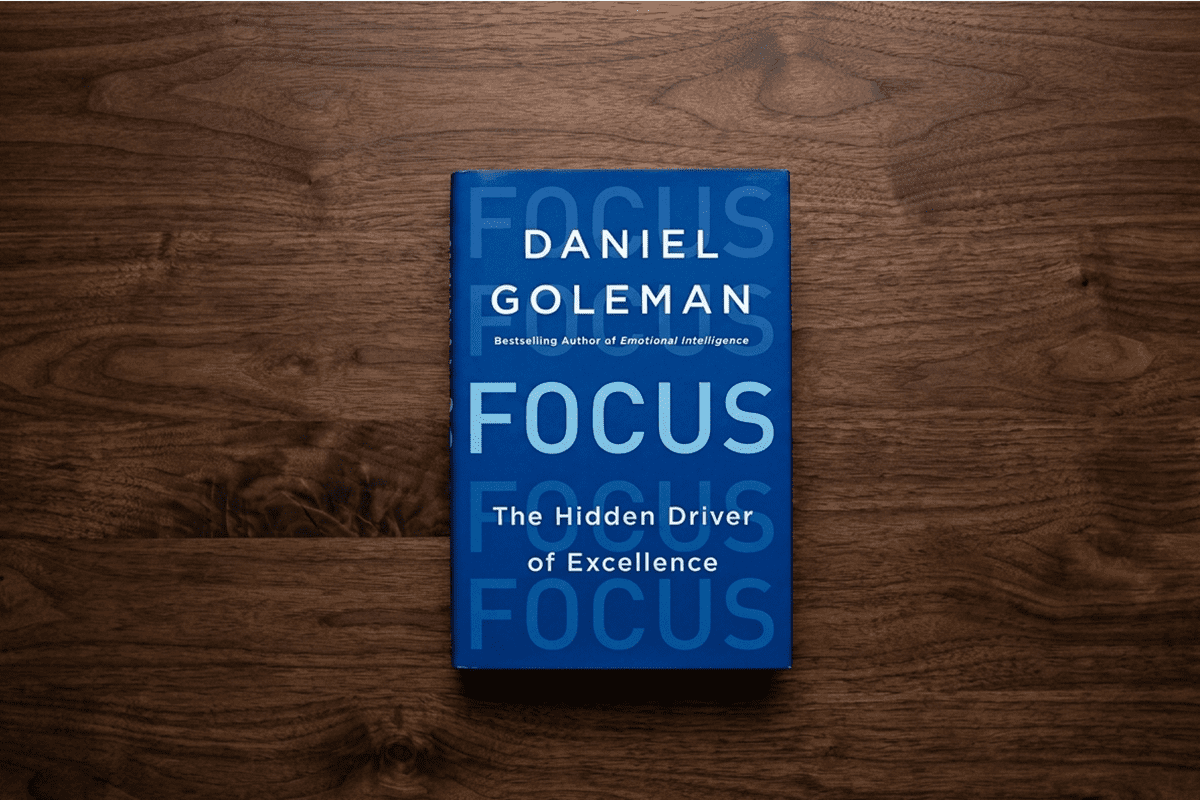
Book review: Focus
The Hidden Driver of Excellence
By Daniel Goleman
Genres:
- Communication Skills
- Self-Improvement
- Leadership
The year it was published:
2013
Number of pages:
320

As an Amazon Associate, I earn from qualifying purchases.
Table of contents:
Part I – The Anatomy of Attention
Chapter 1: The Subtle Faculty
Chapter 2: Basics
Chapter 3: Attention Top and Bottom
Chapter 4: The Value of a Mind Adrift
Chapter 5: Finding Balance
Part II – Self-Awareness
Chapter 6: The Inner Rudder
Chapter 7: Seeing Ourselves as Others See Us
Chapter 8: A Recipe for Self-Control
Part III – Reading Others
Chapter 9: The Woman Who Knew Too Much
Chapter 10: The Empathy Triad
Chapter 11: Social Sensitivity
Part IV – The Bigger Context
Chapter 12: Patterns, Systems, and Messes
Chapter 13: System Blindness
Chapter 14: Distant Threats
Part V – Smart Practice
Chapter 15: The Myth of 10,000 Hours
Chapter 16: Brains on Games
Chapter 17: Breathing Buddies
Part VI – The Well-Focused Leader
Chapter 18: How Leaders Direct Attention
Chapter 19: The Leader’s Triple Focus
Chapter 20: What Makes a Leader?
Part VI – The Well-Focused Leader
Chapter 21: Leading for the Long Future
Thoughts about the book:
In an age of constant distraction, fragmented attention, and digital overload, the ability to direct and sustain focus has become not just useful but foundational to excellence. Daniel Goleman divides focus into three dimensions. Inner focus (self-awareness and self-control), other focus (empathy and social understanding), and outer focus (understanding larger systems and environments). This broader framing gives the book more depth than a standard productivity manual. I really liked how Goleman explains attention as a foundational human skill and how it is connected to leadership, emotional intelligence, decision-making, learning, and even ethics. The book moves fluidly between neuroscience, psychology, education, and organizational behavior, giving it an intellectually rich texture. The writing style is clear and polished, though slightly more academic than many mainstream self-improvement books. He explains scientific concepts carefully, often using stories, studies, and examples to keep the material engaging. Unlike lighter productivity books built around rapid-fire tips, Focus asks the reader to think more deeply about cognition and behavior. Some chapters are highly engaging, particularly those exploring technology and distraction, while others become more conceptual and dense. If you want a light read on self-improvement, then this book might not be for you, but if you are looking for something that will challenge your thoughts and your thinking on this subject, then you should definitely pick up this book.
Who should read this book:
If you feel that your attention is constantly pulled between notifications, obligations, and endless streams of information and you are looking for a way to deal with that, then Focus by Daniel Goleman is a book that you should pick up. It is for people who want to think more clearly, work more meaningfully, and reconnect with the ability to sustain concentration in a world designed to interrupt it. With this book, Goleman’s interest lies in understanding how focus shapes everything from emotional intelligence and empathy to decision-making, creativity, and leadership. What this book will help you do is recognize attention as a trainable skill rather than a fixed trait. It explains how scattered attention weakens performance and relationships, while deep focus strengthens learning, emotional control, and long-term achievement. More importantly, it reframes focus not as narrow concentration alone, but as the foundation of meaningful living.
Summary of the book:
Chapter 1: The Subtle Faculty
This chapter introduces attention and how it is one of our most important mental abilities, shaping how well we think, learn, work, relate to others, and navigate the world. Goleman argues that focus is not just a skill for productivity, but the foundation of a meaningful and effective life. He describes three kinds of focus. Inner focus is awareness of our own thoughts and emotions. Another focus is the ability to pay attention to and understand other people. The third focus is awareness of larger systems, environments, and the world around us. According to Goleman, a balanced life depends on developing all three. The chapter also warns that modern technology is weakening our ability to concentrate. Constant notifications, smartphones, and social media compete for our attention and pull us away from deeper thinking and real human interaction. As a result, people are becoming more distracted, less present, and less able to sustain focus for long periods. Goleman illustrates this with the story of John, a department store detective trained to monitor dozens of shoppers at once while spotting subtle signs of suspicious behavior. John’s ability to ignore distractions and notice tiny details shows how powerful and trainable focused attention can be. He contrasts this with everyday examples of distraction, such as a mother ignoring her child while absorbed in an iPad, or a group of college students sitting together in silence while all using their phones. These moments show how technology can weaken human connection by constantly redirecting attention away from the people physically present. The chapter also explores how attention habits may be changing cognitive abilities. One teacher noticed that students who once handled complex reading without difficulty were now struggling to stay engaged with longer texts, likely because constant short-form digital communication had reduced their ability to focus deeply. Goleman reinforces this with a warning from economist Herbert Simon, who predicted decades earlier that an overload of information would create a shortage of attention. The more information people are exposed to, the harder it becomes to focus on what truly matters.
Chapter 2: Basics
This chapter explains how attention works at a basic level and why staying focused is so difficult. Goleman describes two main sources of distraction, sensory distractions, like noise or movement around us, and emotional distractions, such as worries, stress, or personal concerns. Emotional distractions are especially powerful because the brain naturally prioritizes what feels emotionally important. He also explores how often the mind wanders. Even while reading or working, people frequently “zone out,” with their thoughts drifting away from the task at hand. This mental wandering reduces comprehension, memory, and performance, even when it feels harmless. Goleman demonstrates this by asking readers to recall details from earlier pages, showing how often attention slips without us noticing. The chapter introduces the idea of flow, the state of deep concentration where a person becomes fully absorbed in what they are doing and loses track of time. Flow happens when attention is completely focused on a meaningful challenge, and it is strongly linked to high performance, satisfaction, and enjoyment in work. Goleman also argues that multitasking is largely an illusion. Rather than doing multiple things at once, the brain rapidly switches between tasks, which drains mental energy and lowers effectiveness. Attention has limited capacity, and when it is overloaded, performance suffers. He illustrates this with several examples. At the New York Times, reporters worked in a loud and chaotic newsroom yet still produced high-quality work because they had trained themselves to filter distractions and sustain concentration. In another example, social media researcher Clay Shirky became so absorbed in work at a crowded conference that he failed to notice Goleman standing nearby for several minutes, demonstrating how intense focus can completely block out the surrounding environment. The chapter also references research on “good work,” which studied people who were highly skilled, deeply engaged in their work, and believed it had meaning. These individuals experienced flow far more often than the average person, suggesting that deep focus is closely tied not only to productivity but also to fulfillment and purpose.
Chapter 3: Attention Top and Bottom
This chapter explains that attention is controlled by two different systems in the brain. The top-down system is slow, deliberate, and conscious. It allows us to think carefully, make decisions, and direct our focus intentionally. The bottom-up system is fast, automatic, and emotional. It runs habits, reacts instinctively to the environment, and operates largely outside awareness. Goleman argues that much of daily life depends on the bottom-up system because it allows us to function efficiently without consciously thinking through every action. However, this automatic system can also create problems. Strong emotions, habits, advertising, and fear can all hijack attention before the rational mind has time to respond. One major danger is what Goleman calls a “neural hijack,” where emotions suddenly overwhelm conscious thinking. In these moments, attention narrows completely around the perceived threat or emotion, making clear reasoning much harder. He illustrates this with Olympic hurdler Lolo Jones during the 2008 Beijing Olympics. Jones was leading the race comfortably until she began consciously thinking about her technique. By shifting from automatic trained movement to deliberate control, she disrupted her performance, hit a hurdle, and lost the race. The example shows that overthinking actions that should remain automatic can interfere with high-level performance. Goleman also explains how deeply automatic emotional patterns are rooted. One psychologist who spent years studying how gloomy weather affects mood admitted that cloudy days still made him feel depressed despite fully understanding the science behind it. Intellectual knowledge alone was not enough to override the brain’s automatic emotional responses. The chapter also explores how the bottom-up brain can be influenced without conscious awareness. Studies show that subtle emotional cues, such as flashing happy faces next to products, can shape behavior and decisions even when people do not consciously notice the images. Advertisers and marketers often rely on this automatic system to influence preferences and choices. Goleman reinforces the idea with his own experience of sudden back pain while writing the chapter. The pain immediately triggered catastrophic thoughts and distracted thinking, causing him to make mistakes and lose focus. The episode demonstrates how quickly fear or stress can seize attention and override rational thought, even in someone who understands the process intellectually.
Chapter 4: The Value of a Mind Adrift
This chapter argues that focus is not always the answer. While concentrated attention is essential for learning and productivity, Goleman explains that letting the mind wander also plays an important role. When attention relaxes, the brain continues working in the background, making connections, processing unresolved problems, and generating creative ideas that may not appear through deliberate effort alone. He introduces the brain’s “default network,” which becomes active when we are not focused on a specific task. Far from being useless downtime, this mental state supports creativity, reflection, imagination, and insight. The key is balance, deep focus is useful for executing tasks, while a wandering mind helps with discovery and innovation. Goleman illustrates this with mathematician Henri Poincaré, who struggled unsuccessfully with a difficult problem for days. Only after stepping away and relaxing during a vacation did the solution suddenly appear to him while walking by the sea. His mind had continued processing the problem unconsciously even while he was no longer actively thinking about it. A similar example comes from Marc Benioff, who took time away from work in Hawaii with no fixed agenda. During this period of mental openness and reflection, he developed the idea that eventually became Salesforce. The insight emerged not during intense work, but during unstructured time that allowed his thinking to expand freely. The chapter also highlights the discovery made by astronomers Arno Penzias and Robert Wilson, who initially treated strange background noise in their telescope data as a technical problem. By remaining curious instead of dismissing the unexpected, they realized they had detected faint radiation left over from the Big Bang, leading to a Nobel Prize-winning breakthrough. The story shows how openness to unexpected ideas can lead to major discoveries. Finally, research on creative teams found that innovation rarely comes from sudden flashes of genius. Instead, it develops gradually through small insights accumulated over time. The most creative people and teams had enough unstructured time to think, reflect, and let ideas develop naturally. Without space for the mind to drift and explore, creativity tends to weaken.
Chapter 5: Finding Balance
This chapter explores the balance between focused attention and a wandering mind. While the previous chapter showed that mind wandering can support creativity, Goleman explains that it also has a downside and that is when left unchecked, the mind often drifts toward worry, regret, anxiety, and self-criticism. Research suggests that people spend much of their lives mentally elsewhere, and this constant drifting is often linked to lower happiness. To manage this, Goleman introduces mindfulness, the practice of deliberately bringing attention back to the present moment. Mindfulness helps quiet the endless mental chatter and creates greater awareness of thoughts and emotions without getting trapped in them. He also describes “open awareness,” a calm and flexible state where attention stays relaxed and observant rather than narrowly fixed or emotionally reactive. The chapter highlights how attention can also become exhausted. Constant focus, stress, and information overload drain mental energy, making it harder to think clearly or stay present. One of the best ways to recover, according to Goleman, is spending time in nature, which restores attention without demanding intense concentration. He illustrates these ideas through several examples. One lawyer had spent years fueled by anger and stress until a meditation teacher guided him through a simple mindfulness exercise involving slowly eating a raisin and focusing on his breath. For the first time in years, his racing thoughts became quiet, showing how mindfulness can interrupt habitual mental noise and create calm. Goleman also describes visiting the Museum of Modern Art, where identical vacuum cleaners were perceived completely differently depending on how they were framed and displayed. The story demonstrates how attention is shaped by context and expectations, while open awareness allows people to notice things more directly instead of simply reacting to cues around them. Research using a smartphone app that tracked people’s thoughts throughout the day found that minds wandered about half the time, and people generally felt less happy when they were mentally elsewhere rather than engaged in the present moment. The findings suggest that attention and emotional well-being are closely connected. The chapter closes with the story of editor William Falk, who realized during a family vacation that he was physically present but mentally absorbed in work on his laptop while his daughter waited for his attention. Only when he put the computer away and joined her in the ocean did he feel fully alive and present again. The example captures the book’s larger message, which is that attention is not only about productivity, but also about fully experiencing life and the people around us.
Chapter 6: The Inner Rudder
This chapter focuses on inner focus, the ability to understand our own emotions, values, and instincts. Goleman argues that self-awareness is essential for making good decisions and living authentically. Without it, people often drift through life guided more by external expectations than by what genuinely feels right to them. He explains that emotions are not just abstract thoughts, but physical signals constantly communicated through the body, such as tension, discomfort, excitement, or calmness. Learning to notice these signals is a key part of emotional intelligence because they often reveal important information before the conscious mind fully understands it. Ignoring these internal cues can lead people into choices that look successful on the outside but feel deeply wrong internally. One example is a former student who pursued a prestigious legal career mainly because of family and social pressure. Although outwardly successful, the person always felt disconnected from the work. Only later did they realize they had ignored the uneasy feelings and instincts they experienced when first making those decisions. By suppressing their inner signals, they ended up following a path that did not match who they truly were. Goleman also discusses research on experienced executives who often relied on “gut feelings” when making major decisions. These instincts were not irrational guesses, but rapid emotional signals built from years of accumulated experience and pattern recognition. Their bodies and emotions recognized subtle information before conscious analysis caught up. People who are disconnected from their emotions lose access to this valuable source of insight. The chapter’s central message is that inner focus acts like a compass or “inner rudder,” helping guide decisions and behavior. Developing self-awareness means paying attention not only to thoughts, but also to emotional and physical reactions, because these signals often reveal what matters most and help steer us toward choices that align with our deeper values.
Chapter 7: Seeing Ourselves as Others See Us
This chapter explains that self-awareness is incomplete unless we understand how other people experience us. Goleman argues that everyone has blind spots, such as behaviors, habits, or emotional patterns that are obvious to others but difficult to recognize in ourselves. True self-awareness requires both introspection and honest external feedback. He explains that the brain naturally protects our self-image, which makes it difficult to see our flaws clearly. As a result, people often underestimate the negative effects of their behavior or avoid information that challenges how they see themselves. This is especially dangerous for leaders and high performers, because success can shield them from criticism and make blind spots even harder to detect. Goleman illustrates this with the example of a highly skilled technology executive who was known for bullying and intimidating coworkers. Despite damaging morale and relationships, the company tolerated the behavior because of his technical talent. Since few people were willing to confront him honestly, he remained unaware of the full impact he had on others. The example shows how organizations sometimes protect high performers at the expense of a healthy culture, allowing destructive blind spots to continue unchecked. The chapter also explores how emotions spread socially. Research shows that people unconsciously absorb and mirror the moods of authority figures. A leader who enters a meeting anxious, angry, or tense can quickly shift the emotional atmosphere of the entire group without saying a word. Because emotions are contagious, self-aware leaders understand that they are constantly influencing others through their emotional state and behavior. The central message is that understanding ourselves requires more than private reflection. It also means being willing to hear uncomfortable truths, notice how our actions affect other people, and adjust accordingly. People who actively seek honest feedback and can handle it without defensiveness tend to grow more effectively, lead better, and build healthier relationships.
Chapter 8: A Recipe for Self-Control
This chapter explains that self-control is not mainly about raw willpower, but about how you manage attention. Goleman argues that the ability to direct focus away from temptation or reframe how you see it is the core mechanism behind self-control. People who succeed at delaying gratification are not simply stronger-willed, they are better at shifting attention and changing perspective. He highlights research showing that self-control in early childhood is one of the strongest predictors of success later in life, often more reliable than IQ or socioeconomic background. Importantly, this ability is not fixed. It can be learned and strengthened at any age, especially in a world filled with constant digital distractions that continuously pull attention toward immediate rewards. The famous Marshmallow Test illustrates this clearly. In Walter Mischel’s experiment, young children were given a choice between one treat immediately or two if they waited. The children who were able to wait used strategies like distraction, imagination, or reframing the situation to reduce the temptation’s power. When followed into adulthood, these children tended to have better health, stronger relationships, and greater life success, showing how early attentional control has long-term consequences. A broader version of this idea comes from the Dunedin study in New Zealand, which tracked over a thousand children into adulthood. It found that self-control in childhood was a powerful predictor of later life outcomes, including health, income, and criminal behavior, independent of intelligence or family background. The findings reinforced the idea that attention control is a fundamental life skill. Goleman also shows how these ideas can be taught in practical ways. In a Sesame Street collaboration, Cookie Monster was used as a character to demonstrate impulse control. Instead of immediately eating cookies, he learned to pause, observe, and even reframe the cookie in his mind to reduce its emotional pull. These simple techniques reflect the same strategies used by children in the marshmallow test. Finally, the chapter presents more extreme examples of poor impulse control, such as teenagers making highly short-term decisions that damage their long-term well-being. These cases highlight the real-world consequences of weak attentional control and reinforce the central message which is self-control is largely a matter of where you place your attention, not just how much willpower you have.
Chapter 9: The Woman Who Knew Too Much
This chapter introduces the idea of social sensitivity, the ability to read and interpret the emotional signals of other people. Goleman explains that some individuals are extremely attuned to subtle cues such as facial expressions, posture, timing of movements, and tone, often picking up information that others miss entirely. While this sensitivity can be a major advantage, it can also become overwhelming if a person cannot filter or manage everything they perceive. He describes how much of human communication happens nonverbally. People constantly reveal their emotions through body language and micro-movements, often without realizing it. Experts in areas like negotiation, sports, and performance develop the ability to detect and interpret these signals with great precision, turning intuition into a refined skill. A central example is Katrina, a woman who grew up in a volatile household with an unpredictable, angry father. To stay safe, she learned to constantly scan for early signs of emotional shifts. This made her extremely perceptive as an adult, able to notice hidden dynamics between people that others would miss. However, her sensitivity also created problems, because she struggled to filter or appropriately respond to what she picked up, sometimes reacting to information others were not ready to hear. Goleman also highlights research by Justine Cassell, who studied gesture and conversation timing in detail. She found that meaning is not only in what people say, but in how and when they move. Even slight mismatches between speech and gesture can completely change how a message is interpreted, sometimes turning sincerity into perceived sarcasm. This shows how deeply timing and body language shape communication, often below conscious awareness. Another example comes from baseball, where elite hitters like Hank Aaron studied pitchers closely to detect subtle “tells” in their movements. Small changes in grip or posture could reveal what type of pitch was coming, giving batters a crucial split-second advantage. This demonstrates social sensitivity in a competitive context, where reading another person’s physical signals can directly influence success. The chapter’s overall message is that understanding others depends on noticing fine-grained emotional and behavioral cues, but true skill lies not only in perception, but also in knowing how to interpret and manage what we see.
Chapter 10: The Empathy Triad
This chapter explains empathy as three distinct but interconnected abilities, arguing that strong social skills depend on all of them working together. Cognitive empathy is understanding how another person thinks and sees a situation, emotional empathy is actually feeling what they feel, and empathic concern is caring about their well-being and wanting to help. Goleman shows that imbalances in any of these can create problems in relationships, leadership, and fields like medicine. He also introduces the neuroscience behind empathy, including mirror neurons, which help the brain simulate other people’s actions and emotions, and he warns that empathy can also be misused when someone is good at reading others but lacks genuine concern. In medicine, this balance becomes very clear. Some surgeons are highly skilled and technically excellent, able to diagnose and operate with precision, but come across as cold or detached, which affects how patients experience care. Research discussed in the chapter suggests that empathy is not just a matter of bedside manner, for example, patients treated by more empathic doctors tend to recover faster, follow treatment plans more reliably, and are less likely to file complaints, even when outcomes are not perfect. A similar dynamic appears in hostage negotiation. FBI and police negotiators are trained to combine all three forms of empathy under pressure. They use cognitive empathy to understand what the person wants and fears, emotional empathy to stay human and avoid sounding mechanical, and empathic concern to stay genuinely committed to a safe resolution. When negotiators rely only on strategy without emotional understanding or care, communication tends to break down, and the situation is more likely to escalate.
Chapter 11: Social Sensitivity
This chapter focuses on social sensitivity, the ability to pick up on the unspoken signals that shape human interaction. In any conversation, there’s more happening than just words, there is tone, timing, body language, and emotional cues that all carry meaning. Most people pick up on some of this automatically, but socially sensitive individuals read these layers with far greater accuracy and consistency. Goleman contrasts this with what happens when people lack such sensitivity. They tend to miss cues that signal discomfort or disengagement, interrupt social flow, or continue interactions longer than is welcome. This isn’t about general intelligence, but about tuning in to the emotional and social signals in real time. He illustrates this with a freelance editor he sometimes worked with. In conversation, the editor would fail to notice every sign that the interaction was ending. Even when Goleman shifted his tone, mentioned he needed to leave, picked up his keys, or walked toward his car, the editor kept talking and even followed him, continuing the conversation without noticing the cues. Despite his professional skills, this lack of social awareness eventually made the working relationship too costly to maintain. On a broader level, research on group performance shows a similar pattern. The strongest teams aren’t those with the highest average IQ, but those whose members are most attuned to each other. High-performing groups tend to manage turn-taking well and respond sensitively to one another’s signals. Even a small number of highly socially sensitive members can raise a team’s overall effectiveness. Studies also found that women, on average, score higher on measures of social sensitivity, which helps explain why mixed teams often outperform all-male groups in collaborative tasks.
Chapter 12: Patterns, Systems, and Messes
This chapter introduces outer focus, the ability to step back and see the larger systems that shape how the world works. Unlike inner focus, which is directed at oneself, or other focus, which centers on understanding people, outer focus is about understanding structures like organizations, economies, ecosystems, and social systems. It involves noticing how parts connect and influence each other, often in ways that aren’t immediately visible. A key part of this is systems thinking, the ability to understand how different elements of a complex system interact and produce outcomes that can’t be explained by looking at any single part in isolation. Goleman argues this is one of the most overlooked forms of intelligence, even though it’s increasingly essential in a connected and fast-changing world. One illustration comes from Larry Brilliant, who later led Google’s philanthropic work. While recovering from an injury in an Indian village, he was forced into a period of inactivity that changed how he observed his surroundings. Instead of focusing on individual events, he began noticing patterns linking illness, poverty, and social conditions. That shift in perspective led him toward a systems-level understanding of public health, which later shaped his work in eradicating smallpox in India and building organizations focused on global health and disaster response. A similar systems mindset shows up in effective supply chain management. The strongest managers don’t limit themselves to their immediate responsibilities. Instead, they mentally map the entire chain, from raw material suppliers to end customers, while also considering regulations and geopolitical risks. By holding this broader picture in mind, they’re able to anticipate disruptions and opportunities that others miss, simply because those others are focused on only one part of the system.
Chapter 13: System Blindness
This chapter focuses on system blindness, the tendency humans have to miss large, slow, or invisible systems. Our brains evolved to respond to immediate and concrete threats, like danger or competition in front of us, not gradual, distributed risks such as climate change, ecological collapse, or financial instability. As a result, we often fail to see how small actions accumulate into large-scale consequences. Goleman argues that this limitation is especially dangerous in a modern world where many of the biggest risks are systemic rather than immediate. Related to this is the tragedy of the commons, where individuals acting in their own short-term interest end up collectively damaging a shared resource. System blindness makes this even harder to prevent, because people struggle to see the long-term, collective outcome of their actions while focusing on local and immediate gains. One way to understand the opposite of system blindness is through Mau Piailug, a master navigator from the Caroline Islands. He was able to cross vast stretches of the Pacific Ocean without instruments, relying entirely on a deeply learned mental model of stars, currents, winds, birds, and waves. Over a lifetime of immersion, he trained himself to read subtle signals in the environment and integrate them into a coherent sense of position and direction. When Western navigators first observed his skill, they were struck by how precise and systematic his understanding of the ocean was, even without any external tools. At a very different scale, the 2008 global financial crisis shows what happens when system blindness operates inside complex modern systems. Many experts, regulators, and executives understood their own areas in detail, but very few had a full picture of how risks were interconnected across the financial system. Those who did see the broader vulnerabilities warned about them, but their concerns were largely ignored. The result was a breakdown that revealed just how fragile the system had become — and how costly it is when no one is truly seeing the whole.
Chapter 14: Distant Threats
This chapter looks at why people struggle to focus on risks that are real but distant in time or space, such as climate change, environmental damage, or long-term health effects of lifestyle choices. Our attention systems are tuned for immediate, visible threats, not gradual changes that unfold over years or decades and are easy to ignore in the present moment. Goleman argues that developing “long-range attention” is essential for dealing with modern problems that don’t announce themselves clearly or urgently. He also explores how rare but powerful it is when individuals or organizations manage to build this kind of extended focus. Those who do often gain a significant advantage, because they can anticipate problems earlier and adapt before competitors even recognize there is a risk. One example comes from companies that have learned to anticipate long-term pressures in their supply chains. Rather than reacting only to immediate costs or disruptions, some firms began paying attention to deeper trends like water scarcity, climate instability, and resource depletion. Companies such as Unilever shifted toward tracking environmental impact and sustainability not because it was mandated, but because leadership recognized that their long-term success depended on the stability of natural systems. This broader attention has increasingly become a source of competitive strength, as these companies are better prepared for changes that others only notice once they become crises. A similar shift in attention is illustrated by the Carbon Disclosure Project, where a group of major investors required companies to report their carbon emissions and climate risks. By forcing organizations to measure and disclose what had previously been ignored, they made a distant systemic threat more visible and harder to avoid. As the initiative grew to represent trillions in assets, it reshaped what companies paid attention to, showing how changing measurement and accountability can redirect focus toward long-term risks that would otherwise remain outside normal decision-making.
Chapter 15: The Myth of 10,000 Hours
This chapter challenges the popular “10,000-hour rule,” which suggests that mastery comes simply from accumulating practice hours. Goleman argues this is misleading. What matters is not how much you practice, but how you practice. Repeating the same actions without attention or correction just reinforces habits, even bad ones. Real improvement comes from deliberate practice such as a highly focused, feedback-rich effort that pushes you just beyond your current ability and requires full concentration rather than autopilot. This level of practice depends on strong attentional control, and Goleman emphasizes that attention itself can be trained. Like a muscle, it strengthens through repeated, intentional use under the right conditions. One example is Susan Butcher’s success in the Iditarod sled dog race. Competing in one of the world’s toughest endurance events, she was initially underestimated because of her gentler training style. Instead of relying on brute force, she treated her dogs like elite athletes, carefully managing their nutrition, rest, and performance cycles. She also rethought race strategy, breaking from standard long shifts to shorter run-and-rest cycles based on close observation of her dogs’ condition. This attention to detail and willingness to rethink assumptions allowed her to outperform competitors and change how the race itself was approached. A very different illustration comes from Thupten Jinpa, the Dalai Lama’s interpreter, who can listen to long Tibetan speeches and reproduce them in English almost verbatim without notes. This ability developed through years of intensive training in memorization and repetition in a monastic setting, where he practiced holding and reciting vast amounts of text. Over time, this built extraordinary working memory and attentional control, allowing him to maintain and transform complex information in real time. Neuroscience research on meditation shows how attention can be strengthened more directly. In studies at Emory University, participants practiced a simple exercise such as focusing on the breath, noticing when the mind wanders, and bringing it back. Brain scans revealed that each cycle of noticing and returning functioned like a mental repetition, strengthening the neural circuits involved in attention control. Experienced meditators became faster and more efficient at recovering from distraction, showing that sustained attentional training changes the brain itself. Goleman also uses everyday examples to show how attention is shaped by bias. After a huge positive reaction at Yankee Stadium, comedian Larry David became fixated not on the tens of thousands of cheering fans, but on a single person who shouted an insult. This illustrates negativity bias. The same research that explains this bias also shows that attention can be trained toward the positive, gradually reshaping emotional balance and resilience over time.
Chapter 16: Brains on Games
This chapter takes a balanced look at video games and digital technology, weighing both their benefits and their limitations. Goleman doesn’t dismiss games outright. Some studies show they can strengthen specific cognitive abilities, especially in areas like reaction speed, pattern recognition, and visual attention. However, he also highlights the downsides of excessive screen time, particularly for children and adolescents, where heavy engagement with digital environments can come at the expense of developing real-world social skills and emotional understanding. He also examines “brain games,” or apps designed to train cognition directly. The evidence suggests they do improve performance on the exact tasks they practice, but those improvements rarely transfer to broader abilities outside the game. In other words, you get better at the game, not necessarily better at thinking or paying attention in everyday life. Goleman’s conclusion is that meaningful attention training requires deeper, more demanding forms of practice than gamified exercises typically provide. A clear illustration of the power and limits of digital training comes from Daniel Cates, who started playing strategy video games at a young age and became highly skilled in fast-paced competitive environments. He eventually became a world-class online poker player, earning millions through his ability to process information quickly, recognize patterns, and adapt to opponents in real time. But when he tried to navigate offline social situations, he found those same skills didn’t translate. Years of immersion in digital systems had built exceptional cognitive performance within games, but left gaps in everyday social experience and connection. Research on action video games reinforces this pattern. These games can improve specific attention-related skills, such as tracking multiple moving objects, maintaining peripheral awareness, and responding quickly under pressure. However, these gains tend to stay tightly linked to the training context. People don’t become generally “smarter” or more attentive in all domains, they become better at the kinds of tasks the games repeatedly demand. Goleman’s takeaway is that while digital tools can sharpen narrow abilities, broader attention and life skills require more varied and grounded forms of engagement.
Chapter 17: Breathing Buddies
This chapter focuses on real-world programs that teach attention and self-regulation skills to children, showing that these abilities can be developed early and with lasting impact. Goleman argues that building attention skills in education is one of the most powerful long-term investments a society can make, because these skills shape how well children can learn anything else. A central example comes from P.S. 112 in East Harlem, a school located in one of New York City’s most disadvantaged neighborhoods, surrounded by housing projects and major road infrastructure. Many students arrive carrying significant stress from unstable or difficult home environments, which often shows up as restlessness, impulsivity, and difficulty focusing in class. To address this, the school introduced a Social and Emotional Learning (SEL) program that integrates practices like breathing exercises, emotional vocabulary, mindfulness, and conflict-resolution strategies into everyday school life. Over time, the school’s environment shifted noticeably. Classrooms became calmer, behavioral disruptions decreased, and students became more engaged, allowing teachers to spend more time on teaching academic content rather than managing behavior. This case is supported by broader research on SEL programs. A large-scale analysis of over 200 studies involving more than 270,000 students found consistent benefits across different countries and contexts. Students in SEL programs showed higher academic performance, improved behavior, reduced emotional distress, and more positive attitudes toward school. The gains in achievement were significant and consistent, suggesting that these programs do not compete with academic learning but enhance it. Taken together, the evidence points to a clear conclusion, which is that attention and emotional regulation are not secondary skills in education. They are foundational because without them, even strong academic instruction cannot fully take hold.
Chapter 18: How Leaders Direct Attention
This chapter applies the book’s ideas about focus directly to leadership. Goleman’s main argument is that leaders shape organizations not just through decisions, but through attention. What a leader consistently notices, asks about, measures, and rewards becomes what the entire organization starts to notice. In that sense, leadership is fundamentally about directing collective attention. He connects this to the idea of triple focus. Effective leaders need inner focus to understand their own values and limitations, other focus to read people and build strong relationships, and outer focus to see the larger systems their organization operates within. Weakness in any one of these areas leads to blind spots in leadership and, over time, in the organization itself. One simple but powerful example is a CEO who structured meetings around a single recurring question, “What’s the main point?” By repeatedly asking it, the leader trained the entire organization to clarify thinking before presenting ideas. Over time, employees began preparing their work with that expectation in mind, filtering complexity into clear priorities. Without formal rules or mandates, the leader reshaped how people thought simply by consistently directing attention to what mattered most. Another line of research highlights what happens when leaders lose that attentional discipline. Studies show that leaders who actively seek out and use feedback tend to improve steadily over time, while those who avoid it often become trapped in distorted environments. When leaders surround themselves with agreeable voices, they gradually lose contact with reality and develop an “echo chamber” effect. Without strong inner focus, their attention becomes guided more by ego and reassurance than by accurate signals from the organization.
Chapter 19: The Leader’s Triple Focus
This chapter develops the idea of the triple focus specifically in the context of leadership. Goleman argues that the most effective leaders are able to balance three kinds of attention. The inner focus, which involves self-awareness and understanding one’s own values and emotions, the other focus, which is the ability to read people, build relationships, and sense group dynamics, and the outer focus, which involves understanding the broader systems, markets, and environments in which an organization operates. Weakness in any one of these areas creates predictable blind spots that can quietly undermine a leader’s effectiveness and, in some cases, harm the organization. He connects these forms of attention to both psychological and neural foundations, suggesting that each type of focus relies on different but complementary mental capacities. Leadership effectiveness, in this view, depends on how well these attentional systems are developed and integrated. One example of strong outer focus is investor Steve Tuttleman, who begins his day by scanning an extremely wide range of information sources, from major newspapers like the New York Times and Wall Street Journal to dozens of magazines, RSS feeds, and news aggregators. Rather than becoming overwhelmed, he has built a filtering system that helps him quickly separate signal from noise, deciding what deserves deeper attention and what can be skimmed. This structured approach allows him to maintain a broad awareness of complex financial and global systems without losing clarity or focus. Another example highlights the importance of inner and other focus in leadership behavior. In a study where pairs of strangers interacted briefly, researchers found that when one person held a higher status, the other unconsciously mirrored their body language and emotional tone. The higher-status individual, however, tended not to mirror in return. This asymmetry shows how strongly a leader’s internal state influences the emotional environment around them. Leaders who are more aware of and deliberate about their own emotions tend to create more stable and coherent group dynamics, because others naturally attune to and reflect their internal focus.
Chapter 20: What Makes a Leader?
This chapter brings the book’s ideas together to answer a central question “what actually makes a leader?” Goleman argues that beyond a certain baseline, technical skills and IQ stop being the main differentiators. They matter for entry into leadership roles, but once that threshold is passed, they no longer explain who becomes truly exceptional. What does is emotional intelligence and the capacity for self-awareness, self-management, social awareness, and relationship management, all of which ultimately depend on how a person uses their attention. He connects this directly back to the triple focus framework. Inner focus supports self-awareness and emotional regulation, other focus enables empathy and effective relationships, and outer focus allows leaders to understand the larger systems they are operating within. Together, these forms of attention form the core capabilities that distinguish outstanding leaders from average ones. This idea is grounded in earlier research by David McClelland, which challenged the assumption that academic performance and IQ predict real-world success. His findings showed that grades and intelligence tests were weak predictors of career achievement. Instead, what consistently mattered more were competencies like motivation, self-regulation, and interpersonal skill, which are the early foundations of what would later be called emotional intelligence. Goleman and his colleagues later expanded this work by analyzing data from hundreds of organizations and senior leaders. They found that at higher levels of leadership, technical expertise was no longer what separated top performers from the rest. Instead, the defining differences came from emotional intelligence abilities such as empathy, adaptability, self-awareness, and relationship management. In many cases, these factors accounted for the vast majority of performance differences among senior executives. Taken together, the chapter’s conclusion is that leadership is less about what leaders know and more about how they direct attention either inward to themselves, outward to others, and outward again to the systems they influence.
Chapter 21: Leading for the Long Future
This final chapter zooms out to the largest scale of all, how attention, both individual and collective, can be directed toward the long-term challenges facing humanity. Goleman focuses especially on sustainability and climate change, arguing that the same capacities that define great individuals and effective leaders are exactly what societies need in order to deal with complex, slow-moving global risks. The question is no longer just how individuals succeed, but whether humanity can learn to consistently notice and respond to what is distant, delayed, and easy to ignore. He ends on a cautious note of optimism. The abilities explored throughout the book are not fixed traits. Attention can be trained, emotional intelligence can be developed, and systems thinking can be strengthened at every level, from individuals to institutions to entire societies. The future, in his view, depends on whether these capacities are deliberately cultivated rather than left to chance. One example of long-term outer focus comes from Alvin Weinberg, a nuclear scientist who led Oak Ridge National Laboratory for decades. He became increasingly concerned with the long-term risks of nuclear energy, particularly issues like reactor safety and radioactive waste, and continued to speak publicly about them even when it became professionally inconvenient. His persistence eventually led to his dismissal, but he went on to found one of the first U.S. research institutes focused on alternative energy and was also among the early scientists to warn about climate change. His career reflects both the cost and the importance of sustained attention to long-range systemic risks that others preferred to ignore. A different kind of transformation is seen in Ray Anderson, founder of Interface, a major carpet manufacturing company. After realizing the environmental impact of his business, he reoriented the entire organization toward sustainability. This involved redesigning products, rethinking supply chains, and fundamentally changing how the company measured success. He described the process as “climbing Mount Sustainability,” and Interface became a widely cited example of how industrial companies can operate with full awareness of their environmental footprint when leadership commits to long-term thinking. Finally, Goleman points to educational research showing that even children can be taught to think in longer time horizons. Programs that encourage students to consider the long-term consequences of their actions, not just immediate outcomes, help develop more responsible, future-oriented decision-making. When combined with systems thinking and emotional awareness, this kind of training produces adults who are better equipped to handle complex, delayed-impact problems. His closing message is that these capacities are no longer optional, in a world defined by systemic, long-term challenges, they are becoming essential for survival.