Book review: Flip The Script
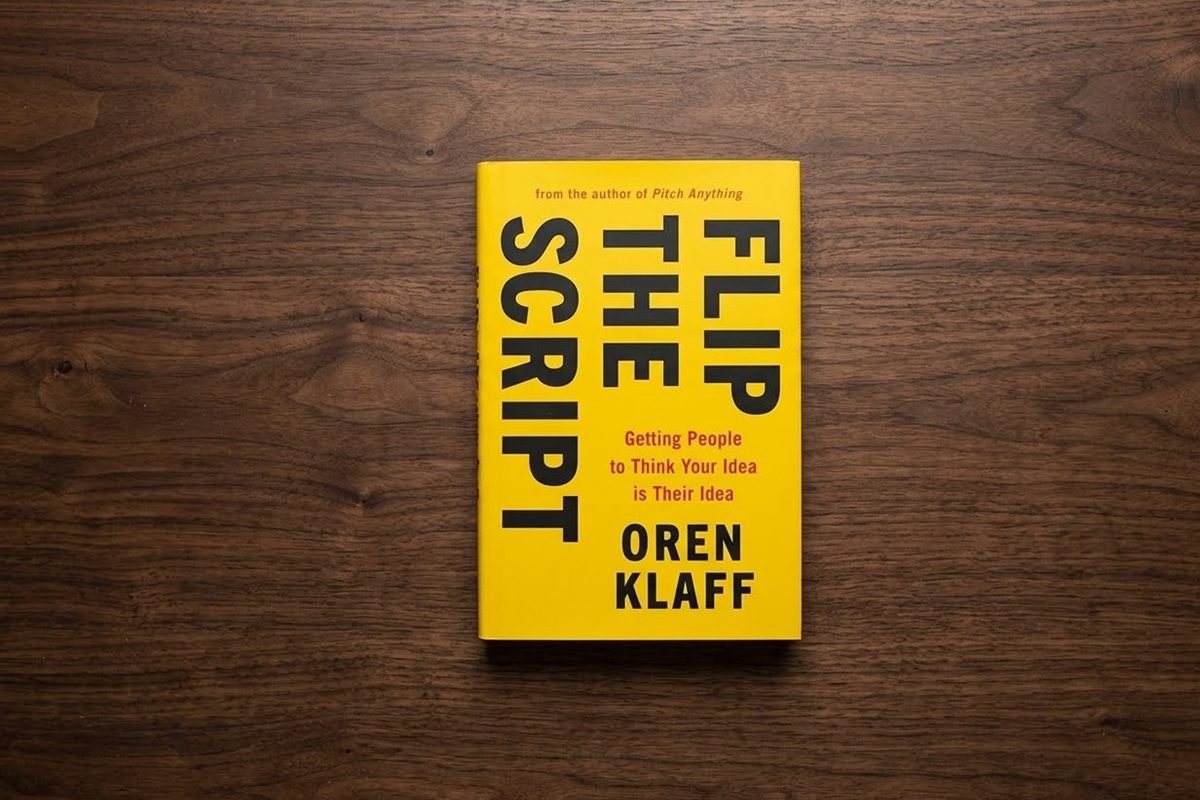
Getting People to Think Your Idea is Their Idea
By Oren Klaff
Genres:
- Persuasion
- Sales & Selling
- Communication Skills
The year it was published:
2019
Number of pages:
256

As an Amazon Associate, I earn from qualifying purchases.
Table of contents:
Introduction
Chapter 1: Why You Need Inception
Chapter 2: The Dominance Hierarchy
Chapter 3: Creating Certainty
Chapter 4: Using Pre-Wired Ideas
Chapter 5: The Power of Plain Vanilla
Chapter 6: Leveraging Pessimism
Chapter 7: How to Be Compelling
Chapter 8: Flip the Script, Go Anywhere, Try Anything, and Put It All on the Line to Win an Impossible Deal
Conclusions
Thoughts about the book:
Flip the Script is an assertive, psychology-driven manual on persuasion, negotiation, and high-stakes dealmaking. Building on themes introduced in Pitch Anything, Oren Klaff, with this book, provides a field manual shaped by real fundraising rooms, capital allocation battles, and live negotiation environments. Klaff’s central argument is clear and consistently reinforced throughout the book, and that is, persuasion is less about logic and more about status alignment and control of the internal narrative. Throughout the book, he returns to a core architecture of the process, which is dominance hierarchy, certainty, pre-wired ideas, and perception management.
Unlike many persuasion books that lean heavily on laboratory research but struggle with practical execution, Klaff writes from his own experiences. In the book, he references evolutionary biology and dominance hierarchies, and then he translates these ideas into accessible, everyday language. Academic jargon is stripped away! That said, the book does not rigorously cite empirical research. Claims about cognitive wiring, dominance structures, and persuasion mechanisms are delivered with confidence but without substantial academic research. Klaff’s tone is direct, occasionally confrontational, and intentionally provocative. Sentences are punchy, arguments are structured in tight, digestible segments, which result is a fast, engaging read that prioritizes actionable insight over literary flourish.
Who should read this book:
If you have ever sensed that persuasion is less about answering objections and more about shaping perception before objections arise, then Flip the Script by Oren Klaff is for you. In this book, Klaff moves beyond the mechanics of pitching and into something subtler, and that is belief. He is not merely interested in closing deals. He is searching for the moment when an idea takes root in someone else’s mind and begins to feel like their own. Drawing on neuroscience and evolutionary psychology, he argues that certainty and not information is what truly drives decisions.
Reading Flip the Script feels like being shown the hidden wiring behind influence. Klaff writes with urgency and confidence, blending case studies from high-stakes finance with bold psychological claims about status, dominance hierarchies, and mental shortcuts. If you want to understand why some messages spread effortlessly while others stall and how to engineer the former, this book challenges you to stop explaining and start positioning.
Summary of the book:
Introduction
In the introduction, Klaff argues that traditional persuasion is broken because it assumes people make decisions through rational evaluation. In reality, decisions are filtered through social hierarchies, emotional certainty, and subconscious bias. He introduces the central concept of “flipping the script,” which means changing the mental narrative inside someone’s head so that your idea feels like their own conclusion. Instead of pushing harder, you reposition yourself and the opportunity in a way that triggers status alignment and internal validation. The introduction establishes the book’s core claim: influence comes from controlling perception, not providing more information.
Chapter 1: Why You Need Inception
Klaff borrows the metaphor of “inception” to describe planting ideas in a way that feels self-generated. People resist being convinced, but they rarely resist their own thoughts. The key to influence is not presenting a fully formed solution but guiding the other person toward discovering it themselves. Klaff explains that when individuals feel ownership over an idea, they defend and commit to it more strongly. This chapter emphasizes subtlety, patience, and strategic questioning rather than direct persuasion. In this chapter, Klaff shares the story of a deal in Moscow with a guy named Victor for $10 million. Klaff was representing a company that needed affordable Russian mathematicians for its data science work. The challenge arose when Viktor used his power and a supposed language barrier to control the conversation, pushing Klaff into a low-status, anxious position. Instead of continuing to pitch, Klaff stopped selling and deployed Inception techniques to reestablish his authority. He then offered Viktor a clear binary choice: “Either say ‘I don’t want to do the deal,’ and that’s fine. Or say ‘I like you and I like the deal and let’s move ahead.'” Then he stopped talking. After three minutes of uncomfortable silence, Viktor asked to see the data again. Klaff responded by casually looking for an Uber on his phone and answered any of Viktor’s questions. Viktor, now intrigued and slightly chasing Klaff, ultimately committed: “I like this deal. We can work together, so thank you, please, now stay.” The $10M deal closed on fair terms.
Chapter 2: The Dominance Hierarchy
Human interaction operates within a dominance hierarchy, whether acknowledged or not. Klaff argues that every negotiation, pitch, or proposal is filtered through an assessment of relative status. If you appear lower in the hierarchy, your ideas are dismissed more easily. If you appear equal or higher, your ideas receive automatic validation. This chapter explores the biological and evolutionary roots of hierarchy and shows how it influences deal-making. Klaff contends that status alignment is often more decisive than the merits of the idea itself. In this chapter, the case study is a $25 million deal. Klaff needed to find John King, a reclusive billionaire energy investor, to rescue a $25M solar deal that had fallen apart. John was rumored to be attending a high-end conference at a Beverly Hills mansion. Klaff arrived and immediately demonstrated Status Alignment. When Klaff finally approached John King, he delivered a carefully prepared Status Tip-Off using energy industry terms, a specific California state bill he’d helped pass, and an upcoming regulatory change that every serious energy investor was tracking. In 68 words, Klaff signaled that he was operating at exactly John’s level. John’s response: “Wait, I didn’t catch your name.” That curiosity was the signal that Status Alignment had been achieved. Within days, John invested in the solar deal.
Chapter 3: Creating Certainty
Uncertainty kills deals. Klaff explains that decision-makers fear social and professional risk more than financial loss. To gain agreement, you must reduce perceived uncertainty. Certainty does not come from overwhelming someone with data; it comes from social proof, authority cues, and narrative coherence. The brain seeks confidence signals from others in the hierarchy. By controlling perception and demonstrating calm authority, you create the feeling of inevitability that moves decisions forward. In this chapter, Klaff shares a story of a $10 million deal. Klaff and his client, Billy Campbell, a cybersecurity expert from Akron, Ohio, traveled to Geneva to pitch a group of famously cautious Swiss bankers. Once there, Billy’s Status Tip-Off worked brilliantly. He examined the Georgian architecture of the bank’s building, identified the window tax tradition, and immediately diagnosed the bank’s cybersecurity problem, which was a lack of ISO 2700 compliance, and that meant they couldn’t trade directly with financial exchanges, causing massive trading lag times. In under two minutes, Billy had achieved Status Alignment and identified a critical pain point. The deal derailed briefly, but Klaff quickly recovered and got the deal closed.
Chapter 4: Using Pre-Wired Ideas
People are guided by pre-existing beliefs and cultural narratives. Klaff advises leveraging ideas that are already “pre-wired” into someone’s thinking rather than attempting to install entirely new frameworks. When your proposal aligns with values or beliefs they already hold, resistance drops. The strategy is not to argue but to connect your idea to something familiar and trusted. Influence works best when it feels consistent with what someone already believes about themselves and the world. In this chapter, Klaff shares a story of a $22 million deal where his client needed investors. The story ends with the CFO emerging from the deliberation room and telling Klaff: “I don’t know what happened in there, but we just voted to invest, and it’s going to be the largest single investment our firm has ever made.”
Chapter 5: The Power of Plain Vanilla
Complexity often creates doubt. Klaff argues that simplicity signals confidence. When an idea is presented in a straightforward, easily digestible manner, it appears more stable and credible. Overcomplicating proposals can make them seem risky or fragile. “Plain vanilla” does not mean boring it means clear, structured, and easy to process. Simplicity lowers cognitive friction and increases acceptance. The story in this chapter is about the $42 Million in Honolulu. Klaff’s partner signed a purchase agreement for a $42M Chinese marketplace in Honolulu without telling him until after the deal was done. The problem was that Klaff’s team researched the market and found that every potential investor thought the property was fascinating but too unusual to buy. So with 30 days to raise $42M or face financial disaster, Klaff needed to reframe the deal so that it would resolve any questions or doubts of any investors on how “unusual this Chinese marketplace” was to invest.
Chapter 6: Leveraging Pessimism
Klaff introduces a counterintuitive insight: acknowledging risk can increase trust. Rather than overselling optimism, addressing potential downsides makes you appear realistic and credible. Decision-makers are often scanning for hidden threats. By articulating them openly, you demonstrate control and preparedness. Leveraging pessimism reframes risk as manageable rather than hidden. In this chapter, Klaff shares the story of how he succeeded at recruiting an eSports celebrity for a different team during a tournament.
Chapter 7: How to Be Compelling
Being compelling is less about charisma and more about narrative control. Klaff argues that compelling communicators create tension, authority, and intrigue simultaneously. They speak with clarity, avoid over-explanation, and maintain social dominance without aggression. Compulsion arises when people sense confidence combined with exclusivity. This chapter synthesizes earlier concepts into behavioral execution. In this chapter, Klaff shares a story of how he coached a sales team to improve their performance. He shares how he listened to hours of recorded sales calls and identified the root cause of not closing deals. The team was cycling through all five apocalyptic personas on every single call. They were trying to be likable, then informative, then persuasive, then gentle, then combative, because of that, the buyers felt manipulated. Klaff’s two-day training taught the team to stop reacting to buyer moods and instead maintain one consistent persona, and that is the expert. This meant refusing discounts, not entertaining idle questions, staying on-script, and treating their product knowledge as genuine authority rather than a performance. Sales more than doubled in the following quarter, and doubled again in the quarter after that.
Chapter 8: Flip the Script, Go Anywhere, Try Anything, and Put It All on the Line to Win an Impossible Deal
The final chapter illustrates how flipping the script can turn unlikely opportunities into victories. Klaff shares high-stakes examples where he redefined power dynamics and reframed conversations to create momentum. He emphasizes boldness and willingness to operate outside conventional constraints. Winning “impossible” deals requires emotional detachment, strategic risk-taking, and disciplined perception control. This whole chapter is a single extended case study showing all six techniques deployed in sequence to win an impossible deal.
Conclusions
In closing, Klaff reinforces the idea that persuasion is not about pushing harder but about restructuring how people perceive status, certainty, and ownership. When you align your idea with someone’s internal narrative and social positioning, resistance fades. The book concludes with a call to apply these principles actively, stressing that mastery comes through practice in real-world environments.