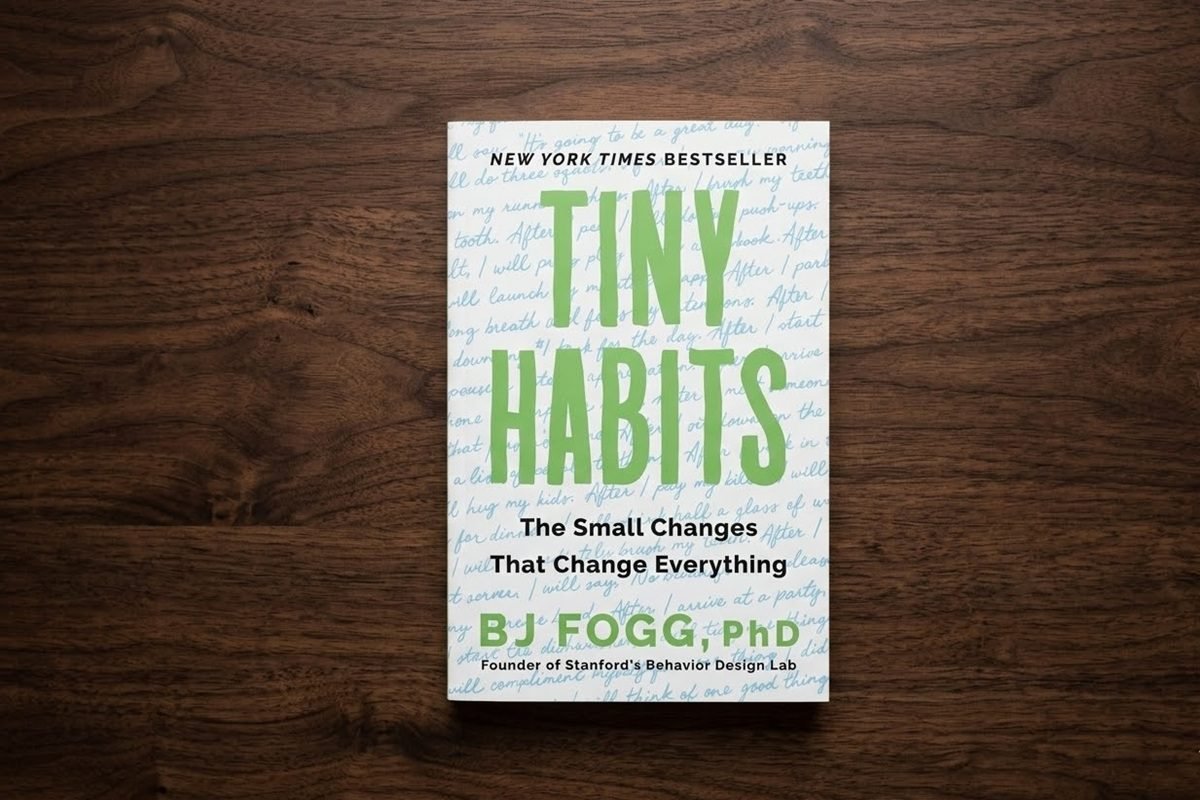
Book review: Tiny Habits
The Small Changes That Change Everything
By BJ Fogg PhD
Genres:
- Time Management
- Self-Improvement
The year it was published:
2019
Number of pages:
320

As an Amazon Associate, I earn from qualifying purchases.
Table of contents:
Introduction: Change Can Be Easy (and Fun)
Chapter 1: The Elements of Behavior
Chapter 2: Motivation — Focus on Matching
Chapter 3: Ability — Easy Does It
Chapter 4: Prompts — The Power of After
Chapter 5: Emotions Create Habits
Chapter 6: Growing Your Habits from Tiny to Transformative
Chapter 7: Untangling Bad Habits: A Systematic Solution
Chapter 8: How We Change Together
Conclusion: The Small Changes That Change Everything
Thoughts about the book:
Tiny Habits is one of those rare behavior-change books that feels less like advice and more like a system redesign for human behavior. B.J. Fogg builds the entire framework around a simple but powerful claim that lasting change does not come from motivation or willpower, but from starting so small that success becomes inevitable. What stands out immediately is how practical the method is. Instead of asking readers to overhaul their lives, Fogg reduces behavior change to its smallest possible unit, a “tiny habit” anchored to an existing routine. This makes the system feel unusually achievable, even for people who have repeatedly failed at self-improvement before. The idea of scaling behavior up gradually rather than forcing transformation is both psychologically realistic and refreshingly non-judgmental. The book is written in a very accessible, conversational style. Fogg avoids academic density despite his scientific background. Concepts from behavioral psychology are translated into simple, repeatable steps rather than theoretical discussion. This makes the book extremely easy to read, almost deceptively so, because the simplicity of the language hides the sophistication of the underlying behavioral design principles. The author relies heavily on his Stanford research and real-world experimentation, but the emphasis is always on application rather than deep theoretical debate. What I particularly liked about the book is the emphasis on emotional reinforcement. Fogg doesn’t just tell readers to repeat behaviors he emphasizes celebrating small wins as a core mechanism for habit formation. This psychological “reward loop” is often overlooked in other productivity systems, but here it becomes central. It gives the framework a surprisingly warm and encouraging tone, which makes sustained change feel less like discipline and more like self-reinforcing progress. There are, however, a few limitations. One minor critique is that the book occasionally repeats its core idea across many examples. While this reinforces understanding, it can feel slightly stretched in places. A more condensed version of the same material might have had an even stronger impact. Despite that, the core strength of the book lies in its usability. Overall, Tiny Habits is not just a book about behavior change, it is itself an example of behavior design. Its strength is not theoretical depth but practical effectiveness. It reframes personal change from a battle of willpower into a process of intelligent design, making improvement feel less like struggle and more like engineering success in small, repeatable steps.
Who should read this book:
If you have ever struggled to maintain change despite strong motivation like starting habits with enthusiasm only to lose momentum days later, then Tiny Habits by BJ Fogg is a book that speaks directly to you. It appeals to those interested in psychology, self-improvement, productivity, health, and habit formation, but who are tired of systems that depend on willpower, intensity, or dramatic lifestyle overhauls. It is especially relevant if you’ve repeatedly tried to “start fresh” only to fall back into familiar patterns. Fogg is searching for a more humane and realistic model of behavior change. His interest lies in how habits actually form in everyday life, not through pressure or perfection, but through simplicity and emotional reinforcement. He argues that lasting change does not come from big goals, but from tiny, almost effortless actions that naturally grow over time. By linking behavior to a sense of success and identity, change becomes something that sticks rather than something that strains. learn how to design behavior so that motivation is no longer required.
Summary of the book:
Introduction: Change Can Be Easy (and Fun)
BJ Fogg opens with a simple but radical idea that building habits does not require willpower or struggle. Instead of seeing failure as a personal flaw, he argues that most behavior change fails because of poor design. The solution is to start extremely small, attach new behaviors to existing routines, and reinforce them with positive emotion. He introduces the “Information–Action Fallacy,” the idea that knowing what to do is not enough to make people do it. Most advice and education fail because behavior change requires systems, not just knowledge. Fogg outlines three paths to lasting change and they are, a rare life-changing moment, redesigning your environment, or using tiny habits. Since epiphanies cannot be controlled, the most reliable methods are environment design and small, repeatable behaviors that can grow over time. At the center of the method is the ABC model, Anchor (an existing routine), Behavior (a tiny new action), and Celebration (a quick positive reinforcement). Even something as small as starting the day by saying “It’s going to be a great day” can build momentum and shape mindset. The strength of tiny habits is that they are fast, easy to start immediately, safe to fail, scalable, and independent of motivation or willpower. Real-life examples show the principle in action. Amy rebuilt her career by starting with a single daily Post-it note task that broke her paralysis and eventually led to major professional success. Juni overcame long-term sugar addiction by replacing small behaviors instead of relying on willpower, reframing her struggle as a design problem rather than a personal weakness. Linda, facing overwhelming personal tragedy, used a simple morning affirmation as an anchor that helped her gradually rebuild stability and purpose.
Chapter 1: The Elements of Behavior
This chapter introduces the Fogg Behavior Model, the book’s central framework for understanding why any behavior happens. According to BJ Fogg, every action is the result of three elements working together at the same moment, motivation (your desire to do it), ability (how easy or hard it is), and prompt (the cue that triggers the action). If any one of these is missing or too weak, the behavior will not occur. Fogg explains this relationship using the “Action Line.” When motivation is high, people can perform difficult behaviors, when it is low, only very easy behaviors will happen. Ability and motivation compensate for each other, which is why making a behavior simpler is often more effective than trying to increase motivation. However, even with strong motivation and ability, nothing happens without a prompt at the right moment. To change behavior, you adjust one of the three components, increase motivation, increase ability by making the behavior easier, or remove/add prompts. To stop unwanted habits, removing the prompt is often the simplest solution. When diagnosing why a behavior is not happening, the best order is to check for a prompt first, then difficulty, then motivation. Real-world examples show the model in action. A text message campaign for Haiti relief succeeded because it combined strong motivation, an easy action (replying), and perfect timing, raising millions quickly. Katie’s morning phone scrolling persisted because all three elements were in place, but it was broken by removing the prompt and increasing difficulty (moving the phone away). A child kicking on an airplane stopped when motivation was gently redirected through a small social gesture. And BJ himself adopted a daily cleaning habit after realizing the task was far easier than he had assumed, once it was clearly demonstrated.
Chapter 2: Motivation — Focus on Matching
This chapter explains why motivation is often the weakest foundation for behavior change. Fogg compares motivation to a “party-animal friend”, useful in bursts, but too inconsistent to rely on long-term. Because motivation naturally rises and falls due to stress, time, environment, and mood, habits built on it tend to collapse when motivation inevitably drops. Fogg describes this fluctuation as the “Motivation Wave.” At the start of any change, people feel energized and optimistic, but this peak is temporary. When motivation crashes, most behaviors disappear, which is why resolutions often fail. To correct this, he distinguishes between aspirations, outcomes, and behaviors. Aspirations are broad desires, like being healthier, outcomes are goals like losing weight, but only behaviors are concrete actions you can actually perform in the moment. Habit change only works when it is grounded in specific behaviors, not abstract goals. To generate effective behaviors, Fogg introduces the “Swarm of Behaviors,” a brainstorming method where you list as many possible actions as you can that might lead to your goal. From there, Focus Mapping helps identify “Golden Behaviors” by evaluating each option based on impact and feasibility. The best behaviors are both effective and realistically easy to do. The central principle is simple, instead of trying to force motivation onto difficult actions, choose behaviors you already want to do and make them easier to perform consistently. Examples show how this works in practice. A couple overwhelmed by their messy backyard initially relied on motivation, but progress only began when they broke the problem into small, specific actions. A bank trying to help customers save money failed when it focused on goals, but succeeded only when it shifted to concrete behaviors like calling to reduce bills or saving spare change. BJ improved his sleep not through willpower but by identifying small environmental and routine changes that were easy to implement and highly effective. Jennifer finally built a consistent exercise habit when she stopped forcing herself into workouts she disliked and instead chose group activities that matched her natural motivation.
Chapter 3: Ability — Easy Does It
This chapter argues that the most dependable way to build habits is not by increasing motivation, but by reducing difficulty. Fogg’s central claim is simple, “simplicity changes behavior.” When something is easy, people do it, when it is hard, they avoid it even if they care deeply about the outcome. He introduces the “Ability Chain,” which explains that any behavior can be blocked by one or more forms of friction, like lack of time, money, physical effort, mental effort, or conflicts with existing routines. To understand why a habit is failing, you first identify which link in the chain is weakest, then ask how to remove that friction. Once the obstacle is clear, there are three ways to increase ability such as improve skills, add tools or resources, or make the behavior smaller. This leads to two core strategies for “tiny habits.” The first is the starter step, where you focus only on the first action (like putting on running shoes instead of going for a run). The second is scaling back the behavior itself until it becomes almost effortless (like doing three breaths instead of a full meditation session). A key insight is that the tiny version of a habit is not temporary, it is the permanent baseline. Even the smallest action counts as success because it keeps the habit alive and prevents total breakdown on low-energy days. Real-world examples show how this works. Instagram succeeded by stripping a complex app down to its simplest action, take a photo and share it. BJ fixed his inconsistent flossing not through discipline, but by switching to thinner floss and committing to flossing just one tooth, which naturally expanded into a full habit. Sarika, managing bipolar disorder, stabilized her routines by reducing them to tiny, manageable actions that could survive emotional ups and downs. Molly improved her cooking habits not by forcing herself to spend more time, but by reducing physical effort with better tools and support from her partner.
Chapter 4: Prompts — The Power of After
Even when motivation is high and the behavior is easy, nothing will happen without a prompt, the cue that tells you “do this now.” Fogg emphasizes that prompts are the missing link in many failed habits, because without them, people simply forget to act. He describes three types of prompts. Person prompts come from internal memory, but they are unreliable. Context prompts come from the environment, like alarms or reminders, but they lose effectiveness over time and can become overwhelming. The most effective are action prompts, where an existing behavior triggers a new one. These action prompts are called Anchors, reliable routines you already do that become the “after this, I will do that” signal for a new habit. Because Anchors are already automatic, they remove the need for memory or effort. Choosing the right Anchor depends on matching location, frequency, and theme so the new habit fits naturally into what you already do. Fogg also highlights the importance of using the “trailing edge” of an Anchor as the precise moment for the new behavior. This makes the cue clearer and more consistent. He expands the idea with Meanwhile Habits, where small actions are inserted into natural waiting periods in the day, and Pearl Habits, where annoying or negative moments are repurposed as triggers for positive actions. Real examples show how powerful this becomes in practice. BJ discovered the Anchor principle by noticing how daily routines naturally chain together, leading to habits like doing push-ups after using the bathroom that have lasted for years. Amy used Anchors tied to emotional daily routines, like school drop-off, to build a consistent writing habit during a difficult period in her life. She also turned moments of emotional pain into Pearl Habits that helped her recover and regain control. Even something as small as an air conditioner clicking on became a cue for relaxation, improving sleep.
Chapter 5: Emotions Create Habits
This chapter challenges the common belief that habits form through repetition alone. Fogg argues that it is not the number of times you repeat a behavior that creates a habit, but the emotional experience immediately following it. When a behavior produces a positive feeling right away, the brain tags it as worth repeating and encodes it more quickly. This process is tied to dopamine, the brain’s reward signal, which is released when we feel a sense of success. That reward teaches the brain that the behavior is valuable. Because timing matters, the feeling must occur immediately after the action. Delayed rewards are much less effective for building habits. Fogg calls this deliberate creation of positive emotion “celebration,” or Shine. It does not need to be dramatic, it can be a smile, a fist pump, or a simple “yes.” What matters is that it feels authentic and reinforces a sense of success. He emphasizes that people can celebrate at different moments, when they remember the habit, while doing it, or right after completing it. Each timing reinforces different parts of the habit loop, but immediate celebration after completion is the most powerful for wiring in behavior. Rehearsing the full sequence of anchor, behavior, and celebration can also accelerate habit formation by strengthening the neural connection. Real-life examples show how powerful this shift is. BJ discovered that even something as small as flossing one tooth could feel meaningful when paired with celebration, which made habits stick during a difficult period of his life. Linda, initially skeptical, found that celebrating tiny actions dramatically improved her mood and helped her persist through personal crises, eventually turning celebration into a survival tool. Sarah experienced a cascade of positive change after a single moment of self-care, reinforced by a sense of pride and identity. Jill transformed a mundane chore into a meaningful act by connecting it to her deeper values, making celebration feel genuine rather than forced. The core message is that habits are not built through repetition alone, but through positive emotion. By deliberately creating moments of success, you train your brain not just to repeat behaviors, but to want to repeat them.
Chapter 6: Growing Your Habits from Tiny to Transformative
This chapter explains how tiny habits naturally expand into meaningful life change, answering the question of how small beginnings can lead to big outcomes. Fogg describes two ways habits grow, either they can expand directly over time, becoming larger versions of the same behavior, or they can multiply by triggering new related habits that form a chain of positive routines. A key driver of this expansion is “success momentum.” Frequent small wins build confidence and motivation far more reliably than occasional large achievements. As people experience repeated success, even at very small scales, they begin to trust themselves more and take on bigger challenges naturally. To support this process, Fogg introduces the “Skills of Change,” a set of abilities that allow someone to design and adjust habits effectively. These include choosing and shaping behaviors, understanding personal motivations, troubleshooting when habits fail, designing supportive environments, and developing a mindset that embraces flexibility and identity change. Among these, identity is especially important, shifting from “I am trying to do this” to “I am the kind of person who does this” makes behavior more stable and self-reinforcing. Environmental design also plays a major role. Fogg’s “SuperFridge” example shows how simply making healthy food visible, prepared, and easy to access removes friction and makes good choices automatic, reducing reliance on willpower. Real examples illustrate how these principles work in practice. Sukumar transformed his health by starting with just two push-ups, which gradually grew into a full workout routine and ultimately reshaped his identity and life direction. Sarika built a complete morning routine by stacking tiny habits that naturally led into one another, turning a single small action into a structured daily system.
Chapter 7: Untangling Bad Habits: A Systematic Solution
This chapter shifts the focus from building good habits to removing unwanted ones. Fogg argues that bad habits are not character flaws to “break” through willpower, but tangled patterns that need to be gradually untangled. Like knots in a rope, they cannot be undone all at once, only one strand at a time. He divides habits into three types. Uphill habits are positive behaviors that require effort but are easy to stop. Downhill habits are negative behaviors that are easy to continue but hard to quit, such as phone checking or junk food. Freefall habits are addictions that typically require professional support and go beyond habit design tools. To address downhill habits, Fogg introduces the Behavior Change Masterplan. The first step is to build positive habits elsewhere, strengthening confidence and skill so change feels possible. The second step is to get highly specific about the unwanted behavior and treat each instance separately, rather than trying to eliminate a broad category. The third step is to replace the bad behavior with a better one that serves the same underlying need. Across all stages, the most effective lever is the prompt. Removing cues, such as deleting apps, changing environments, or avoiding triggers, often eliminates the behavior more reliably than trying to resist it in the moment. Specificity is essential because vague goals like “stop snacking” cannot be designed against, while precise behaviors like “eating chips while watching TV after dinner” can be. Real examples show how this works. Juni overcame long-standing sugar addiction by first building success with small positive habits, then systematically identifying and dismantling specific sugar-related routines, while replacing them with healthier coping strategies. BJ applied the same approach to his own clutter habits, breaking them down into small, concrete actions like leaving clothes or books in specific places, and eliminating them one by one. Each small win built momentum for the next.
Chapter 8: How We Change Together
Tiny Habits is not limited to personal change, as the same principles can be used to help other people and even reshape group behavior. Fogg argues that we are always influencing each other, whether intentionally or not, so the ethical question is not whether to influence, but how. The right approach is to help people succeed at what they already want, rather than forcing them toward something they resist. He describes two styles of applying Behavior Design in groups. The “Ringleader” openly guides others through the process, teaching the method and leading structured exercises. The “Ninja” applies the same principles quietly, shaping conversations, tasks, and feedback without explicitly naming the system. In both cases, the underlying steps remain the same, identify goals, generate behavior options, choose simple and effective actions, attach them to reliable prompts, reinforce them with celebration, and adjust over time. The main difference is scale and visibility, not method. A key insight is the importance of positive feedback, especially in what Fogg calls the “Power Zone,” where people are learning something they care about but are still uncertain. In these moments, encouragement is extremely powerful, while criticism can be highly damaging. Specific, timely praise helps reinforce confidence and progress. Real examples show how this plays out. Mike and Carla transformed their strained relationship with their adult son Chris, not through pressure or nagging, but by starting with extremely small, achievable tasks and reinforcing success. Over time, these tiny wins rebuilt his confidence and improved his independence. Amy used the same principles to help her daughter Rachel overcome severe academic struggles by breaking tasks into manageable steps, building supportive routines, and celebrating progress. This gradually shifted Rachel’s confidence and long-term academic trajectory. At a hospital level, nurses experiencing burnout improved their well-being when they adopted tiny, embedded habits like breathing exercises, hydration cues, and mutual encouragement. Small actions, reinforced socially, shifted the broader workplace culture and reduced stress.
Conclusion: The Small Changes That Change Everything
Fogg closes with a deeply personal reflection on his nephew Garrett’s death from an overdose, an event that reinforced his urgency to share Behavior Design widely. He also reflects on his sister Linda, whose use of Tiny Habits helped her rebuild stability and meaning through years of profound personal loss. The conclusion reframes habit change not as a private self-improvement project, but as something that can ripple outward into families, communities, and society. The central message is that meaningful change always starts small. Across the book, every major transformation, whether overcoming addiction, rebuilding a career, improving health, or restoring relationships, begins with a single tiny behavior that is easy, specific, and consistently celebrated. Big outcomes are built from these small, repeatable wins rather than from dramatic resolutions. Fogg distills his approach into two guiding principles, help people do what they already want to do, and help them feel successful. When applied consistently, these ideas make behavior change more sustainable and less reliant on willpower or pressure. The final insight is that change compounds. One small habit leads to another, success builds confidence, confidence shapes identity, and identity reshapes behavior at a larger scale. Over time, these small shifts extend beyond the individual, influencing the people and systems around them. The book ends with the idea that lasting transformation is not the result of a single breakthrough, but of many small, well-designed moments that accumulate into something much larger.