Book review: Stories for Work
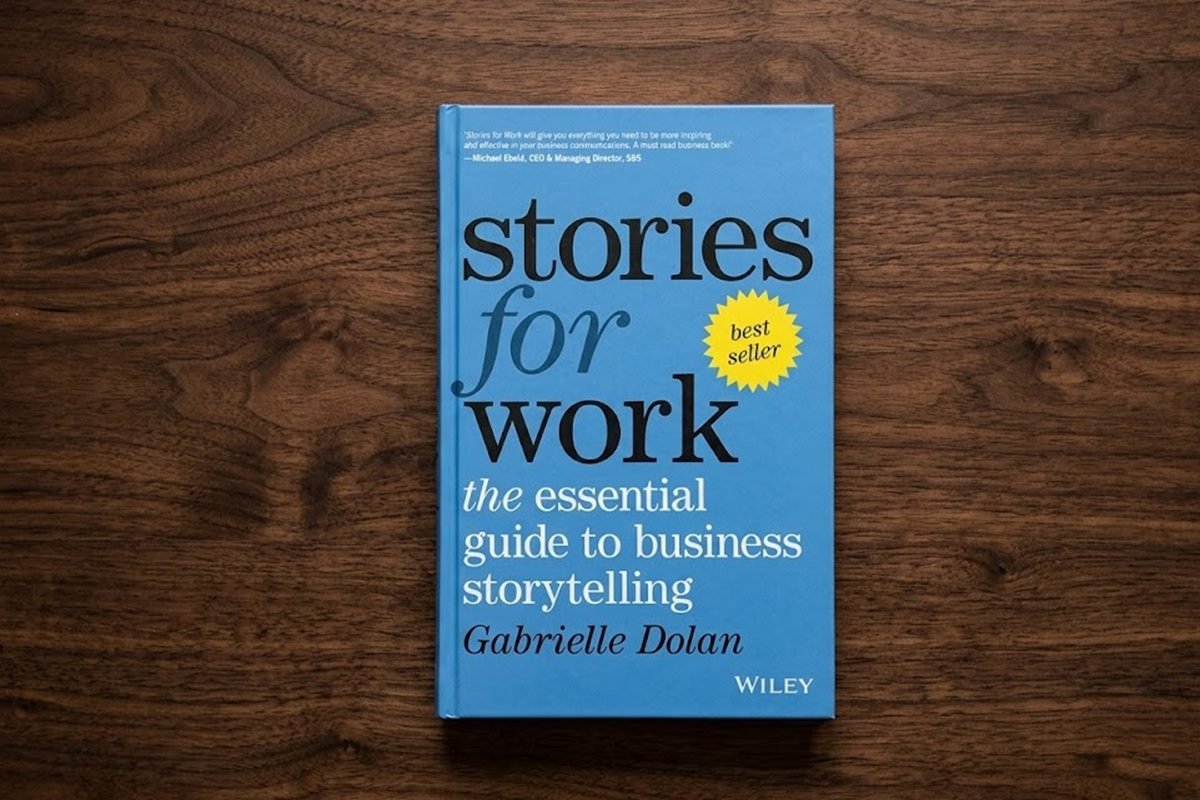
The Essential Guide to Business Storytelling
By Gabrielle Dolan
Genres:
- Storytelling
- Communication Skills
The year it was published:
2017
Number of pages:
192

As an Amazon Associate, I earn from qualifying purchases.
Table of contents:
Introduction: The Power of Stories in Business
Part I – SHAPING YOUR STORIES
Chapter 1: The Science of Storytelling
Chapter 2: Four Types of Stories You Need in Business
Chapter 3: How to Find Stories for Work
Chapter 4: How to Construct and Share Your Stories
Part II – SHARING YOUR STORIES
Chapter 5: Stories That Work for Presentations
Chapter 6: Stories That Work for Change
Chapter 7: Stories That Work for Sales
Chapter 8: Stories That Work for Values and Vision
Chapter 9: Stories That Work for Your Personal Brand
Chapter 10: Stories That Work for Coaching
Chapter 11: Stories That Work for Job Interviews
Chapter 12: Stories That Work for Newsletters and Blogs
Part III – STORYTELLING CASE STUDIES
Chapter 13: Australia Post Case Study
Chapter 14: Bupa Case Study
Chapter 15: Spark New Zealand Case Study
Conclusion: Secrets to Make Your Stories Work
Thoughts about the book:
In Stories for Work, Gabrielle Dolan makes the case that facts alone rarely change behavior, while stories create emotional connection, clarity, and memory. She breaks storytelling down into usable categories and structures, showing how professionals can use short, authentic stories to influence colleagues, clients, and teams. What I liked most about the book is its practicality. Dolan focuses heavily on how to find stories in everyday work life, how to structure them, and when to use them effectively. The emphasis on “real stories” rather than polished, theatrical narratives is refreshing. She encourages readers to draw from lived experience rather than inventing dramatic examples, which makes storytelling feel accessible rather than intimidating. The writing style is clear, simple, and highly approachable. The chapters are short, the concepts are broken into manageable steps, and the examples reinforce understanding without overwhelming the reader. One of the downsides of the book is that it can sometimes feel a bit repetitive. Still, Stories for Work succeeds in making storytelling feel practical, achievable, and relevant to everyday professional life. It lowers the barrier to entry for people who might otherwise think storytelling is a “soft skill” reserved for charismatic speakers.
Who should read this book:
If you find that facts and figures alone rarely move people to action, whether in meetings, presentations, or leadership conversations, then Stories for Work by Gabrielle Dolan is a book that directly addresses that gap. This is a book for readers who are searching for influence through communication. It speaks to those interested in leadership, corporate communication, marketing, or team dynamics. It is especially relevant if you’ve ever struggled to make your message land with clarity and emotional impact in a professional setting. Dolan is searching for the role of authentic storytelling in the workplace. Her interest lies in how real stories, which are rooted in lived experience rather than polished corporate language, can transform understanding, build trust, and drive action. She explores why stories are remembered when data is forgotten, and how narrative can bridge the gap between intention and impact in business environments. What this book will help you do is communicate in a way that people actually remember and respond to. It provides practical guidance on finding, shaping, and delivering stories that suit professional contexts without losing authenticity. Rather than encouraging performance or exaggeration, it focuses on clarity, relevance, and emotional connection grounded in truth.
Summary of the book:
Introduction: The Power of Stories in Business
This book is built around a simple idea, which is that in business, stories connect with people more effectively than facts, data, or bullet points. Gabrielle Dolan arrived at this insight during her work as a corporate change manager. Over ten years of working with leaders around the world, she repeatedly heard the same concerns, whether storytelling really works in business, what kinds of stories to tell, and how to find stories when someone feels they don’t have any. The book addresses these questions by showing that everyone already has stories and that the key is learning how to recognise and shape them. It is divided into three parts. The first explains how to find and build stories from everyday experiences. The second shows how to use them in practical workplace situations like leadership and change. The third presents case studies of organisations that successfully embedded storytelling into their culture. One early example comes from Merrin Butler at National Australia Bank, who used to ignore airline safety briefings because they felt irrelevant. During a turbulent flight, however, when the pilot warned of a final landing attempt, the instructions suddenly became urgent and everyone paid attention. Dolan later used this story with Butler’s HR team ahead of a major organisational change, helping them understand that information often only matters when it feels immediately relevant. The story stuck with the team and was repeatedly referenced, reinforcing the practical impact of storytelling in business.
Chapter 1: The Science of Storytelling
This chapter explains why stories are so powerful using brain science and research, showing that their effectiveness is measurable rather than just intuitive. Stories activate more of the brain than facts alone. While data mainly engages language areas, stories also trigger emotion, memory, and sensory regions, which makes them far more memorable and engaging. Research by Paul Zak shows that storytelling can release oxytocin, a hormone linked to trust and social bonding. This helps explain why people are more likely to trust and be influenced by a story than by credentials or statistics alone. Neuroscience research by Antonio Damasio also shows that emotion is essential for decision-making. People may use logic, but decisions are first driven by emotion. Stories work because they create that emotional response. Stories are also remembered better. Uri Hasson’s research found that listeners’ brain activity can align with the storyteller’s, making stories feel like lived experiences, which is why they stay in memory far longer than typical presentations. Overall, stories trigger emotion, emotion builds trust, trust drives decisions, and emotion improves memory. This makes storytelling one of the most effective tools in business communication. This is shown in practice by examples like Air New Zealand, which turned routine safety briefings into humorous story-based videos featuring celebrities, making them widely watched and memorable. Research by Paul Zak further supports this, showing that emotionally charged stories increase trust and motivate action, especially when they build tension and then resolve it in a meaningful way.
Chapter 2: Four Types of Stories You Need in Business
Rather than using many different categories, Dolan simplifies storytelling into a “Story Wheel” made up of four types. Together, they cover almost every business story you will ever need. Triumph stories are about success and achievement, though not necessarily big, dramatic wins. They can be moments of overcoming challenges, helping others, or achieving something meaningful. The focus should be on what you learned and how you grew, rather than on bragging about the outcome. Tragedy stories involve regret, failure, or loss. These might include mistakes you made, difficult experiences, or things you wish you had handled differently. The purpose is not to complain or play the victim, but to show honesty, self-awareness, and what the experience taught you. Tension stories are about situations where you had to choose between competing priorities, values, or responsibilities. They are powerful because they reveal what you truly stand for when decisions are difficult, such as balancing fairness with performance or work with personal commitments. Transition stories focus on change, such as starting a new job, moving countries, or going through a major life or work shift. All stories, regardless of type, must follow two rules. First, they must be authentic and genuinely true, since credibility is easily lost if stories are fabricated. Second, they must have a clear purpose, meaning there should always be a reason for telling them and a message they support. Each type of story serves a different role. Triumph builds credibility, tragedy builds connection, tension reveals values, and transition helps people relate during change. The key is knowing which story to use in the right situation.
Chapter 3: How to Find Stories for Work
Most people think they don’t have any stories, but this chapter argues the opposite. Dolan compares finding stories to using a metal detector on a beach, they are already there, just slightly buried in your memory and waiting to be uncovered with the right approach. One way to find them is by looking at your work history. By listing every job you have had, including part-time and short-term roles, you can go back through each one and identify moments linked to the four story types, things you are proud of, mistakes or regrets, difficult or unfair situations, and moments of change. Even brief or ordinary jobs often contain meaningful experiences once you start looking for them carefully. The same process can be used for personal life. By mapping out key experiences from childhood to now, you can identify simple but meaningful events such as early achievements, conflicts, accidents, travel experiences, or turning points. Each one may connect to more than one type of story, and that is completely normal. The key idea is that you do not need an extraordinary life to be a good storyteller. Ordinary experiences often resonate more strongly because they are easier for others to relate to. What makes a story powerful is not the event itself, but the meaning you attach to it and the message it supports. At the same time, finding a story does not mean you must share it. You always control what you tell and in what context. A story that is appropriate in a private coaching conversation may not be suitable for a large audience, and good storytelling involves making those judgment calls carefully. A simple example shows how this works in practice. Someone reflecting on their role as an Operations Manager in Technology ANZ identified multiple stories from the same period. A triumph came from improving their leadership approach after poor feedback and later receiving strong performance reviews. A tragedy involved dealing with their sister’s illness while living away from family and feeling guilty for not being closer. A tension story came from trying to adopt a leadership style that didn’t feel natural and receiving difficult feedback from their team. A transition story came from relocating their family to a new city, with all the uncertainty and adjustment that followed. All of these were hidden within one ordinary job, showing how much story material already exists in everyday experience.
Chapter 4: How to Construct and Share Your Stories
Now that you have your stories, the next step is shaping them using a simple structure based on Aristotle’s three parts, beginning, middle, and end, adapted for business use. The beginning should quickly set time and place, such as “Last Tuesday morning…” or “When I was growing up…” This signals to the audience that a story is starting and helps them switch into listening mode. It should be brief, without overexplaining or using phrases like, “Let me tell you a story.” The middle is the core of the story. It should include only relevant details that support the message, with anything unnecessary removed. Characters should be named to make the story more real, and language should be simple and direct, replacing corporate phrasing with honest emotional terms like “I failed” or “I was scared.” The end has three parts. First, a bridge that brings the story back to the business context, such as “I’m sharing this because…” Second, a link that connects the story to the message using inclusive language like “we,” without stating the moral directly. Third, a pause, allowing the message to land through silence. Stories should always be practised out loud, as speaking them reveals awkward phrasing and improves flow and natural delivery. Examples show this in action. Jack Percy recalls a university story about a bar that changed profitability by extending hours, illustrating non-linear thinking. Although he forgot the details of the course, he still remembers the story decades later, showing its lasting impact. Similarly, the shoe brand Django & Juliette uses its origin story inside its products, creating an immediate personal connection and showing that stories can be used anywhere communication matters, not just in formal presentations.
Chapter 5: Stories That Work for Presentations
This chapter shows how professionals use personal stories to open and close presentations, and why this is far more effective than starting with agendas or data-heavy slides. Opening with a story works because the first moments of a presentation decide whether people engage or switch off. A personal story immediately captures attention, shows authenticity, and builds trust before any argument is made. For example, Bill Clinton’s 2016 DNC speech began with “In the spring of 1971, I met a girl…”, drawing the audience in emotionally before any political message was delivered. Ending with a story is equally powerful because it leaves a lasting emotional impression that outlives the final slide. Some speakers also use a central story throughout a talk, returning to it as a thread that ties everything together and reinforces the message. Real-world examples show how effective this is. Suzanne Smith from MLC Insurance opened a financial literacy event by sharing her mother’s story of working in aged care, earning little, and relying on a pension in retirement. It immediately grounded the topic in real life, encouraged audience engagement, and set the emotional tone for the event. Erika Lanza from Bank of Melbourne used a childhood story about procrastinating on a school project to inspire executives to sell 65 charity gala tables. By comparing the task to a “blue whale,” she reframed it as overwhelming but achievable if broken into steps, and the team exceeded the target. Leadership coach Michelle Sales uses a horseback riding story to close workshops, where a coach tells her to “trust your horse,” creating a powerful message about confidence and action that often leaves audiences emotional. Lynne Cazaly opens presentations with a story about a security guard who advises, “Don’t be a donkey,” meaning don’t just complain, act. The humour and simplicity engage audiences immediately and set the tone for practical, action-focused leadership content. Across all examples, the pattern is consistent, stories at the beginning create attention and trust, and stories at the end create emotional impact and lasting memory.
Chapter 6: Stories That Work for Change
Change is one of the hardest challenges in any organisation. Traditional change management often relies on strategy documents and PowerPoint cascades, but these rarely shift behaviour. This chapter argues that personal stories are far more effective because they make change human and real. Stories work better than memos because facts alone rarely change behaviour. When people hear about change, their instinct is often scepticism, “Here we go again.” What actually matters is emotion. A personal story helps people understand what the change means for them and creates a reason to care. Stories also spread in a way formal communication cannot. Through informal networks, people naturally share messages they connect with. This “organisational grapevine” can be intentionally used by seeding meaningful stories that reinforce desired behaviours, creating a ripple effect that continues long after the original message is delivered. Real examples show this in practice. Paul Quickenden, CEO of Putti Technology, shared a personal story about being caught in a dangerous rip current while at the beach with his children. The experience became a metaphor for rapidly changing market conditions and the need to stay alert and respond quickly, making the message far more memorable than a standard business warning. Barbara Hepponstall at Accenture used her first day leading a newly restructured team to share her personal journey as an immigrant who struggled to find work until a mentor supported her. She framed her leadership as “paying it forward,” which built immediate trust and even moved senior team members emotionally. Nathan Jenson from AECOM used a story about misjudging a colleague on a flower farm based on her serious expression to challenge assumptions about safety culture. The story helped his team recognise how false beliefs can undermine better decision-making. Dermot Crowley, productivity expert, tells a story about discovering his father’s journals after his death, including a rare entry highlighting the day he met his future wife. He uses this to show the importance of clearly marking priorities so they are not lost in everyday noise. Across all examples, the effect is consistent, stories make change personal, emotional, and shareable, which is why they succeed where traditional communication often fails.
Chapter 7: Stories That Work for Sales
People buy based on emotion first and logic second. This chapter shows how using the right stories in sales builds trust, strengthens relationships, and reduces objections more effectively than features, pricing, or pitches. There are three main ways to use stories in sales. First, you can demonstrate product value by sharing real customer experiences instead of listing features, making the benefit more concrete and memorable. Second, you can reveal your values through stories, since clients often decide based on trust in the person or company as much as the product itself. Third, you can address concerns before they are raised by sharing stories that naturally respond to common doubts, which builds empathy and reduces resistance. The key rule is that every story must have a clear purpose. Small talk or random anecdotes do not work in sales unless they directly support trust, clarity, or decision-making. This is illustrated in practice by Keith Chittleborough, a hearing aid specialist, who tells a short story about a 40-year-old man who resisted hearing aids until he wanted to hear his newborn baby cry at night. The story quickly communicates the emotional value of the product, challenges stereotypes, and shows its practical benefit all at once. Jane Anderson uses a car dealership story where she was given a weekend test drive to explain how professionals can build trust by letting clients “experience” their expertise in advance through content like blogs. She reinforces that many buying decisions happen before a sales conversation even begins. Christina Guidotti shares her father’s story as a Greek immigrant who built a business from nothing through hard work and reliability. This immediately communicates her values and credibility without needing a traditional pitch. Jason Garner uses a personal story about his father’s respect for people in business to change the tone of difficult rent conversations. Instead of an adversarial exchange, the story reframes the interaction as a partnership, helping tenants see him as someone who wants to help rather than pressure them. Across all examples, the effect is the same, stories replace resistance with connection, making sales conversations more human, trustworthy, and effective.
Chapter 8: Stories That Work for Values and Vision
Company values are often reduced to polished words on a wall that sound good but are rarely remembered or lived. This chapter argues that stories are what turn those abstract values into real behaviour inside organisations. Traditional values rollouts usually fail because they rely on posters, slogans, and presentations. Employees may remember the words, but they often don’t understand how they apply in everyday situations. The result is values that are communicated but not truly absorbed. In contrast, organisations already have a powerful informal communication system, the grapevine. This is where stories, opinions, and experiences actually spread between employees. While much of this network carries negative or informal chatter, leaders can influence it by sharing authentic personal stories linked to values. These stories spread naturally and shape culture in a way formal communication cannot. One of the most effective approaches is also the most surprising, sharing moments when you did not live up to a value. These stories are often more powerful than success stories because they show honesty and self-awareness. Admitting failure and reflecting on it signals that the value genuinely matters, rather than simply being a slogan. This is illustrated by Angela Middleton from ME Bank, who introduced the value “go to the moon” by sharing her own leap of faith in quitting a stable job, moving cities with no plan, and starting over with uncertainty. Her story made the idea of being brave and taking risks feel real and personal rather than abstract. Stefani Adams from Australia Post Accelerator shares a story from a school information night where she dismissed a young teacher’s presentation as unhelpful, only to be corrected by her son, who reminded her to show respect. By openly admitting her mistake, she brought the value of respect to life in a way that felt authentic and relatable. Matthew Ricker from National Australia Bank uses a simple family story about his grandmother’s pride when he became a bank employee. He contrasts this with the modern reputation of banks to express the organisation’s aspiration to “make our nanas proud again,” turning a corporate vision into something personal and meaningful. Across these examples, the pattern is clear, values only become real when they are told through stories, especially honest ones. Stories don’t just describe values, they demonstrate them in action, making them believable and memorable inside an organisation.
Chapter 9: Stories That Work for Your Personal Brand
Your personal brand is not your job title or LinkedIn summary. It is what people say about you when you are not in the room, more specifically, the stories they tell about you. This chapter explains how to shape that brand intentionally through the stories you choose to share. The SEA framework helps guide this. Strategy means being clear about what you want to be known for and what you stand for, and being willing to say no to opportunities that don’t fit. Evolution recognises that your brand will change over time as you grow, so it should not trap you in an outdated identity. Authenticity ensures your brand is sustainable and believable, because anything you cannot genuinely live will eventually fall apart. Stories are the main way your brand is built. Each story you tell communicates your values, character, and perspective far more effectively than a CV or online profile. They are also repeatable, meaning others can retell them, allowing your reputation to spread naturally without your involvement. This is illustrated by Stephen Purcell, who shared a story on LinkedIn about choosing between a safe teaching path and an uncertain law degree. His father didn’t give advice, but asked thoughtful questions that led him to choose law. The story reveals Stephen’s values around challenge, reflection, and long-term thinking more clearly than any professional bio. Aishwarya Rao uses a deeply personal story about surviving a serious illness and reflecting on life priorities. After her experience, she uses the phrase “life is too short to iron tea towels” to encourage people to leave toxic environments and make bolder life choices. The story is powerful because it is vulnerable and emotionally honest, which makes her message more credible and memorable. Mark Truelson shares a raw account of losing his career stability, marriage, and sense of identity, and how he rebuilt his life after a personal breakdown. By openly telling this story, including his struggles with depression and family intervention, he communicates resilience and transformation in a way that feels deeply human and relatable. Across these examples, the message is consistent, your personal brand is not what you claim about yourself, but what your stories make others believe about you.
Chapter 10: Stories That Work for Coaching
This chapter is for managers, mentors, and anyone helping others grow, change behaviour, or see situations differently. Its core idea is simple, instead of telling people what to do, share a story and let them arrive at the insight themselves. Stories work better than direct advice because advice often triggers defensiveness, while stories create curiosity. When someone hears a personal experience, they are more open, more engaged, and more likely to internalise the lesson because they discover it rather than being instructed. Vulnerability strengthens this effect. Stories that include your own struggles or mistakes reduce hierarchy and create connection. They signal, “I’ve been there too,” which builds trust and makes the coaching relationship feel more human and less instructional. This is shown by Georgina Laurie, who encouraged women in a leadership program to act on their learning by sharing her own experience of learning to drive a manual car. After delaying out of fear, she finally tried, struggled in real traffic, and eventually succeeded. Her message was that people often leave useful skills unused because of hesitation, but progress only happens through action. Gabrielle Dolan shares a coaching story about being a nervous first-time umpire at a softball game. Her instinct was to admit her inexperience, but a mentor told her to project confidence instead. By acting decisively, she quickly grew into the role. She uses this to show how confidence can be built through behaviour, not just preparation. Shane Nottage shares a deeply personal story about building a life and business with his wife, only to lose her to brain cancer. He uses this experience to remind others not to spend all their time focused on work while neglecting life itself. The emotional weight of the story makes the message far more powerful than a simple warning. Paul Worth uses the example of airport security before and after 9/11 to show how low trust creates high cost and inefficiency. He applies this to organisations, encouraging teams to reflect on how a lack of trust may be slowing their own systems and relationships. Across all examples, the pattern is clear, coaching stories replace instruction with reflection. They create space for people to think, connect, and change on their own terms, which is what makes them so effective.
Chapter 11: Stories That Work for Job Interviews
Most job candidates rely on rehearsed answers to predictable interview questions, which makes them sound interchangeable. The candidates who stand out are those who use stories to reveal personality, values, and character. Stories make people memorable in a way no CV can. Standard interview responses, especially in behavioural interviews, often stay too general. Candidates describe what they would do instead of what they actually did. A specific personal story, by contrast, creates a real moment the interviewer can engage with and turns the interview into a genuine conversation. A useful way to understand this is Aristotle’s model of persuasion. Logos is your logic, qualifications, and experience. Ethos is your credibility, the trust you inspire. Pathos is an emotional connection, the sense of rapport you build. Most candidates focus on logos, but stories naturally combine all three, especially ethos and pathos, which are what make someone truly memorable. Personal stories in interviews work because they show how you think and behave in real situations. Whether it’s a marathon, a family challenge, or a difficult decision, these moments reveal resilience, values, and personality in a way job descriptions never can. This is shown by Rose McCarthy, who was applying for a medical receptionist role with limited experience. Instead of relying on her CV, she shared the story of moving to Ireland with three young children during a recession, framing it as proof of her adaptability and willingness to take on challenges. She got the job shortly after. Catherine used a story from an ethics course where she challenged inappropriate material despite professional risk. This demonstrated courage and values in action, leading to a conversation that helped her secure a senior diversity and inclusion role despite not having a traditional HR background. Bianca Drieberg answered a question about herself by sharing her marathon experience, including setbacks and perseverance. She linked this directly to her work ethic, showing determination and follow-through, which left a strong impression on the interviewer. Liz Earl used a ballet class story to explain her approach to teamwork, describing how beginners and experienced dancers supported each other and came together for a performance. This made her idea of collaboration tangible and led to her being hired as Head of Marketing. Across all examples, the pattern is clear, stories turn interviews from evaluations into conversations, and from scripted answers into evidence of who you really are.
Chapter 12: Stories That Work for Newsletters and Blogs
Stories are not limited to face-to-face communication. They are just as powerful in writing, be it in emails, blogs, newsletters, and website copy. For people who are not yet comfortable telling stories out loud, writing is often the best place to start building confidence. Written communication is usually filled with jargon, data, and impersonal language, which makes it easy to ignore. A short personal story changes that completely. It makes writing more engaging, more human, and more likely to be read and shared. In fact, research shows that blogs and newsletters containing personal stories consistently generate higher engagement, especially when they include images of the people involved. Written stories work in much the same way as spoken ones, but they should be slightly more polished and structured. The tone can be cleaner and more refined, but it should still feel conversational and personal rather than formal or corporate. This is illustrated by Peter Cook, who shares a travel story about missing a flight to Cairns after multiple setbacks. At first, the day felt like a disaster, but when he learned another family would have to pay thousands to rebook while he paid nothing due to his status, the same experience suddenly felt like a win. The story shows how perception changes based on comparison, not absolute reality. In another story, Peter Cook describes his lifelong obsession with making his sideburns perfectly even, only to realise that no one else has ever noticed them. He uses this to remind people not to overthink minor flaws in their work, because audiences are far less critical than creators assume. Dayle Stevens from National Australia Bank shares a story about her seven-year-old son who carried two hats to school so that another child would not be left out. This simple moment became the foundation for a blog about inclusion, showing how small everyday actions can reflect powerful workplace values. Lynne Naphtali from Accenture writes about a colleague, Colin Fulton, whose calm and authentic leadership style left a lasting impression on her early career. His unexpected death prompted her to reflect on what genuine leadership looks like and commit to writing about authentic leadership more regularly. Across these examples, the pattern is consistent, written stories turn routine communication into something memorable, relatable, and emotionally engaging, helping ideas spread more effectively across organisations.
Chapter 13: Australia Post Case Study
Australia Post is a government-owned enterprise with around 36,000 employees and more than 4,000 post offices. As digital communication reduced traditional mail, the organisation faced major pressure on its core business. In 2015, it introduced new shared values and needed a way to make them meaningful across a large, diverse workforce. The challenge was that previous top-down rollouts had failed to change behaviour. Australia Post needed a different approach that would genuinely influence culture rather than just communicate slogans. The solution was a program called the Grapevine, which deliberately used the organisation’s informal communication network. Instead of relying on central messaging, influential employees from different levels were trained in storytelling and encouraged to share personal experiences linked to five values, being safe everywhere, respecting everyone, helping each other, improving every day, and delighting customers. These stories were shared in sessions and then distributed internally through audio and video. The impact was significant. Understanding of the values increased from 50% to 97%. Participants showed higher engagement and stronger pride in the organisation, and even teams with just one participant experienced a measurable uplift. Over 1,000 employees across multiple states took part, creating a widespread cultural ripple effect. The strength of the program came from simple, relatable stories shared by employees. For example, Scott Mansell shared a story about his wife falling from a bike he gave her, which made him realise how easily safety assumptions can fail. He used it to highlight that safety is everyone’s responsibility, especially when onboarding new people. Jonathan Snelling shared a story about refusing help while changing a flat tyre on a family trip, only to realise later that pride had cost his family time and comfort. The story reinforced the value of accepting help and working collaboratively. Aiden Turner shared his personal journey of losing weight through small, consistent daily improvements, eventually completing a marathon. His story made the idea of “improving every day” tangible and motivating for colleagues. Across all examples, the success of the Grapevine program shows that culture does not change through instructions or policies, but through stories that employees relate to, repeat, and live.
Chapter 14: Bupa Case Study
Bupa is one of the world’s largest healthcare companies, serving over 32 million customers across 190 countries. In 2014, it doubled in size to around 80,000 employees after a series of acquisitions, bringing together people from many different organisations, cultures, and ways of working. The challenge was to introduce seven new global values and make them meaningful across such a large and diverse workforce. Rather than treating this as a traditional rollout, Bupa redefined success. As Managing Director Dean Holden explained, the goal was not for employees to simply remember the values, but to see them reflected in everyday behaviour. This shifted the entire approach from communication to cultural change. The solution was a storytelling-based launch at a global leadership conference. Seven leaders, one for each value, were trained to share personal stories that illustrated what the values meant in real life. These stories were delivered at the very start of the conference, before any formal agenda, creating an immediate emotional and authentic tone that many attendees described as the most memorable part of the event. The impact was both cultural and measurable. The storytelling approach was adopted across Bupa regions globally. An internal “bupathanks” initiative generated thousands of expressions of appreciation between employees, reinforcing the values in daily interactions. Employee feedback also showed a clear link between engagement and the lived experience of values, those who saw the values in action reported higher satisfaction, while those who didn’t highlighted this gap as their main concern. The strength of the initiative came from the personal stories behind each value. For example, John Rizzo shared a story about his mother’s long struggle to build a sensory room for disabled young people, showing passion as persistence in the face of repeated obstacles. Tina Paterson reflected on a conversation with her young son, whose simple reaction to learning about meat challenged her assumptions and reminded her what openness looks like in its purest form. Maureen Berry shared her experience growing up in a difficult family environment and making a courageous decision as a child to keep her siblings together, a story that later shaped her leadership in healthcare transformation. Across all examples, the outcome was clear, when values are told through real human stories, they stop being abstract concepts and become lived behaviours that shape culture, identity, and everyday decision-making.
Chapter 15: Spark New Zealand Case Study
Spark (formerly Telecom New Zealand) is New Zealand’s largest telecommunications company with over 5,000 employees. In 2013, it underwent a major transformation, including a full rebrand and the creation of entirely new company values designed from scratch. Instead of imposing values from the top, Spark used three independent working groups across different regions, each asked to create “real values for real people” in plain language. Without seeing each other’s work, all groups produced almost identical outcomes, which gave strong early validation and employee ownership. The final values were, we listen, we’re straight up, we get stuck in, we win together. To bring these values to life, Spark focused on storytelling rather than slogans. Leaders were trained in storytelling workshops, with demand so high that sessions quickly filled and expanded from 300 to 600 senior leaders, including the CEO and executive team. The goal was to help leaders translate abstract values into everyday behaviour. The results were strong, almost all participants reported increased confidence in communicating with teams and customers, and the vast majority found the training highly useful. A “Little Victories” program was also introduced to collect and share stories of employees living the values, helping reinforce behaviour across the organisation and break down silos between teams. The power of the approach is seen in individual stories. Amanda Jarvie from Spark Digital shared a story inspired by rugby coach John Kirwan about listening to teenagers on their own terms. It made her realise she was not truly listening to her own children, leading her to change small daily habits. She used this to reinforce the idea that listening in business also means meeting customers where they are, not when it is convenient. Wendy Ireland shared a story about a plaque she saw in a law school that said, “Don’t raise your voice, improve your argument.” While she initially admired it intellectually, she only truly understood it later through a manager who modelled honest but empathetic communication. This helped her redefine what being “straight up” really means, not bluntness, but courageous honesty delivered with care. Across Spark’s transformation, the key insight is consistent, values only become real when leaders and employees translate them into personal stories that shape everyday behaviour.
Conclusion: Secrets to Make Your Stories Work
The book closes with five core principles the author describes as the “secrets” of great storytelling, the habits that separate effective storytellers from truly compelling ones. The first is embracing vulnerability. Strong storytellers are willing to share real, human moments rather than only polished success. As Brené Brown’s research highlights, vulnerability is a key measure of courage, and it makes stories more relatable and trustworthy. However, it must be used carefully and appropriately, depending on context and relationship, since oversharing or misjudged openness can have the opposite effect. The second is keeping stories succinct. In business settings, spoken stories should usually last no more than one to two minutes. Anything longer risks losing attention or diluting the message. The key is discipline, removing unnecessary detail so only what supports the core point remains. The third is using humour wisely. Humour can build connection and ease tension, but it must be handled carefully. Self-deprecating humour is safest because it creates warmth without targeting others, while humour that could be offensive or divisive should be avoided entirely. The effectiveness of humour always depends on knowing the audience. The fourth is being prepared. Even the most natural storytellers do not improvise, they refine. Great stories are written, practised aloud, edited, and tested until the delivery feels effortless. Preparation is what makes a story clear, confident, and impactful, especially in high-stakes situations like interviews or presentations. The fifth is having variety. Relying on a single story weakens impact over time as audiences begin to recognise and tune it out. Strong storytellers continuously collect new material from everyday life, finding story potential in ordinary moments and constantly building a diverse “story bank.” Together, these principles reinforce the idea that storytelling is not spontaneous performance, but a disciplined, ongoing practice grounded in awareness, preparation, and everyday observation.