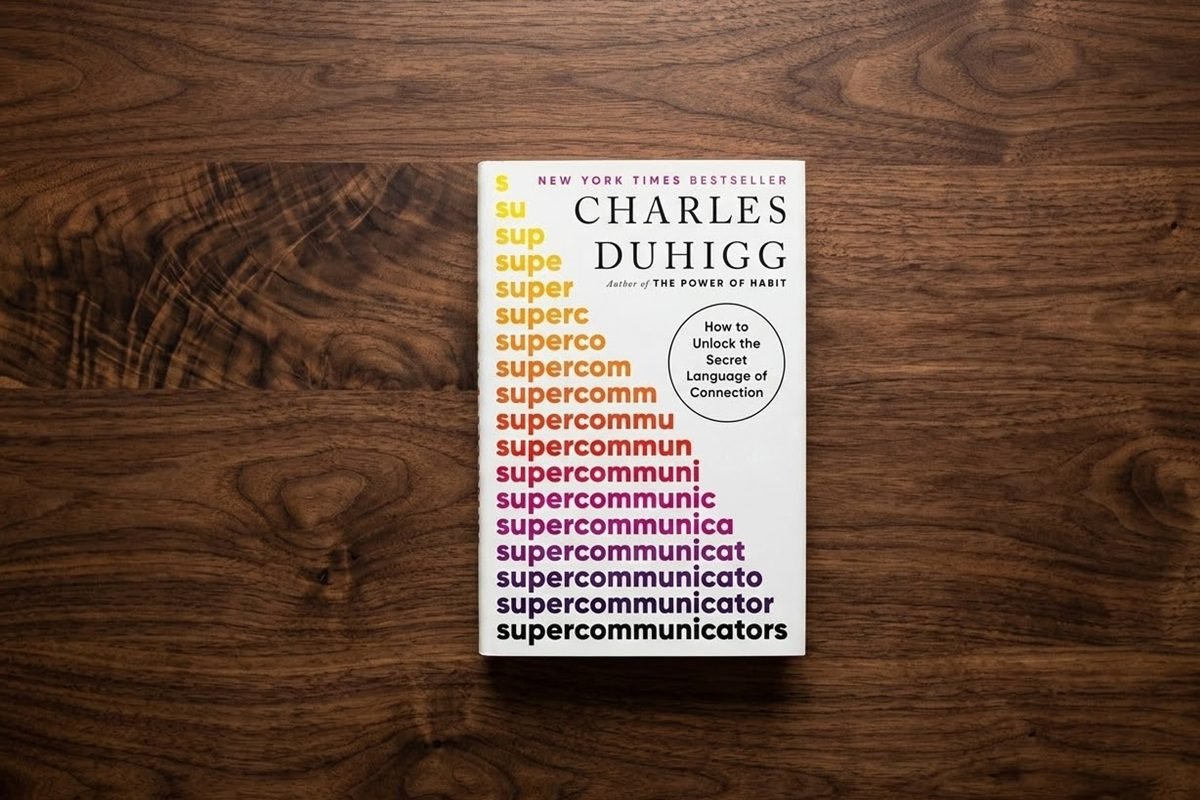
Book review: Supercommunicators
How to Unlock the Secret Language of Connection
By Charles Duhigg
Genres:
- Communications skills
- Social Psychology
- Negotiation
The year it was published:
2024
Number of pages:
320

As an Amazon Associate, I earn from qualifying purchases.
Table of contents:
Prologue
Part I – THE THREE KINDS OF CONVERSATION
Chapter 1: The Matching Principle — How to Fail at Recruiting Spies
Guide Part 1: The Four Rules for a Meaningful Conversation
Part II – THE WHAT’S THIS REALLY ABOUT? CONVERSATION
Chapter 2: Every Conversation Is a Negotiation — The Trial of Leroy Reed
Guide Part II: Asking Questions and Noticing Clues
Part III – THE HOW DO WE FEEL? CONVERSATION
Chapter 3: The Listening Cure — Touchy-Feely Hedge Funders
Chapter 4: How Do You Hear Emotions No One Says Aloud? — The Big Bang Theory
Chapter 5: Connecting Amid Conflict — Talking to the Enemy About Guns
Guide Part III: Emotional Conversations, in Life and Online
Part IV– THE WHO ARE WE? CONVERSATION
Chapter 6: Our Social Identities Shape Our Worlds — Vaccinating the Anti-Vaxxers
Chapter 7: How Do We Make the Hardest Conversations Safer? — The Problem Netflix Lives With
Guide Part IV: Making Hard Conversations Easier
Afterword: The Harvard Study of Adult Development
Thoughts about the book:
Great communicators are not necessarily charismatic speakers, they are people who understand what kind of conversation is actually happening. Duhigg divides conversations into categories such as practical, emotional, and social conversations, showing how communication breaks down when people think they are having the same conversation but are actually operating on completely different levels. It is a deceptively simple insight, but one with enormous explanatory power. The book is written in classic Charles Duhigg fashion, which is narrative-driven, highly readable, and structured around compelling real-world stories. He blends neuroscience, psychology, behavioral science, and journalism into a style that feels smooth rather than academic. One chapter may explore CIA interrogators or marriage counselors, while another examines political polarization or workplace conflict. Duhigg excels at turning research into narrative momentum, which makes the book surprisingly difficult to put down for a nonfiction work. Complex psychological concepts are translated into everyday language. Many communication books reduce human interaction to tactics like persuading better, negotiating harder, dominate conversations. Duhigg repeatedly emphasizes listening, emotional recognition, vulnerability, and curiosity. The book understands that communication is not merely about transmitting information it is about creating connection and mutual understanding. That said, the book has its downsides. At times, it can feel repetitive because Duhigg reinforces the same core framework across many examples. In some cases, you might feel that certain anecdotes are stretched slightly too long to maximize emotional impact. I also would have liked a deeper exploration of digital communication and how modern technologies distort conversation. While the book touches on polarization and online interaction, there is room for a more in-depth research of how social media algorithms, fragmented attention, and digital identity affect communication itself. Ultimately, Supercommunicators is not a book about manipulation or rhetorical tricks. It is a book about understanding people. Duhigg’s greatest achievement is showing that extraordinary communication is often less about speaking brilliantly and more about recognizing what another person truly needs from the conversation. That insight gives the book unusual warmth and humanity for a work grounded so heavily in behavioral science.
Who should read this book:
If you have ever walked away from a conversation feeling misunderstood or wondered why some people seem able to instantly build trust, defuse tension, and make others feel deeply heard, then Supercommunicators by Charles Duhigg is a book that deserves your attention. This is a book for anyone who is searching for genuine connection in a world full of constant communication but surprisingly little understanding. It speaks to those interested in psychology, relationships, leadership, negotiation, teamwork, and human behavior. Duhigg is searching for the hidden patterns behind meaningful conversations. His interest lies in understanding why some interactions create alignment and trust while others collapse into confusion, defensiveness, or distance. He argues that many communication failures happen because people are unknowingly having different kinds of conversations at the same time, practical, emotional, or social, and are failing to recognize which one matters most in the moment. What this book will help you do is become more intentional and perceptive in how you communicate. It teaches how to listen beneath words, recognize conversational dynamics, and create dialogue where people feel understood rather than managed. Through research and storytelling, Duhigg shows that extraordinary communicators are not necessarily more charismatic instead, they are simply more aware of how connection actually works.
Summary of the book:
Prologue
The book begins with Felix Sigala, an FBI negotiator known for making people feel understood, valued, and comfortable. Researchers studied him to discover why he connected so easily with others. His strength was not charisma, but simple, learnable habits, listening carefully, asking thoughtful questions, matching emotions, and showing vulnerability in return. Charles Duhigg connects this to his own struggles as a manager and husband, realizing that many conversations fail because people are having different kinds of discussions without noticing it. He explains that most conversations fall into three categories, and they are practical conversations about solving problems, emotional conversations about feelings, and social conversations about identity and relationships. Real connection happens when both people are having the same type of conversation at the same time. The chapter also introduces the idea of “neural entrainment,” where people in meaningful conversations begin to emotionally and physically sync with each other. Their reactions, emotions, and even body responses align, creating the feeling of genuine understanding and connection.
Chapter 1: The Matching Principle — How to Fail at Recruiting Spies
This chapter introduces the book’s core idea. Effective communication depends on recognizing what kind of conversation is happening, be it practical, emotional, or social, and matching it. Problems arise when people are having different conversations at the same time, such as responding to emotional frustration with practical advice instead of empathy. Duhigg explains that real connection creates “neural entrainment,” where people’s brains and emotions begin to synchronize. In experiments led by neuroscientist Beau Sievers, groups that discussed confusing movie clips became mentally aligned after talking together. The most connected groups always included someone who asked many questions, admitted confusion openly, and helped others feel comfortable speaking. These people did not dominate discussions, but quietly shaped how the group understood things. The chapter stresses that matching is not fake mimicry. It means genuinely understanding another person’s emotional state and responding honestly. This is illustrated through CIA officer Jim Lawler, who struggled to recruit a woman named Yasmin as an informant. Instead of pressuring her with arguments, he dropped his rehearsed pitch and admitted his own fears and insecurities. By matching her vulnerability with his own, he made her feel understood, and she eventually agreed to work with the CIA for decades.
Guide Part I: The Four Rules for a Meaningful Conversation
This section turns the Matching Principle into practical advice. Before entering a conversation, Duhigg suggests identifying what kind of discussion you want to have, practical, emotional, or social, while also paying attention to what the other person needs. Communication improves when both people are operating in the same mode. One helpful technique is to define your goal in a single sentence before an important discussion. Research with investment bankers showed that simply clarifying intentions ahead of time reduced conflict and made conversations more productive. The chapter also highlights a simple but powerful question taught in some schools, “Do you want to be helped, hugged, or heard?” The question helps uncover whether someone wants advice, comfort, or simply empathy. For Duhigg, good conversations begin with understanding what the other person is truly looking for and making that clear in return.
Chapter 2: Every Conversation Is a Negotiation — The Trial of Leroy Reed
This chapter explains that every conversation involves an unspoken negotiation about two things, what people want to discuss and how they want to make decisions together. Great communicators succeed because they recognize these hidden dynamics and adapt to them. Duhigg describes two kinds of reasoning people use in conversations. The first is the logic of costs and benefits, which relies on facts, evidence, and rational analysis. The second is the logic of similarities, where people are persuaded through stories, emotions, and shared experiences. Miscommunication often happens when people use one type of logic while the other person responds with another. This is shown in the trial of Leroy Reed, a mentally limited ex-convict charged with illegally possessing a gun. Although the law suggested he was guilty, juror John Boly realized the group was not persuaded by legal facts alone. By asking questions and reframing Reed’s actions as fearful and innocent rather than criminal, he encouraged jurors to empathize with Reed and imagine themselves in his position. Even the most strict juror changed his mind after Boly connected the argument to his personal values about public safety, leading to a unanimous acquittal. The same principle appears in the work of cancer surgeon Dr. Behfar Ehdaie. He struggled to convince prostate cancer patients to avoid unnecessary surgery because he focused only on medical data. Once he began asking broader questions about what patients feared and valued, he discovered they cared more about family, identity, and uncertainty than statistics. By addressing those emotional concerns instead of only presenting evidence, he significantly reduced unnecessary surgeries.
Guide Part II: Asking Questions and Noticing Clues
This section provides practical ways to understand what people want from a conversation. Research shows that people constantly give subtle signals about what interests or matters to them, but these clues are often missed. Duhigg suggests preparing before conversations by thinking of a few possible topics, something you hope to share, and a question you want to ask. This makes discussions smoother and more confident. During conversations, open-ended questions are especially useful because they encourage people to reveal their values, experiences, and emotions. Questions about decisions, opinions, or life experiences often lead to more meaningful discussions. The chapter also emphasizes paying attention to body language and reactions. Eye contact, leaning forward, interruptions, and engaged responses usually signal interest, while silence, vague answers, or passive reactions suggest the person wants to shift topics. Good communicators notice these cues and adjust the conversation accordingly.
Chapter 3: The Listening Cure — Touchy-Feely Hedge Funders
This chapter explains that real connection comes from asking emotional questions and responding with vulnerability in return. Duhigg argues that good listening is not about pretending to understand someone’s feelings, but about encouraging them to explain their experiences themselves. Research by psychologist Nicholas Epley shows that “perspective taking”, imagining yourself in someone else’s position, often fails because people project their own assumptions. A better approach is “perspective getting,” which means directly asking people how they feel and genuinely listening to the answer. The chapter also explores emotional contagion, the idea that emotions naturally spread between people. When someone shares something personal or vulnerable, others instinctively respond emotionally as well. This creates trust and closeness, especially when both people share openly. Duhigg highlights the “Fast Friends” experiment, where strangers formed strong emotional bonds by asking each other increasingly personal questions. Participants expected the exercise to feel awkward, but most found it deeply meaningful. Nicholas Epley saw the same reaction when he asked skeptical hedge fund managers to discuss emotional topics. Conversations that people feared would be uncomfortable quickly became some of the most engaging they had experienced in months. The chapter ends with Epley’s own story about overcoming drunk driving as a teenager. Instead of lecturing him, a counselor asked thoughtful questions that forced him to reflect on his actions and future. Those conversations changed his life, showing that people are often transformed not by advice, but by questions that help them understand themselves more deeply.
Chapter 4: How Do You Hear Emotions No One Says Aloud? — The Big Bang Theory
This chapter explains that people communicate emotions mostly through nonverbal signals such as tone, laughter, posture, facial expressions, and energy levels rather than words alone. To make others feel understood, we instinctively try to match both their mood and energy. A response can feel disconnected not because the words are wrong, but because the emotional intensity does not align. Duhigg describes communication as operating on two dimensions, mood, which ranges from positive to negative emotions, and energy, which ranges from calm to excited. Successful conversations happen when people synchronize along both dimensions. Even laughter often serves this purpose. Research by Robert Provine found that most laughter is not caused by jokes but by a desire to signal connection and shared understanding. This idea appears in NASA’s astronaut selection process. Psychiatrist Terence McGuire discovered that emotional intelligence could not be measured through scripted answers, so he tested candidates by expressing emotions himself and observing how they reacted. The strongest candidates naturally matched his tone, asked caring follow-up questions, and responded emotionally, while weaker candidates remained detached despite saying the “right” things. The same principle helped save the sitcom The Big Bang Theory. Early versions of the show failed because audiences could not emotionally connect with the socially awkward characters. The breakthrough came when the writers focused less on dialogue and more on emotional tone and matching energy between characters, especially through Penny’s warmth and expressiveness. Audiences could then understand the relationships emotionally, even through simple exchanges like saying “Hi.” The chapter’s message is that people connect less through perfect words than through shared emotional rhythm.
Chapter 5: Connecting Amid Conflict — Talking to the Enemy About Guns
This chapter argues that conflict becomes destructive when people try to control each other instead of managing themselves and the conversation. Beneath every argument are two conflicts, the surface issue and the deeper emotional issue underneath it. Problems persist when people debate the surface without addressing the feelings driving it. One of the chapter’s key tools is “looping for understanding,” where you ask questions, repeat back what you heard in your own words, and check if you understood correctly. This helps people feel heard and lowers defensiveness, making productive conversation possible. Research on marriage found that happy and unhappy couples argue about the same topics, but successful couples focus on controlling themselves, their environment, and the scope of the argument instead of trying to control each other. They calm themselves down, choose better times for difficult discussions, and avoid turning one disagreement into a list of every past frustration. The chapter illustrates these ideas through a dialogue between gun-control activists and gun-rights supporters after the Parkland shooting. Instead of debating facts, participants shared personal stories and practiced listening techniques. People who initially saw each other as enemies began to understand the fears, values, and experiences behind each other’s views. Even strong disagreements became less hostile once participants felt genuinely heard. The chapter’s central lesson is that connection during conflict comes from understanding, not winning.
Guide Part III: Emotional Conversations, in Life and Online
This section focuses on improving emotional conversations by bringing feelings into the open instead of avoiding them. Duhigg suggests asking deeper questions about values, experiences, and emotions, since questions like “How did that feel?” or “What was that experience like?” encourage people to share what truly matters to them. For conflict situations, he recommends first showing understanding before making arguments. Restating what the other person means, finding even small points of agreement, and avoiding absolute language like “always” or “everyone” helps keep conversations calm and productive. The chapter also explains that online conversations require extra care because tone is harder to interpret. Simple politeness, appreciation, and avoiding sarcasm or public criticism can prevent misunderstandings and stop hostility from escalating.
Chapter 6: Our Social Identities Shape Our Worlds — Vaccinating the Anti-Vaxxers
This chapter explores how social identity shapes communication and why people often struggle to connect across differences. Duhigg explains that we all belong to multiple groups and identities, but conflict happens when one identity becomes dominant and overshadows the rest. He introduces the concept of stereotype threat, where awareness of negative stereotypes can harm performance and confidence. Research showed that women performed worse on math tests when gender stereotypes were emphasized, but the gap disappeared when they were reminded of their broader identities beyond gender. The lesson is that people communicate and perform better when they see themselves as multidimensional rather than reduced to one label. The chapter also discusses the “contact hypothesis,” which argues that prejudice decreases when opposing groups work together as equals toward a shared goal over time. This idea appears in Dr. Jay Rosenbloom’s work with vaccine-hesitant patients. Instead of arguing with facts alone, he built trust by finding shared identities and asking questions about patients’ values, families, and fears. By making conversations personal rather than confrontational, he became more successful at changing minds. A stronger example comes from post-ISIS Iraq, where Christian and Muslim soccer players who initially distrusted each other were placed on mixed teams. Cooperation on the field gradually created friendships, trust, and mutual respect. Over time, former enemies began helping one another, socializing together, and seeing each other as teammates instead of stereotypes. The chapter’s main message is that connection across divisions happens when people recognize shared humanity and create experiences that make identities feel broader, more personal, and less adversarial.
Chapter 7: How Do We Make the Hardest Conversations Safer? — The Problem Netflix Lives With
This chapter explains why conversations about race, gender, identity, and bias often break down, they threaten people’s sense of identity. When someone is reduced to a label they don’t accept or excluded from a group they identify with, it triggers “identity threat,” which quickly shuts down openness and makes real dialogue difficult. Duhigg highlights that most failed conversations are not caused by bad intentions, but by these identity threats. Because they are so common, effective communication requires preparation. Research shows that taking a few minutes before difficult discussions to think about possible benefits, likely challenges, and how to respond to discomfort leads to far better outcomes. Simply accepting that discomfort is normal helps people stay engaged instead of withdrawing. The chapter also emphasizes the importance of setting clear guidelines for hard conversations. These include avoiding blame and generalizations, speaking from personal experience, and responding to others’ emotions with acknowledgment rather than problem-solving. Mistakes are expected, but the goal is constructive dialogue, not perfection. This is illustrated by Netflix’s internal crisis after a senior executive used a racial slur during a meeting. The company initially struggled with conflict and division, but later introduced structured inclusion workshops focused on respectful dialogue and emotional awareness rather than standard diversity training. Over time, this approach improved communication across the company and helped employees navigate later controversies with more openness and empathy. A research study on cross-racial friendships shows the same effect. When participants were unprepared, conversations about race quickly became awkward or shut down. But when they were given time to anticipate discomfort and set expectations, they had deeper, more honest discussions. Instead of avoiding sensitive topics, they were able to talk about them naturally and maintain a connection. The chapter’s main message is that difficult conversations succeed not when differences disappear, but when people feel safe enough to bring their full identities into the conversation without fear of judgment or exclusion.
Guide Part IV: Making Hard Conversations Easier
This final guide offers a practical framework for navigating the hardest conversations, especially those involving identity, bias, feedback, or anything that could feel personal or threatening to someone’s sense of self. Before the conversation, it helps to clarify what you and the other person are trying to achieve. Anticipate possible obstacles and think about how you will respond if tension arises. It also helps to reflect on whether the conversation is worth having, since in most cases, it is. At the start, it is important to set simple guidelines that keep the conversation safe and productive. The focus should be on understanding rather than winning, with no blaming or shaming. People should be encouraged to speak from their own experiences, and it should be acknowledged upfront that discomfort is normal in these discussions. As the conversation continues, it becomes important to remind everyone that identities are complex and multi-layered, rather than fixed or one-dimensional. Ensuring that everyone has equal space to speak helps prevent power imbalances from shaping the discussion. Finally, meaningful connection comes from finding real shared experiences, not surface-level similarities, but genuine points of understanding that matter to both people.
Afterword: The Harvard Study of Adult Development
The book concludes with one of psychology’s most consistent findings, long-term studies, including Harvard’s 80-year tracking of participants, show that the strongest predictor of a flourishing life is not wealth, status, or achievement, but the quality of a person’s relationships. Deep, warm connections with family, friends, colleagues, and community are what most strongly relate to health, happiness, and longevity. The contrast between two Harvard participants illustrates this clearly. One, Godfrey Camille, began life with significant disadvantages and a traumatic background, yet gradually built a rich social world through friendship, community involvement, and shared experiences. Over time, he became deeply connected to others and lived a long, fulfilled life surrounded by people who cared about him. In contrast, John Marsden, who began with every advantage, intelligence, wealth, and early success, became increasingly isolated over time. Despite external achievements, he withdrew from relationships, experienced multiple failed marriages, became estranged from his children, and ultimately died alone.