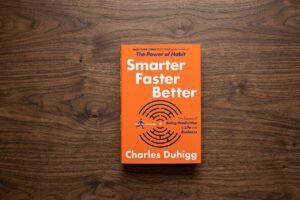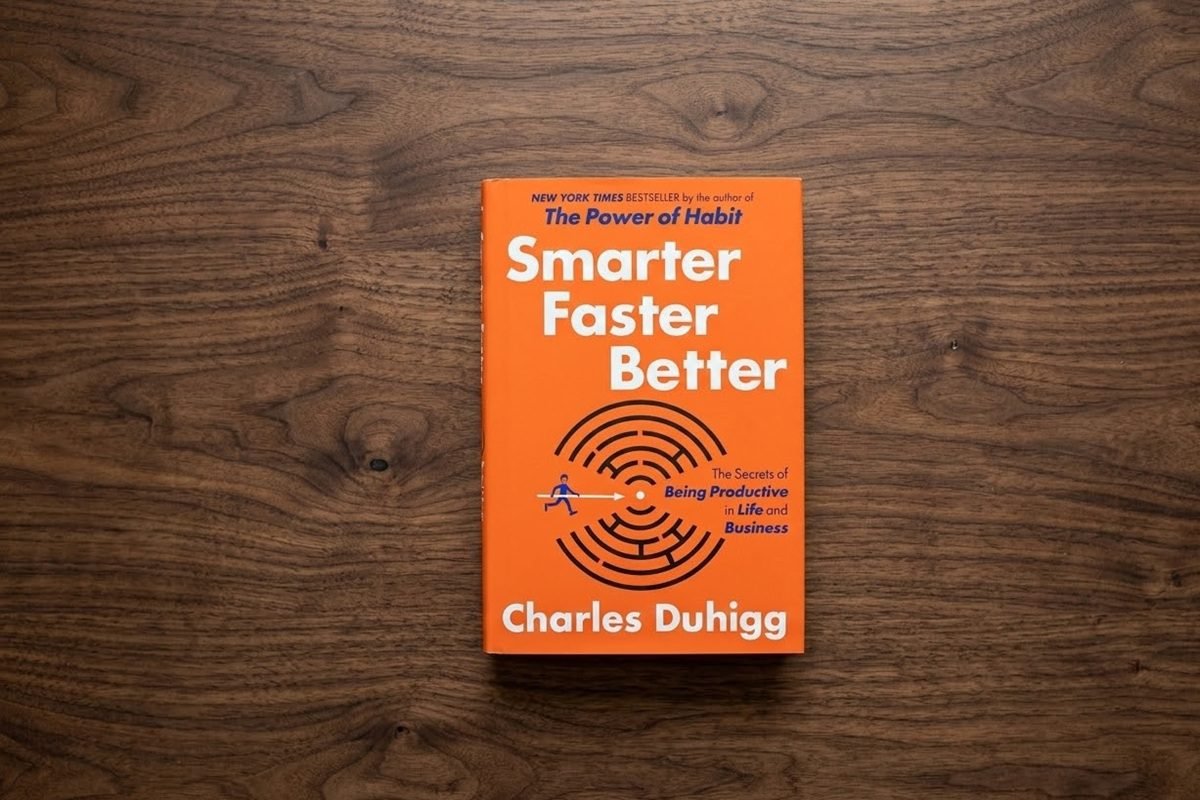
Book review: Smarter Faster Better
The Secrets of Being Productive in Life and Business
By Charles Duhigg
Genres:
- Self-Improvement
- Social Psychology
The year it was published:
2016
Number of pages:
400

As an Amazon Associate, I earn from qualifying purchases.
Table of contents:
Introduction – What Is Productivity, Really?
Chapter 1: Motivation: Locus of Control & the Marines
Chapter 2: Teams: Psychological Safety at Google & Saturday Night Live
Chapter 3: Focus: Mental Models, Air France 447 & Qantas 32
Chapter 4: Goal Setting: SMART Goals, Stretch Goals & the Yom Kippur War
Chapter 5: Managing Others: NUMMI, Lean Thinking & the FBI Kidnapping
Chapter 6: Decision Making: Bayesian Thinking & Annie Duke’s Poker
Chapter 7: Innovation: Idea Brokers, West Side Story & Disney’s Frozen
Chapter 8: Absorbing Data: Disfluency & Cincinnati’s Schools
Thoughts about the book:
In the book Smarter Faster Better, Charles Duhigg explores the science behind productivity itself, examining why some individuals and organizations consistently achieve more meaningful results than others. Duhigg argues that productivity is not about doing more tasks, but it is about making better choices, maintaining focus, setting effective goals, building motivation, and making smarter decisions. The book examines eight core concepts, including motivation, focus, goal setting, decision-making, innovation, and teamwork, creating a framework that feels comprehensive rather than narrowly focused. One of the book’s greatest strengths is its storytelling. Duhigg is a journalist by training, and it shows. Rather than presenting abstract theories, he builds each chapter around fascinating real-world stories. When reading the book, you will encounter FBI agents, airline pilots, business leaders, military teams, teachers, entrepreneurs, and ordinary individuals facing extraordinary challenges. These stories make the research memorable and engaging while illustrating how the concepts work in practice. I really liked how Duhigg was able to “translate” complex psychological and cognitive research into language that almost anyone can understand. From a scientific standpoint, the book is well researched and grounded in behavioral science, psychology, neuroscience, and organizational studies. However, it is not an academic work. Duhigg demonstrates how people become more motivated when they believe they have meaningful choices and agency, even in difficult circumstances. This insight appears throughout the book and ties many of the chapters together in a powerful way. I enjoyed the sections on mental models and decision-making. The examples of airline disasters, crisis management, and organizational failures reveal how productive people and teams often succeed because they build better mental representations of reality. For some readers seeking immediate step-by-step productivity systems, this book may not be what they are looking for. In that case they should maybe pick up “Tiny Habits” by BJ Fogg, “Atomic Habits” by James Clear, or “The Power of Habit” by Charles Duhigg. In Smarter Faster Better, Duhigg focuses more on understanding the underlying principles of performance than on providing detailed daily routines.
Who should read this book:
If you are constantly looking for ways to become more productive, yet suspect that the real challenge is not managing time but managing how you think, then Smarter Faster Better by Charles Duhigg is a book you should read. This is a book for people who are searching for an edge not through longer hours or greater effort, but through better decisions, sharper focus, and more effective mental habits. Duhigg is searching for the hidden principles that separate activity from achievement. His interest lies in understanding how highly effective individuals and organizations think differently. Rather than focusing on schedules and to-do lists, he investigates motivation, decision-making, goal setting, innovation, and the psychology of peak performance. What this book will help you do is work with your mind rather than against it. You’ll learn why a sense of control increases motivation, how mental models improve decision-making, why certain teams outperform others, and how focus can be cultivated even in complex and uncertain environments. The lessons are grounded in research but brought to life through compelling stories from business, sports, aviation, and beyond
Summary of the book:
Introduction – What Is Productivity, Really?
The author, Charles Duhigg, begins with a simple but revealing question, why do some people manage to achieve far more than others without working themselves to exhaustion? This question became personal when he emailed the surgeon, writer, and professor Atul Gawande seeking advice, only to receive a surprising reply Gawande couldn’t meet because he had taken his children to a rock concert. That contrast stayed with him, a highly accomplished person who still had space for family and rest, versus his own experience of constant busyness without real balance. That moment led Duhigg into years of research into what actually drives productivity. His central argument is that productivity is not about working longer or harder, but about making better choices in how attention, effort, and decisions are structured. The book identifies eight key ideas that distinguish genuinely productive people and teams from those who are simply busy. These ideas begin with motivation, which focuses on how a sense of control over one’s actions increases the likelihood of sustained effort. It then moves to teams, showing how psychological safety allows groups to perform better by encouraging openness and trust. Focus is another key area where productive people use mental models to direct attention toward what truly matters rather than reacting to constant distractions. From there, goal setting becomes important, especially the combination of ambitious goals with clear, concrete plans for achieving them. Managing others shifts attention to leadership, emphasizing trust and the importance of pushing decision-making closer to the people doing the work. Decision-making itself is reframed around probability rather than certainty, encouraging more flexible and realistic thinking. The book also explores innovation, which often comes not from entirely new ideas but from recombining existing ones in new ways. Finally, absorbing data highlights the importance of engaging with information in a more effortful way, so that it is truly understood and retained rather than passively consumed.
Chapter 1: Motivation: Locus of Control & the Marines
This chapter asks a simple but powerful question, what actually drives people to act? The answer, supported by neuroscience and psychology, is that motivation comes from a sense of control over our own choices. The chapter opens with the case of Robert Philippe, a successful Louisiana businessman who suddenly loses all drive after a minor brain injury. He is not depressed and has no memory problems, but he stops caring about work, hobbies, or even basic decisions. Doctors eventually trace the issue to damage in a part of the brain called the striatum, which helps convert decisions into the feeling that action is worth taking. Without it, choices no longer feel rewarding, and motivation fades. This leads to a broader finding in neuroscience when people are given choices, even very small ones, their brains show activity linked to anticipation and engagement. When decisions are removed and made for them, that activity drops. In other words, the act of choosing itself is what creates motivation. The military discovered something similar. Under General Charles Krulak, Marine boot camp was redesigned to create what he called a “bias toward action.” Instead of simply following instructions, recruits were placed in ambiguous, difficult situations where they had to decide for themselves what to do. This approach didn’t just build discipline, it trained people to see themselves as capable decision makers. The result was more confident and motivated soldiers. The chapter also highlights research in nursing homes. Elderly residents who were given even small amounts of control over their environment, such as choosing food or arranging their rooms, lived longer, stayed more active, and were happier than those who simply followed rules. These small acts of choice had a measurable impact on health and well-being. Robert Philippe’s case adds a personal dimension to this idea. When his wife began asking him to make simple decisions, like choosing between lunch options, he gradually regained his sense of engagement. The act of choosing itself helped restore his motivation, suggesting that it was not gone, just disconnected from action.
Chapter 2: Teams: Psychological Safety at Google & Saturday Night Live
This chapter asks why some teams succeed while others with equally talented people fail. The answer, based on Google’s Project Aristotle, is not team composition but team norms, especially psychological safety, the belief that it is safe to speak up, take risks, and make mistakes without punishment or humiliation. Google studied 180 teams and found that the highest performers weren’t necessarily the smartest or most experienced. They were the ones where everyone participated equally and showed awareness of others’ emotions. In these teams, people felt safe enough to contribute openly, which improved performance and learning. This idea was independently supported by Harvard researcher Amy Edmondson, who found that the best hospital teams reported more errors not because they made more mistakes, but because they felt safe admitting them. Poorer teams hid problems. The chapter also shows how norms shape creativity in places like Saturday Night Live, where conflict and competitiveness were intense, but success came from a shared rule that every voice would be heard and no idea dismissed without consideration. Across examples, the lesson is consistent that high-performing teams don’t require harmony or friendship, but they do require psychological safety and respectful communication norms that allow honest participation.
Chapter 3: Focus: Mental Models, Air France 447 & Qantas 32
The chapter opens with Air France Flight 447, where pilots lost situational awareness after an autopilot shutdown. With no clear mental picture of what was happening, they fixated on the most visible cue (the flight display) and made incorrect inputs until the plane stalled and crashed. The disaster highlights how easily attention collapses under stress when people don’t know what to focus on. In contrast, a NICU nurse named Darlene detected a baby’s early sepsis despite normal monitor readings. She noticed subtle physical cues that others dismissed because she constantly maintained a mental model of what a healthy baby should look like. The mismatch between expectation and reality triggered her attention. The solution the chapter offers is mental models continuously simulating what should be happening so you can quickly detect when something is wrong. People who mentally rehearse situations before they occur are better able to direct attention under pressure. This is illustrated again by Qantas Flight 32, where Captain Richard de Crespigny managed a catastrophic in-flight failure by simplifying the situation and relying on pre-built mental frameworks for emergencies. His preparation allowed him to cut through information overload and focus on what mattered, saving the aircraft. Across cases, the lesson is clear, failure often comes not from lack of knowledge but from poor attention under pressure, and mental models help people see clearly when it matters most.
Chapter 4: Goal Setting: SMART Goals, Stretch Goals & the Yom Kippur War
This chapter explores a central question in productivity, how we should set goals. The main idea is that effective goal-setting requires two different kinds of goals working together rather than relying on just one approach. It begins with SMART goals, a system made popular by General Electric in the 1980s. These goals are Specific, Measurable, Achievable, Realistic, and Time-bound, and research shows they are useful because they turn vague intentions into clear, actionable plans. However, the chapter also shows a hidden problem when people become too focused on making goals achievable, they tend to set small, low-impact targets. At GE, for example, some teams became highly skilled at writing detailed SMART goals, but many of the goals themselves were trivial, such as improving office supply ordering, building fences, or refining security procedures. Everything looked disciplined on paper, but the organisation risked mistaking the satisfaction of ticking boxes for real progress. To balance this, the chapter introduces stretch goals, which are intentionally ambitious and often seem impossible at first. A key example comes from GE under CEO Jack Welch, who challenged his aircraft engine division to reduce manufacturing defects by 70% in three years. Managers initially believed this was unrealistic, since even modest improvements were difficult. But the scale of the goal forced a complete rethink of how the factory operated. Instead of simply hiring more inspectors, they had to retrain workers, and when that still wasn’t enough, they shifted their entire hiring strategy to recruit FAA-certified specialists. To attract them, they redesigned jobs to offer more autonomy and reorganised teams to be self-managed, which in turn required dismantling central scheduling systems. What began as a single extreme target ultimately reshaped the entire production system. The result was a 75% reduction in defects and a long period without missed deliveries, something that incremental targets alone would likely never have achieved. A similar pattern appears in Japan’s development of the bullet train. In 1955, railway leaders set a seemingly unrealistic goal of building a train that could travel at 120 miles per hour between Tokyo and Osaka, despite engineers arguing it could not be done safely on Japan’s mountainous terrain. The goal forced engineers to rethink basic assumptions. Instead of trying to push existing trains faster, they redesigned the system itself building tunnels through mountains, giving each carriage its own motor, and creating continuously welded rails for stability. Over nearly a decade of experimentation and problem-solving, they gradually made the impossible achievable. When the first bullet train launched in 1964 at the target speed, it did more than improve transportation in Japan it influenced high-speed rail systems around the world and supported Japan’s broader post-war economic growth. The chapter contrasts these productive uses of goal-setting with a cautionary example from the Yom Kippur War. Israel’s intelligence chief, Eli Zeira, was focused on a different kind of goal, providing firm, confident assessments that would prevent public panic. To maintain certainty, he relied on a fixed analytical framework that assumed Egypt and Syria could not launch a successful attack without specific military capabilities they did not yet have. This need for clarity and decisiveness led him to dismiss growing evidence that an invasion was imminent. Even as warning signs mounted, including unusual military movements and intelligence reports, he consistently reassured leadership that the likelihood of war was low. When the coordinated Egyptian and Syrian attack came in 1973, Israel was caught off guard, suffering heavy casualties. In hindsight, Zeira acknowledged that his desire for certainty had made him overlook contradictory evidence at a critical moment. Taken together, these examples lead to the chapter’s main conclusion. SMART goals are valuable because they provide structure and clarity, helping turn ideas into concrete action. But stretch goals are equally important because they push people and organisations to rethink what is possible. The most effective approach is to use both stretch goals to define an ambitious direction, and SMART goals to map the practical steps toward it. Without stretch goals, progress becomes efficient but uninspired. Without SMART goals, ambition remains abstract and ungrounded.
Chapter 5: Managing Others: NUMMI, Lean Thinking & the FBI Kidnapping
This chapter asks how leaders can get the best out of the people they manage or work with. Its core argument is that performance improves when decision-making is pushed closer to the people who actually do the work, and when organisations build real trust and commitment rather than relying on tight control. It opens with the 2014 kidnapping of Frank Janssen in North Carolina. The FBI had to untangle a complex case involving encrypted messages, burner phones, and gang networks. A new system called Sentinel helped connect the data, but what really made the difference was how the system was built and used. Instead of relying on slow layers of approval, the FBI allowed junior agents and programmers to make decisions quickly and experiment with solutions. Ideas could move from suggestion to working prototype in days rather than months, which proved crucial in a fast-moving investigation like this one. That shift in culture didn’t come out of nowhere. It was influenced by the transformation of the NUMMI car factory in Fremont, California, a joint venture between GM and Toyota. The same factory had once been one of the worst in the United States, with extremely high absenteeism, low morale, and even workers deliberately damaging cars. When Toyota took over, it kept the same workforce but completely changed the management approach. Workers were treated as capable problem-solvers rather than people to be tightly supervised. They were given tools like andon cords that allowed them to stop the assembly line if they spotted a problem, and their suggestions for improvements were acted on quickly. Managers also made a strong commitment not to lay workers off except in extreme circumstances. This combination of trust and responsibility changed behaviour dramatically. The same employees who had once struggled under GM became highly engaged and productive, with absenteeism falling sharply and quality improving to industry-leading levels. The lesson was that when organisations genuinely invest in their people, people tend to respond in kind. This idea is supported by research as well. A long-term study of Silicon Valley start-ups by Stanford professors Baron and Hannan found that companies built around strong commitment between employer and employee were the most consistently successful over time, and none of them failed during the study period. The key factor was not just incentives or structure, but a culture where both sides felt responsible to each other. The FBI’s Sentinel project shows how this kind of approach can work in practice. For years, the organisation had tried and failed to build a system to help agents track complex cases, spending hundreds of millions of dollars in the process. Progress was slow because every decision had to pass through layers of bureaucracy. When a new leader took over, he reduced the size of the team, cut the budget, and most importantly, gave decision-making authority to the people closest to the work. This allowed small, practical ideas to be tested immediately rather than debated for months. One example was a suggestion to model part of the system on TurboTax, making complicated procedures simpler and more intuitive. Under the old system, this idea would have taken months to approve under the new approach, it was turned into a working feature within days. That same system and culture proved essential in real-world operations like the Janssen kidnapping case. When Frank Janssen was abducted, FBI agents used Sentinel to track fragmented clues across phone records and communications. Because they were empowered to act quickly and follow leads without waiting for multiple levels of approval, they were able to piece together that the kidnapping was being coordinated from inside the prison by a gang leader. This allowed them to locate and rescue Janssen in time. The case showed how trust, speed, and decentralised decision-making can be critical in high-pressure situations.
Chapter 6: Decision Making: Bayesian Thinking & Annie Duke’s Poker
Many of the most important decisions in life are really bets on an uncertain future whether to take a job, have children, or invest money. The chapter argues that the people who make the best decisions are not the ones who feel most certain, but the ones who are most comfortable with uncertainty and most skilled at reasoning in probabilities. It introduces Annie Duke, who began as a cognitive psychology PhD student before becoming one of the world’s top poker players. Her academic background helped her see poker differently from most players. In poker, you never know your opponent’s cards, so the goal is not to be right with certainty but to make the best possible decision given the odds. At the 2004 Tournament of Champions, she faced a difficult decision holding a pair of tens against a large all-in bet from Greg Raymer. After a long pause, she folded. Raymer later revealed he had two kings, meaning her decision was correct even though it meant giving up the hand. She eventually went on to win the tournament, including a final victory over her brother. The key insight from her experience is that good decisions are defined by the quality of the reasoning at the time, not by whether the outcome happens to go well. This way of thinking is also supported by research from the Good Judgment Project, a US government-funded study on forecasting world events. Instead of relying only on experts, researchers trained ordinary participants such as lawyers and interested members of the public to think in terms of probabilities. They were taught to break down uncertain outcomes into multiple possible futures, assign likelihoods to each, and update those estimates as new information arrived. This simple shift in thinking led to dramatic improvements in accuracy, with some participants improving their forecasting performance by up to 50% and even outperforming many professional analysts. The main skill was not specialist knowledge, but the ability to hold uncertainty comfortably and revise beliefs when evidence changed. One exercise from the project illustrates this approach using the French presidential election involving Nicolas Sarkozy. Participants were asked to estimate his chances of re-election by combining different perspectives, historical data suggesting a strong advantage for incumbents, opinion polls showing weak approval ratings, and economic conditions pointing to mixed outcomes. When these different signals were combined, they produced a probability estimate that suggested Sarkozy was slightly more likely to lose than win. The actual result closely matched this prediction, reinforcing the idea that no single viewpoint is fully reliable on its own. Underlying all of this is Bayesian thinking, which is the habit of starting with an initial belief and then updating it as new information arrives. In theory, people do this naturally, but in practice, we often distort it. We tend to overweigh memorable successes and undercount failures, which leads to overly confident judgments about the future. The chapter suggests a practical correction deliberately look for cases where things went wrong, not just where they went right, so that your sense of probability is grounded in a more balanced view of reality.
Chapter 7: Innovation: Idea Brokers, West Side Story & Disney’s Frozen
This chapter asks where genuinely new ideas come from. Its answer is counterintuitive, most innovation doesn’t come from inventing something entirely new, but from combining existing ideas in ways that haven’t been tried before. It begins with Disney’s early development of Frozen, which at first was a disaster. In the initial version, Elsa was written as a simple evil villain, and Olaf was her scheming assistant. Test audiences felt no emotional connection to the characters, and with the release date fixed, the creative team had to rethink everything. The breakthrough didn’t come from adding more plot complexity, but from a shift in perspective. Songwriters Robert Lopez and Kristen Anderson-Lopez wrote Let It Go from the point of view of a character who was not evil, but afraid and overwhelmed. That change opened the door for director Jennifer Lee to reimagine Elsa entirely. Instead of a villain, she became a misunderstood sister struggling with her identity, and the emotional centre of the film shifted to the relationship between Elsa and Anna. Drawing on Lee’s own experiences of complicated sibling relationships, the story became about love between sisters rather than a traditional romantic rescue. That emotional reframing turned Frozen into a huge success and one of Disney’s most successful films. A similar pattern appears in the creation of West Side Story. Jerome Robbins, Leonard Bernstein, and Arthur Laurents built the musical by constantly borrowing from and recombining different traditions of ballet, jazz, opera, Broadway, and Shakespeare. Robbins in particular acted as a kind of creative disruptor, pushing the team away from familiar storytelling habits. For example, instead of opening the musical with dialogue that explained the story, he insisted the prologue should communicate everything through movement alone. The result was a nine-minute dance sequence that established character, conflict, and setting without a single spoken line. The musical as a whole reimagined Romeo and Juliet in the context of New York street gangs, and its success came from this deliberate blending of forms that had rarely been connected before. This idea is supported by large-scale research on scientific innovation. A study of nearly 18 million academic papers by Brian Uzzi and Ben Jones found that the most influential research was not the most radically original in content, but the most original in combination. Around 90% of the ideas in highly creative papers already existed somewhere before what made them important was that they brought together concepts from different fields in new ways. Papers that connected distant disciplines were especially likely to produce breakthroughs, because they exposed researchers to ideas that would not normally interact.
Chapter 8: Absorbing Data: Disfluency & Cincinnati’s Schools
We are surrounded by more information than any generation in history, yet we often feel less able to understand it. The chapter argues that the issue is not a lack of data, but the way we interact with it. When information is too easy to consume, we tend to absorb it passively and fail to engage with it deeply. The surprising solution is that learning improves when information is made slightly harder to process, not easier. This idea is illustrated through the experience of Cincinnati’s public schools, particularly South Avondale Elementary, which was one of the lowest-performing schools in Ohio despite receiving substantial funding, advanced data dashboards, and detailed weekly reports about student performance. In theory, teachers had more information than ever. In practice, most of it went unused. The data was simply too effortless to ignore. To fix this, the city’s Elementary Initiative took an unusual approach. Instead of improving the dashboards or simplifying the reports, it removed the technology altogether from the learning process. Teachers were brought into simple rooms and asked to manually work with the data copying scores onto index cards, sorting them into groups by hand, drawing graphs themselves, and testing ideas using paper and discussion. At first, this felt like unnecessary extra work, but it forced teachers to slow down and actively engage with the information. Patterns that were invisible in digital summaries suddenly became obvious when teachers physically organised the data themselves. One teacher noticed that two classes were struggling in different areas and realised they could swap teaching strategies. Another group of students was grouped by neighbourhood and redesigned reading assignments to fit their social context. Within a few years, the school’s performance dramatically improved, with most students meeting state standards. The key change was not more data, but deeper interaction with the data already available. A similar principle appears in the work of Charlotte Fludd, who managed a debt collection team at Chase Manhattan Bank. Her team consistently outperformed others despite handling the most difficult accounts. Their advantage did not come from better scripts or more training, but from how they treated information. Instead of relying on automated summaries or standard procedures, they recorded every call, annotated outcomes, and ran constant informal experiments. They tested patterns such as the best time of day to call different types of customers and refined their approach based on what worked. Over time, each interaction became a source of learning. Like the teachers in Cincinnati, they were not just consuming information but actively working with it, turning raw data into insight through repeated engagement and adjustment. The chapter then brings this idea into a more personal context through the story of Delia Morris, a high school student in Cincinnati who grew up in unstable housing and poverty. Despite her circumstances, she excelled academically, but her plans were disrupted when her sister asked her to babysit a newborn every afternoon. The request felt like a moral obligation, and she initially saw the situation as a simple choice between helping her family or focusing on her future. Her engineering class, however, had taught her a structured decision-making process. Using this framework, she broke the problem into smaller parts, mapping out her time, her responsibilities, and the likely consequences of each option. When she looked at the situation in this structured way, the trade-offs became clearer. She could see that while helping her family in the short term would be meaningful, it would likely limit her education and long-term ability to support them in bigger ways later. With this clearer view, she discussed the decision with her father, who supported her reasoning. She chose to prioritise her education, went on to graduate as valedictorian, and earned multiple scholarships to university. Across these examples, the same theme emerges. Information alone is not enough. When data is simply presented to us, we tend to skim it or ignore it. But when we are forced to actively work with it by sorting it, questioning it, or structuring it ourselves, we understand it more deeply and make better decisions. The paradox is that making information slightly harder to absorb can make us far better at using it.