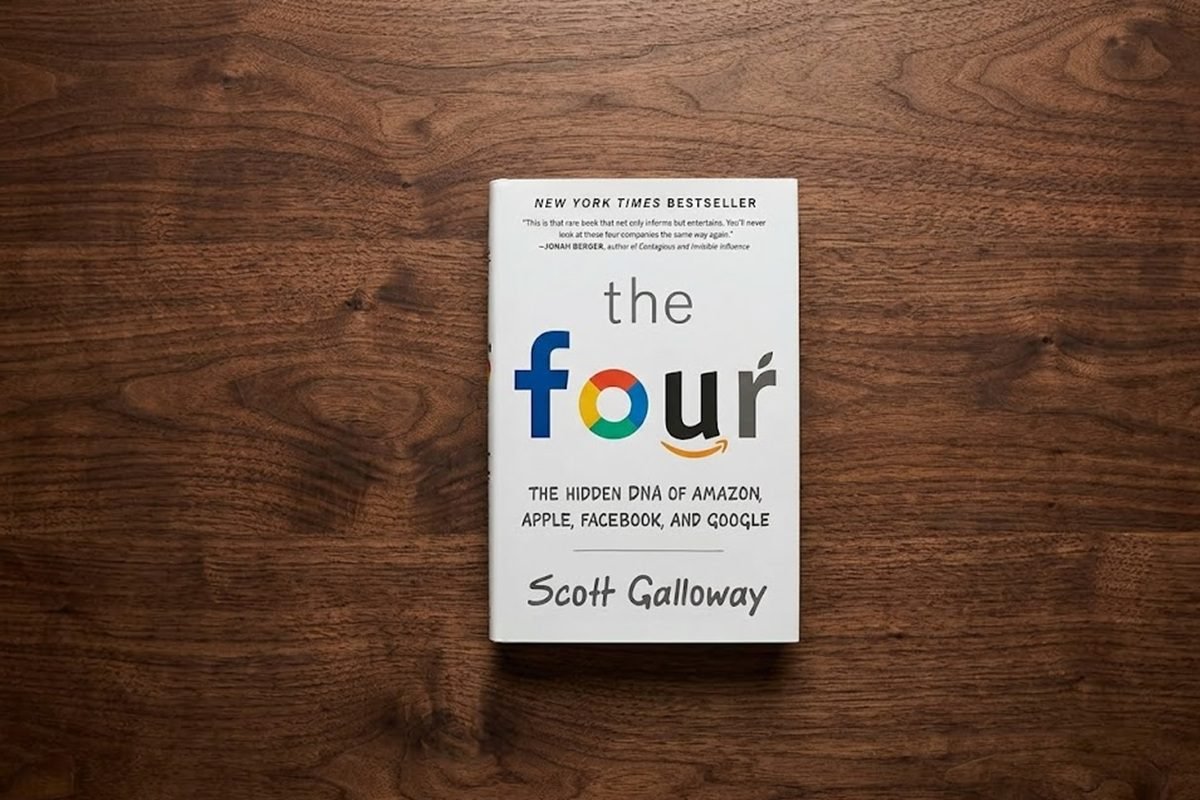
Book review: The Four
The Hidden DNA of Amazon, Apple, Facebook, and Google
By Scott Galloway
Genres:
- Business
The year it was published:
2017
Number of pages:
320

As an Amazon Associate, I earn from qualifying purchases.
Table of contents:
Chapter 1: The Four — Who Are These Companies and Why Do They Matter?
Chapter 2: Amazon — How Amazon Became the Most Disruptive Firm in the World
Chapter 3: Apple — Tech Goes Luxury
Chapter 4: Facebook — Love Is Key to Longevity and Great Advertising
Chapter 5: Google — Our Modern-Day God
Chapter 6: Lie to Me — The Four and Funny Business
Chapter 7: Business and the Body — All Businesses Appeal to One of Three Organs
Chapter 8: The T Algorithm — What It Takes to Get to a Trillion
Chapter 9: The Fifth Horseman? — Who Will Be Next?
Chapter 10: The Four and You — Follow Your Talent, Not Your Passion
Chapter 11: After the Horsemen — Where Are the Four Taking Us?
Thoughts about the book:
In the book The Four the author argues that the following four companies, Amazon, Apple, Facebook, and Google, have achieved unprecedented dominance over the digital economy, shaping not only markets but also culture, behavior, and even identity. Galloway’s central thesis is less about celebration and more about power, how these companies became modern-day empires, and what that means for competition and society. Galloway writes with a distinctive mix of business analysis and cultural commentary. He is not neutral, and he does not pretend to be. That makes the book engaging. His breakdown of each company’s strengths, like Amazon’s logistics dominance, Apple’s brand loyalty, Facebook’s attention capture, and Google’s data monopoly, is sharp, memorable, and often provocative. Galloway uses simple, punchy language mixed with rhetorical flair, which makes the book easy to read. The structure is clear, the chapters are focused, and the arguments are broken into digestible sections. You do not need technical expertise to follow it, although familiarity with the tech industry enhances appreciation of the examples and critiques. With this book, Galloway offers a compelling and often unsettling perspective on the companies that dominate modern life.
Who should read this book:
If you are trying to understand who truly controls the modern economy and how four companies came to quietly shape so much of your daily life, then The Four by Scott Galloway is a book that will sharpen your perspective immediately. This is a book for readers who are searching for clarity in the chaos of big tech. It speaks to those interested in business, strategy, technology, branding, and power, but who suspect that the most important forces shaping the world are not always visible on the surface. It is especially relevant if you want to understand not just how companies succeed, but how a small number of them come to dominate entire industries and influence culture itself. Galloway is searching for the architecture of modern power. His interest lies in the rise of four dominant platforms, Amazon, Apple, Facebook (Meta), and Google, and what their success reveals about scale, data, attention, and human behavior. He dissects how these companies didn’t just win markets, but how they reshaped expectations, habits, and even identity. What this book will help you do is see beneath the brand names and into the logic of dominance. It explains how these firms leverage network effects, emotional connection, and ecosystem control to create a near-insurmountable advantage. At the same time, it challenges readers to think critically about the trade-offs, convenience versus privacy, and innovation versus concentration of power. Reading The Four is an invitation to stop viewing big tech as separate products and start seeing it as a system. For anyone who wants to understand where wealth, influence, and attention are really flowing in the modern world, this book offers a blunt, insightful, and highly readable map.
Summary of the book:
Chapter 1: The Four — Who Are These Companies and Why Do They Matter?
Scott Galloway opens the book by introducing Amazon, Apple, Facebook, and Google, companies he labels the “Four Horsemen.” He begins with their positive impact. Over the past two decades, they have created enormous wealth, generated hundreds of thousands of jobs, put powerful computing in people’s pockets, and made modern life more connected and convenient at a global scale. He then turns the perspective sharply. The same companies can also be seen as entities that minimize taxes, strain or reshape labor markets, accumulate vast personal data, resist regulation, and exert overwhelming control over their respective industries. Galloway’s point is not that one view is correct and the other is false, but that both are true at the same time and that understanding their power requires holding those contradictions together. From there, he frames the central question of the book, how did these four companies become so dominant economically, culturally, and politically, and what does their concentration of power mean for everyone else? The “Four Horsemen” label, drawn from biblical imagery of unstoppable forces, becomes his shorthand for their scale and influence. Galloway also briefly positions himself in relation to them. As an NYU professor, entrepreneur, and former board member of the New York Times, he writes from inside the system as well as outside it. He describes having seen their rise firsthand as a founder whose company was displaced by Amazon, as a media insider watching Google reshape publishing, and as an educator trying to prepare students for a world fundamentally shaped by these platforms.
Chapter 2: Amazon — How Amazon Became the Most Disruptive Firm in the World
Galloway argues that Amazon’s true advantage is not just technology or logistics, but a deeply human instinct, the urge to collect and accumulate. For most of human history, gathering more resources meant survival, and Amazon has built its entire model around making that instinct effortless, turning desire into instant delivery with minimal friction. He traces the evolution of American retail, from small local stores to department stores, shopping malls, big-box retailers like Walmart, and eventually e-commerce. In this history, Jeff Bezos didn’t simply create an online bookstore, he recognized a structural shift and rebuilt retail around it. Amazon started with books because they were standardized and easy to ship, allowing the company to perfect its systems before expanding into virtually every category. A key part of Amazon’s dominance, Galloway argues, is its access to cheap capital. Investors believed Bezos’s long-term vision of becoming “Earth’s Biggest Store,” which allowed Amazon to operate without the pressure of short-term profits. Instead of distributing earnings, the company reinvested aggressively into warehouses, logistics, and technology, creating a scale advantage that competitors could not easily match. The chapter also highlights two major extensions of Amazon’s power. Amazon Web Services is described as even more profitable than its retail business, effectively turning Amazon into the backbone of the internet itself. Meanwhile, devices like Amazon Echo and its voice assistant Alexa represent a shift toward a more embedded presence in daily life, positioning Amazon to anticipate and influence consumer behavior directly inside the home. Together, these elements form Galloway’s broader point that Amazon’s strength lies not just in selling products, but in building a system that increasingly understands and shapes how people consume in the first place.
Chapter 3: Apple — Tech Goes Luxury
Galloway argues that Apple’s real strength is not technology, but luxury. Apple succeeded by transforming itself into the first truly dominant luxury brand in tech, where profit comes less from functionality and more from identity and status. He explains that luxury works because it taps into deep human instincts, the desire for status and transcendence. Owning an iPhone signals membership in an “innovation class,” suggesting success, taste, and belonging to a higher-status group. The value is not just in what the device does, but in what it communicates about the person using it. Galloway outlines five traits Apple shares with great luxury brands, a mythic founder in Steve Jobs, obsessive craftsmanship and design, tight control over hardware and software, a consistent global image, and sustained price premiums that customers willingly accept. The chapter also revisits Apple’s confrontation with the FBI after the San Bernardino attack, when the company refused to unlock a terrorist’s phone. Galloway argues that this level of defiance was possible only because Apple has a quasi-religious cultural status, treated differently from nearly any other corporation. He also draws lessons from retail history, particularly the influence of Mickey Drexler’s transformation of The Gap into an experience-driven brand. Drexler’s approach to store design later influenced Steve Jobs, who applied similar thinking to Apple Stores, turning them into highly profitable brand environments rather than simple retail outlets. The chapter contrasts Apple’s rise with Nokia’s collapse. Nokia once dominated global mobile phones and represented a huge share of Finland’s economy, but the launch of the iPhone in 2007 rapidly destroyed its market position, demonstrating how one Apple product can reshape entire industries and even national economies. Finally, Galloway points to the launch of the Apple Watch as proof of Apple’s identity as a luxury brand. By advertising in Vogue, featuring fashion models, and selling a $12,000 rose-gold version, Apple deliberately positioned itself far beyond technology. It was no longer selling devices it was selling status, taste, and belonging.
Chapter 4: Facebook — Love Is Key to Longevity and Great Advertising
Galloway argues that Facebook represents the most successful human platform ever created in terms of adoption. With billions of users, it surpasses religions, languages, and sports in reach. Its growth, he argues, comes from tapping into one of the strongest human needs, the desire to connect, to belong, and to be loved. At its core, Facebook is also the most powerful advertising machine in history because it combines unmatched scale with precise targeting. Advertisers can define extremely specific audiences, and Facebook can deliver ads to them with remarkable accuracy, turning personal data into commercial precision. But Galloway also emphasizes the darker side of this system. Facebook’s algorithm is built to maximize engagement, and the emotions that most reliably drive engagement are anger, fear, and outrage. This creates incentives that amplify polarization, misinformation, and filter bubbles, where users are increasingly exposed only to content that reinforces their existing beliefs. He also highlights how this power reshaped the media industry. When publishers allowed Facebook to distribute their content through formats like Instant Articles, they effectively gave up control over their audiences, becoming dependent on a platform that dictated distribution and visibility. A key example of Facebook’s strategic dominance is its acquisition of Instagram. Bought for $1 billion when it was still small, Instagram is now worth tens of billions and is considered one of the most successful acquisitions in modern tech history. Galloway also examines competitive behavior. When Snap Inc. threatened Facebook’s dominance with Snapchat, Facebook attempted to buy it, failed, and then rapidly copied its core features, including Stories and filters, an approach Galloway summarizes as, if you can’t buy it, replicate it. Finally, he discusses the “Pizzagate” incident during the 2016 U.S. election, where a false conspiracy theory spread widely on Facebook due to its high engagement. The story escalated to real-world violence when an armed individual fired shots inside a restaurant, illustrating how algorithmic amplification can turn misinformation into physical consequences.
Chapter 5: Google — Our Modern-Day God
Galloway argues that Google operates less like a traditional corporation and more like a modern form of religion. Historically, people turned to religious figures for answers to personal, uncertain, or private questions. Today, many of those same questions are directed to a search bar. He notes that a significant share of Google searches are entirely new questions that have never been asked before, suggesting that people now outsource even their most intimate uncertainties to the platform. Google’s power, in his view, comes from trust. Users ask it things they would not tell another person, and they generally accept the results as neutral. The combination of “organic” search results and clearly labeled advertising creates a perception of fairness, which underpins a massive revenue engine built on targeted ads. Galloway also draws on his experience as a board member of the New York Times to illustrate how this dynamic plays out in practice. He argued that the newspaper was effectively giving away its content to Google, which used it to generate traffic and advertising revenue while returning little value in exchange. He pushed for the idea of publishers collectively limiting or licensing their content, but the proposal was rejected out of fear of losing visibility in search. Over time, he argues, this dependency allowed Google’s influence over media distribution to deepen further. He also highlights the collapse of About.com after a Google algorithm change, showing how a single adjustment in search rankings can significantly damage a media business dependent on traffic. Another example is the JCPenney scandal, where the retailer used manipulated backlinks to game Google’s search rankings. When exposed and penalized by Google, its visibility dropped dramatically. Galloway uses this as an illustration of Google’s power over digital existence itself, being downgraded in search results is akin to being erased from public view, reinforcing his comparison of Google’s role to a system of judgment and authority rather than just a tool.
Chapter 6: Lie to Me — The Four and Funny Business
Galloway shifts focus to the darker foundation beneath the success of the Four Horsemen, arguing that much of their growth was built through the appropriation of ideas, labor, and content. He suggests that at scale, “stealing” is not an exception in high-growth tech firms but a recurring pattern, even if it is later reframed as innovation or competition. He describes two recurring strategies. First, the absorption of intellectual property, taking ideas, designs, or products from others, integrating them into their own platforms, and then aggressively protecting their own versions through legal means. Second, the monetization of other people’s work using content, data, or audiences created by others to generate massive revenue while compensating the original creators minimally or not at all. Galloway also argues that many industries participated in their own disruption. Media companies allowed Google to index and distribute their content for free. Brands invested heavily in building audiences on Facebook, only to later find that those audiences were no longer fully accessible without payment. Sellers joined Amazon marketplaces, where they could eventually be undercut by Amazon’s own competing products. He illustrates the cycle with historical and contemporary examples. One is Apple, which benefited from ideas developed at Xerox PARC, including the graphical user interface. Galloway’s point is less about legality and more about execution. Apple transformed existing concepts into mass-market products, where the original source could not. Another example is Facebook’s evolving relationship with brands. Companies like Nike invested heavily in building audiences on the platform, only to later find that organic reach was sharply reduced, forcing them to pay for visibility. Galloway frames this as a structural shift in control from brands owning audiences to platforms controlling access to them. Finally, he places these dynamics in historical context, noting that early U.S. industrialization involved significant imitation of British technology, often encouraged by figures like Alexander Hamilton. He draws a parallel to modern China, suggesting that patterns of imitation and appropriation are not anomalies of Silicon Valley, but recurring phases in global economic development.
Chapter 7: Business and the Body — All Businesses Appeal to One of Three Organs
Galloway introduces a simple framework for understanding why the Four Horsemen are so dominant. Successful companies win by appealing to one of three parts of human decision-making, the brain, the heart, or the genitals. “Brain” businesses compete on logic and efficiency. Companies like Amazon win by offering lower prices, broader selection, and faster delivery. But this space is brutally competitive once a rational “best” option emerges, it tends to dominate, leaving little room for others. “Heart” businesses appeal to emotion and connection. Facebook thrives here by tapping into friendship, love, memory, and belonging. The product is not just content, but social connection itself, which keeps users engaged far beyond what pure utility would justify. “Genital” businesses, as Galloway provocatively frames it, are driven by status, aspiration, and attraction. Apple is the key example, its products function as luxury signals, communicating identity and success as much as utility. The value is emotional and social rather than technical, which allows for extreme pricing power. He illustrates this with the contrast between Gateway and Apple. Gateway competed on cost efficiency and low margins, while Apple built products that signaled status and design sophistication. Over time, Gateway collapsed, while Apple became one of the most valuable companies in history, demonstrating Galloway’s central point, competing on pure rationality is a losing strategy if someone else can always do it cheaper. The framework ultimately explains the durability of the Four Horsemen, they don’t just win markets, they align themselves with fundamental human drivers logic, emotion, and status.
Chapter 8: The T Algorithm — What It Takes to Get to a Trillion
Galloway introduces what he calls the “T Algorithm,” an eight-part framework for predicting which companies can realistically reach trillion-dollar valuations. He builds it by analyzing the shared traits of the Four Horsemen and treating them as a blueprint for modern monopoly-scale success. The first factor is product differentiation, the product must be meaningfully better than alternatives, not just better marketed, because today’s consumers can easily compare options. Second is visionary capital the ability to raise large amounts of funding by telling a simple, compelling story about the future, as Amazon did with its “Earth’s Biggest Store” vision. Third is global reach, the product must work across borders and cultures, since national limits cap scale. Fourth is likability, which Galloway argues reduces regulatory pressure and public resistance, companies like Apple and Google maintain a strong public appeal even while exercising significant market power. Fifth is vertical integration, owning more of the value chain from product to distribution to customer experience, which reduces dependency and increases control. Sixth is AI and data advantage, where platforms improve as more users generate more data, creating self-reinforcing systems that competitors struggle to match. Seventh is career accelerant, the ability to attract elite talent by becoming a top destination for ambitious workers. The Four Horsemen benefit from being seen as the most prestigious places to build a career in tech. Eighth is geography, proximity to elite engineering ecosystems, particularly around Stanford, Berkeley, and the University of Washington, which concentrate talent and innovation. Together, these factors form Galloway’s argument that trillion-dollar companies are not accidental. They are built through a repeatable set of structural advantages that compound over time and reinforce each other.
Chapter 9: The Fifth Horseman? — Who Will Be Next?
Galloway applies his “T Algorithm” to evaluate which companies could become a “Fifth Horseman” a trillion-dollar firm with global, structural dominance similar to Amazon, Apple, Facebook, and Google. He analyzes several candidates, including Alibaba Group, Uber, Microsoft (along with its acquisition of LinkedIn), Airbnb, IBM, and major telecom firms. Each shows some of the required traits, but none fully match the complete set needed for long-term dominance. His strongest case is Tesla. He argues Tesla comes closest to satisfying the full T Algorithm, it has strong product differentiation, a luxury-style brand, tight vertical integration through its direct-to-consumer sales model, and a powerful narrative driven by Elon Musk. Its vehicles improve over time through over-the-air software updates, and its launch strategy has repeatedly demonstrated extraordinary demand, such as massive pre-orders for the Model 3 before production even began. By contrast, Uber scores highly on technology and scale but fails on what Galloway considers a critical factor, likability. Despite strong global reach and a powerful platform model, Uber has been undermined by reputational issues, leadership controversies, and cultural problems. Galloway argues that these issues damaged its ability to attract top talent and cost the company significant long-term value, even if users continued to rely on the service. Other firms fall short for different structural reasons. Alibaba is constrained by geopolitical trust issues and limited global brand appeal. Microsoft has successfully reinvented itself through cloud computing and LinkedIn, but Galloway sees it more as a resilient incumbent than a category-defining leader. Overall, his conclusion is that while many companies can achieve massive scale, only those that satisfy all eight elements of the T Algorithm simultaneously have a realistic path to becoming the next trillion-dollar “Horseman,” and Tesla is the closest example in his assessment.
Chapter 10: The Four and You — Follow Your Talent, Not Your Passion
Galloway shifts from analysis to practical advice about how to build a career in a world dominated by the Four Horsemen. His central argument is blunt, inequality has increased, the gap between average and exceptional performance has widened, and being merely “good” is no longer enough to compete. He starts by challenging the popular idea of “following your passion.” Instead, he argues people should follow their talent, identify what they are naturally good at, develop real mastery in it, and allow passion to emerge through competence rather than preference. He notes that advice to “follow your passion” often comes from people who are already financially secure. Education is another pillar. Galloway strongly advocates for attending college, especially a high-quality one, arguing that it remains one of the strongest predictors of lifetime earnings and opportunity. In his view, the signal and network effects of elite education still matter significantly in a competitive labor market. He also emphasizes geography, moving to major global cities increases exposure to opportunity, talent, and capital, since economic activity is increasingly concentrated in a small number of urban hubs. On personal development, he highlights emotional maturity as a key differentiator. The ability to manage stress, collaborate effectively, and understand one’s own behavior is, in his view, more important than raw intelligence in most careers. Financial strategy is another focus. He advises prioritizing equity over salary whenever possible, since ownership, not income, is what creates significant long-term wealth. Closely related is his idea of “serial monogamy” with employers staying long enough (typically 3–5 years) to build value and credibility, but not so long that growth and compensation stagnate. Finally, he stresses the importance of understanding the Four Horsemen themselves. Amazon, Apple, Facebook, and Google are not just consumer platforms they are foundational business systems. Galloway argues that professionals who ignore them are effectively opting out of the modern economy, while those who understand them can use them as leverage in nearly any career path.
Chapter 11: After the Horsemen — Where Are the Four Taking Us?
In the final chapter, Galloway zooms out to consider what the Four Horsemen mean for society as a whole, especially for inequality, democracy, and the structure of modern capitalism. His conclusion is cautious and, at times, unsettling. He highlights the scale imbalance at the heart of the modern tech economy. The Four Horsemen collectively employ about 418,000 people roughly the population of a mid-sized city like Minneapolis, yet are worth around $2.3 trillion, comparable to the GDP of a country like France, which has tens of millions of citizens. By contrast, traditional industrial giants like General Motors employ far more people while generating far less concentrated wealth. The implication is that the most valuable companies in history are also among the least labor-intensive, concentrating economic gains in a relatively small group of owners and executives. Galloway argues that despite their scale and capability, these companies are not oriented toward solving humanity’s largest problems. Instead, Amazon, Apple, Facebook, and Google are primarily focused on expanding consumption and engagement. He contrasts this with historical efforts like the Manhattan Project, which mobilized massive resources toward a singular, world-altering goal, suggesting that today’s tech giants have even greater capacity but far narrower ambitions. He also raises concerns about the broader economic effects of tax avoidance, job displacement, and wealth concentration, which he argues contribute to the erosion of the middle class and growing political frustration. However, he is careful not to frame the Four as purely negative forces. They create real value, drive innovation, and improve daily life in measurable ways. His final position is not abolition but balance. Galloway argues that society must understand these companies clearly, regulate them appropriately, and ensure that innovation does not come at the expense of fairness and long-term social stability.