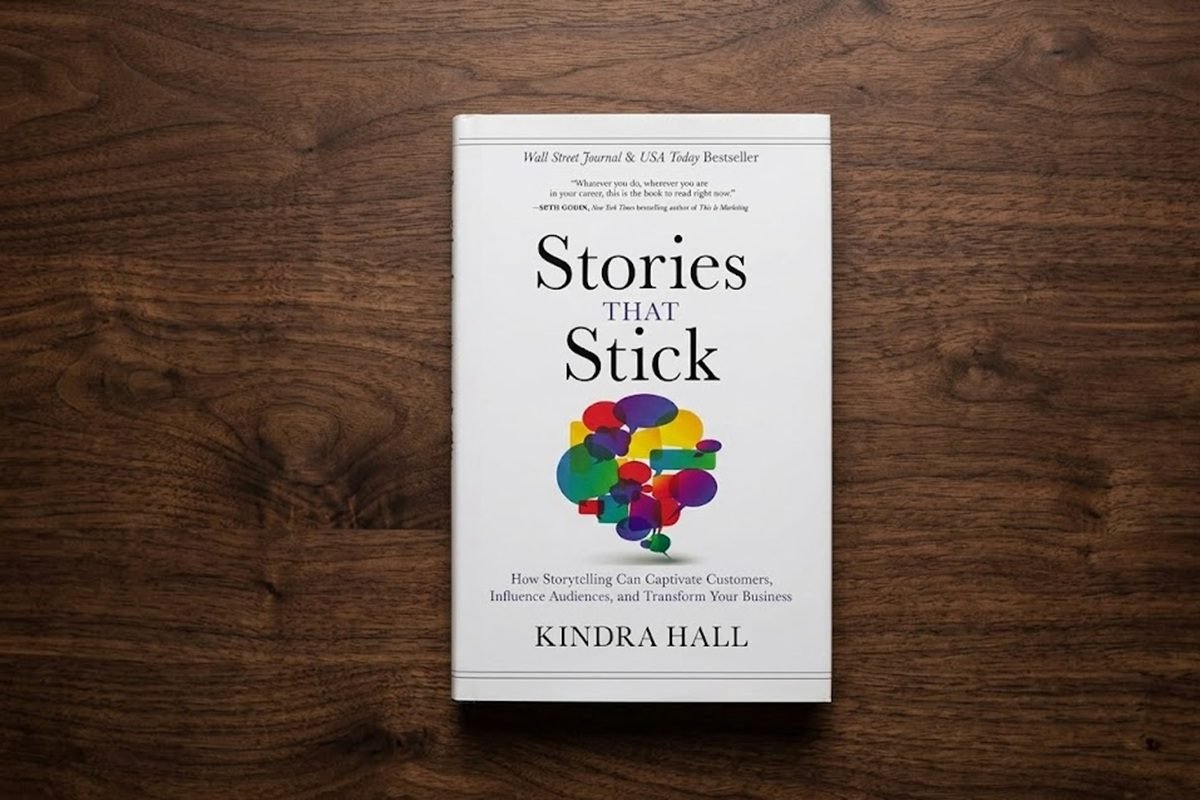
Book review: Stories That Stick
How Storytelling Can Captivate Customers, Influence Audiences, and Transform Your Business
By Kindra Hall
Genres:
- Storytelling
- Communication Skills
- Sales & Selling
The year it was published:
2019
Number of pages:
240

As an Amazon Associate, I earn from qualifying purchases.
Table of contents:
Introduction: Slovenia, JFK, and the Story That Kidnapped My Husband
Part I – The Irresistible Power of Storytelling
Chapter 1: The Gaps in Business and the Bridges That Close (and Don’t Close) Them
Chapter 2: Once Upon a Brain — Storyhacking the Nervous System
Chapter 3: What Makes a Story Great (And Beats Puppies and Supermodels Every Time)
Part II – The Four Essential Stories
Chapter 4: The Value Story — How Storytelling Drives Sales and Marketing
Chapter 5: The Founder Story — How Entrepreneurs Use Story to Attract Money, Customers, and Talent
Chapter 6: The Purpose Story — How Great Leaders Use Story to Align and Inspire
Chapter 7: The Customer Story — Sweet-Smelling Armpits and the Story You Can’t Tell
Part III – Create Your Story
Chapter 8: Finding Your Story — How to Find Stories Anywhere
Chapter 9: Crafting Your Story — How to Create Compelling Stories Even If You Don’t Think You Can
Chapter 10: Telling Your Story — Where, When, and How to Tell Your Stories
Conclusion: Happily Ever After Is Just the Beginning
Thoughts about the book:
In the book, Kindra Hall introduces a simple but effective framework for crafting stories that “stick,” focusing on four types of stories. The Value Story, the Founder Story, the Purpose Story, and the Customer Story. Each is designed to serve a specific communicative function, whether in marketing, leadership, or personal positioning. What I liked most about the book is its clarity and structure. Kindra Hall is exceptionally good at breaking storytelling into practical components that non-writers can actually use. The numerous examples from brands to individuals make the ideas concrete and easy to visualize. There is a strong emphasis on emotional resonance, which helps the reader understand why certain stories linger in memory while others fade. Hall uses everyday language and avoids academic or technical terminology when writing the book. The chapters are short and include frequent illustrative anecdotes. You can go through the book quickly and still retain the core ideas. With this book, Hall hits the spot by demystifying what makes stories compelling and giving readers practical tools to apply immediately in professional and personal contexts.
Who should read this book:
If you’ve ever told a story that felt important but somehow didn’t land, didn’t spread, or didn’t stick, then Stories That Stick by Kindra Hall is a book that speaks directly to that frustration. This is a book for readers who are searching for influence through clarity and memorability. It provides valuable information to anyone interested in marketing, branding, leadership, entrepreneurship, and communication, and they sense that information alone is not enough to get their target audience’s attention. It is especially relevant if you’ve ever struggled to make your ideas resonate beyond the moment they are spoken. Hall is searching for the mechanics of stories that endure. Her interest lies in why certain narratives are remembered, repeated, and acted upon, while others disappear almost instantly. She breaks storytelling down into practical components, showing that effective stories are not accidents of charisma, but structured tools that can be learned, shaped, and intentionally deployed. What this book will help you do is transform the way you communicate ideas, whether in business, sales, leadership, or personal branding. It teaches how to identify core stories from real experiences, structure them for maximum emotional impact, and use them to build trust and connection. The emphasis is not on embellishment, but on authenticity sharpened by intention.
Summary of the book:
Introduction: Slovenia, JFK, and the Story That Kidnapped My Husband
The book opens with Kindra Hall and her husband, Michael, visiting Ljubljana, Slovenia, during the holiday season. Michael is not someone who enjoys shopping and rarely buys anything he does not need. While browsing a boutique, he is approached by a young sales assistant near a fragrance display who does not immediately try to sell him a product. Instead, she begins with a story about a cologne called Eight & Bob. The story involves John F. Kennedy, who in 1937 met a French aristocrat named Albert Fouquet on the French Riviera and was so impressed by his personal fragrance that he requested samples for himself and his brother Robert Kennedy. The demand for the scent later grew, but during World War II, it had to be secretly shipped, hidden inside hollowed-out books to avoid being confiscated by the Nazis. After telling the story, the assistant opens a box containing a crystal bottle of cologne embedded inside a cut-out book, bringing the narrative physically into the present moment. Despite having no intention to buy anything, Michael immediately says he will take it, even though there is none in stock, and he plans to return the next day to check again. This experience becomes the foundation for the book’s central idea, a well-told story can change how people think, feel, and act. In this case, the story alone created desire, trust, and emotional connection strong enough to drive a purchase without persuasion or product demonstration. It illustrates how storytelling in business can turn customers into believers, employees into advocates, and leaders into influential communicators.
Chapter 1: The Gaps in Business and the Bridges That Close (and Don’t Close) Them
Every business operates across gaps between where it is and where it wants to be. These gaps exist between companies and customers, leaders and employees, and ideas and action. Success depends on how effectively those gaps are bridged. Most organisations rely on ads, presentations, and statements to do this, but these are quickly ignored. They may inform, but they rarely change behaviour or last in memory. Storytelling is presented as the only tool that consistently captures attention, influences decisions, and creates lasting change. Stories draw people in voluntarily, shape how they think without pressure, and stay with them long after the moment has passed. This happens through “narrative transportation,” where listeners mentally enter the story and actively co-create it using their own emotions and experiences. This deep engagement makes stories far more memorable and persuasive than facts alone. Effective storytelling bridges gaps through three steps, capturing attention, influencing action, and creating lasting transformation so the message does not need to be repeated. A clear example is Extra Gum. Facing declining sales, the brand replaced product-focused advertising with a two-minute emotional story about a couple whose relationship is marked by shared gum wrappers. The campaign went viral, reached over 100 million views, and helped reverse the brand’s decline.
Chapter 2: Once Upon a Brain — Storyhacking the Nervous System
This chapter explains the science behind why stories work, drawing on research from neuroscientist Paul Zak. His work shows that stories trigger two key brain chemicals, oxytocin and cortisol. Oxytocin is associated with trust and connection, while cortisol is linked to attention and focus. Together, they make people both emotionally engaged and more open to influence. In Zak’s experiments, participants watched an emotionally powerful story about a father and his terminally ill son. Compared to a neutral video, viewers showed a 47% increase in oxytocin and donated significantly more money to charity afterwards. The same people and setting produced very different behaviour depending on whether a story was present, showing that stories can directly affect brain chemistry and decision-making. The chapter also highlights broader neuroscience findings. Cortisol rises during moments of tension or emotional importance, helping the brain focus and stay alert. This is why compelling stories hold attention so effectively. Research by Uri Hasson adds that during storytelling, the brains of speaker and listener actually begin to synchronize, meaning stories create shared understanding at a neurological level rather than just transmitting information. Hall applies these insights in practice through the Maricopa Health Foundation gala in Arizona. Traditional presentations by doctors had failed to generate strong fundraising results. When the format was changed to feature speakers chosen for their personal stories rather than their credentials, the outcome shifted dramatically. Stories from patients and public figures about life-saving care created an emotional connection, and donations more than doubled compared to the previous year. The key takeaway is that oxytocin builds trust, cortisol drives attention, and together they make stories uniquely powerful. Stories don’t just communicate information they change how people feel, think, and act by engaging the brain on a biological level.
Chapter 3: What Makes a Story Great (And Beats Puppies and Supermodels Every Time)
Everyone agrees storytelling is important, but many things labelled as “stories” are not actually stories. Hall argues that mission statements, product descriptions, and bullet-point summaries are often mistaken for storytelling, even though they lack the key elements that make a real story work. Research by Keith Quesenberry at Johns Hopkins shows that the most successful Super Bowl ads are not those with celebrities or humour, but those that tell a complete story. The key factor is not spectacle, but narrative structure. Hall’s research with over 1,600 respondents identified four elements that make stories effective, identifiable characters, authentic emotion, a specific moment in time, and concrete details. Together, these make a message more memorable, persuasive, and engaging. Real stories also follow a simple structure, normal (before change), explosion (the moment of change), and new normal (after the change). Without this progression, content may be informative but it is not a story. A clear distinction is that not everything is a story. Facts, lists, and descriptions are not stories, even if they are labelled as such. A real story must include a character, emotion, a moment, a detail, and change. This is illustrated by the Budweiser “Puppy Love” ad, which follows a puppy and a horse forming a friendship, facing separation, and reuniting. Its clear narrative made it one of the most successful Super Bowl ads ever. In contrast, many so-called “brand stories” fail because they only describe information without emotion or change.
Chapter 4: The Value Story — How Storytelling Drives Sales and Marketing
The value story is the most important story in business. Its purpose is to answer a simple question, what does your product or service actually mean in a real person’s life? Not what it does technically, but what changes for the customer. Hall warns against the “information temptation”, explaining products through features, data, and benefits. This pushes people into what Daniel Kahneman calls System 2 thinking, slow, effortful, analytical processing that often leads to hesitation. Stories, on the other hand, engage System 1 thinking, which is fast, intuitive, and effortless. People don’t feel persuaded, they simply follow the narrative. Research by Jennifer Escala supports this, showing that people are more likely to accept ideas when they are delivered as stories. A strong value story follows a simple structure, the customer’s problem (normal), the introduction of your solution (explosion), and the improved outcome (new normal). The focus is not the product itself, but the change it creates. A key principle is that the customer, not the product, must be the hero. The product is only the tool that helps them succeed, like a sword in the hands of a knight. The story should always centre on the person using it and the transformation they experience. Several examples illustrate this. Workiva turned complex financial software into a story about a man finally achieving his dream of completing a triathlon because his reporting workload was automated. Apple’s “Misunderstood” holiday ad showed a teenager secretly creating a family video, demonstrating emotional value rather than technical camera specs. Unbounce promoted a product without showing it at all, instead telling the story of a stressed marketer whose life improved when the tool was introduced. Photographer Sara shifted from listing session details to sharing a personal story about losing photos with her grandmother, which led to overwhelming bookings.
Chapter 5: The Founder Story — How Entrepreneurs Use Story to Attract Money, Customers, and Talent
Every business has a founder story, who started it, why it began, and what it took to get it off the ground. It’s one of the most powerful tools an entrepreneur has, yet it’s often underused or told poorly. The founder story works for three audiences, investors, who want to know if you can handle adversity, customers, who want to understand why they should choose you, and employees, who want to believe in the mission and the leader behind it. Hall suggests looking for it in four places, early life (where the seeds of interest began), the “there has to be a better way” moment that sparked the idea, the difficult early struggles that show persistence, and early wins that prove momentum. The key idea is that founder stories humanise businesses. In markets where competitors sound identical, the founder story is something no one can copy. It gives people a reason to trust the person behind the company, not just the product. Common mistakes include confusing it with a product story, getting tired of telling it, thinking only founders can tell it, or being overly reluctant to share it. In reality, audiences hear it fresh every time, and it doesn’t need to be self-promotional to be effective, it just needs to be real. Examples make this clear. Airbnb’s origin two roommates renting air mattresses during a conference, helped investors move from scepticism to belief in minutes, eventually contributing to major funding. Desert Star Construction founder’s story about building elaborate childhood forts helped win a major luxury building contract by revealing genuine passion. A “Shark Tank” pitch for baby moccasins transformed once the founder shared how she scraped together $200 by recycling aluminium to start the business, shifting investor perception entirely. And a financial advisor’s childhood story about “washing money” reframed her lifelong connection to money in a way that built client trust.
Chapter 6: The Purpose Story — How Great Leaders Use Story to Align and Inspire
As companies grow, leaders face a new challenge, how to keep people who didn’t found the organisation connected to its mission. The answer Hall offers is the purpose story. A purpose story is a leader’s way of connecting everyday work to a bigger “why.” Research by Paul Zak shows that people are more motivated by transcendent purpose, how their work improves lives, than by transactional purpose, which is simply what the company sells. Purpose stories make that deeper meaning real. The method is simple. Decide what you want people to think, feel, know, or do, then ask when you personally experienced or learned that truth. That moment becomes the story that carries the message. These stories often require vulnerability. Drawing on Brené Brown’s research, Hall emphasises that sharing honest experiences of failure, doubt, or struggle builds trust and makes leaders more human and credible. Purpose stories help align teams, address difficult issues, and reconnect employees to meaning. Instead of abstract mission statements, leaders use real experiences to show why the work matters. Examples show the impact. Michael’s water polo story during the 2008 financial crisis reframed a struggling sales team as athletes fighting for a championship, shifting morale and focus. A VP of sales used a personal story about his daughter correcting his hypocrisy at dinner to highlight misalignment between company messaging and incentives. A Sodexo chef shared memories of family meals in New Delhi to express the deeper meaning of food, bringing emotional clarity to everyday work. And a Maricopa CEO told a simple story about a homeless man being treated with dignity at a hospital forum, powerfully reinforcing the organisation’s purpose and inspiring donations.
Chapter 7: The Customer Story — Sweet-Smelling Armpits and the Story You Can’t Tell
The customer story is the most credible story in business and the only one a company cannot fully own. When you say your product is great, it is marketing. When a customer says it is great, it becomes a referral, and referrals carry far more weight. A customer story is more than a review. It has a character (the customer), emotion (how they felt before and after), a moment (their first experience), and specific details (their real-life situation). These elements make it feel authentic and relatable in a way that generic testimonials do not. Hall highlights two key practices. First, you must actively ask customers to share their experience. Second, you must ask in a structured way, guiding them through what their situation was before, what changed, and what their experience is now. This naturally shapes their response into a story. A key insight is that the source determines credibility. The same claim, for example, that a product “works extremely well,” is dismissed when it comes from a brand, but believed when it comes from a named customer describing their personal context and concerns. Another important principle is that imperfection builds trust. Real customer stories often include small grammar errors or repetition, and these flaws actually make them more believable because they signal a real human voice rather than a polished marketing script. Examples make this clear. Native Deodorant built much of its marketing around detailed customer stories, collected through structured prompts and follow-ups, leading to thousands of authentic reviews and even TV advertising based on real users. In contrast, a McDonald’s UK ad that told a fictionalised emotional story about a grieving child was heavily criticised because it came from the brand itself rather than a real customer, making it feel manipulative despite its emotional intent.
Chapter 8: Finding Your Story — How to Find Stories Anywhere
The biggest barrier to telling stories isn’t fear or lack of skill, it’s the belief that you don’t have any stories. This chapter challenges that assumption and shows how to uncover the stories already sitting in your memory. Hall separates the process into two steps, collecting and choosing. Collecting is open brainstorming without judgment. Choosing is then selecting the right story for a specific purpose. A practical way to find stories is to focus on nouns, people, places, and objects in your life. Instead of asking “What are my stories?”, ask “Who were my teachers?”, “What was my first job?”, or “What homes have I lived in?” These prompts unlock specific memories that can become usable stories. Other strong sources include firsts (first sale, first failure, first customer), customer objections, moments when your message was tested in real life, and questions like your proudest moment or your worst day at work. A key insight is that your own experiences don’t feel like stories, they just feel like life. Because you lived them, you overlook their significance. But many of those ordinary memories are exactly what make powerful business stories. Once collected, stories must be chosen based on audience, objective, and story type. Different goals require different stories, value stories for sales, founder stories for trust and differentiation, purpose stories for alignment, and customer stories for credibility. Examples show how this works. An executive used a simple “noun list” exercise to recall a childhood moment involving a $300 phone call, which became a clear story about how innovation can be both exciting and costly. VetBilling initially relied on a strong founder story to attract interest, but it didn’t drive adoption. When they shifted to value stories focused on veterinarians’ real experiences, usage increased dramatically.
Chapter 9: Crafting Your Story — How to Create Compelling Stories Even If You Don’t Think You Can
Once you have a story idea, the next step is crafting it into a clear, compelling narrative. The structure remains simple, Normal, then Explosion, then the New Normal, supported by a character, emotion, moment, and specific details. A key shift is to start in the middle. The “explosion” is usually the easiest part to recall, so begin there, then build backward to establish the normal context and forward to show the new normal and meaning. Most weak business stories fail because they skip the normal and jump straight to the point. Without a strong normal, the audience has no reason to care about the change. This is where the character is introduced, emotion is grounded, and small details are added that make the story relatable and real. Another common mistake is losing alignment with the goal. A story might be engaging but lead the audience toward the wrong action, as seen in Sharon’s volunteer story, which inspired people to volunteer rather than donate. Crafting is what corrects this direction. Hall also stresses not to over-edit. Small details are often what make a story believable and memorable. Removing them in the name of brevity can strip a story of its impact entirely. The key insight is that the normal is where stories succeed or fail. It creates recognition and emotional connection, which makes the rest of the story work. Hall also shares a lesson from her own experience at a storytelling festival, over-rehearsing led to a technically perfect but lifeless performance. The takeaway is to prepare thoroughly, but not rigidly, leaving room for natural delivery, and audience connection matters more than exact wording. Examples reinforce this. Sharon’s fundraising story initially centred on her experience as a volunteer, which unintentionally drove volunteer sign-ups instead of donations. Reframing the story around the child and the donor impact aligned it with the goal. In another case, a financial executive’s childhood bank story lost all its impact when editors removed vivid details, proving that specificity is what brings stories to life.
Chapter 10: Telling Your Story — Where, When, and How to Tell Your Stories
A great story is useless if it never gets told. This chapter is about making storytelling part of everyday communication, not something reserved for special moments. The idea is simple, use stories everywhere in emails, meetings, presentations, proposals, social media, voice notes, and interviews. Research even shows that when brands build messages as a sequence of stories rather than isolated campaigns, engagement can increase dramatically because people stay emotionally invested over time. In presentations, the key is to open with a story because it immediately lowers resistance and makes you more relatable. Stories should be told in your own words rather than supported by heavy visuals, since slides and images interrupt the listener’s imagination and weaken the emotional effect. Over-rehearsing also reduces impact because memorised delivery can feel flat. It’s better to know the structure and message rather than the exact wording. The same principle applies in interviews, where replacing standard answers with short personal stories makes candidates far more memorable and distinctive than rehearsed responses. A strong story works because it activates the listener’s imagination. When you describe something in words, each person builds their own mental picture based on their experience. That shared imagination is what makes stories engaging. If you replace words with images, you remove that process and reduce emotional connection. For that reason, visuals should support you, not replace you. Another important principle is restraint. Not every dramatic or emotional experience needs to be shared. Stories only work when they feel natural and authentic to the storyteller. If a story feels forced or uncomfortable, it will sound that way. The most effective stories are often simple moments that feel honest rather than extreme. This becomes clear in practice. A fighter pilot applying for commercial aviation jobs answered every interview question with a prepared story instead of abstract statements about skills and experience, which made him stand out so strongly that he received an offer the same day. In another example, a spin instructor struggling to engage her class began telling short personal stories before songs to give context and meaning to the experience. Over time, her classes grew from a few participants to standing room only, and what people remembered most wasn’t the workout but the stories that framed it.
Conclusion: Happily Ever After Is Just the Beginning
The book ends with a simple scene at home. Hall’s young son insists on hearing the same bedtime story about a construction site every night, no matter what else she offers. One evening, she tries something different and tells him a memory from her own childhood, sneaking outside on warm summer nights to catch fireflies in the grass. He immediately becomes completely absorbed, sitting still and asking her to tell it again and again, while the old favourite is forgotten. That moment captures the entire idea of the book. He doesn’t want information, explanations, or novelty for its own sake. He wants a story. And not just him—everyone does. Humans are wired for story in a way that predates written language. It’s how we understand the world, build connections, and remember what matters. The point for business is that storytelling isn’t a technique layered on top of communication. It’s the most natural form of it. When you use stories, you’re not inventing something artificial, you’re returning to how people have always made sense of meaning. Hall closes with a quiet challenge. And that is notice your own stories, shape them with intention, and share them more often. Because finishing the book isn’t really the end, it’s the beginning of learning to speak in a way people are actually built to hear. Once upon a time, I read a book about storytelling in business, and then…