Book review: What the Dog Saw
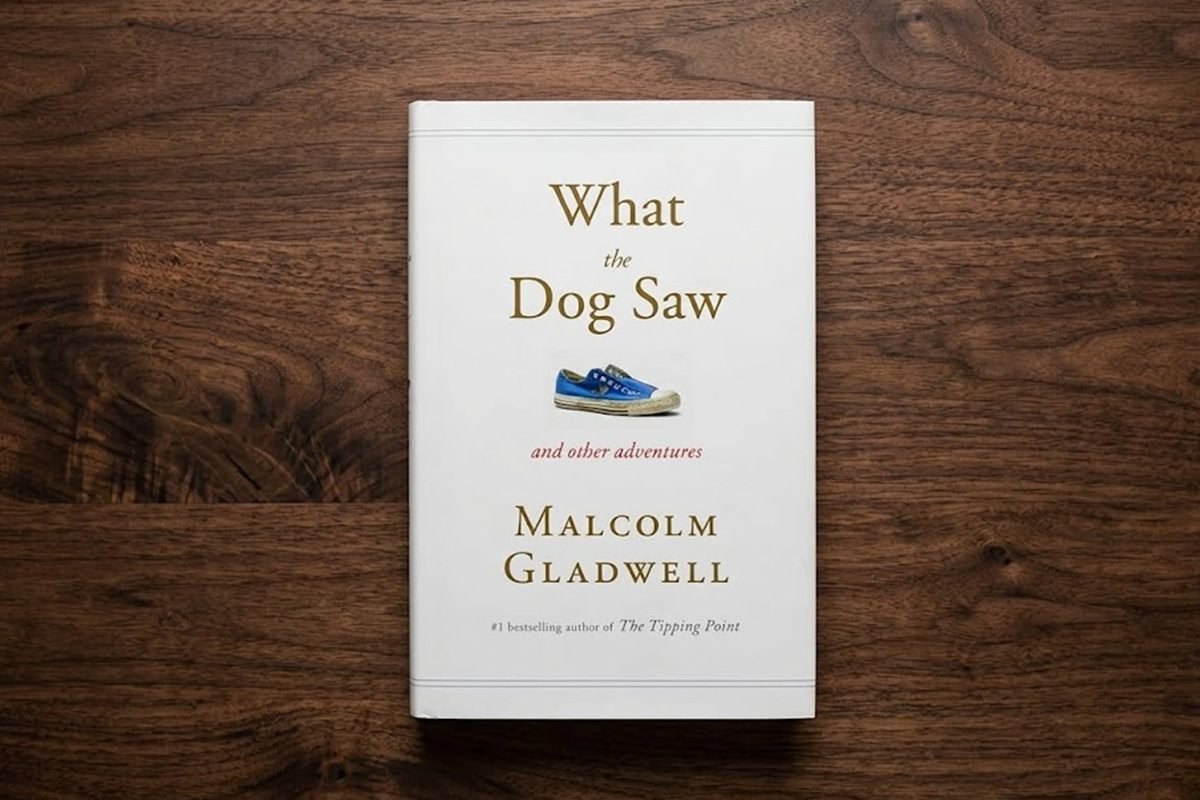
And Other Adventures
By Malcolm Gladwell
Genres:
- Theory of Economics
- Social Psychology
The year it was published:
2009
Number of pages:
410

As an Amazon Associate, I earn from qualifying purchases.
Table of contents:
Preface
Part I – Obsessives, Pioneers, and Other Varieties of Minor Genius
Chapter 1: The Pitchman
Chapter 2: The Ketchup Conundrum
Chapter 3: Blowing Up
Chapter 4: True Colors
Chapter 5: John Rock’s Error
Chapter 6: What the Dog Saw
Part II – Theories, Predictions, and Diagnoses
Chapter 7: Open Secrets
Chapter 8: Million-Dollar Murray
Chapter 9: The Picture Problem
Chapter 10: Something Borrowed
Chapter 11: Connecting the Dots
Chapter 12: The Art of Failure
Chapter 13: Blowup
Part III – Personality, Character, and Intelligence
Chapter 14: Late Bloomers
Chapter 15: Most Likely to Succeed
Chapter 16: Dangerous Minds
Chapter 17: The Talent Myth
Chapter 18: The New-Boy Network
Chapter 19: Troublemakers
Thoughts about the book:
What the Dog Saw by Malcolm Gladwell is a brilliant collection of essays about the strange, hidden logic behind ordinary life. Rather than presenting one central argument, Gladwell takes the reader through a series of seemingly unrelated subjects and repeatedly asks us to look at familiar things from an unexpected angle. What I liked most is Gladwell’s unusual talent for finding fascinating questions where most people would see nothing interesting. Why does one person become exceptionally successful while another with similar talent does not? Why do some products suddenly become popular? Why are some experts extraordinarily good at what they do while others fail despite impressive credentials? These questions give the essays an investigative quality. The title essay, What the Dog Saw, perfectly captures Gladwell’s approach. He explores the work of dog whisperer Cesar Millan and uses it to ask a larger question about expertise, since sometimes people who are exceptionally skilled at something cannot fully explain how they do it. Their knowledge has become so intuitive that they operate almost beneath conscious awareness. Another major strength is the variety of subjects. One essay can take you into the world of ketchup and food science, while another explores hair-coloring products, criminal profiling, or the psychology of an extraordinary salesman. This variety keeps the book fresh and prevents it from becoming predictable. The book is extremely easy to read. Gladwell writes in a journalistic, conversational style that feels closer to a fascinating magazine feature than a traditional nonfiction book. His sentences are clear, his explanations are accessible, and he introduces complicated subjects through people and stories rather than abstract theory. This is particularly impressive because many of the topics are intellectually complex. Gladwell discusses psychology, economics, sociology, statistics, medicine, marketing, and human cognition, but rarely makes the reader feel as though they are reading an academic textbook. One of the downsides of this book is that Gladwell’s stories can sometimes make complicated realities seem more certain than they actually are. He is an exceptionally persuasive storyteller, and occasionally the elegance of the narrative can overshadow the limitations of the evidence. Readers should therefore enjoy his conclusions while maintaining a healthy degree of skepticism.
Who should read this book:
If you are fascinated by the hidden complexity behind ordinary things, then What the Dog Saw by Malcolm Gladwell is a book worth getting lost in. Rather than following one central argument, Gladwell brings together a collection of seemingly unrelated stories, from ketchup and dog training to financial markets, criminal profiling, and the psychology of success, and uses them to reveal how much more complicated the world becomes when you look beneath the surface. This is a book for readers searching for unexpected explanations. It will appeal to anyone interested in psychology, business, science, human behavior, decision-making, and the strange details that are usually overlooked. If you enjoy asking “Why does this work this way?” when everyone else has stopped questioning it, Gladwell writes directly for you. What Gladwell is searching for is the story behind the obvious story. He’s fascinated by people who see the world differently, the expert who notices what everyone else misses, the unconventional thinker who solves a problem others cannot, or the seemingly insignificant detail that turns out to explain something much larger. He is constantly looking for the hidden variable. This book will help you develop a different kind of curiosity. It teaches you to slow down, question conventional explanations, and look for the overlooked detail that might completely change your understanding of a problem. More than a book of answers, it is a collection of invitations to think differently. Reading What the Dog Saw is like being handed a magnifying glass and told to examine the ordinary world again.
Summary of the book:
Preface
In the preface, Gladwell explains that his writing comes from a lifelong curiosity about what goes on inside other people’s minds. As a child, he watched his mathematician father become completely absorbed in his work but could not understand what he was thinking. This experience reflects what psychologists call the “other minds problem” the realization that other people experience the world in ways we can never fully see. This curiosity shapes the whole book. Gladwell is less interested in famous or powerful people than in what he calls “minor geniuses”, ordinary people who have developed unusual knowledge through their work. A pitchman selling vegetable slicers at a county fair, for example, may understand persuasion better than a marketing professor, while a hair colorist may have deeper insight into women’s self-image than many sociologists. The book is divided into three parts: the first looks at obsessives and minor geniuses, the second explores theories and ways of making sense of experience, and the third examines how we predict and judge other people. Gladwell’s aim is not simply to convince readers of his ideas, but to make them curious about how other people think.
Chapter 1: The Pitchman
This chapter follows Ron Popeil, the man behind products such as the Ronco Showtime Rotisserie and Veg-O-Matic, while exploring the tradition of the great American pitchman. Gladwell’s main point is that successful selling is not just about persuasion, it is about making a product so clear and easy to understand that it almost sells itself. Popeil understood this well. The Veg-O-Matic was effective because viewers could immediately see it slicing vegetables, while the Showtime Rotisserie used a glass door so customers could watch the chicken spin and brown. The simple promise was: “set it and forget it.” Popeil learned this approach from his family, who had spent generations selling kitchen gadgets at fairs, flea markets, and on boardwalks. One of them, Arnold Morris, demonstrated the traditional pitch by entertaining the crowd, showing the product repeatedly, and knowing exactly when to ask for the sale. Gladwell calls this moment “the turn”, the point when the pitch shifts from entertainment to asking people for their money. The difference between this approach and ordinary product marketing becomes clear in Gladwell’s discussion of the VCR. Although the VCR was an important invention, it was difficult for ordinary people to understand and use. Many could not even figure out how to set the clock. Popeil would have approached the problem differently: instead of expecting customers to learn a complicated product, he would have redesigned it to make its usefulness obvious. Popeil’s success showed how powerful this approach could be. When he and Mel Korey tested the Veg-O-Matic on local television in Butte, Montana, they sold 2,500 units in just five weeks. Years later, Popeil brought the same technique to QVC, selling more than a million dollars’ worth of Showtime Rotisseries in a single hour. For Gladwell, these examples show that great selling is not simply about having a persuasive personality. It is about understanding the customer and making the value of a product immediately visible.
Chapter 2: The Ketchup Conundrum
This chapter explores why there are dozens of varieties of pasta sauce but only one ketchup that seems to dominate the market. At the center is Howard Moskowitz, a Harvard-trained psychophysicist who changed the way food companies think about taste. He challenged the idea that there is one perfect version of a product and showed that people have different preferences. When Pepsi asked him to find the ideal sweetness for Diet Pepsi, his research revealed that there was no single level everyone preferred. The better approach was to create different versions for different tastes. Moskowitz put this idea to work with Prego. By studying thousands of consumers, he discovered that about a third preferred chunky pasta sauce, even though that option barely existed in stores. Prego introduced an extra-chunky variety, which became a huge commercial success and demonstrated Moskowitz’s belief that consumer preferences are plural, not singular. The same approach did not work with ketchup. Jim Wigon tried to create new varieties, but Heinz was difficult to improve on because its flavor was already so well balanced. Its combination of sweet, salty, sour, bitter, and umami creates what food scientists call “amplitude”, a rich, rounded taste in which no single flavor dominates. This helps explain why Heinz feels more satisfying than many cheaper brands, where one flavor may stand out too strongly. Gladwell also uses Grey Poupon to show how companies can succeed by understanding different kinds of consumers. Its famous Rolls-Royce advertisement presented Dijon mustard as sophisticated and luxurious, turning a niche product into a leading premium brand. The larger lesson is that companies should not assume everyone wants the same thing. Sometimes success comes from recognizing that people have different tastes and creating products that meet those differences.
Chapter 3: Blowing Up
This chapter explores the very different approaches of Nassim Taleb and Victor Niederhoffer, two investors with opposite views of how predictable financial markets are. Taleb believes that rare, extreme events are much more common than conventional financial models suggest. His strategy is therefore to accept small losses most of the time by buying options, essentially paying for insurance against a major market crash. Most options expire worthless, but when a crisis occurs, the payoff can be enormous. Niederhoffer took the opposite approach. He believed markets could be understood and predicted through careful analysis, allowing him to make steady profits by selling options. For years, this strategy worked extremely well, but it exposed him to huge losses when markets behaved unexpectedly. In 1997, the market suddenly fell 8 percent in one day, costing Niederhoffer $130 million and wiping out his fund. The following year, the collapse of Long-Term Capital Management provided another example of the danger of relying too heavily on financial models. Despite being run by Nobel Prize-winning economists, LTCM suffered enormous losses when Russia defaulted on its bonds, an event its models had considered extremely unlikely. Taleb calls events like these “black swans”, rare and unpredictable events that have enormous consequences and often seem obvious only after they happen. He argues that financial markets have “fat tails,” meaning extreme events occur much more often than a normal statistical model would predict. The chapter’s larger lesson is that uncertainty cannot simply be eliminated through better predictions. Sometimes the wisest strategy is to recognize that unexpected events are inevitable and prepare for them rather than assuming they will not happen.
Chapter 4: True Colors
This chapter traces the history of hair dye in America and shows how two famous advertising slogans, Clairol’s “Does she or doesn’t she?” and L’Oréal’s “Because I’m worth it,” reflect changing ideas about identity, assimilation, and women’s independence. Shirley Polykoff, the daughter of Jewish immigrants from Brooklyn, created the Clairol campaign in the 1950s. For her, hair coloring represented the freedom to change how you were seen and to fit into American society. The question “Does she or doesn’t she?” was deliberately ambiguous: it asked not only whether a woman dyed her hair, but whether she was really who she appeared to be. The campaign captured the pressure many immigrants and minorities felt to adapt and appear “American enough.” One woman even wrote to Clairol claiming that dyeing her hair blond had finally led her boyfriend to propose. Years later, she admitted she had written the letter herself, but the story captured the fantasy behind the campaign perfectly. By the 1970s, this idea had shifted toward personal independence. Ilon Specht, a 23-year-old copywriter, created L’Oréal’s “Because I’m worth it” after becoming frustrated with male colleagues who treated women as objects in advertising. She wrote the line in just five minutes as an act of defiance, turning the focus from how women were seen by others to how they saw themselves. Together, the two slogans capture a broader cultural shift, from changing yourself to fit society’s expectations to asserting your own identity and worth.
Chapter 5: John Rock’s Error
This chapter follows John Rock, a devout Catholic doctor who helped develop the birth control pill and believed it was compatible with his faith. Rock argued that the Pill simply extended a natural process: progestin, the hormone that prevents ovulation during pregnancy, could be used to extend the body’s naturally infertile period. He was so convinced that science and Catholic teaching could be reconciled that, when an FDA official suggested the Church would never accept the Pill, Rock firmly replied, “Young man, don’t you sell my church short.” To make the Pill appear more natural and acceptable to the Catholic Church, Rock and his collaborator Gregory Pincus designed it to produce a monthly withdrawal bleed. There was no medical need for this; the bleeding was caused by stopping the hormones and was intended to mimic menstruation. The decision reflected Rock’s belief that the Pill should resemble the body’s natural cycle, even though it actually works by suppressing ovulation. Gladwell uses this story to show how deeply our ideas about “natural” processes can influence medicine. Rock believed he was simply extending nature, but the Pill does not actually reproduce a normal hormonal cycle. The chapter suggests that his decision to include a monthly bleed may have prevented women from benefiting earlier from the possibility of safely suppressing menstruation. The chapter also questions how we interpret disease. A Danish autopsy study found cancerous or pre-cancerous changes in the breast tissue of many women who had died from other causes, even though only a small proportion had died from breast cancer. This suggests that some abnormalities can remain harmless or disappear on their own, raising a larger question about whether every abnormality we detect needs to be treated aggressively. Overall, the chapter shows how medical decisions are often shaped not only by science, but also by cultural beliefs, assumptions, and our ideas about what is “natural.”
Chapter 6: What the Dog Saw
This is the title chapter of the book and follows César Millán, the famous “Dog Whisperer,” a Mexican immigrant with no formal training who became known for calming difficult and aggressive dogs. Gladwell is less interested in Millán’s apparent “magic” than in understanding what he is actually doing and, more importantly, what the dogs are perceiving. Millán’s effectiveness comes largely from his understanding of nonverbal communication. Dogs pay far more attention to posture, movement, pace, and emotional state than to words. While many people approach difficult dogs with fear, excitement, or anxiety, Millán remains calm and confident. He calls this “calm-assertive energy,” a steady presence that makes the dog feel that someone else is in control. Gladwell sees this clearly when Millán works with Wilshire, an aggressive pit bull that has attacked both dogs and people. Without saying much, Millán changes the situation simply through the way he enters the space, moves, and carries himself. The dog’s posture and behavior gradually change in response. Researchers who studied Millán’s movements also found that his distinctive, rhythmic way of walking seems to encourage dogs to follow rather than lead. The larger point is that we often focus on what a person is doing without considering what another person or animal is actually perceiving. Millán succeeds because he instinctively understands the signals dogs are constantly reading, even when humans barely notice them.
Chapter 7: Open Secrets
This chapter introduces one of Gladwell’s central ideas, the difference between a puzzle and a mystery. A puzzle is a problem caused by missing information and can usually be solved by finding the missing pieces. A mystery is different, it involves too much information, much of it confusing or contradictory, and the real challenge is understanding what it means. Gladwell uses the Enron scandal to illustrate the difference. Enron’s fraud was not hidden from the public. Its financial reports contained enough warning signs for a careful analyst to recognize that something was wrong, but the information was complicated and difficult to interpret. In fact, a group of Cornell MBA students analyzed Enron’s public financial statements in 2000 and recommended selling the stock because they believed the company was overvalued and its business model was dangerously risky. They reached this conclusion long before the scandal became public. The lesson is that some of the biggest failures in business, intelligence, and medicine are not caused by a lack of information but by an inability to make sense of the information we already have. Puzzles require more facts; mysteries require judgment, interpretation, and the ability to recognize which signals matter.
Chapter 8: Million-Dollar Murray
This chapter explores how a small number of extreme cases can account for a surprisingly large share of a social problem. Gladwell begins with Murray Barr, a chronically homeless alcoholic in Reno who was well known and liked by local police and hospital workers. Over ten years, however, his repeated ambulance trips, emergency room visits, and stays in detox centers cost the public around $1 million. Barr’s story leads Gladwell to the idea of a “power law” distribution. Unlike a bell curve, where most cases are close to average, a power law means that a small group of extreme cases accounts for most of the activity or cost. This pattern appears in homelessness, car pollution, and police complaints. Most homeless people do not remain chronically homeless, most cars produce relatively little pollution, and most police officers receive few complaints. The biggest problems are concentrated among a small minority. This changes how social problems should be addressed. In Denver, the Colorado Coalition for the Homeless gave 106 of the city’s most expensive chronically homeless people their own apartments and caseworkers. The program cost less than $15,000 per person each year, compared with far higher costs from shelters, hospitals, police, and emergency services. The same principle applied to car pollution. A Denver chemist found that about 5 percent of vehicles produced 55 percent of all automobile emissions, leading to a more targeted approach, identify and remove the worst polluters rather than subjecting every driver to the same process. Gladwell uses these examples to highlight the tension between fairness and efficiency. Giving the most troubled people more resources may seem unfair, but when a small group creates most of the cost, concentrating resources on them can be the most effective way to solve the larger problem.
Chapter 9: The Picture Problem
This chapter examines why we often trust images more than we should. Photographs, X-rays, and satellite images can feel like objective evidence, but Gladwell shows that seeing something does not necessarily mean understanding what it is or what it means. He illustrates this with the Gulf War, when American pilots used expensive infrared cameras to hunt Iraqi Scud missile launchers. The pilots believed they had destroyed nearly 100, but post-war analysis confirmed none. Many of the targets were actually oil tanker trucks. A similar problem appears in medicine. Researcher Joann Elmore gave 150 mammograms to ten trained radiologists, who often reached very different conclusions. One identified 85 percent of cancers while another found only 37 percent, and the same image could be judged abnormal by one doctor and normal by another. The difficulty is that mammograms contain genuine ambiguity, not simply mistakes. Gladwell also discusses DCIS, an early form of breast tissue abnormality detected through mammography. Autopsy studies have found DCIS in many women who died from other causes without ever developing breast cancer, raising the possibility that some abnormalities are treated even though they would never have become dangerous. The same problem appeared during World War II, when American forces destroyed a German ball-bearing factory at great cost, only to discover that the Germans could rely on stockpiles, imports, and redesigned machinery. Destroying a target does not necessarily achieve the intended result. Finally, Gladwell examines the satellite images used to support claims about Saddam Hussein’s weapons of mass destruction. What analysts interpreted as decontamination vehicles were later identified by an expert as likely fire trucks. Across all these examples, the lesson is the same: images may give us information, but they do not interpret themselves. The real challenge is understanding what we are looking at and what conclusions the evidence actually supports.
Chapter 10: Something Borrowed
This chapter examines Gladwell’s own experience with plagiarism and asks what it really means to create something original. A Broadway play called Frozen, written by Bryony Lavery, contained passages that closely resembled Gladwell’s New Yorker profile of psychiatrist Dorothy Lewis, who studies serial killers. Lewis felt that the play had taken not only her story but part of her identity. Gladwell, however, became more interested in the larger question of whether borrowing is always wrong. He argues that creativity has always depended on existing ideas. Musicians regularly borrow melodies, rhythms, and sounds from earlier artists. The more important question is whether the borrowing creates something genuinely new or simply copies what already exists. Lavery used material from Gladwell’s article as a foundation for a play about forgiveness, transforming the original material into something with a different purpose and meaning. Gladwell develops this idea through several examples from music. The Beastie Boys sampled a short flute passage from jazz musician James Newton, but a court ruled that the three-note sequence was too basic to belong to anyone. Andrew Lloyd Webber faced a similar accusation when a melody in Phantom of the Opera was compared with an earlier song, only for an expert to discover that Lloyd Webber had used almost the same melody in two of his own earlier works. These examples show how difficult it is to draw a clear line between inspiration, borrowing, and plagiarism. Gladwell ultimately argues that our obsession with originality can go too far. Creativity is rarely created from nothing; it usually comes from rearranging and transforming what already exists. The important distinction is between borrowing that produces something new and borrowing that simply pretends to be original.
Chapter 11: Connecting the Dots
This chapter examines the criticism that intelligence agencies should have been able to “connect the dots” and prevent the September 11 attacks. Gladwell argues that this view is heavily influenced by hindsight. Before a disaster happens, important clues are buried among thousands of other pieces of information, many of which seem just as plausible. Only afterward does a clear pattern emerge. He calls this “creeping determinism”, our tendency to believe that an event was more predictable and preventable than it actually was. The 1973 Yom Kippur War illustrates this problem. In the months before the attack, Egyptian forces mobilized 19 times without starting a war. When they finally attacked, Israeli intelligence had become so accustomed to false alarms that the chief of intelligence still believed war was unlikely. The same problem faced American intelligence agencies before September 11 when suspicious activity and warnings existed, but there was no reliable way to know which signals mattered. Gladwell also argues that attempts to improve intelligence systems can create new problems. The CIA and FBI were structured to operate independently partly to prevent groupthink, but greater cooperation might have made information sharing easier. Similarly, making agencies more sensitive to possible threats can produce more false alarms. He illustrates this through psychologist David Rosenhan’s experiment, in which healthy people were admitted to psychiatric hospitals after reporting symptoms of mental illness. When a hospital was later warned that fake patients might be sent, staff identified dozens of genuine patients as possible impostors even though no fake patients had been sent. The larger lesson is that better systems do not eliminate uncertainty. They often solve one problem while creating another. Intelligence work is not simply about collecting more information, it is about deciding which information matters in a world filled with noise, ambiguity, and false signals.
Chapter 12: The Art of Failure
This chapter distinguishes between two types of failure under pressure that can look similar but happen for very different reasons: choking and panicking. Choking happens when an expert becomes too conscious of what they are doing, disrupting the automatic skills they have developed through years of practice. Panicking is almost the opposite: an inexperienced person under extreme stress stops thinking clearly and relies on instinct instead of the skills they have been taught. Jana Novotna’s collapse at the 1993 Wimbledon final illustrates choking. While leading Steffi Graf and only a few points from winning, Novotna began thinking consciously about her shots instead of playing naturally. She started making simple mistakes and quickly lost control of her game. Her skills had become automatic, but pressure pushed her back into conscious thinking, disrupting her performance. JFK Jr.’s fatal plane crash illustrates panic. While flying over the dark ocean, he lost sight of the horizon. Because the inner ear cannot reliably tell a pilot whether a plane is level during a turn, he needed to trust his instruments rather than his feelings. Instead, he relied on instinct and lost control of the aircraft. Unlike Novotna, he was not an expert whose automatic skills broke down; he was a relatively inexperienced pilot whose instincts took over when he needed to think. Gladwell connects these examples to the difference between explicit and implicit learning. Beginners perform skills through conscious, step-by-step thought, while experts eventually perform them automatically. He also discusses “stereotype threat,” in which awareness of a negative stereotype can create enough anxiety to interfere with performance. The broader lesson is that pressure can disrupt performance in opposite ways: experts may think too much, while novices may stop thinking enough.
Chapter 13: Blowup
This chapter examines the 1986 Challenger Space Shuttle disaster and challenges the conventional explanation that NASA managers simply ignored engineers’ warnings and made a reckless decision to launch in cold weather. Sociologist Diane Vaughan’s research found something more troubling: NASA had followed its normal decision-making process. The problem was that the culture itself had gradually made risky decisions seem acceptable. Over the years, NASA had “normalized deviance.” O-ring damage had occurred on earlier launches, but because the shuttle had continued to fly successfully, the damage was gradually treated as an acceptable risk. Each successful launch reinforced the belief that the problem was not serious. By the time Challenger launched, warning signs that should have been alarming had become part of what NASA considered normal. Gladwell connects this to the idea of “normal accidents,” developed by sociologist Charles Perrow. In complex, tightly connected systems, small failures can interact in unexpected ways and produce a major disaster. The Three Mile Island nuclear accident illustrates this: several individually minor problems, including blocked filters, closed valves, faulty instruments, and misleading warnings, combined into a potentially catastrophic situation. No single mistake caused the accident; the complexity of the system allowed small problems to build on one another. The chapter also introduces “risk homeostasis,” the idea that people often compensate for greater safety by taking greater risks elsewhere. For example, taxi drivers with anti-lock brakes were found to drive faster and more aggressively, reducing the expected safety benefit. The broader lesson is that accidents are often not caused by one bad decision. They can emerge gradually from the way people adapt to risk and from complex systems in which small problems become normalized until they combine in unexpected ways.
Chapter 14: Late Bloomers
This chapter challenges the idea that genius always appears early in life. Economist David Galenson studied creative careers and found two different paths to great work, conceptual innovators, who often peak young with a clear vision, and experimental innovators, who develop their ideas gradually through years of trial and error. Ben Fountain, for example, left his career as a lawyer at 33 to become a writer. He spent 18 years writing, revising, and facing rejection while his wife supported the family. His persistence eventually paid off when his first story collection, published in 2006, received major critical acclaim. Paul Cézanne followed a similar path. Unlike Picasso, who achieved fame early, Cézanne spent decades struggling, experimenting, and refining his work before producing some of his greatest paintings in his sixties. His relationship with art dealer Ambroise Vollard captures this persistence, Vollard reportedly sat for 150 portrait sessions, only for Cézanne to eventually abandon the painting. Gladwell argues that late bloomers need more than talent. They need the freedom to experiment, fail, and improve over many years, as well as people who are willing to support them through the long period when their work may attract little attention. Cézanne had support from his father, friends, and fellow artists, while Fountain had his wife. The broader lesson is that creative success does not follow a single timeline. Some people have their best ideas early, while others need decades of experience before they find their voice.
Chapter 15: Most Likely to Succeed
This chapter explores the difficulty of predicting who will succeed in jobs where performance depends heavily on context and interpersonal skills. Gladwell calls this the “quarterback problem”: highly rated college quarterbacks often fail in the NFL, while some players who were overlooked in college become stars. The skills that matter are so specific to the job that tests and credentials cannot reliably predict success beforehand. Teaching is a particularly important example. Research shows that the difference between an excellent and a poor teacher can be enormous, with students of great teachers making far more academic progress. Yet degrees, certifications, and standardized tests cannot reliably identify the best teachers before they enter the classroom. What matters includes qualities such as “withitness,” a teacher’s ability to understand what is happening throughout the classroom and respond before small problems grow. Researchers like Bob Pianta have shown that trained observers can identify these qualities by watching teachers interact with students, but they cannot be measured effectively through traditional credentials or tests. Gladwell uses the 1999 NFL draft to make the same point. Five quarterbacks were selected in the first round, but only Donovan McNabb became a consistently successful NFL player. Interestingly, McNabb had the lowest Wonderlic score among the group, despite the test being viewed as a predictor of football success. The example shows how difficult it is to identify talent before someone actually performs the job. Gladwell therefore argues for a different approach to hiring. Instead of trying to predict success in advance, organizations should give more people opportunities to enter, evaluate them carefully on the job, and then invest heavily in those who prove themselves while quickly moving on from those who do not. In some professions, actual performance is a far better predictor of future success than any test or credential.
Chapter 16: Dangerous Minds
Criminal profiling, the technique made famous by shows like Mindhunter and The Silence of the Lambs, is presented as a scientific way to identify a criminal from clues at a crime scene. Gladwell argues that it is often much less reliable than it appears. James Brussel, the psychiatrist who became known as the father of criminal profiling, famously helped police identify New York’s “Mad Bomber” in 1956. One of his predictions was that the bomber would be wearing a buttoned, double-breasted suit when arrested, which turned out to be true and made Brussel famous. But his prediction was not nearly as accurate as the legend suggests. He was also wrong about several other details, including the bomber having a facial scar, working nights, and being born in Germany. In reality, the bomber was a Polish-American. Gladwell shows that this kind of profiling often relies on statements that sound specific but are actually vague enough to fit many different people. Liverpool University researchers tested FBI profiles and found that they contained so many broad, contradictory, and ambiguous descriptions that almost any suspect could seem like a match. In one experiment, the same FBI profile was judged highly accurate when people were told it described the real killer and when they were told it described a completely fictional offender. The FBI’s distinction between “organized” and “disorganized” criminals provides another example. The theory claims that planned, controlled crimes reveal an organized personality, while chaotic crimes point to a disorganized one. But when researchers examined 100 real serial crimes, they found that the supposed crime-scene traits did not reliably appear together, weakening the entire system. The profile of the BTK Killer shows the problem even more clearly. In 1984, FBI profilers John Douglas and Roy Hazelwood predicted that BTK was likely married or divorced, lower-middle class, of average-to-high intelligence, driving a decent car, and possibly working in a uniformed job. Much of this happened to fit Dennis Rader, who was married, had two children, and held a respectable position in his community. But the profile was broad enough to describe many ordinary people and therefore offered little real help in identifying him. Gladwell’s larger point is that profiling can create the illusion of insight through techniques similar to cold reading. Vague statements, flexible interpretations, and predictions that seem impressive only after the fact can make a profile appear far more accurate than it really is. The lesson is that sounding specific is not the same as being scientifically reliable, and a convincing story about a criminal is not necessarily a useful way to find one.
Chapter 17: The Talent Myth
McKinsey & Company promoted the idea that the key to corporate success was hiring the smartest, most talented people, people who could “think outside the box.” Enron took this philosophy to an extreme. It hired brilliant young MBAs, paid them huge salaries, and gave them enormous freedom. Talented employees were constantly moved into new roles, which made it difficult to see their weaknesses or hold them responsible when things went wrong. Enron became a company built around individual stars, and that culture eventually contributed to its collapse. Gladwell argues that the problem was not simply that Enron had bad people, but that it had created a system that treated talent as a substitute for good management. The company became what psychologists might call a “narcissistic corporation”; it took excessive credit for success, avoided admitting failure, and protected its image of being exceptional. Carol Dweck’s research on fixed and growth mindsets helps explain why this can be dangerous. People who are constantly praised for being “smart” may become afraid of failure because it threatens their identity, while people praised for effort are more willing to take on difficult challenges and learn from mistakes. The importance of the system becomes clear in the example of the U.S. Navy during World War II. In 1942, German U-boats were sinking American ships at an alarming rate. The Navy had plenty of talented individuals, but its operations were fragmented and poorly coordinated. The British, despite having fewer resources and less individual talent, had a more centralized system for coordinating ships and responding to threats. The Americans eventually created the Tenth Fleet to bring their efforts together, and U-boat kills tripled within six months. Gladwell contrasts this with companies such as Southwest Airlines, Wal-Mart, and Procter & Gamble, which built their success less around finding extraordinary individuals and more around creating strong systems. His larger point is that organizations succeed not simply because they have talented people, but because they create environments that allow people to work effectively, learn from mistakes, and coordinate with one another. In great organizations, the system, not the individual star, is the real source of strength.
Chapter 18: The New-Boy Network
Gladwell examines how much faith we place in job interviews, even though they may tell us far less than we think. He argues that interviewers often form an opinion within the first few seconds and then spend the rest of the interview finding reasons to justify that initial impression. He illustrates this with Nolan Myers, a Harvard computer science student whom Gladwell met briefly at a coffee shop. Gladwell immediately felt that Myers was exceptional, even though he could not explain exactly why. A Silicon Valley CEO and a recruiter had a similar reaction after spending only a short time with him. Microsoft CEO Steve Ballmer had an even stronger response after seeing Myers ask a question at a recruiting event and personally followed up with him. These examples show how quickly powerful judgments can form from very limited information. Research by psychologist Nalini Ambady supports the idea that people are remarkably good at “thin slicing,” making judgments from very small amounts of behavior. In one study, people who watched only two seconds of a silent video of a teacher rated that teacher’s effectiveness almost the same way as students who had spent an entire semester in the classroom. Frank Bernieri found something similar in job interviews, observers who watched just 15 seconds of a candidate entering a room, shaking hands, and sitting down often rated the candidate similarly to interviewers who had spent 20 minutes with them. The problem is that these quick judgments are not necessarily accurate measures of ability. We tend to favor people who appear confident, friendly, polished, or familiar, even when those qualities have little connection to actual job performance. Once we form a positive or negative first impression, we may interpret everything that follows through that lens. Gladwell’s larger point is that interviews can create an illusion of careful evaluation when they are often driven by instinct and bias. First impressions can sometimes reveal useful information, but they can also become self-fulfilling prophecies, influencing how we treat people and how we judge everything they do afterward.
Chapter 19: Troublemakers
This final chapter uses the controversy over pit bull bans to explore a larger question: how should we judge individuals when we know something about the group they belong to? Gladwell calls this kind of thinking “profiling,” assuming that a person’s characteristics can be predicted from their group. Many cities have banned pit bulls after highly publicized attacks, assuming the breed itself is inherently dangerous. But Gladwell argues that the evidence behind these bans is weak. Dog-bite statistics are unreliable, breed identification is often inaccurate, and even veterinarians can struggle to identify a dog’s breed correctly from photographs. More importantly, a dog’s behavior is shaped heavily by its upbringing, training, environment, and owner. A well-raised pit bull may be harmless, while a poorly treated dog of another breed can be dangerous. Denver’s experience illustrates the problem. After several attacks, the city banned pit bulls, and animal-control officers began taking dogs away and euthanizing them. But because officials could not reliably identify pit bulls, harmless and well-socialized dogs were sometimes targeted simply because they looked like the banned breed. The policy focused on what a dog was assumed to be rather than what that particular dog had actually done. Gladwell contrasts this with Calgary, Canada, which took a behavior-based approach instead of banning specific breeds. Owners were held responsible when their dogs showed aggression, regardless of breed, and the city strongly enforced leash laws and other requirements. Dog-bite rates fell dramatically, making Calgary one of North America’s safer cities for dog attacks. The policy worked because it focused on actual behavior and individual responsibility rather than group membership. Gladwell connects this to a much broader problem. Group profiling, whether it involves dog breeds, race, age, or other categories, can seem efficient because it simplifies decision-making, but it can also be inaccurate and unfair. Individual assessment requires more effort, but it is often better at identifying genuine risk. The chapter’s larger lesson is that we should judge people and animals by their actual behavior whenever possible, rather than assuming that belonging to a particular group tells us who they are.