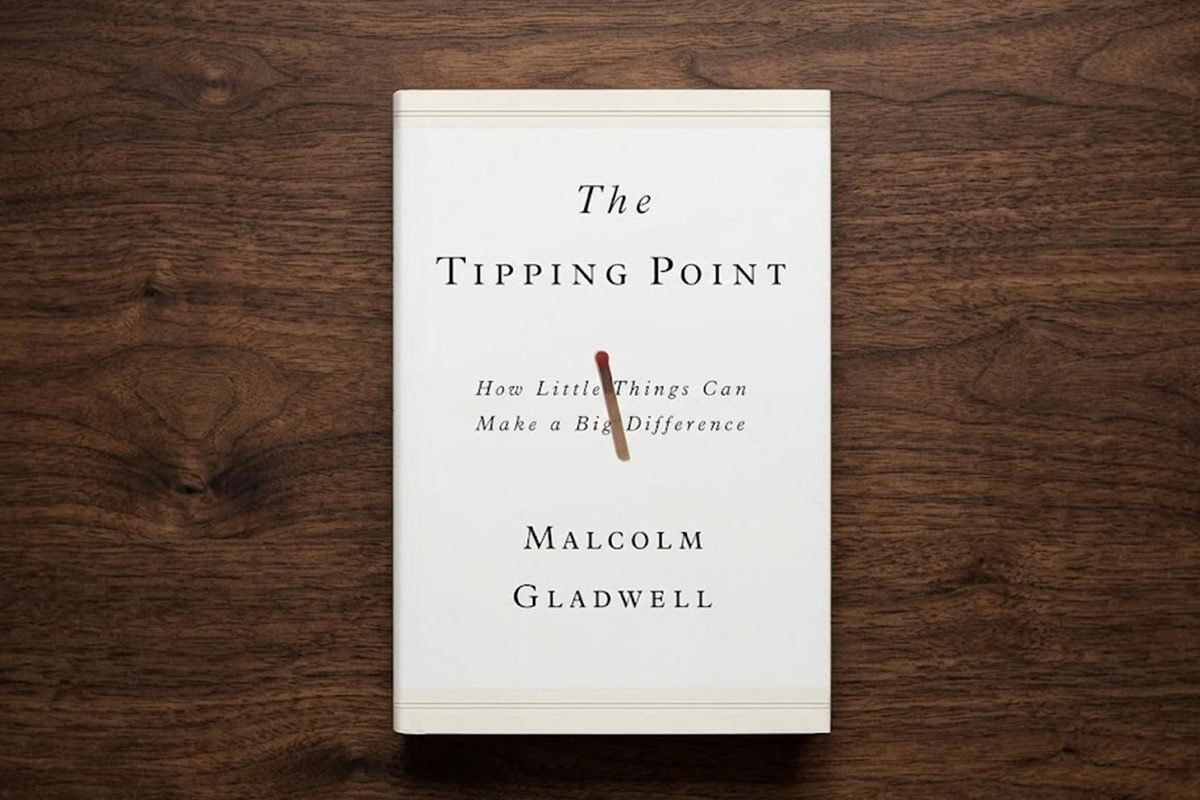
Book review: The Tipping Point
How Little Things Can Make a Big Difference
By Malcolm Gladwell
Genres:
- Social Science
- Business
- Psychology
The year it was published:
2002
Number of pages:
304

As an Amazon Associate, I earn from qualifying purchases.
Table of contents:
Introduction: The Tipping Point — What Is It?
Chapter 1: The Three Rules of Epidemics
Chapter 2: The Law of the Few — Connectors, Mavens, and Salesmen
Chapter 3: The Stickiness Factor — Sesame Street, Blue’s Clues, and the Educational Virus
Chapter 4: The Power of Context (Part One) — Bernie Goetz and the Rise and Fall of New York City Crime
Chapter 5: The Power of Context (Part Two) — The Magic Number One Hundred and Fifty
Chapter 6: Case Study — Rumors, Sneakers, and the Power of Translation
Chapter 7: Case Study — Suicide, Smoking, and the Search for the Unsticky Cigarette
Chapter 8: Conclusion — Focus, Test, and Believe
Afterword: Tipping Point Lessons from the Real World
Thoughts about the book:
Malcolm Gladwell takes a seemingly ordinary question like, why do some ideas, products, behaviors, and trends suddenly explode while others disappear, and turns it into a fascinating exploration of psychology, sociology, marketing, and human networks. The book’s greatest strength is its storytelling. Gladwell rarely begins with theory and then gives dry evidence. He usually begins with a person, an unusual event, a company, or a mystery and gradually reveals the larger principle behind it. The stories about Paul Revere, Sesame Street, Hush Puppies, and the Baltimore crime epidemic are particularly memorable because they make complicated ideas feel almost intuitive. The writing is extremely easy to read. Gladwell uses short, energetic sentences and everyday vocabulary rather than academic language. Even when he discusses epidemiology, psychology, sociology, or behavioral research, he explains the concepts through stories and analogies. You do not need a background in social science to understand the book. At the same time, the book is genuinely informative. Gladwell introduces several important concepts, including the Law of the Few, the Stickiness Factor, and the Power of Context. Together, they provide a framework for understanding why certain messages spread and why seemingly small environmental changes can produce surprisingly large behavioral effects. I particularly enjoyed the Law of the Few. Gladwell argues that social epidemics are often driven disproportionately by a small number of extraordinary individuals, people with unusually large networks, persuasive abilities, specialized knowledge, or social influence. It is an attractive idea because it challenges the assumption that everyone contributes equally to the spread of an idea. The Power of Context is equally interesting. Gladwell demonstrates that human behavior is heavily influenced by surroundings and circumstances. Small changes in an environment can sometimes produce dramatic changes in behavior. This is one of the book’s most valuable lessons because it encourages readers to look beyond individual personality and consider the systems and environments surrounding people. I really liked how The Tipping Point teaches readers to notice patterns. After reading it, ordinary events start to look different. You begin asking things like, Who are the influential people? What makes the message memorable? What changed in the environment?
Who should read this book:
If you have ever wondered why some ideas suddenly become unstoppable while others disappear without a trace, then The Tipping Point by Malcolm Gladwell is a book that will change the way you see social change. This is a book for readers searching for the hidden forces behind trends, movements, and cultural shifts. It speaks to anyone interested in psychology, sociology, marketing, business, human behavior, and the strange ways small events can produce enormous consequences. In this book, Gladwell is searching for the moment when an idea, behavior, or trend crosses an invisible threshold and becomes contagious. His interest lies in the mechanics of social epidemics, the people who spread ideas, the messages that make them memorable, and the environments that allow them to flourish. Rather than treating major change as the result of massive forces, he looks for the small influences that quietly accumulate until everything suddenly shifts. What this book will help you understand is why small changes can have disproportionate effects. You begin to see trends not as random explosions of popularity, but as phenomena shaped by networks, context, timing, and human psychology. The lessons are particularly valuable for anyone working in marketing, leadership, entrepreneurship, or communication.
Summary of the book:
Introduction: The Tipping Point — What Is It?
Malcolm Gladwell begins by asking why some ideas, products, trends, and behaviours suddenly become widespread while others fade away. He introduces the concept of the “tipping point,” the moment when a small change reaches a critical threshold and spreads rapidly, much like a virus. Rather than developing gradually, Gladwell argues that social change often happens suddenly once the right conditions are in place. He illustrates this with the comeback of Hush Puppies shoes. In 1994, the brand was close to disappearing until a small group of young people in New York began wearing the shoes because they were unfashionable. As fashion designers noticed the trend, it quickly spread, turning Hush Puppies into a major success without significant advertising. Gladwell then compares this to the sharp decline in New York City’s crime rate during the 1990s, arguing that although the two examples are very different, both demonstrate how small changes can reach a tipping point and lead to rapid, widespread change. Gladwell concludes by introducing the three principles that explain how social epidemics spread: the Law of the Few, the Stickiness Factor, and the Power of Context. These ideas provide the foundation for the rest of the book.
Chapter 1: The Three Rules of Epidemics
This chapter introduces the book’s central framework, the idea that social trends spread much like diseases. Gladwell uses the syphilis epidemic that struck Baltimore in the mid-1990s to explain the three factors that can cause an epidemic to suddenly take off: the Law of the Few, the Stickiness Factor, and the Power of Context. The Law of the Few suggests that a small number of people are responsible for most of the spreading because they have unusual social influence or connections. The Stickiness Factor means that an idea or message must be memorable enough to stay with people and encourage them to act. The Power of Context highlights how strongly people’s behaviour is shaped by their surroundings and circumstances. Gladwell also introduces the 80/20 Principle, which shows how a small proportion of people or causes can produce a large share of the results. The Baltimore syphilis epidemic illustrates how these factors can work together. Between 1995 and 1996, cases increased dramatically, and experts offered different explanations. Some blamed crack cocaine and the risky behaviour associated with it, while others pointed to cuts in sexual health services or the demolition of public housing, which moved infected residents into new neighbourhoods. Gladwell’s main point is that none of these changes was especially large on its own. Yet together, they were enough to push the epidemic past its tipping point, showing how small changes in the right circumstances can produce major social effects.
Chapter 2: The Law of the Few — Connectors, Mavens, and Salesmen
This chapter explores the first of Gladwell’s three rules: the Law of the Few. He argues that social epidemics depend heavily on a small number of people with unusual social abilities. He identifies three types: Connectors, who know many people across different social groups, Mavens, who collect information and enjoy sharing it, and Salesmen, who are naturally persuasive and can motivate others to act. The key idea is that word of mouth is not equal, the person delivering a message can determine whether it spreads or is ignored. Gladwell illustrates this through the story of Paul Revere and William Dawes. On the night of April 18, 1775, both men rode through the countryside warning people that British troops were approaching, but Revere’s message spread much more effectively. Unlike Dawes, Revere was deeply connected to different communities and was widely known and trusted, making people more likely to listen to him and pass the warning on. The same principle appears in Stanley Milgram’s famous chain-letter experiment, which showed that most people could be connected through only five or six acquaintances. More importantly, many of the letters passed through just a few highly connected individuals. These examples demonstrate Gladwell’s central point that social epidemics often depend not on large numbers of people, but on a small group of unusually influential individuals who can connect, inform, and persuade others.
Chapter 3: The Stickiness Factor — Sesame Street, Blue’s Clues, and the Educational Virus
This chapter explores the second rule, the Stickiness Factor, which explains why some messages stay with us while others are quickly forgotten. Gladwell argues that making a message memorable is not necessarily about making it louder or more obvious. Instead, small, carefully tested changes can make a message much more effective. He illustrates this through Sesame Street, whose creators discovered that children paid more attention to educational content when Muppets and human characters appeared together. They also found that repetition helped children learn rather than making them lose interest. This idea was taken even further by Blue’s Clues, which aired the same episode five days in a row. Instead of becoming bored, children became more engaged and learned more with each viewing because repetition helped them understand and solve the show’s puzzles. Gladwell also looks at direct marketing to show that stickiness can be tested and measured. In an experiment involving the Columbia Record Club, marketer Lester Wunderman added a simple gold box to magazine advertisements and asked readers to cut it out and attach it to their order forms. While standard advertising increased sales by 19 percent, the ads with the gold box increased sales by 80 percent. The small interactive element made people more engaged with the message and more likely to act on it. Together, these examples show that effective messages often become sticky through simple, carefully designed changes that match the way people naturally learn, remember, and respond.
Chapter 4: The Power of Context (Part One) — Bernie Goetz and the Rise and Fall of New York City Crime
This chapter explores the third rule, the Power of Context, which argues that people’s behaviour is strongly shaped by their surroundings and circumstances. Gladwell challenges the idea that behaviour is mainly determined by personality or character, suggesting that even small changes in the environment can have a major effect. He illustrates this through the decline of crime in New York City’s subway system. In the 1980s, the subway was covered in graffiti, fare evasion was widespread, and violent crime was common. Transit officials first focused on graffiti, making sure that tagged trains were cleaned before returning to service. Later, police began enforcing rules against fare evasion, which had previously been treated as a minor offence. Surprisingly, many of those arrested for fare evasion were found to have outstanding warrants or weapons. By addressing these small signs of disorder, officials helped create an environment where order was clearly being maintained, and subway crime eventually fell dramatically. Gladwell connects this to the Broken Windows Theory, which suggests that visible signs of disorder can encourage further disorder and crime. He also introduces the Fundamental Attribution Error, our tendency to explain people’s behaviour through their character rather than their circumstances. Together, these ideas show how powerful context can be in changing the environment, even in seemingly small ways, and how it can change people’s behaviour and help push a social epidemic towards a tipping point.
Chapter 5: The Power of Context (Part Two) — The Magic Number One Hundred and Fifty
This chapter continues exploring the Power of Context, but focuses on social environments, particularly the size of the groups we belong to. Gladwell argues that people can maintain meaningful relationships with only a limited number of others, a figure known as Dunbar’s Number, which is roughly 150. Once groups become larger, relationships become less personal, trust can weaken, and cooperation becomes more difficult. He also introduces the idea of transactive memory, where people rely on one another’s knowledge, and channel capacity, which describes the limits of how much information we can process at once. Gladwell illustrates the importance of group size through W. L. Gore & Associates, the company behind Gore-Tex. When a workplace grows beyond about 150 people, communication and trust begin to suffer, so the company creates a new unit instead of allowing the existing one to grow larger. By keeping teams small, Gore maintains strong relationships and effective collaboration. He also shows how small groups can help social epidemics spread through the success of The Divine Secrets of the Ya-Ya Sisterhood. The book became a bestseller largely through women’s book clubs, where groups read and discussed it together before recommending it to friends and family. These examples demonstrate how small, close-knit groups can create stronger connections, spread ideas more effectively, and influence behaviour in ways that larger groups often cannot.
Chapter 6: Case Study — Rumors, Sneakers, and the Power of Translation
This chapter moves from theory to practical application by examining how ideas and products cross from small subcultures into the mainstream. Gladwell introduces the diffusion curve, which describes how innovations typically spread from Innovators and Early Adopters to the Early Majority, Late Majority, and finally Laggards. A major challenge is crossing the “chasm” between early adopters and the mainstream, which often requires translating an idea without losing what made it appealing in the first place. Gladwell illustrates this through Airwalk, a small skateboarding shoe company that grew from a niche brand into a global phenomenon. Advertising agency Lambesis carefully studied skateboarding culture and translated its values of individuality, rebellion, and humour into advertising that mainstream teenagers could understand while still feeling authentic. Airwalk’s sales rose dramatically from $16 million in 1993 to $175 million in 1996. When the advertising strategy later changed, the brand quickly lost its appeal, showing how carefully a social epidemic must be managed. The same pattern appeared in a 1930s study of hybrid corn in Iowa. Farmers adopted the new seed gradually, beginning with a small group of innovators, followed by respected early adopters, and eventually the mainstream. Adoption then accelerated rapidly before slowing as most farmers had switched. Together, these examples show that even a better product does not automatically become successful. It needs the right people, message, and strategy to cross the gap between a small group of early users and the wider public.
Chapter 7: Case Study — Suicide, Smoking, and the Search for the Unsticky Cigarette
This chapter examines two troubling social epidemics, teen suicide and teen smoking, to show how understanding the logic of contagion can help explain and potentially reduce harmful behaviours. Gladwell argues that both spread through social influence, imitation, and identity rather than simply through individual choice or lack of information. He illustrates this through the teen suicide epidemic in Micronesia, where suicide was once rare but became increasingly common among young men after a series of highly visible cases. Over time, the behaviour became associated with particular situations and social meanings, making it seem like an accepted response to humiliation or conflict. This reflects the Werther Effect, the idea that suicide can spread through imitation, especially when influenced by charismatic or widely known individuals. Gladwell then applies the same logic to teen smoking. Research shows that most teenagers already understand the health risks of smoking, so information campaigns alone are often ineffective. Instead, smoking spreads because it is linked to identity, rebellion, and social status, often influenced by a small group of admired or risk-taking peers. Gladwell argues that reducing smoking requires making the behaviour itself less appealing or “sticky,” rather than simply increasing warnings about its dangers. Together, these examples show that harmful behaviours spread through the same social forces as positive trends, and that effective solutions must address the deeper social and psychological factors behind them.
Chapter 8: Conclusion — Focus, Test, and Believe
In the conclusion, Gladwell brings together the three main principles of the book, the Law of the Few, the Stickiness Factor, and the Power of Context, and shows how they can be used to create meaningful change. He argues that successful interventions do not always require large budgets or sweeping programs. Instead, small, targeted changes can have a much greater impact when they focus on the right people, the right message, and the right environment. Gladwell illustrates this through Georgia Sadler’s health campaign in San Diego. After her efforts to raise awareness of diabetes and breast cancer in local churches produced little interest, she changed her approach and began working with hair stylists. Because stylists were trusted figures who spent hours talking with their clients, they were ideal Connectors and Salesmen. Sadler trained them to share health information through natural conversations and tested different ways of presenting the message. With very little money, the campaign reached many more women and turned a simple health message into a small information epidemic. The example captures Gladwell’s broader message thaz creating change is about focus, testing, and believing in the power of small actions. Like a Band-Aid, an intervention does not have to be large or complicated to be effective. When the right people, message, and circumstances come together, a surprisingly small change can produce a much larger result.
Afterword: Tipping Point Lessons from the Real World
Written after The Tipping Point became a bestseller, the afterword looks at how Gladwell’s ideas were applied in the real world and adds several observations about changes the original book did not fully anticipate. He describes how people used the principles of tipping points to solve problems in libraries, schools, and communities, often through small and targeted interventions rather than large programs. One example comes from New Jersey, where philanthropist Sharon Karmazin sent copies of the book to public libraries and challenged librarians to apply its ideas. Their responses included putting up signs to make a difficult-to-find library easier to access, training well-connected seniors to teach internet skills, and adding Spanish-language materials to attract underserved communities. Similarly, educator Ken Futernick applied the Power of Context to teacher recruitment in Oakland by suggesting that experienced teachers and a strong principal be recruited as a team. By changing the environment and allowing people to work as a close-knit group, a problem that seemed difficult to solve individually became more manageable. Gladwell also reflects on several broader changes. He points to growing social isolation among teenagers and suggests that disconnected young people may be more vulnerable to harmful ideas and behaviours. He argues that people have also developed greater resistance to traditional advertising because they are constantly exposed to messages, making trusted personal recommendations more influential. This makes Mavens increasingly important, particularly in the information age, where people rely on trusted sources to help them navigate an overwhelming amount of information. Overall, the afterword reinforces the book’s central message, which is that meaningful change often comes from understanding how people connect, how information spreads, and how small changes in the right circumstances can create much larger effects.