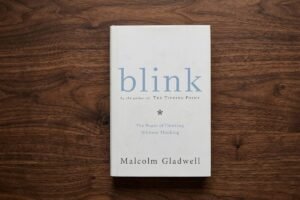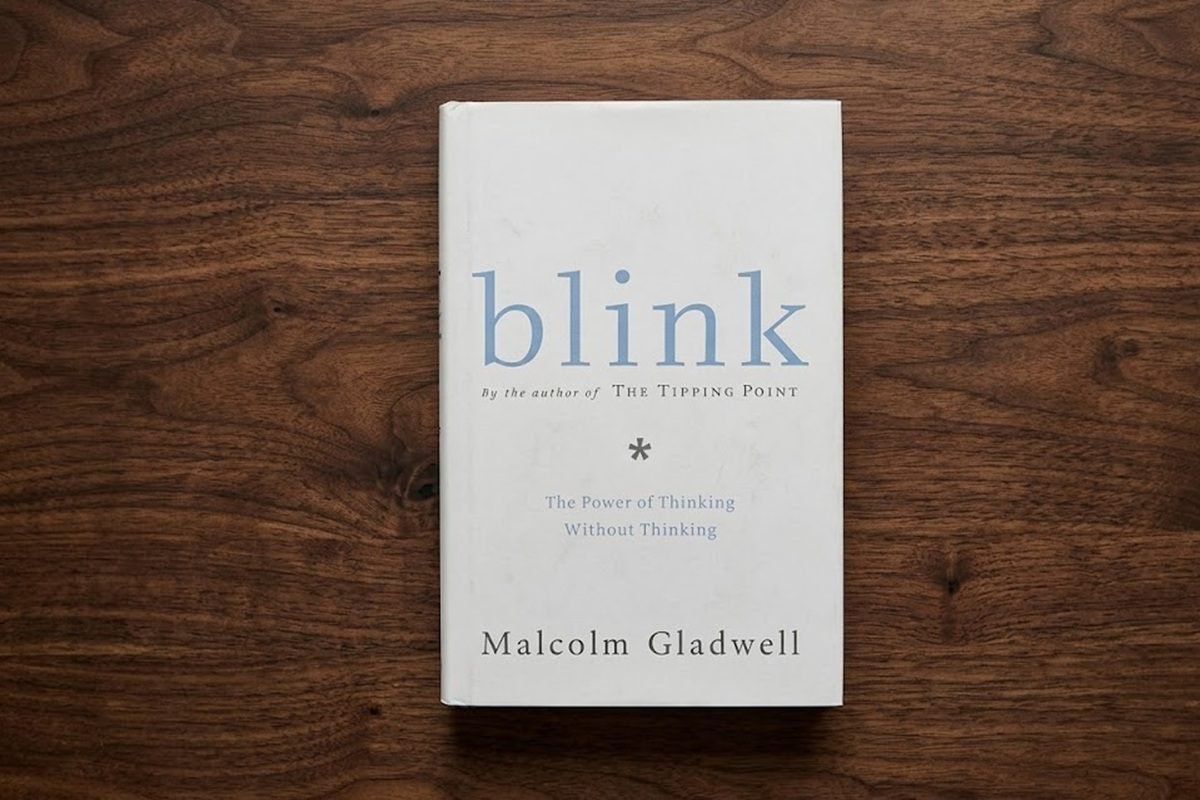
Book review: Blink
The Power of Thinking Without Thinking
By Malcolm Gladwell
Genres:
- Decision-Making
- Psychology
The year it was published:
2005
Number of pages:
288

As an Amazon Associate, I earn from qualifying purchases.
Table of contents:
Introduction: The Statue That Didn’t Look Right
Chapter 1: The Theory of Thin Slices — How a Little Bit of Knowledge Goes a Long Way
Chapter 2: The Locked Door — The Secret Life of Snap Decisions
Chapter 3: The Warren Harding Error — Why We Fall For Tall, Dark, and Handsome
Chapter 4: Paul Van Riper’s Big Victory — Creating Structure for Spontaneity
Chapter 5: Kenna’s Dilemma — The Right and Wrong Way to Ask People What They Want
Chapter 6: Seven Seconds in the Bronx — The Delicate Art of Mind Reading
Conclusion: Listening with Your Eyes — The Lessons of Blink
Thoughts about the book:
Blink by Malcolm Gladwell is a fascinating exploration of intuition, rapid decision-making, and the mysterious power of the human mind to reach conclusions in the blink of an eye. I really like Gladwell’s ability to take an abstract psychological concept and turn it into something vivid, memorable, and relevant to everyday life. The central idea is both simple and provocative: sometimes our first impressions and instantaneous judgments can be remarkably accurate. Gladwell calls this rapid form of thinking “thin-slicing”, the ability to make sophisticated judgments from very small amounts of information. In the book, the author highlighst and important question. When should we trust our instincts, and when should we be suspicious of them? One of the book’s greatest strengths is its storytelling. Gladwell does not write like a traditional psychology textbook. Instead, he introduces readers to fascinating people and situations such as art experts, firefighters, doctors, military officers, police officers, psychologists, and ordinary consumers and uses their experiences to illustrate larger psychological principles. The result is a book that feels more like a collection of compelling investigations than a conventional nonfiction study. The writing is very easy to read. Even when discussing sophisticated ideas from cognitive psychology and neuroscience, he explains them through stories and analogies. You do not need any prior knowledge of psychology to follow the argument. At the same time, the book is intellectually ambitious. Gladwell explores concepts such as unconscious cognition, pattern recognition, priming, intuition, stereotyping, and decision-making under pressure. He makes scientific research accessible without turning the book into an academic lecture. One of the things I also liked in the book was the distinction between good and bad intuition. Gladwell does not simply argue that we should “trust our gut.” In fact, one of the more interesting lessons of the book is that intuition can be extraordinarily powerful in some circumstances and dangerously misleading in others. Expertise, experience, environment, and emotional conditioning all influence whether an instinctive judgment deserves to be trusted. Gladwell shows how quickly people can form powerful impressions based on appearance and how those impressions can operate beneath conscious awareness. It is an uncomfortable reminder that our minds make judgments before we have consciously decided what we think. However, the book also has weaknesses. My biggest criticism is that Gladwell can occasionally make complicated psychological research appear more conclusive than it actually is. There is also a danger of taking the book’s message too literally. Blink can leave readers with the impression that intuition is a kind of hidden superpower. In reality, intuition is highly dependent on context. An expert firefighter making a split-second decision is very different from an inexperienced person making a snap judgment about someone’s character. In the end, what I liked most about Blink is that it changes the way you think about your own thinking. After reading it, you become more conscious of those tiny moments when you instantly like someone, distrust someone, recognize a pattern, or make a decision before you can explain why.
Who should read this book:
If you have ever wondered why you can meet someone for the first time and immediately feel that you can trust them or, conversely, sense that something is wrong before you can explain why, then Blink by Malcolm Gladwell is a fascinating book to read. This is a book for readers searching for a deeper understanding of intuition, rapid decision-making, and the hidden processes behind judgment. It will appeal to anyone interested in psychology, neuroscience, human behavior, leadership, communication, and decision-making, especially those curious about whether our first impressions are sources of wisdom or traps waiting to mislead us. In the book, Gladwell is searching for the mystery behind those extraordinary moments when we seem to “know” something without knowing how we know it. What this book will help you understand is that intuition is neither magic nor automatically reliable. Sometimes our unconscious judgment is remarkably sophisticated, at other times, it is distorted by prejudice, assumptions, and incomplete information. Blink teaches you to become more aware of that split-second judgment and, perhaps more importantly, to recognize when you should trust your instincts and when you should slow down and question them. For anyone fascinated by the question of why we make the decisions we do and how much of our thinking happens before we are even aware of it, this book offers a compelling and thought-provoking journey into the power and danger of intuition.
Summary of the book:
Introduction: The Statue That Didn’t Look Right
Blink explores how we make rapid judgments, often within the first few seconds of seeing or experiencing something. Gladwell argues that these snap decisions can sometimes be remarkably accurate because our minds quickly recognize patterns using what he calls the adaptive unconscious. At the same time, these instincts can also be distorted by biases and limited information, so understanding how they work can help us make better decisions. The adaptive unconscious operates automatically, processing details and patterns before we are consciously aware of them. This connects to psychologist Gerd Gigerenzer’s idea of “fast and frugal” thinking, where people make effective decisions by focusing on a small amount of relevant information rather than considering every possible detail. Gladwell illustrates this with the Getty Kouros, an ancient Greek statue that the J. Paul Getty Museum spent months scientifically examining before purchasing. Although the tests appeared to confirm its authenticity, several art experts immediately felt that something was wrong when they first saw it. Their instincts proved correct when the statue was later exposed as a forgery. Their rapid judgments were based on years of experience that allowed them to recognize subtle details they could not immediately explain. The Iowa Gambling Experiment provides another example. Participants were given four decks of cards, two of which were designed to produce losses over time. Although participants needed around 80 cards to consciously understand which decks were dangerous, their bodies began showing stress responses after only about 10 cards. Their unconscious minds were detecting the pattern before their conscious minds could explain it. Together, these examples show how quickly the brain can process information and how our instincts can sometimes know something before we consciously do.
Chapter 1: The Theory of Thin Slices — How a Little Bit of Knowledge Goes a Long Way
This chapter introduces the idea of “thin-slicing,” the ability of the unconscious mind to recognize meaningful patterns from very small amounts of information. Gladwell argues that more information is not always better. In many situations, a few seconds of behaviour, tone, or body language can provide enough information to make an accurate judgment, especially when the person making the judgment has relevant experience. Psychologist John Gottman demonstrates this through his research on couples. At his “Love Lab,” he recorded couples discussing disagreements and analysed their interactions moment by moment using a system called SPAFF. Small signals such as contempt, dismissive tones, and defensive behaviour could reveal serious problems in a relationship. Gottman found that even short recordings could predict with surprising accuracy whether couples would eventually divorce. Other studies show that thin-slicing is not limited to relationship experts. Nalini Ambady found that students could judge a teacher’s effectiveness from just two seconds of silent video, while Sam Gosling showed that people could accurately judge aspects of someone’s personality simply by looking at their dorm room. Ambady also found that the tone of a surgeon’s voice could help predict whether they had faced a malpractice lawsuit, even when the actual words were removed. Together, these examples show that our unconscious minds can extract a surprising amount of information from very limited data, although the accuracy of these judgments often depends on experience and the ability to recognize meaningful patterns.
Chapter 2: The Locked Door — The Secret Life of Snap Decisions
This chapter explores the limits of our ability to understand our own snap judgments. Gladwell describes the unconscious as a “locked door”, where we can experience a strong instinct or reaction, but we often cannot explain what caused it. When asked to explain our decisions, we may create logical-sounding explanations after the fact, even when they have little connection to what actually influenced us. This “storytelling problem” shows why people’s explanations of their own behaviour are not always reliable. Gladwell illustrates this through tennis coach Vic Braden, who could predict when players were about to double-fault but could never identify the specific cue he was noticing. His unconscious mind had recognized a pattern that his conscious mind could not explain. Priming experiments by psychologist John Bargh provide another example, showing how subtle words and environmental cues could influence people’s behaviour without them realizing it. Gladwell also introduces unconscious associations, including those measured by the Implicit Association Test, which can reveal automatic connections that differ from our conscious beliefs. The same gap between intuition and conscious understanding appears in Karl Duncker’s rope experiment. Participants struggled to solve a puzzle until a small movement of one of the ropes gave them an unconscious clue. They quickly found the solution but could not explain what had helped them. Together, these examples show that our minds often make decisions and solve problems using processes that remain hidden from conscious awareness, making our explanations of our own behaviour much less reliable than we assume.
Chapter 3: The Warren Harding Error — Why We Fall For Tall, Dark, and Handsome
This chapter explores the darker side of snap judgments, showing how the unconscious mind can lead us astray when it relies on irrelevant characteristics such as appearance, height, voice, or race. These judgments can feel as convincing as genuine intuition, but they may reflect biases absorbed from our environment rather than meaningful information. Gladwell illustrates this with the “Warren Harding Error.” Harding’s tall, handsome appearance and authoritative presence made him seem presidential, helping him win the 1920 election despite having few political achievements. His later record of corruption and poor leadership showed how easily people can mistake appearance for ability. Similar biases can be seen in the workplace, where taller people are often perceived as better leaders, and in Ian Ayres’ study of car dealerships, where equally qualified buyers received different treatment based largely on race and gender. Gladwell then examines the Implicit Association Test (IAT), which measures unconscious associations that can influence our behaviour even when they conflict with our conscious beliefs. These biases can affect decisions in areas such as hiring, healthcare, policing, and business. Gladwell argues that unconscious bias cannot simply be removed through conscious effort, but it can be influenced by changing the experiences and associations our minds are exposed to. His own experience with the Race IAT demonstrates this point: even people who consciously reject racism can carry automatic associations shaped by the culture around them. The chapter’s broader message is that understanding our unconscious biases is an important first step toward reducing their influence.
Chapter 4: Paul Van Riper’s Big Victory — Creating Structure for Spontaneity
This chapter examines how expert intuition works and why it can be weakened by too much information or analysis. Gladwell argues that expert snap judgments are not random guesses but are built on deep experience and pattern recognition. Experts often recognize a situation, quickly assess whether their first response will work, and act without comparing every possible option. This approach, known as Recognition-Primed Decision Making, can be more effective than lengthy analysis, especially in situations where decisions must be made quickly. The Millennium Challenge war game illustrates this clearly. While the U.S. Blue Team relied on massive amounts of data, technology, and detailed procedures, retired General Paul Van Riper’s Red Team used simple, unconventional tactics and rapid decision-making to overwhelm them. Similarly, at Cook County Hospital, a simple medical algorithm using only a few key factors proved more effective at identifying patients needing urgent cardiac care than doctors trying to consider every available piece of information. Gladwell also shows that expertise depends on internalized rules and can be disrupted by conscious analysis. Improvisational performers at Second City appear spontaneous because they have deeply absorbed rules such as “yes, and,” allowing them to react naturally without overthinking. The same problem appears in verbal overshadowing: experiments showed that people who described a face in detail before identifying it later performed worse because putting their visual memory into words interfered with recognition. Overall, the chapter argues that good intuition depends on experience, simple frameworks, and trust in automatic processes, while excessive information and analysis can sometimes make our decisions worse.
Chapter 5: Kenna’s Dilemma — The Right and Wrong Way to Ask People What They Want
This chapter examines the limits of market research and focus groups, arguing that people’s stated preferences are not always reliable. Snap judgments can be useful when they come from someone with the right experience and context, but unfamiliar products can confuse consumers, and asking people to explain their reactions can sometimes make their judgments less accurate. Gladwell illustrates this with the musician Kenna, whose unusual sound impressed experienced music executives but received poor ratings from ordinary listeners in market research. The listeners were unfamiliar with his style and therefore struggled to recognize its appeal. A similar problem occurred with New Coke. Although blind taste tests showed that people preferred the sweeter formula in small sips, Coca-Cola’s decision to replace its original recipe ignored the emotional connection consumers had with the brand and the experience of drinking a full can. The same pattern appeared when Herman Miller tested its unusual Aeron chair. Focus groups disliked its unfamiliar design, but the company trusted its designers’ expertise and launched it anyway, turning the chair into a major success. Gladwell also describes an experiment in which ordinary people and expert tasters ranked jams. When ordinary participants were asked to explain their preferences, their judgments became even less consistent, while the experts were able to use their knowledge and vocabulary to make better assessments. These examples show that first impressions are most useful when the person making the judgment has the experience and context needed to understand what they are seeing, hearing, or tasting.
Chapter 6: Seven Seconds in the Bronx — The Delicate Art of Mind Reading
In this chapter, Gladwell explores the dangerous side of snap judgments through the fatal shooting of Amadou Diallo, an unarmed Black man who was shot 41 times by New York City police officers after they mistook his wallet for a gun. Gladwell uses the case to examine how people normally read emotions and intentions from faces and body language, and how extreme stress can disrupt this ability. Psychologists Paul Ekman and Silvan Tomkins showed that humans can recognize universal emotions through facial expressions, including brief micro-expressions that reveal feelings before they are consciously controlled. However, Gladwell argues that this ability can break down under extreme arousal. As heart rate rises, fine motor skills and complex thinking deteriorate, leaving people more vulnerable to fear, tunnel vision, and misinterpretation. The Diallo shooting demonstrates how quickly these failures can compound. The officers approached Diallo in a high-crime area at night, interpreted his movements as threatening, and then reacted to one another’s perception of danger. Diallo was frightened, but his fear was interpreted as aggression, leaving no time to reconsider the situation. Gladwell describes this as “running out of white space” when events happen so quickly that there is no opportunity to pause and correct a mistake. The chapter’s broader lesson is that in high-stakes situations, slowing events down and creating space for reflection can be essential to preventing catastrophic errors.
Conclusion: Listening with Your Eyes — The Lessons of Blink
The conclusion brings together the main lessons of Blink, concerning how snap judgments are powerful and often accurate, but they can also be distorted by bias, stress, irrelevant information, or lack of experience. Rather than simply trusting or rejecting our instincts, Gladwell argues that we should create conditions that allow our unconscious judgments to work more reliably. He illustrates this through the introduction of blind auditions in classical music. For decades, major orchestras were dominated by men, partly because musicians were judged while being seen. Once auditions began taking place behind screens, the number of women hired increased dramatically. The screen removed irrelevant visual information and allowed musicians to be judged purely on their performance. The experience of trombonist Abbie Conant shows how powerful this change could be. Conant impressed the Munich Philharmonic audition panel so strongly from behind the screen that the conductor immediately chose her. When he discovered she was a woman, however, his attitude changed, and he later tried to undermine her position despite evidence that she was an exceptional musician. The contrast showed how quickly unconscious bias could corrupt an otherwise accurate judgment. Gladwell’s final message is that snap judgments should neither be blindly trusted nor dismissed. They can be remarkably powerful when based on experience and made under the right conditions, but they can also be distorted by hidden biases and pressure. The goal, therefore, is to understand what influences our first impressions and design environments that protect them from those influences.