Book review: The Storytelling Animal
How Stories Make Us Human
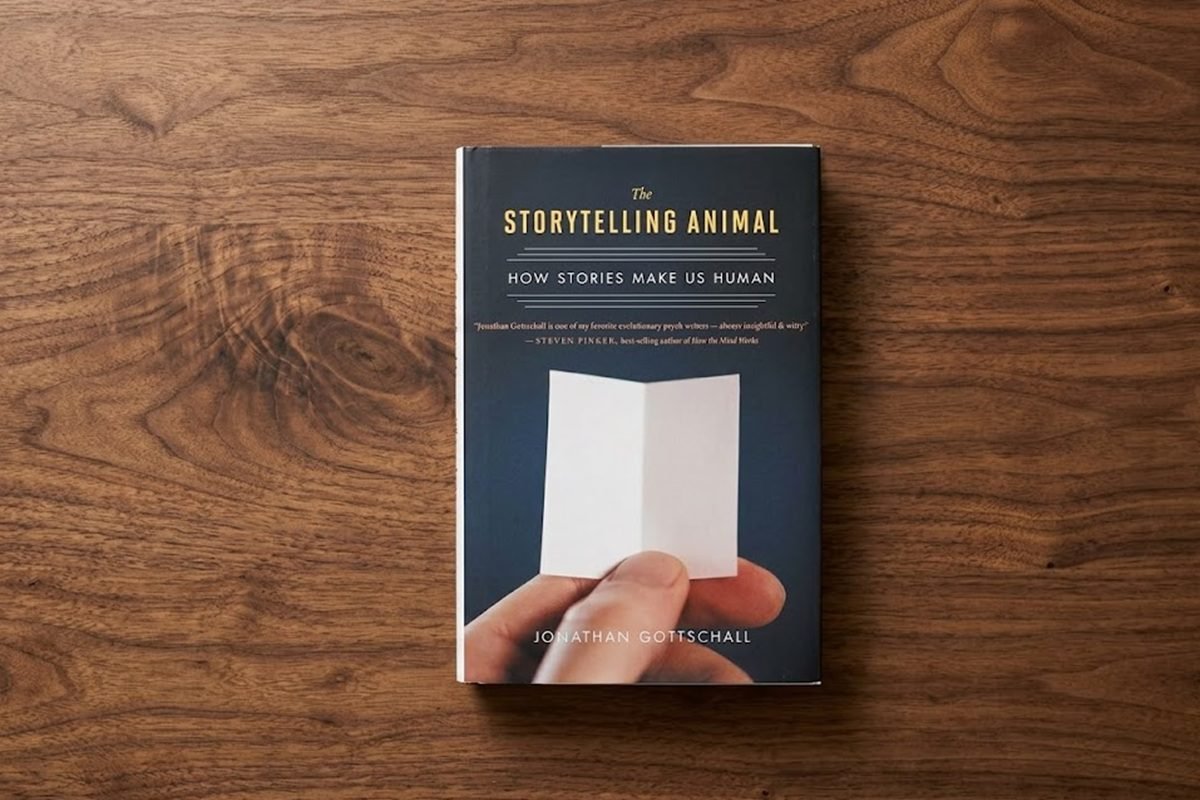
By Jonathan Gottschall
Genres:
- Storytelling
- Psychology
The year it was published:
2013
Number of pages:
272

As an Amazon Associate, I earn from qualifying purchases.
Table of contents:
Preface
Chapter 1: The Witchery of Story
Chapter 2: The Riddle of Fiction
Chapter 3: Hell Is Story-Friendly
Chapter 4: Night Story
Chapter 5: The Mind Is a Storyteller
Chapter 6: The Moral of the Story
Chapter 7: Ink People Change the World
Chapter 8: Life Stories
Chapter 9: The Future of Story
Thoughts about the book:
At its core, the book argues that humans are “storytelling animals.” We are wired to create, consume, and live through stories. According to Jonathan Gottschall, narrative is not a cultural luxury, but it is a biological and psychological necessity. From dreams and myths to novels, gossip, films, and personal identity, stories shape how we think, feel, remember, and relate to the world. What I liked most about the book is how Gottschall moves fluidly between neuroscience, psychology, evolutionary biology, anthropology, and literary analysis. Rather than treating storytelling as an artistic niche, he presents it as a central operating system of human cognition. The idea that stories function almost like mental simulations, helping us rehearse emotions, conflicts, and social interactions, is especially compelling. The writing style is one of the book’s greatest strengths. Gottschall writes with clarity, wit, and enthusiasm. In terms of readability, it is relatively easy to read, though slightly more intellectually demanding than mainstream self-help or business books. The concepts require attention, but the author’s storytelling ability keeps the material engaging. Complex ideas are explained clearly, often through vivid examples drawn from literature, history, and popular culture.
Who should read this book:
If you have ever wondered why human beings are so irresistibly drawn to stories, then The Storytelling Animal by Jonathan Gottschall is a book that will fundamentally change how you see human nature. This is a book for readers who are searching for a deeper understanding of why stories matter. It speaks to those interested in psychology, neuroscience, literature, anthropology, communication, and human behavior, especially anyone who senses that storytelling is not merely entertainment, but something far more essential. Jonathan Gottschall’s interest lies in a profound question. “why did humans become the storytelling species?” He explores how narrative shapes memory, identity, morality, relationships, and even our perception of reality itself. Stories, he argues, are not a cultural luxury, but they are a survival mechanism woven into the architecture of the mind. What this book will help you do is recognize storytelling everywhere, like for example in advertising, politics, religion, personal identity, and your own internal monologue. It explains how narratives influence emotions, beliefs, and behavior, often without our awareness. At the same time, it deepens your appreciation for fiction, imagination, and the human need to create meaning through narrative structure. Reading The Storytelling Animal is an invitation to understand yourself not just as a rational thinker, but as a creature built to interpret life through stories. For anyone fascinated by how stories influence our lives, this book offers a rich, thought-provoking, and deeply illuminating exploration.
Summary of the book:
Preface
Before diving into the chapters, Jonathan Gottschall introduces the central idea of the book, which is that humans are storytelling creatures. Unlike any other animal, we constantly create and consume stories, be it in conversations, books, movies, daydreams, and even dreams while we sleep. He calls this imaginative world “Neverland” and describes humans as “Homo fictus,” meaning “fiction man,” because stories are so deeply woven into our lives that we barely notice their influence. Gottschall explains that he wants to study storytelling through science, using psychology, biology, and neuroscience to understand why stories affect us so strongly. Rather than ruining their magic, he believes science makes stories even more fascinating by revealing how deeply they shape human emotions and behavior. He illustrates this with a personal experience. While driving, he heard the country song “Stealing Cinderella” by Chuck Wicks, a story about a young man asking a father for permission to marry his daughter. The emotional story overwhelmed him so much that he had to pull over because he was crying. That moment led him to ask a larger question: why do stories have such extraordinary power over us? Gottschall also discusses the famous “infinite monkey theory.” In 2003, researchers gave monkeys a computer keyboard to see whether random typing could eventually produce something like Shakespeare’s Hamlet. After weeks, the monkeys produced only meaningless pages of letters. The experiment showed that stories do not appear by accident. Yet Hamlet was still created by a primate, a human being. Long before writing existed, humans were already gathering around fires to tell stories, suggesting that storytelling is one of the most natural and defining human behaviors.
Chapter 1: The Witchery of Story
This chapter explores how stories dominate human life, often without us realizing it. Gottschall argues that stories shape not only books and movies, but also advertising, sports, politics, religion, and everyday conversations. Humans naturally turn events into narratives with heroes, villains, conflict, and resolution because the brain is built to think in stories. Once a story becomes engaging, it captures attention so completely that people stop questioning it. Using examples from fiction, television, and sports, Gottschall shows how easily the mind becomes absorbed in imagined worlds. He describes the true story of the whaleship Essex, where readers become so immersed in the vivid narrative that they fail to notice when he inserts a false detail, demonstrating how stories can override skepticism. The chapter also asks why humans evolved to spend so much time telling stories if storytelling does not directly aid survival. Gottschall imagines two prehistoric tribes, one focused only on practical work and another that also tells stories around the fire. Although the practical tribe seems more efficient, humans ultimately became “the story people,” suggesting storytelling serves an important evolutionary purpose. Gottschall explains that stories work because readers help create them. Writers provide only fragments, while the brain fills in the rest, making reading an active process. He connects this idea to the 2010 Masters tournament, where media transformed Tiger Woods’s scandal and Phil Mickelson’s family struggles into a dramatic narrative with an emotional ending. The chapter ends with children fully absorbed in imaginative play before instantly returning to reality when interrupted. Gottschall uses this scene to show that humans begin living inside stories from early childhood, moving naturally between imagination and reality.
Chapter 2: The Riddle of Fiction
This chapter explores “the riddle of fiction”, why humans spend so much time telling stories that are not real. From an evolutionary perspective, fiction seems wasteful because it consumes time and energy without obvious survival value. Yet storytelling exists in every culture, suggesting it serves an important purpose. Gottschall presents several explanations for why fiction evolved. Storytelling may function as a display of intelligence and creativity, similar to birdsong or a peacock’s tail. More importantly, fiction may act as a “mental simulator,” allowing people to rehearse danger, conflict, love, betrayal, and survival without real-world consequences. This idea is especially clear in children’s play. Across cultures, children naturally invent stories involving monsters, fighting, fear, injury, and death. Gottschall argues these dark themes are not accidental but a form of preparation for reality. Studies of preschool storytelling show children repeatedly creating narratives about danger and loss, suggesting the brain may be biologically driven to practice stressful situations through fiction. The chapter also explores gender differences in storytelling, drawing on Vivian Paley’s classroom studies. Boys often preferred action and combat stories, while girls more commonly created relational narratives. Whether biological or cultural, these patterns suggest storytelling instincts may be deeply rooted in human psychology. Gottschall argues fiction likely serves many purposes at once, entertaining, teaching, bonding communities, regulating emotions, and transmitting values. He also introduces the idea of “fiction as a drug,” suggesting stories stimulate reward systems in the brain, making humans naturally crave them. The chapter concludes that stories are not merely entertainment or escapism. Through dark fairy tales, play, and fiction, humans use narrative to process danger, prepare for reality, and ultimately learn how to survive it.
Chapter 3: Hell Is Story-Friendly
This chapter explores the uncomfortable truth that humans are drawn to conflict rather than peace. Stories thrive on suffering, danger, betrayal, and loss because conflict is the engine of narrative. Gottschall explains that every story follows the same basic structure, someone wants something, obstacles appear, and a struggle follows. Without conflict, there is no story. He connects this idea to evolution by arguing that stories function as mental simulations for survival. Since humans evolved to prepare for danger rather than comfort, narratives naturally focus on threats, grief, violence, and uncertainty. The grocery store example captures this perfectly, a peaceful shopping trip is forgettable, but a missing child creates immediate emotional tension and attention. Gottschall also discusses “transportation,” the psychological state in which readers become fully absorbed in stories. Research suggests stories can temporarily shape beliefs, emotions, and behavior because people experience them emotionally, not just intellectually. This helps explain why storytelling is powerful not only in fiction but also in areas like law and politics, where people respond more strongly to coherent narratives than to facts alone. One of the chapter’s key insights is that fiction’s darkness may actually be adaptive. Horror, tragedy, and crisis reflect the brain’s natural focus on threat detection and preparation. Through stories, humans rehearse fear, grief, injustice, and loss in safe environments, turning fiction into a form of emotional training. Ultimately, Gottschall argues that stories are not escapism. Humans are drawn to conflict in fiction because understanding conflict has always been essential for survival in reality.
Chapter 4: Night Story
This chapter from The Storytelling Animal explores the idea that humans are drawn more to conflict than peace. Stories thrive on danger, suffering, betrayal, and loss because conflict is the core of narrative. Gottschall explains that every story follows the same structure, someone wants something, obstacles appear, and struggle follows. Without conflict, there is no story. He connects this to evolution by arguing that stories act as mental simulations for survival. Since humans evolved to prepare for danger rather than comfort, narratives naturally focus on threats, grief, violence, and uncertainty. The grocery store example highlights this paradox, a peaceful trip home is forgettable, but a missing child immediately becomes compelling because humans are instinctively drawn to crisis. Gottschall also discusses “transportation,” the idea that people become emotionally absorbed in stories. Research suggests stories can temporarily shape beliefs, emotions, and behavior because they are experienced emotionally, not just intellectually. This explains why storytelling is powerful not only in fiction but also in areas like law, where jurors often respond more strongly to convincing narratives than to facts alone. The chapter argues that fiction’s darkness may actually be adaptive. Tragedy, horror, and crisis reflect the brain’s focus on threat detection and preparation. Through stories, humans safely rehearse fear, grief, injustice, and loss, turning fiction into a form of emotional training. Ultimately, Gottschall suggests stories are not escapism. Humans are drawn to conflict in fiction because understanding conflict has always been essential for survival in reality.
Chapter 5: The Mind Is a Storyteller
This chapter argues that the human brain is not just attracted to stories but constantly creates them. Gottschall explains that the mind automatically builds explanations, motives, and causal patterns, even when information is incomplete or random. Using neuroscientist Michael Gazzaniga’s split-brain experiments, the chapter shows how the brain’s “interpreter” invents coherent explanations after the fact. In these studies, people confidently created false but convincing reasons for actions they could not actually explain. This process, called confabulation, suggests the brain values coherence more than truth. Gottschall connects this idea to everyday behavior through experiments like the sock study, where people invented detailed reasons for preferring identical socks, and the Heider-Simmel animation, where viewers turned moving geometric shapes into dramatic stories with heroes and villains. These examples show that humans instinctively transform randomness into narrative. The chapter also explains why conspiracy theories are so compelling. They provide emotionally satisfying stories with clear villains, motives, and causes, which the brain often prefers over uncertainty. Gottschall even compares schizophrenia to storytelling disconnected from reality, where imagined narratives are mistaken for facts. Ultimately, the chapter argues that storytelling is not separate from human thought but central to it. Humans are storytelling creatures who use narrative to organize reality, make decisions, and create meaning. This ability helps people understand the world, but it also makes them vulnerable to bias, illusion, and self-deception.
Chapter 6: The Moral of the Story
This chapter argues that storytelling is deeply connected to morality. Gottschall explains that stories are one of humanity’s main tools for teaching values, shaping behavior, and holding societies together. Across cultures, narratives consistently reward good behavior and punish wrongdoing, a pattern he calls “poetic justice.” One key idea is “imaginative resistance.” People can accept fictional worlds with magic or impossible events, but they struggle with stories that treat cruelty or injustice as morally acceptable. This suggests moral instincts are deeply rooted in human psychology. Gottschall shows how religious texts use stories rather than abstract rules to teach morality through heroes, betrayal, punishment, and redemption. He also argues that nations use shared narratives and myths to create social unity, often simplifying history into clear moral stories. The chapter discusses research on the “just world” belief, showing that people exposed to fiction are more likely to believe good actions are rewarded and bad actions are punished. Although this may not always reflect reality, it encourages trust, cooperation, and moral behavior within societies. Ultimately, Gottschall argues that stories do more than reflect moral values, they actively shape them. Fiction, religion, and cultural myths function as moral training systems that influence how people understand justice, empathy, and how the world ought to be.
Chapter 7: Ink People Change the World
This chapter argues that fictional stories and characters shape real human beliefs, emotions, and behavior. Gottschall explains that fiction is persuasive because it bypasses critical thinking. When people become emotionally absorbed in stories a process called “transportation” they stop analyzing and begin experiencing the narrative as if it were real. Research shows that highly immersive stories can influence beliefs, emotions, and even personality. Fictional fear, for example, often leaves lasting psychological effects, and repeated exposure to violent or prosocial narratives can subtly shape aggression, empathy, and behavior over time. Gottschall supports this argument with historical examples. Adolf Hitler’s fascination with Wagner’s operas helped shape the mythic and nationalist imagination behind Nazi ideology, while Uncle Tom’s Cabin influenced public attitudes toward slavery and strengthened abolitionist sentiment before the American Civil War. The Nazi book burnings of 1933 further demonstrated that political regimes understood the power of stories to shape society. The chapter also discusses experiments showing that even brief exposure to fiction can measurably affect readers’ personalities and perspectives. Stories, therefore, are not harmless entertainment but forces that influence culture, identity, and history. Ultimately, Gottschall argues that fiction changes people because humans experience stories emotionally rather than logically. Fictional characters may be imaginary, but their effects on the real world are powerful and lasting.
Chapter 8: Life Stories
This chapter argues that humans constantly create stories not only about the world, but about themselves. Gottschall explains that personal identity is built through self-narratives, where each person sees themselves as the main character in an ongoing life story. The chapter challenges the idea that memory is a reliable recording of the past. Instead, memory works through reconstruction, the brain rebuilds events, fills gaps, and reshapes experiences according to current emotions and beliefs. Even vivid “flashbulb memories” of major events are often inaccurate, showing that confidence in memory does not guarantee truth. Gottschall also explains that people naturally edit their life stories to protect self-esteem. Most individuals remember successes more clearly than failures and interpret events in ways that present themselves as generally good or capable. This connects to the “Lake Wobegon effect,” where most people believe they are above average in intelligence, kindness, or ability. The chapter suggests these positive self-stories may actually support mental health. Mild self-deception can increase motivation and emotional stability, while depression is often linked to more negative or stagnant self-narratives. Gottschall also discusses research showing how false memories can be implanted, demonstrating how easily the mind can construct believable but inaccurate personal histories. Ultimately, the chapter argues that identity itself is a narrative construction. Humans are not just consumers of stories, they are authors of the stories they tell about their own lives, and those stories shape how they understand themselves and the world.
Chapter 9: The Future of Story
This chapter argues that storytelling is not dying in the digital age but evolving into new forms. While many believe technology is reducing attention spans and weakening literature, Gottschall argues that stories remain central to human life. Novels, films, music, television, and digital media continue to dominate culture, showing that storytelling has simply adapted to new formats. One key idea is that poetry has largely migrated into music. Song lyrics, especially in genres like hip-hop and pop, function as modern poetry consumed daily by millions of people. Video games represent an even bigger shift because players no longer just watch stories, they actively participate in them. Interactive worlds allow people to inhabit narratives rather than simply observe them. Gottschall suggests future storytelling may become even more immersive, resembling virtual worlds where people fully experience stories rather than merely consume them. However, he warns this could lead to “story addiction,” where fictional environments become more emotionally rewarding than real life. Examples like Live Action Role Playing (LARP) and World of Warcraft show how strongly humans desire immersive narratives, often finding purpose, identity, and social connection inside fictional worlds. Reality television also demonstrates that even “reality” is shaped into narrative form through conflict, structure, and emotional drama. Ultimately, the chapter argues that storytelling is a permanent part of human nature. Technology is not replacing stories it is creating new ways for humans to live inside them.