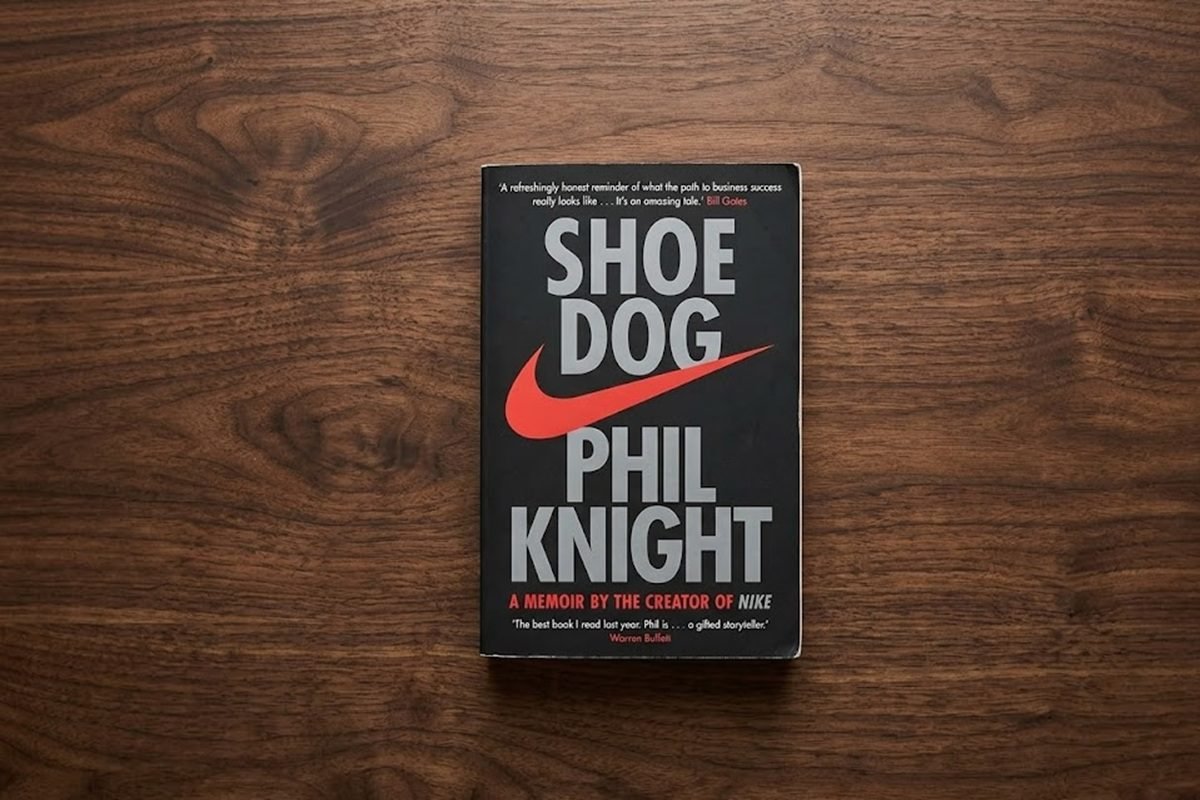
Book review: Shoe Dog
A Memoir by the Creator of Nike
By Phil Knight
Genres:
- Business
- Biography
The year it was published:
2016
Number of pages:
400

As an Amazon Associate, I earn from qualifying purchases.
Table of contents:
DAWN (Prologue)
Part I
1962
1963
1964
1965
1966
1967
1968
1969
1970
1971
1972
1973
1974
1975
Part II
1975
1976
1977
1978
1979
1980
NIGHT (Epilogue)
Thoughts about the book:
The book Shoe Dog is about obsession, risk, endurance, and the chaotic reality of building something from nothing. Phil Knight tells the story of Nike from its fragile beginnings as Blue Ribbon Sports, importing running shoes from Japan, through years of financial instability, legal battles, manufacturing crises, and relentless uncertainty. The remarkable thing is how close the company often feels to collapse. Success, in retrospect, appears inevitable, in Knight’s telling, it felt anything but. What I liked most about the book is its honesty. Knight does not present himself as a flawless visionary. He often appears uncertain, anxious, introverted, and even overwhelmed. This vulnerability gives the memoir unusual credibility. Instead of the polished certainty found in many business books, Shoe Dog captures the emotional turbulence of entrepreneurship, the fear, exhaustion, and improvisation behind the success story. The writing style is another major strength. The book is very easy to read as the narrative flows naturally, and the chronological structure keeps the momentum strong. Even readers with little interest in business or sports branding can become absorbed in the human drama of the story. It reads more like an adventure memoir than a corporate history. In the book, Knight is not trying to teach management theory or present research-backed principles. Instead, the lessons emerge organically through experience. You learn about negotiation, branding, leadership, risk, and resilience through lived moments rather than formal frameworks. This makes the book feel authentic rather than instructional. Because the book is rooted in memory and emotion, it occasionally romanticizes the chaos of entrepreneurship, and the endless crises become part of the mythology, which can obscure the human cost beneath the ambition.
Who should read this book:
If you are fascinated by ambition, not the polished version celebrated after success, but the uncertain, exhausting, deeply human struggle before it, then Shoe Dog by Phil Knight is a book you should definitely pick up. This is not a conventional business book filled with formulas and hindsight certainty. It is a story for readers searching for the reality behind entrepreneurship and all that comes with it, the anxiety, improvisation, risk, obsession, and resilience that accompany building something meaningful from nothing. It speaks to those interested in startups, creativity, leadership, branding, and personal ambition, but who also want honesty rather than mythology. What this book will help you understand is that entrepreneurship is rarely a straight line. It shows how vision is sustained not through confidence alone, but through persistence, relationships, and an almost irrational belief in the possibility of something greater. You also gain insight into how iconic brands are built not only through strategy, but through identity, culture, and relentless conviction.
Summary of the book:
DAWN (Prologue)
The book opens with Phil Knight, the founder of Nike, going for an early morning run at age 54 and reflecting on the unlikely journey that built one of the world’s biggest companies. He thinks back to a simple idea he had after graduating from Stanford Graduate School of Business, importing lightweight, high-quality running shoes from Japan to sell in America, where runners only had access to heavy domestic shoes. Knight calls it his “Crazy Idea” because he had no clear plan and no guarantee it would work, but he felt compelled to try anyway. Through this reflection, he introduces the central theme of the memoir success comes from following conviction, taking risks before you feel ready, and continuing forward even when the odds seem impossible.
1962
After graduating from Stanford Graduate School of Business, Phil Knight sets off on a round-the-world trip that ultimately turned his “Crazy Idea” into something real. Before leaving, he nervously pitches the idea of importing Japanese running shoes to his father, who unexpectedly agrees to support him financially. He then travels with his former track teammate Carter through countries across Asia, the Middle East, and Europe, taking in unfamiliar cultures while searching for direction in life. The defining moment comes in Kobe, Japan, when Knight learns about Onitsuka Co. and its Tiger running shoes. Acting on instinct, he walks into the company’s office with no business experience, no company, and no clear plan. During the meeting, he invents the name Blue Ribbon Sports on the spot and convinces the executives to let him distribute their shoes in America. The deal gives real shape to his vision. Although he continues traveling afterward, his focus never leaves the opportunity he has just created. By the time he returns to Oregon, he knows he is committed to building a business around Japanese running shoes, no matter how uncertain the future looks.
1963
After returning home from his travels, Phil Knight struggles with the gap between ambition and reality. Although Onitsuka Co. promised to send sample shoes, months passed with no sign of them, leaving his business idea stuck in uncertainty. In the meantime, he moves back in with his parents, works as an accountant, and tries to settle into ordinary life, even though he feels restless and disconnected from it. As he waits, Knight questions himself and wonders whether the excitement and freedom of his world trip were the high point of his life. He spends his days writing letters to Japan and trying to stay hopeful, but the lack of progress becomes emotionally draining. The chapter captures the frustration of being caught between dreaming about the future and actually beginning it, showing how difficult it can be to keep believing in something when nothing seems to be happening.
1964
When the first shipment of Tiger running shoes finally arrives from Onitsuka Co., Phil Knight feels that his business dream is finally becoming real. Excited by the quality of the shoes, he sends a few pairs to his former track coach, Bill Bowerman, expecting only feedback and support. Instead, Bowerman immediately asks to become a partner in the business. With each man investing $500, Blue Ribbon Sports officially begins. Bowerman quickly becomes more than an investor. Obsessed with improving performance, he starts experimenting with the Tiger shoes and suggesting design changes, planting the early seeds of innovation that would later define Nike. Meanwhile, Knight sells shoes directly from the trunk of his car at track meets around Oregon, where runners respond enthusiastically and sales grow quickly through word of mouth. As orders increase, his sister Jeanne helps manage the paperwork, becoming the company’s first employee. Alongside the excitement of building the business, the chapter also highlights Knight’s complicated relationship with his father, who supports him in his own way but struggles to fully understand why his son is so determined to make a career out of selling running shoes.
1965
This chapter introduces Jeff Johnson, one of the most important early figures in Blue Ribbon Sports. After receiving a free pair of Tiger shoes, Johnson becomes obsessed with them and starts enthusiastically promoting them to everyone he meets. Impressed by his energy and passion, Phil Knight hires him on commission as the company’s first full-time employee. Johnson quickly proves invaluable. He constantly sends Knight long letters filled with customer feedback, marketing ideas, shoe improvements, and personal reflections, even though Knight rarely replies. His dedication helps Blue Ribbon grow beyond a small side business, and he eventually opens the company’s first retail store in Santa Monica, turning the operation into a real brand with a physical presence. Through Johnson’s connection with customers, Knight begins to understand that runners are not simply buying shoes, they are buying identity, belonging, and a deeper connection to the sport. That realization becomes a key part of the philosophy that would later shape Nike.
1966
As Blue Ribbon Sports continues to grow, Phil Knight becomes increasingly anxious about the company’s dependence on Onitsuka Co.. With the distribution contract nearing expiration and rumors that Onitsuka may be searching for other American partners, Knight realizes how vulnerable the business is when its entire future depends on another company’s decisions. He constantly worries that everything he has built could disappear overnight. Even with that uncertainty, sales continue rising, helped by the success of Jeff Johnson’s Santa Monica store and the growing loyalty of runners who see Blue Ribbon as more than just a shoe company. Knight starts to understand that the brand’s real strength lies in the emotional connection customers feel toward running and the identity surrounding it. At the same time, he begins considering the possibility of eventually creating his own shoes instead of relying on Onitsuka, an idea that quietly marks the beginning of what would later become Nike. Outside of work, however, Knight still feels unsettled personally and continues searching for stability in his life.
1967
Phil Knight pushes Blue Ribbon Sports further east by sending Jeff Johnson to open a store in Boston, even though Johnson is reluctant to leave California. The move reflects Knight’s tendency to avoid difficult conversations until decisions are already made, but the gamble pays off when the new store quickly succeeds. The strong response from runners on the East Coast confirms that demand for high-quality running shoes is growing nationwide. At the same time, Knight is still juggling multiple lives. He teaches accounting at Portland State University during the day while running Blue Ribbon at night, leaving him constantly exhausted but deeply committed to the business. Meanwhile, tensions with Onitsuka Co. continue to grow as Knight travels back to Japan to negotiate the distribution agreement. Both sides understand that Blue Ribbon depends heavily on Onitsuka, giving the Japanese company significant leverage. Despite the uncertainty, Knight slowly builds a loyal team of sales representatives and employees who believe in the company’s vision. Although Blue Ribbon remains small, its culture of passion and commitment is beginning to take shape, laying the foundation for what would later become Nike.
1968
This chapter marks a major shift in Phil Knight’s personal and professional life. He marries Penelope Parks, a former student from his accounting class at Portland State University, and she quickly becomes a steady source of support as the pressures of the business grow. Around the same time, Knight leaves his stable job at Price Waterhouse to focus entirely on Blue Ribbon Sports, despite warnings that abandoning a secure career for an unpredictable startup is reckless. As Blue Ribbon expands, Knight and Penny also start a family with the birth of their son, Matthew. Knight admits, however, that he struggles to balance family life with the demands of the company, which consumes most of his attention and energy. Financial pressure becomes one of the chapter’s main themes. Even though sales keep rising, the company constantly faces cash shortages because it must pay for inventory long before revenue arrives. The faster Blue Ribbon grows, the more money it needs to survive. This creates ongoing conflict with First National Bank and loan officer Bob Wallace, who repeatedly warns Knight that the company is growing too aggressively and borrowing too heavily. Knight refuses to slow down, convinced that continued growth is the only way the business can survive and eventually become something larger, the future Nike.
1969
As Blue Ribbon Sports grows rapidly, Phil Knight expands the team by hiring people who share an obsession with running rather than traditional business credentials. Many of the new employees are former runners, coaches, or outsiders who struggled to fit into conventional careers but thrive in Blue Ribbon’s energetic environment. Among them are Geoff Hollister and Bob Woodell, a former Oregon runner who manages operations from a wheelchair after a paralyzing accident. The company moves into its first real office, though the space feels more chaotic than professional. Despite the disorder, the culture is driven by enthusiasm, loyalty, and a shared belief in what they are building. The employees begin calling themselves “shoe dogs,” a term for people completely devoted to shoes and running culture. Knight realizes that passion and belief in the mission matter more than polished résumés, and that this unconventional team gives Blue Ribbon its identity and momentum. At the same time, Knight cannot shake the fear that the company’s dependence on Onitsuka Co. will eventually become a serious threat. As sales continue climbing, he starts thinking more urgently about creating a backup plan and gaining greater control over the company’s future, ideas that move Blue Ribbon closer to becoming Nike.
1970
Phil Knight travels back to Japan just before Christmas to renegotiate Blue Ribbon Sports’ contract with Onitsuka Co.. The meeting is tense because Onitsuka has grown more confident and aware that Blue Ribbon depends heavily on them, giving the Japanese company the upper hand. Knight manages to secure a contract extension, but he also discovers something unsettling, Onitsuka has been quietly speaking with other potential U.S. distributors, leaving Blue Ribbon’s future uncertain. Although there is no immediate replacement in place, Knight realizes the relationship is no longer secure. It becomes clear that relying entirely on Onitsuka is too risky, and he begins, in secret, to consider making his own shoes. Back in the U.S., he shares the situation with his team, and while the news is worrying, the group responds with determination. They decide to strengthen their relationship with Onitsuka by proving themselves as the best possible partner. The chapter closes with a new plan, inviting Onitsuka executive Kitami to visit the United States and experience Blue Ribbon’s people and culture firsthand, in the hope of reinforcing the partnership while Knight quietly prepares for a future where they may need to stand on their own.
1971
This is one of the most pivotal moments in the story, where Blue Ribbon Sports shifts from distributor to creator. When Onitsuka Co. executive Kitami visits Portland, Phil Knight and his team go out of their way to impress him, hosting tours and dinners to showcase how far Blue Ribbon has come. Kitami seems pleased, and for a moment, it feels like the partnership might stabilize. That illusion breaks when an employee notices Kitami’s briefcase left unattended and finds documents showing Onitsuka has been negotiating with other U.S. distributors. The message is clear, Blue Ribbon is being replaced. Knight is furious, but also decisive. He realizes the company can no longer depend on Onitsuka and must build something of its own. From that point, he quietly begins planning a new direction, working with a Japanese trading company, Nissho Iwai, and a manufacturer, Nippon Rubber, to produce shoes under a new independent brand. This is a major leap, since it means moving from selling products to designing and owning them. To build the brand identity, Knight hires designer Carolyn Davidson, who creates the now-famous Swoosh logo for $35. Knight is uncertain about it at first, but accepts it as a starting point. At the same time, Jeff Johnson suggests a name inspired by a dream, Nike, named after the Greek goddess of victory. The new brand debuts at the 1972 National Sporting Goods Show in Chicago, where the response from sales reps is unexpectedly strong. What began as a reaction to betrayal now takes its first real step toward becoming a global sports brand.
1972
Everything in Blue Ribbon Sports now hinges on the National Sporting Goods Association Show in Chicago, the key trade event where shoe companies either secure their future or fade away based on buyer orders. This time, Phil Knight and his team arrive with something radical, their new brand, Nike, rather than the Tiger shoes from Onitsuka Co.. The break from Onitsuka is essentially complete, and Knight has staked the company’s survival on this risky debut. The gamble pays off. Sales reps respond with curiosity and excitement, and orders begin to come in, giving Knight the relief he desperately needs. The company is no longer just surviving on borrowed products, it is starting to exist in its own right. Around the same time, the book turns to the 1972 Munich Olympics, where tragedy strikes with the terrorist attack on Israeli athletes, casting a shadow over the Games. In the midst of this, Nike’s presence begins to appear on the global stage. Star runner Steve Prefontaine finishes fourth in the 5,000 meters, deeply disappointed, but he is wearing Nike shoes, bringing unexpected visibility to the brand. Knight is struck by the connection between Prefontaine’s personality and what Nike is becoming. Pre’s fearless, uncompromising style reflects the identity Knight wants for the company, not just performance, but attitude and spirit. In that moment, Nike starts to feel less like a business idea and more like a symbol of a certain kind of athlete.
1973
Nike is now growing rapidly, with sales rising, new products being developed, and the brand gaining strong attention in the running world. But the success brings new problems. Phil Knight is suddenly managing a fast-growing team that is passionate but often disorganized, while also dealing with the fallout from the breakup with Onitsuka Co.. Legal battles begin to form on both sides, and the dispute threatens to destabilize everything he has built. At the same time, Steve Prefontaine is struggling emotionally after the Munich Olympics, shaken by the tragedy of the terrorist attack and disappointed with his own performance. Despite this, he remains Nike’s most powerful and authentic ambassador. He continues to compete in Nike shoes and speak passionately about the brand, helping it grow through his influence and identity as a fearless runner. On the personal side, Knight and his wife, Penelope Parks, have their second son, Travis. While Penny carries much of the responsibility at home, Knight remains absorbed in building the company, acknowledging the imbalance but not fully changing it. The chapter closes under growing pressure. The lawsuit with Onitsuka looms large, and Knight understands that if the case goes against them, Nike itself could be at risk of collapse just as it is beginning to take off.
1974
The legal battle between Blue Ribbon Sports and Onitsuka Co. unfolds in a federal courthouse in Portland and becomes one of the most intense periods in Phil Knight’s life. On one side, Knight and his lawyer, Rob Strasser, present a small, scrappy defense team. On the other hand, Onitsuka arrives with experienced corporate lawyers and a stronger legal position, accusing Blue Ribbon of secretly developing competing shoes while still under contract. The case centers on mutual accusations of betrayal. Onitsuka argues that Blue Ribbon violated their agreement, while Knight’s team counters that Onitsuka had already begun negotiating with other U.S. distributors behind their backs. Knight himself takes the stand and recounts the moment his team discovered documents in Kitami’s briefcase suggesting Onitsuka was actively planning to replace them. That testimony becomes a key turning point in the case. The verdict ultimately favors Blue Ribbon. The court rules largely in their favor, ordering Onitsuka to pay damages. The outcome removes a major existential threat just as the company is beginning to grow into something larger. In the aftermath, Knight recognizes how crucial strong legal support has become, and Strasser emerges as a trusted and forceful ally who will play a major role in shaping the company’s future. At the same time, Nike attempts to secure a major endorsement deal with rising tennis star Jimmy Connors, but the deal falls through at the last moment. Even so, the momentum of the business carries forward too quickly for setbacks to slow it down.
1975 (Part I)
Nike wins the Onitsuka lawsuit, but there is little time to celebrate because an even more dangerous crisis emerges. The company’s bank is preparing to cut off its line of credit, which would effectively destroy Nike overnight. The issue comes from Nike’s rapid growth. Sales are increasing at a remarkable pace, but the business model requires large upfront purchases of inventory long before the shoes are sold. This keeps Nike constantly in debt, relying heavily on bank financing just to operate. When the bank’s management changes, the new leadership sees Nike’s borrowing as too risky and threatens to pull the loans immediately. Phil Knight is suddenly facing the possibility of losing everything. The turning point comes when Nissho Iwai, which has been quietly supporting Nike’s manufacturing and financing, steps in. Their strong backing signals confidence in the company and puts pressure on the bank, forcing it to reconsider and ultimately back down. The crisis is narrowly avoided, but it leaves Knight deeply unsettled. He realizes how fragile Nike’s financial structure is and how dependent it is on outside institutions. At the same time, his trust in Nissho grows significantly, as they prove to be a crucial partner at a moment when the American financial system was ready to abandon the company.
1975 (Part II)
This short, devastating chapter focuses on the death of Steve Prefontaine on May 30, 1975. He dies at just 24 years old in a single-car accident near his home in Eugene, Oregon, after attending a party. His car flips, and he is pinned underneath it. By the time help arrives, it is too late. The loss hits Phil Knight and the entire Nike team with immediate force. Prefontaine had been more than their top athlete he had become the living expression of what the brand was trying to represent, intensity, defiance, courage, and an unwillingness to accept limits. In many ways, he was Nike’s first true symbol. Knight visits the crash site and is struck by how quickly it has turned into a place of mourning. Fans have already begun leaving flowers, notes, and running shoes, transforming the area into an informal memorial that Nike would later help preserve. The chapter is intentionally restrained, reflecting the scale of the loss. Rather than building drama, it focuses on absence, on what is gone too suddenly to fully process. Prefontaine’s influence, however, does not end with his death. His spirit continues to shape Nike’s identity long after he is gone.
1976
With the Onitsuka lawsuit behind them and the immediate banking crisis temporarily eased, Phil Knight begins thinking less about survival and more about what Nike is becoming. He starts asking bigger questions about identity, what kind of company they are building, and what it should stand for.His management style remains highly unconventional. He gathers his core team for informal, chaotic meetings they jokingly call “Buttface” sessions, a name reflecting their belief that only stubborn, irreverent people willing to endure constant pressure for little reward would survive at Nike. These meetings are loud, blunt, and often messy, but Knight encourages that intensity. He believes honest disagreement and debate produce better ideas than polished agreement. As this culture takes hold, Nike expands quickly. The company signs more athletes, grows its product range, and begins entering international markets, shifting from a small running-shoe distributor into a broader sports brand. At the same time, Knight’s personal life becomes more strained. His sons, Matthew and Travis Knight, struggle with his constant absence and emotional distance as work continues to dominate his attention. Knight recognizes the tension and admits his shortcomings, but does little to change his behavior. Despite the personal cost, Nike’s momentum is undeniable, driven by a culture that values intensity, honesty, and relentless forward motion.
1977
This chapter centers on a major product breakthrough that reshapes Nike’s future. A former NASA aerospace engineer, Frank Rudy, arrives with an unusual proposal, embedding air-filled cushioning inside a running shoe sole. To prove it works, he demonstrates the idea in a meeting by jumping off a desk without the air unit bursting. Phil Knight is skeptical but intrigued, and the concept moves forward. The result is the Nike Tailwind, the first shoe to use air cushioning, which later leads to iconic products like the Air Force 1. This innovation transforms performance footwear and helps establish Nike as a leader in sports technology, not just design or marketing. At the same time, Knight’s personal life continues to fray. His relationship with his sons remains distant, and he reflects on the cost of building Nike, acknowledging, without fully resolving, that his obsession with the company has come at the expense of family life. The chapter also introduces a serious financial threat, the American Selling Price (ASP) controversy. The U.S. government imposes heavy import duties on Nike based on a pricing system Knight sees as arbitrary and unfair. The potential tax liability reaches tens of millions of dollars, creating another existential risk for a company that is still financially fragile despite its rapid growth.
1978
The American Selling Price (ASP) customs ruling escalates into a full-blown crisis when the U.S. government issues Nike a $25 million bill in back duties, an amount that could wipe the company out. Phil Knight and his key legal strategist, Rob Strasser, respond with an intense lobbying effort, treating the fight as a matter of survival. They bring in political consultants, meet with senators, and press their case in Washington, trying to challenge a system they see as arbitrary and punishing. The process is exhausting and often infuriating. Knight encounters bureaucrats who seem detached from the realities of business, and he is both frustrated and strangely energized by the scale of the fight. Through the ordeal, Knight begins to understand that Nike is no longer just a business operating in the market, it is an organization shaped by policy and politics. He reluctantly steps into the role of corporate advocate, learning how to navigate government power as carefully as he once navigated suppliers and banks. At the same time, Nike continues its rapid global expansion. Manufacturing operations grow in places like Taiwan and South Korea, and the company becomes increasingly international in scope. What started as a small distribution venture has now become a complex global enterprise, with hundreds of employees, rising revenue, and political exposure that matches its growing size.
1979
Knight continues traveling to Washington, D.C., repeatedly trying to fight the $25 million customs bill tied to the American Selling Price (ASP) customs ruling. He is especially frustrated by dealing with a Treasury Department official he nicknames a “micro-kraken,” a small but powerful bureaucrat who seems to take satisfaction in controlling Nike’s fate. Despite the frustration, Knight and his team gradually make progress through persistence, pressure, and political lobbying. During this period, he also brings in a key new figure, David Chang, an eccentric but sharp Chinese-American entrepreneur who helps Nike begin exploring manufacturing opportunities in mainland China. At the time, China was only just opening its economy, making this move unusually forward-looking and risky. Eventually, the customs dispute is settled for far less than the original $25 million demand, giving Nike a crucial financial reprieve. The victory stabilizes the company, but it comes at a cost. Knight is left exhausted from years of constant crises, travel, and pressure, and he admits to feeling increasingly disconnected from the company’s day-to-day reality. Even so, he continues forward, convinced that Nike’s growth phase is far from over and that the most important chapters are still ahead.
1980
This culminating chapter follows Nike’s decision to go public through an Initial Public Offering (IPO), marking its transformation from a scrappy startup into a major corporation. Phil Knight and his team spend months preparing for the process, working closely with investment banks, lawyers, and financial advisors. It is an uncomfortable step for a company built on secrecy and tight internal trust, since going public requires opening its finances and operations to outside scrutiny for the first time. Despite the tension, the IPO is a major success. On the first day of trading, Nike’s valuation skyrockets, and Knight suddenly finds himself worth roughly $178 million. His reaction is understated rather than celebratory. He wakes up, goes to work as usual, and finds that nothing in the physical world feels different. The company has crossed into a completely new scale, but its surroundings remain unchanged. The chapter shifts from numbers to reflection. Knight thinks about the people who made Nike possible, Bill Bowerman, Jeff Johnson, Rob Strasser, and many others, along with his wife Penelope Parks and the broader team who believed in the company when it made little sense to do so. At the same time, Knight reflects honestly on what the journey cost him. His family life, personal relationships, and inner peace were all deeply affected, as Nike became the dominant force in his life. The company was, in effect, a third child, one that demanded everything it had.
NIGHT (Epilogue)
The epilogue takes place in 2007, long after Nike’s rise, when Phil Knight and Penelope Parks go to see the film “The Bucket List”. The movie unexpectedly forces Knight to think about aging, mortality, and what gives life meaning. That night, unable to sleep, he sits alone in his recliner and begins quietly listing the most important people and moments of his life. What emerges is not a celebration of wealth or success, but of relationships and shared effort. Knight reflects on the team that built Nike with him, and on what he is most proud of, not the financial outcome, but the fact that they created something that mattered to people and gave meaning to those who believed in it. The tone shifts into grief as he recalls personal losses. His son, Matthew Knight, died in a scuba diving accident in 2004 at the age of 34, and Knight reflects with painful honesty on the distance that existed between them during Matthew’s life. He also remembers key figures from Nike’s history, including Steve Prefontaine, Bill Bowerman, Jeff Johnson, Bob Woodell, and Rob Strasser, many of whom shaped the company and some of whom died too young to see its full legacy. In the end, Knight does not close with triumph but with reflection. His final message is simple and enduring, keep going, don’t stop. Not as a slogan for business success, but as a way of moving through life itself.