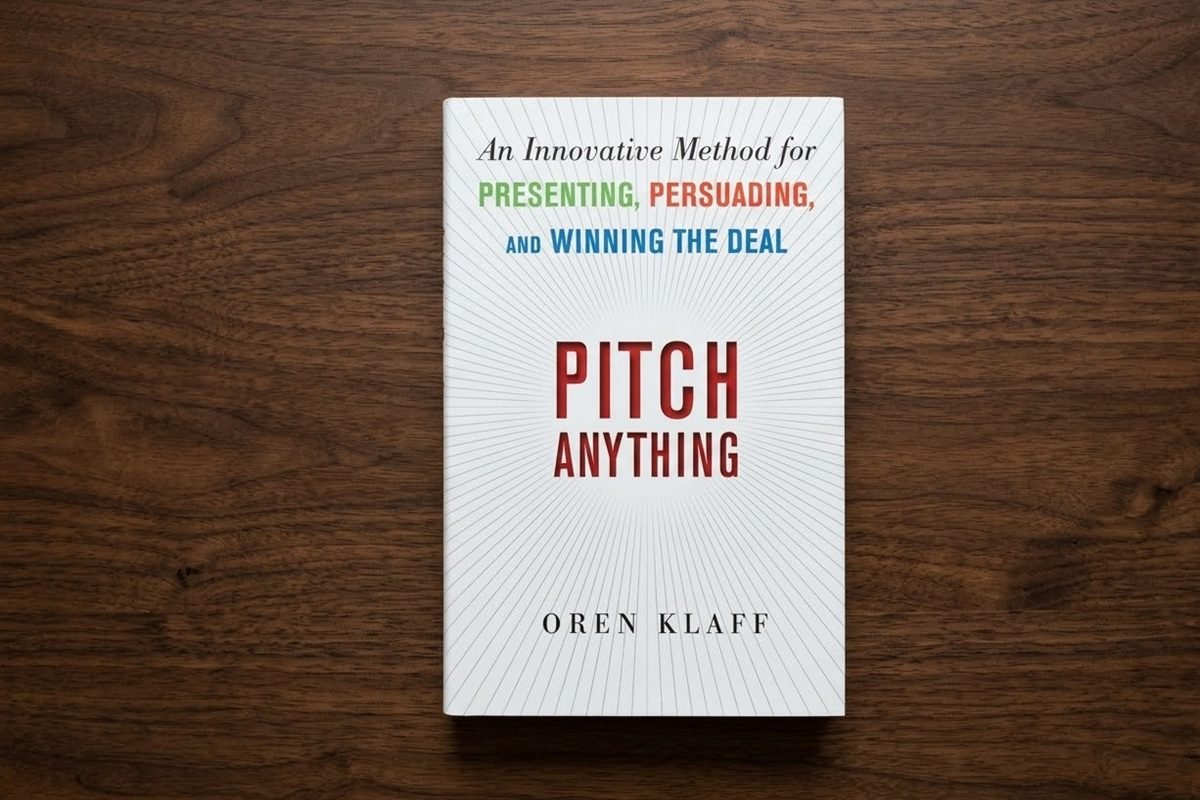
Book review: Pitch Anything
An Innovative Method for Presenting, Persuading, and Winning the Deal
By Oren Klaff
Genres:
- Persuasion
- Sales & Selling
- Communication Skills
The year it was published:
2011
Number of pages:
240

As an Amazon Associate, I earn from qualifying purchases.
Table of contents:
Chapter 1: The Method
Chapter 2: Frame Control
Chapter 3: Status
Chapter 4: Pitching Your Big Idea
Chapter 5: Frame Stacking and Hot Cognitions
Chapter 6: Eradicating Neediness
Chapter 7: Case Study: The Airport Deal
Chapter 8: Get in the Game
Thoughts about the book:
Pitch Anything is bold, provocative, and unapologetically strategic. Klaff does not present pitching as a polite exchange of information but as a psychological power game. His central claim is that influence depends more on status and frame control than on logic, and with this immediately challenges conventional business wisdom. The book is written with confidence and edge, and it aims to rewire how readers think about persuasion. The greatest strength of the book lies in its clarity and practical focus. Klaff distills complex social dynamics into memorable concepts such as “frame control,” “croc brain,” and “prize frame.” These ideas are easy to grasp and immediately applicable. His case study of the airport deal adds credibility and narrative tension, demonstrating that his methods operate in high-stakes environments. Another strength is psychological realism. I also liked that the writing style is direct, fast-paced, and assertive. There is no fluff. Every chapter moves toward application of what the author has shared so far. Readers who appreciate tactical advice will find the book energizing.
However, the book’s confidence occasionally borders on overstatement. Klaff presents his method as universally powerful, yet real-world negotiations are often more nuanced than a battle of frames. Complex deals can depend heavily on long-term trust, technical expertise, and collaborative problem-solving—areas the book touches only lightly. The neuroscience framework, particularly the “croc brain” metaphor, is simplified to the point of caricature. While it serves as a useful teaching device, it lacks scientific depth. Readers seeking rigorous psychological research may find the explanations somewhat thin. Additionally, the tone may not resonate with everyone. Klaff’s style emphasizes dominance, detachment, and strategic tension. Some readers may interpret this as overly aggressive or transactional. Those who value relationship-building over power dynamics may feel the approach is incomplete.
To sum up, Pitch Anything is powerful for readers who operate in competitive, high-stakes environments and want to sharpen their persuasive edge. It reframes pitching as a game of perception and status rather than a data dump. While it lacks deep scientific grounding and occasionally oversimplifies human interaction, it delivers a memorable and actionable system. This is not a book about being liked. It is a book about controlling the room.
Who should read this book:
If you have ever felt that great ideas alone should win the room, only to discover they rarely do, then Pitch Anything by Oren Klaff is an invitation to rethink everything you believe about persuasion. Klaff is not searching for better slides, smoother delivery, or clever closing lines. He is searching for control of the frame, of attention, of status. His interest lies in the psychology that unfolds in the first few seconds of any high-stakes meeting. Why do some pitches electrify investors while others dissolve into polite indifference? Why does confidence outweigh content? Why does neediness repel opportunity? These are the tensions he dissects with unapologetic clarity.
Reading Pitch Anything feels less like attending a lecture and more like being handed a tactical playbook from someone who has fought in real financial arenas. The prose is sharp, direct, and occasionally provocative. Whether you are raising capital, selling an idea, negotiating a salary, or leading a team, this book challenges the comforting myth that logic wins arguments. It suggests something more unsettling and more useful, which is that people decide emotionally, and the person who controls the frame controls the outcome.
Summary of the book:
Chapter 1: The Method
Klaff begins by dismantling the traditional belief that a great pitch is built on logic, data, and detailed explanation. He argues that most presenters mistakenly speak to the analytical part of the brain, while real decisions are first filtered through the primitive, survival-oriented “croc brain.” This part of the brain is highly sensitive to status, novelty, and threat, and it quickly ignores anything perceived as boring or low value. Klaff introduces the STRONG method as a structured way to guide attention and emotion throughout a pitch. He emphasizes that pitching is not about transferring information but about managing perception. A successful pitch must be concise, intriguing, and framed in a way that signals authority and opportunity rather than need. The STRONG method stands for: 1. Setting the frame, 2. Telling the story, 3. Revealing the intrigue, 4. Offering the prize, 5. Nailing the hookpoint, 6. Getting a decision
Chapter 2: Frame Control
In this chapter, Klaff explains that every social interaction operates within a “frame,” or a set of unspoken rules about power and authority. When two people interact, their frames compete, and only one ultimately dominates. If the presenter fails to control the frame, the audience will impose its own, often shifting into analytical questioning or skepticism that weakens momentum. Klaff teaches that frame control requires calm confidence rather than aggression. The presenter must resist being pulled into defensive explanations and instead subtly redirect the conversation to maintain authority. By controlling time, attention, and tone, a presenter establishes dominance without confrontation. Klaff distinguishes between several types of frames: the Power Frame (asserting authority and dominance), the Prize Frame (positioning yourself as the one being evaluated, not the other way around), the Time Frame (controlling the pace and duration of the interaction), and the Analyst Frame (deflecting cold, analytical challenges that kill emotional momentum).
Chapter 3: Status
Klaff argues that status is one of the most powerful forces in any negotiation or pitch. People constantly assess social ranking through subtle cues such as posture, speech patterns, emotional reactions, and urgency. Low-status behaviors, such as over-explaining, seeking validation, or reacting defensively, immediately reduce influence. High-status individuals remain composed, speak succinctly, and show selective interest. Status is not about arrogance but about signaling self-assurance and scarcity. Klaff outlines practical tactics for seizing status from the opening moments of a meeting: arriving with a clear agenda, not apologizing for inconveniences, creating mild tension through small denials, and resisting the urge to please. He also introduces the concept of “prizing,” which is behaving as though you are the prize being sought, rather than the person doing the seeking. This flips the social dynamic so that the target begins to qualify themselves to you. The author provides some examples, which include deflecting flattery, setting your own time constraints, and walking away when disrespected. The underlying message is that status and frame control work together. When you control the frame, you raise your status, and when your status is high, your frame holds.
Chapter 4: Pitching Your Big Idea
In Chapter 4, Klaff focuses on structuring the pitch itself. He advises against overwhelming the audience with slides and financial projections at the outset. Instead, the presenter should introduce a clear and compelling big idea that is easy to grasp and sparks curiosity. The narrative should unfold in a way that builds tension and leaves strategic gaps, encouraging the audience to lean in. Klaff highlights the importance of revealing enough information to demonstrate credibility while withholding enough to maintain intrigue. The pitch should feel dynamic and controlled, guiding the listener toward a decision rather than drowning them in analysis.
Chapter 5: Frame Stacking and Hot Cognitions
Klaff deepens his argument by explaining how multiple persuasive frames can be layered simultaneously to intensify impact. By combining scarcity, authority, time pressure, and intrigue, the presenter creates emotional urgency. He introduces the concept of “hot cognitions,” which are emotionally charged judgments that occur rapidly and subconsciously. According to Klaff, decisions are made emotionally first and justified logically afterward. Therefore, the pitch must generate excitement and desire before logic is introduced. Emotional engagement, not spreadsheets, drives commitment. To do this, Klaff teaches “frame stacking,” which is the layering of multiple frames at the close of a pitch to create a powerful, emotionally resonant crescendo. These include the Intrigue Frame (a compelling story that creates curiosity and tension), the Prize Frame (you are selective about who you work with), the Time Frame (scarcity and urgency), and the Moral Authority Frame (you stand for something larger than the deal itself). When stacked correctly, these frames work together to make the target feel genuine desire and urgency.
Chapter 6: Eradicating Neediness
This chapter centers on the destructive power of neediness in negotiations. Klaff contends that the moment a presenter appears dependent on closing the deal, their leverage disappears. Investors and decision-makers instinctively detect desperation, which lowers perceived status and increases skepticism. To counter this, the presenter must cultivate detachment and project abundance. Being willing to walk away signals strength. Klaff reframes pitching as offering an opportunity rather than seeking permission. When the audience senses that the presenter has options, interest increases.
Chapter 7: Case Study: The Airport Deal
Klaff illustrates his concepts through a detailed account of a high-stakes airport investment deal. In a tense meeting environment filled with skepticism, he demonstrates how frame control and status management can shift the power dynamic. Instead of reacting defensively to challenges, he maintains composure and subtly redirects the conversation. By controlling time constraints and reinforcing scarcity, he positions himself as the prize rather than the supplicant. The case study transforms theory into lived experience, showing how psychological control can determine the outcome of multimillion-dollar negotiations.
Chapter 8: Get in the Game
In the concluding chapter, Klaff emphasizes that understanding these principles intellectually is not enough. Mastery of pitching requires real-world application and repeated exposure to high-stakes environments. He encourages readers to observe social hierarchies, practice controlling frames in everyday conversations, and refine their storytelling skills. Pitching is presented not merely as a business tactic but as a broader social competence rooted in confidence and awareness. The ultimate message is clear, and that is that success belongs to those willing to step into the arena and apply the method consistently.