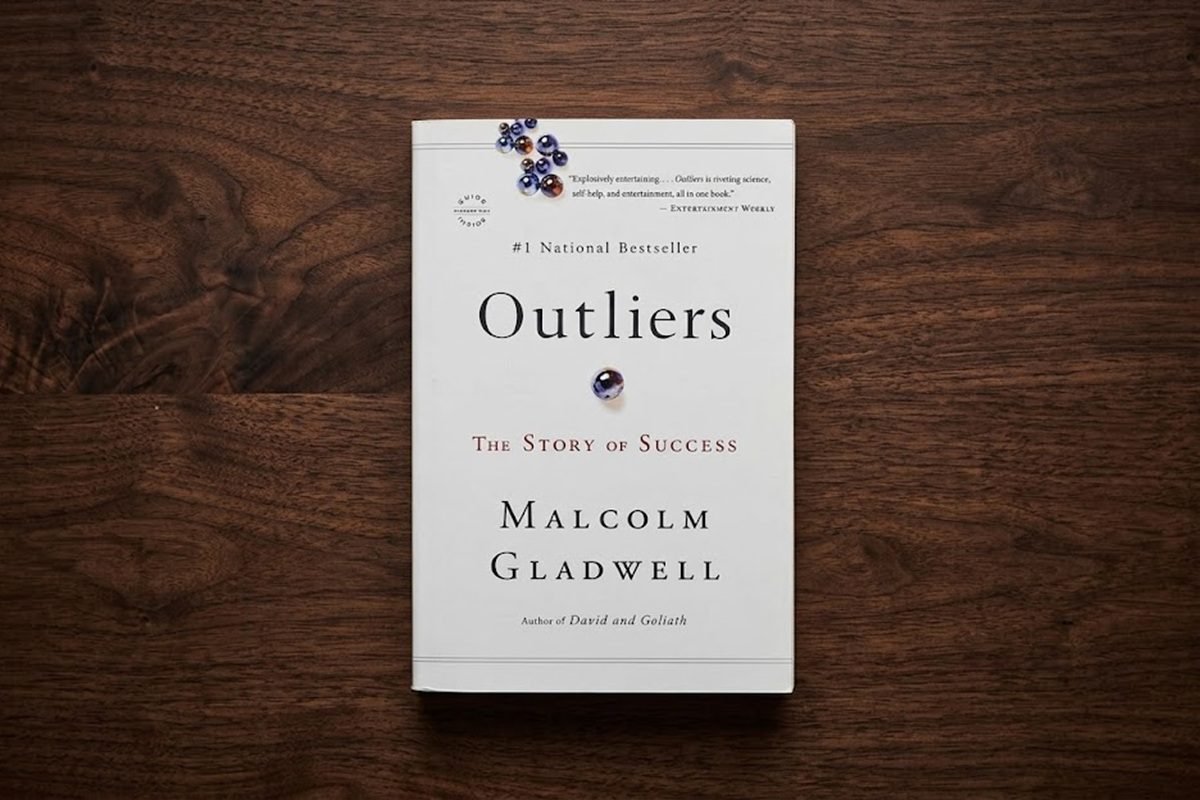
Book review: Outliers
The Story of Success
By Malcolm Gladwell
Genres:
- Social Science
- Problem Solving
- Decision Making
The year it was published:
2008
Number of pages:
309

As an Amazon Associate, I earn from qualifying purchases.
Table of contents:
Introduction: The Roseto Mystery
Part I – Opportunity
Chapter 1: The Matthew Effect
Chapter 2: The 10,000-Hour Rule
Chapter 3: The Trouble with Geniuses, Part 1
Chapter 4: The Trouble with Geniuses, Part 2
Chapter 5: The Three Lessons of Joe Flom
Part II – Legacy
Chapter 6: Harlan, Kentucky
Chapter 7: The Ethnic Theory of Plane Crashes
Chapter 8: Rice Paddies and Math Tests
Chapter 9: Marita’s Bargain
Epilogue: A Jamaican Story
Thoughts about the book:
Outliers by Malcolm Gladwell is a fascinating examination of success. Its central argument challenges a deeply rooted assumption that extraordinary achievement is primarily the result of individual talent, intelligence, and hard work. Gladwell argues that success is also shaped by timing, culture, family background, opportunity, education, and circumstances that are often completely outside an individual’s control. What I liked most about the book is how effectively Gladwell makes the reader question conventional ideas about successful people. Instead of simply celebrating exceptional individuals, he asks what happened around them before they became exceptional. The famous examples of Bill Gates, the Beatles, Canadian hockey players, and extremely successful lawyers are used to demonstrate how opportunity and accumulated advantages can influence the trajectory of a person’s life. The 10,000-hour idea is probably the book’s most famous concept and had the biggest impact on me. Gladwell argues that extraordinary performance generally requires enormous amounts of deliberate practice, but he goes further by asking an important question:, who gets the opportunity to accumulate those hours? This shift in perspective is one of the book’s strongest contributions. Hard work matters, but access to the right opportunities can determine who gets the chance to work hard in the first place. I also found the cultural sections particularly interesting. Gladwell explores how cultural traditions can influence attitudes toward authority, communication, education, and work. The discussion of Korean Air and pilot communication, for example, illustrates how cultural expectations can have consequences in environments where teamwork and communication are literally matters of life and death. The book is easy to read. Gladwell writes like a journalist rather than an academic. He rarely overwhelms the reader with technical terminology. Instead, complex ideas from psychology, sociology, economics, and cultural studies are introduced through memorable people and real-world situations. You can read Outliers without any background in social science and still understand the major arguments. At the same time, the book gives you plenty to think about after you finish it. Gladwell draws on research and statistics, but he selects particular studies and examples that support his broader narrative. He is exceptionally good at connecting evidence into a compelling story, but readers should remember that a compelling case study does not necessarily prove a universal rule. One of the downsides of the book is that Gladwell occasionally gives the reader a strong impression of causality from relatively limited examples. His storytelling is persuasive enough that it can sometimes feel more conclusive than the underlying evidence warrants.
Who should read this book:
Outliers by Malcolm Gladwell is a book for readers searching for the hidden forces behind success. It will appeal to anyone interested in psychology, human behavior, achievement, education, business, leadership, and the influence of culture and circumstance. If you are fascinated by why some people get extraordinary opportunities while others with equal potential never do, Gladwell offers a very different way of looking at achievement. Gladwell is searching for what exists behind the individual. His interest is not simply in what successful people do, but in the circumstances that make their success possible, like, for example, when they were born, where they grew up, the culture they inherited, the opportunities they encountered, and the people who opened doors for them. He examines the uncomfortable idea that success is rarely as individual as we like to believe. What this book will help you understand is that talent needs opportunity, and opportunity is rarely distributed equally. Gladwell explores ideas such as the famous “10,000-hour” concept, cultural legacy, timing, and accumulated advantages to show how small differences early in life can compound into enormous differences later.
Summary of the book:
Introduction: The Roseto Mystery
Gladwell opens Outliers with the unusual case of Roseto, Pennsylvania, a town founded by Italian immigrants that had remarkably low rates of heart disease. Doctor Stewart Wolf and sociologist John Bruhn investigated the town and ruled out the obvious explanations, including diet, exercise, genetics, and the local environment. The key difference turned out to be Roseto itself. Families often lived together, neighbours regularly supported one another, and the community was closely connected through churches, clubs, and shared traditions. This strong social network seemed to protect residents from the stresses of everyday life. Gladwell uses Roseto to introduce the book’s central argument, which is that exceptional outcomes cannot always be explained by individual qualities such as talent, intelligence, or hard work. The environment and circumstances surrounding a person can be just as important. An “outlier” is someone who stands far outside the normal range, and Gladwell argues that such people often become exceptional because of unusual combinations of opportunity, timing, culture, and support. The rest of the book explores this idea by asking not only what successful people are like, but also where they come from and what circumstances helped shape their success.
Chapter 1: The Matthew Effect
Gladwell begins with a surprising pattern in Canadian junior hockey. Elite teams have far more players born early in the year than late in the year. The reason is the January 1 age cutoff. A child born in January can be almost a year older than one born in December while still competing in the same age group. At nine or ten, that difference can mean being bigger, stronger, and more coordinated. Because coaches select elite teams at a young age, these slightly older children are more likely to be chosen. Once selected, they receive better coaching, stronger teammates, more games, and more practice. Over time, this small advantage grows into a real difference in ability. The same pattern appears in European soccer and hockey, where players born early in the eligibility year are also overrepresented. Gladwell finds a similar effect in schools. Research shows that older children within a grade tend to perform better on standardized tests and are more likely to receive opportunities such as gifted programs. An advantage that begins with nothing more than age can therefore influence achievement years later. Gladwell calls this the Matthew Effect, the idea that early advantages create further advantages. Success builds on success. What eventually looks like natural talent may actually be the result of years of extra opportunities and practice. The larger point is that exceptional achievement is rarely the product of talent and hard work alone. Circumstances such as birth date, education, timing, and opportunity can shape who gets the chance to develop their abilities. To understand success, Gladwell argues, we need to look not only at what successful people are like, but also at the opportunities and systems that helped make them successful.
Chapter 2: The 10,000-Hour Rule
Gladwell argues that extraordinary achievement depends less on natural talent than on the amount of meaningful practice a person gets. His famous 10,000-Hour Rule suggests that reaching a world-class level in a complex skill generally requires around 10,000 hours of focused practice. But the important question is not simply who is willing to work that hard, it is who gets the opportunity to do so. Gladwell illustrates this through Bill Joy, who became a brilliant programmer after gaining unusually easy access to computers at the University of Michigan in the early 1970s. While most students had limited access to computers, Joy could spend countless hours programming, giving him an enormous head start. The same pattern appears in Anders Ericsson’s study of violin students, the best performers had accumulated about 10,000 hours of practice by age twenty, while students who practiced less generally achieved lower levels. There was no shortcut based on natural talent alone. The Beatles provide another example. Before becoming famous, they played hundreds of performances in Hamburg, sometimes for eight hours a night. That intense experience gave them thousands of hours of practice and helped transform them into exceptional performers. Bill Gates had a similar advantage. His school gave him access to a computer terminal at a time when computers were extremely rare, and he later found other opportunities to program for hours as a teenager. By the time he founded Microsoft, he had already accumulated years of experience. Gladwell then shows that timing matters as much as practice. Many of America’s richest industrialists were born in the 1830s, putting them at the perfect age to take advantage of the economic boom created by railroads and industrialization. Likewise, many of the pioneers of the personal computer revolution, including Gates, Steve Jobs, Paul Allen, Bill Joy, and Steve Ballmer, were born around 1954–1955 and were therefore the right age when personal computers emerged in the 1970s. The larger point is that success requires more than talent and hard work. People need the right opportunities, resources, support, and timing to accumulate the enormous amount of practice required for mastery. Behind many extraordinary achievements is therefore not just individual ability, but a combination of practice, opportunity, and luck.
Chapter 3: The Trouble with Geniuses, Part 1
Gladwell challenges the idea that extraordinary intelligence automatically leads to extraordinary success. He begins with Christopher Langan, who had an exceptionally high IQ and demonstrated remarkable intellectual ability from childhood, yet struggled to build an academic career. His story suggests that being extremely intelligent is not enough if a person lacks the opportunities, support, and circumstances needed to turn that intelligence into achievement. Gladwell compares Langan with psychologist Lewis Terman’s long-term study of about 1,470 children with very high IQs. Terman expected these children, known as the “Termites,” to become the country’s future intellectual elite. Although many became successful professionals, many others had ordinary careers, and none won a Nobel Prize. Meanwhile, two children who had been rejected from the study for not having a high enough IQ, William Shockley and Luis Alvarez, later became Nobel Prize winners. This leads Gladwell to the idea of an IQ threshold. Intelligence clearly matters, but only up to a certain point. Once someone is around an IQ of 120, having an even higher IQ does not necessarily make that person more successful. Gladwell compares this to height in basketball, you need to be tall enough to compete, but being much taller than necessary does not automatically make you a better player. Once someone is “smart enough,” other qualities become more important. Gladwell also points to the educational backgrounds of Nobel Prize winners, many of whom attended good but not necessarily elite universities. Similarly, a study of graduates from the University of Michigan Law School found that students who entered with lower test scores could go on to careers just as successful as those of their higher-scoring classmates. Once people have enough ability to succeed, factors such as persistence, creativity, personality, and opportunity become more important. This is where Gladwell introduces divergent thinking. While IQ tests mainly measure the ability to find the correct answer, divergent thinking involves generating many different and creative possibilities. In one example, students were asked to think of uses for an ordinary brick. A student with a lower IQ produced a much more imaginative range of answers than a student with a very high IQ. Gladwell uses this to suggest that creativity and flexible thinking may be more important for major breakthroughs than exceptional IQ alone. The larger point is that there is a difference between being intelligent and knowing how to use intelligence effectively. Once a person is smart enough, success depends increasingly on creativity, personality, persistence, opportunity, and the ability to navigate the world around them.
Chapter 4: The Trouble with Geniuses, Part 2
Gladwell continues Christopher Langan’s story by asking why someone with extraordinary intelligence could fail to achieve the success expected of him. He contrasts Langan with physicist J. Robert Oppenheimer, who was also exceptionally intelligent but had something Langan lacked: practical intelligence, or the ability to understand social situations, deal with authority, and get people to help him. Langan grew up in poverty with little stability or guidance. When his college scholarship was lost because of a missed financial-aid form, he did not know how to challenge the decision. Later, when a car breakdown created a scheduling problem at another college, he again failed to negotiate with the administration and eventually dropped out. His intelligence was not the problem; he simply had not learned how to navigate institutions. Oppenheimer grew up wealthy and well-educated, surrounded by adults who taught him how to communicate and handle difficult situations. Even after seriously misbehaving at Cambridge, his family connections and social confidence helped him avoid being expelled. Years later, despite having little administrative experience and being politically controversial, he was able to impress General Leslie Groves and become scientific director of the Manhattan Project. Gladwell connects this difference to psychologist Robert Sternberg’s idea of practical intelligence. Unlike IQ, practical intelligence involves knowing when to speak, whom to approach, how to negotiate, and how to make your needs understood. Gladwell argues that these skills are largely learned through childhood. Sociologist Annette Lareau’s research helps explain where they come from. Wealthier parents tend to practice “concerted cultivation,” actively organizing their children’s lives and teaching them to question adults, negotiate, and speak confidently to authority figures. Working-class and poor families are more likely to follow what Lareau calls “accomplishment of natural growth,” giving children more independence but less practice navigating institutions. This difference can be seen in something as simple as a doctor’s appointment: children raised through concerted cultivation are often encouraged to ask questions and speak up, while others are more likely to remain quiet. Gladwell returns to Terman’s gifted children to show the same pattern. His most successful “Termites” and least successful ones had similarly high IQs, but the successful group was much more likely to come from wealthy, well-educated families. The lesson is that intelligence alone is not enough. Success also depends on learning how to use that intelligence within the social and institutional world around you.
Chapter 5: The Three Lessons of Joe Flom
Gladwell uses the life of Joe Flom, who grew up in a poor Jewish immigrant family in Depression-era Brooklyn and became one of America’s most powerful corporate lawyers, to show that success is shaped by opportunity, timing, and background as much as talent. Flom’s success came from three advantages that initially looked like disadvantages. First, discrimination pushed Flom into an area of law that other lawyers avoided. Because Jewish lawyers were often excluded from prestigious Wall Street firms, Flom was forced to take on unglamorous litigation and proxy fights involving corporate takeovers. He spent decades becoming an expert in this niche. When hostile takeovers became hugely important in the 1970s, Flom’s unusual experience suddenly became extremely valuable. The same discrimination that had limited his opportunities early in his career helped position him for success later. Second, Flom was born at the right time. People born around 1930 were part of a small generation created by the low birth rates of the Great Depression. They faced less competition in schools and universities and entered the workforce when opportunities were expanding. Flom and the founders of Wachtell, Lipton, Rosen & Katz were about forty when the takeover boom began, giving them the experience and seniority to take advantage of it. By contrast, lawyers from slightly older generations, such as Maurice Janklow, entered the profession during the Depression and faced far greater competition. Finally, Gladwell argues that Flom benefited from a culture of meaningful work. He uses Louis and Regina Borgenicht, Jewish immigrants who built a successful clothing business on New York’s Lower East Side, as an example. Their work gave them independence, required constant problem-solving, and created a clear connection between effort and reward. Families like the Borgenichts passed this attitude to their children, teaching them that initiative and hard work could create opportunities. The larger lesson is that success rarely comes from talent alone. Flom had ability, but his success depended on being born at the right time, being pushed into a valuable specialty, and growing up in a culture that taught him the value of hard work and initiative. Gladwell uses his story to show how circumstances that seem like disadvantages can sometimes become unexpected advantages. The chapter also introduces the idea of a demographic trough, a period when fewer children are born and therefore face less competition throughout their lives. Gladwell argues that these hidden advantages of timing can have a major effect on who succeeds.
Chapter 6: Harlan, Kentucky
Gladwell uses the violent history of Harlan County, Kentucky, to show how cultural traditions can survive for generations and continue shaping behavior long after the original conditions have disappeared. The chapter focuses on the feud between the Howard and Turner families, which began with a card-game dispute and escalated into years of shootings and killings. Similar feuds, including the Hatfield-McCoy feud, were common throughout Appalachia, suggesting that something deeper than individual conflict was involved. Gladwell explains this pattern through the idea of a “culture of honor.” In traditional herding societies, a person’s reputation was closely tied to survival because livestock could easily be stolen. Appearing weak could therefore have serious consequences, making people more likely to defend their reputation aggressively. Many Appalachian settlers came from the Scots-Irish borderlands of Britain, where this culture had developed over centuries. When they settled in the mountainous regions of America, they brought these attitudes with them. The surprising part is that this cultural pattern can still influence people today. Psychologists Dov Cohen and Richard Nisbett demonstrated this in an experiment at the University of Michigan. When young men were deliberately insulted, Southern students reacted with greater anger and physical aggression than Northern students, even though most had no connection to farming, herding, or the traditional culture that supposedly created this behavior. The larger lesson is that our behavior can be shaped by cultural legacies we may not even recognize. Patterns developed centuries ago can continue to influence how people respond to conflict, reputation, and insults long after the original reasons for those patterns have disappeared.
Chapter 7: The Ethnic Theory of Plane Crashes
Gladwell examines why Korean Air experienced an unusually high number of fatal crashes in the 1980s and 1990s and how the airline eventually transformed its safety record. He argues that plane crashes are rarely caused by one major mistake. More often, they result from a chain of small errors, especially poor communication between the captain and other members of the crew. A key idea is “mitigated speech,” the tendency to soften or hint at something instead of saying it directly, especially when speaking to someone with more authority. This can be dangerous in a cockpit. In the case of Avianca Flight 052, the first officer repeatedly hinted that the plane was running out of fuel but never clearly declared an emergency. The air traffic controllers failed to understand how serious the situation was, and the plane eventually crashed after running out of fuel. Gladwell connects this problem to Geert Hofstede’s “Power Distance Index,” which measures how strongly a culture expects people to respect and defer to authority. In high-power-distance cultures such as South Korea and Colombia, junior employees may be reluctant to directly challenge their superiors. This pattern appeared in the crash of Korean Air Flight 801 in Guam. The first officer and flight engineer noticed problems with the captain’s decisions but expressed their concerns indirectly, and the plane crashed before anyone took decisive action. Gladwell then shows that cultural habits can be changed. Korean Air brought in outside leadership and required pilots to communicate in English, creating a professional environment in which junior crew members could speak more directly and challenge the captain when necessary. Combined with Crew Resource Management training, this helped transform Korean Air into one of the world’s safest airlines. The larger lesson is that communication and culture can be as important as technical skill. A highly trained team can still fail if its members are afraid to speak openly. But once the underlying problem is recognized, systems can be redesigned to make better communication possible.
Chapter 8: Rice Paddies and Math Tests
Gladwell asks why students from East Asian countries consistently perform better on international math tests and argues that the difference is largely cultural rather than biological. One explanation is language, Chinese, Japanese, and Korean number systems are more logical and easier to remember than English. For example, “thirty-seven” is essentially “three-tens-seven,” making numbers easier for young children to understand and manipulate. Studies also show that Chinese speakers can remember longer strings of numbers because their shorter number words fit more easily into short-term memory. Gladwell’s deeper explanation comes from the history of rice farming. Growing rice requires enormous amounts of careful, sustained work, but that effort is directly connected to the size of the harvest. Farmers who work harder and manage their fields more carefully can produce more. Over generations, this helped create a cultural belief that persistence and effort lead to results. Gladwell argues that this attitude carried into education, where patience and willingness to keep working through difficult problems become major advantages. He illustrates this through Renee, an adult student who spent twenty-two minutes working through a difficult algebra problem about the slope of a vertical line. Instead of giving up when she struggled, she kept experimenting until she understood it. Gladwell contrasts this persistence with the tendency of many students to abandon difficult problems after only a few minutes. He also points to the TIMSS questionnaire, where the countries whose students were most willing to complete the long and tedious questionnaire were also the countries that performed best in mathematics. The larger lesson is that mathematical success is not simply about intelligence. It is also about language, cultural attitudes, and the willingness to keep working when a problem becomes difficult. Gladwell uses the history of rice farming to show how a centuries-old culture of effort and persistence can continue to shape something as modern as performance on a math test.
Chapter 9: Marita’s Bargain
Gladwell uses KIPP Academy in the South Bronx to show how opportunity, hard work, and time can transform educational outcomes. KIPP serves mostly low-income students, yet its students perform far better than many of their peers, especially in mathematics. Gladwell connects this success to research by sociologist Karl Alexander, who found that poor and wealthy students make similar academic progress during the school year. The major difference appears during summer vacation. Wealthier children continue learning through books, camps, travel, and other activities, while poorer children often make little progress or even lose some of what they learned. Over several years, this “summer learning gap” becomes a major part of the achievement gap. KIPP addresses this problem by giving students much more learning time. Students attend school from early morning until late afternoon, come in on Saturdays, and spend extra weeks in school during the summer. Twelve-year-old Marita’s demanding routine shows the personal cost of this approach: she wakes before 6 a.m., spends most of the day at school, and often works on homework until late at night. Gladwell connects KIPP’s approach to the “rice-paddy” work ethic from the previous chapter. Just as rice farming requires long hours of sustained effort, KIPP gives students more time to practice, learn, and develop their skills. The larger lesson is that success is not simply about intelligence or talent. Children also need enough time, support, and opportunity to develop those abilities. Marita succeeds not because she is naturally different from other children, but because she has been given the conditions that allow her potential to grow.
Epilogue: A Jamaican Story
In the final chapter, Gladwell applies the book’s central argument to his own family, showing that his mother’s success was not simply the result of talent or hard work. It was shaped by a series of historical events, opportunities, sacrifices, and lucky coincidences. Gladwell’s mother, Joyce, was born in rural Jamaica in 1931. Around the time she was old enough for secondary school, political unrest following the 1937 Caribbean riots pushed the British colonial government to expand educational opportunities and create new scholarships. Joyce benefited from this change in policy, although even that opportunity came partly by chance: her twin sister received a scholarship first, while Joyce obtained another after a student who had won two scholarships gave one up. Her education continued only because of another act of personal generosity. When Joyce was ready to attend university in London, her mother, Daisy, could not get a bank loan to pay for it. Instead, a local shopkeeper, Mr. Chance, trusted her enough to lend the money. That decision helped make Joyce’s university education possible and eventually allowed her to build a successful life abroad. Gladwell also traces his family history further back to Jamaica’s colonial past. His mixed-race ancestors benefited from a racial hierarchy that gave people of mixed European and African ancestry greater access to education, legal rights, and skilled work than most Black Jamaicans. Although this advantage came from a deeply unjust system, Gladwell shows how its effects continued across generations and helped shape his family’s opportunities. The larger lesson is that even a seemingly self-made success story is built on circumstances that individuals did not create themselves. Joyce’s life was shaped by political reforms, family sacrifices, personal generosity, historical injustice, and simple luck. Gladwell ends by returning to the book’s central idea: outliers do not succeed alone. Their achievements are the result of individual effort combined with opportunities created by family, culture, history, and circumstance.