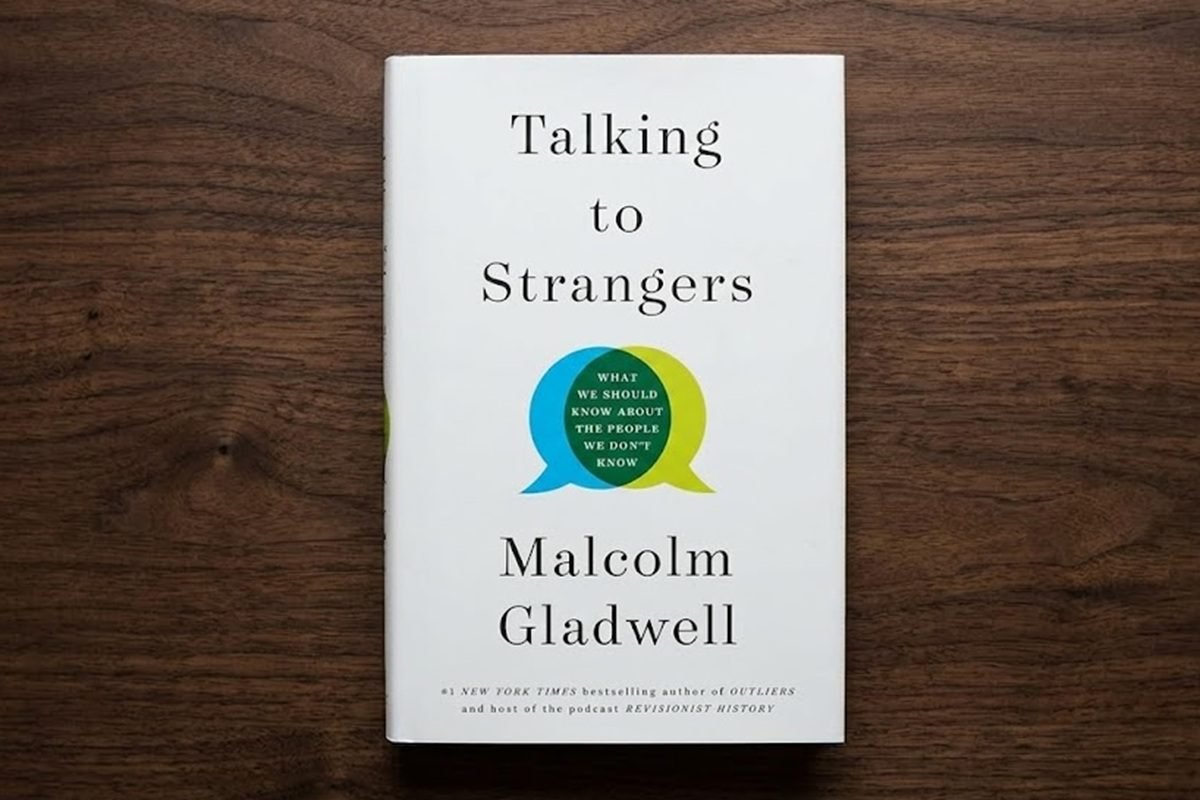
Book review: Talking to Strangers
What We Should Know about the People We Don't Know
By Malcolm Gladwell
Genres:
- Communication
- Sociology
The year it was published:
2019
Number of pages:
400

As an Amazon Associate, I earn from qualifying purchases.
Table of contents:
Introduction: “Step Out of the Car!”
Part I – Spies and Diplomats: Two Puzzles
Chapter 1: Fidel Castro’s Revenge
Chapter 2: Getting to Know der Führer
Part II – Default to Truth
Chapter 3: The Queen of Cuba
Chapter 4: The Holy Fool
Chapter 5: Case Study — The Boy in the Shower
Part III – Transparency
Chapter 6: The Friends Fallacy
Chapter 7: A (Short) Explanation of the Amanda Knox Case
Chapter 8: Case Study — The Fraternity Party
Part IV – Lessons
Chapter 9: KSM — What Happens When the Stranger Is a Terrorist?
Part V – Coupling
Chapter 10: Sylvia Plath
Chapter 11: Case Study — The Kansas City Experiments
Chapter 12: Sandra Bland
Conclusion
Thoughts about the book:
Talking to Strangers by Malcolm Gladwell is a fascinating and unsettling book about one of the most ordinary things we constantly do, and that is we constantly make judgments about the people we meet. Do we really know how to read other people? Can we tell when someone is lying? Can we recognize when a person is in danger? Why do intelligent, experienced people sometimes completely misunderstand strangers? Gladwell’s answer is uncomfortable, we are much worse at understanding strangers than we think we are. I really liked how Malcolm shows how we take for granted and overestimate our ability to understand other people. Gladwell builds his argument through a series of real-life stories involving politicians, criminals, victims, police officers, judges, students, and ordinary people caught in extraordinary circumstances. The cases are often disturbing, but they are also extremely effective at illustrating the book’s central ideas. One of the most powerful concepts is what Gladwell calls our tendency to default to truth. Most of us generally assume that other people are telling the truth unless we have a strong reason to believe otherwise. This is useful for everyday life, but it can also make us dangerously vulnerable to deception. We often think that facial expressions, tone of voice, body language, and behavior provide reliable windows into someone’s thoughts and emotions. Gladwell shows how unreliable those signals can sometimes be. This is an important lesson because modern culture places enormous faith in the idea that we can “read” people. We hear advice about body language, eye contact, facial expressions, and micro-expressions as though they provide a secret code for understanding someone’s true intentions.
I also really liked Malcolm’s choice of stories. The discussion of Amanda Knox, Bernie Madoff, Neville Chamberlain, and the case involving Sandra Bland gives the book emotional and historical weight. These aren’t merely abstract psychological examples, they involve real consequences, sometimes devastating ones. The book therefore becomes more than a discussion of communication. It becomes an examination of judgment, trust, institutions, prejudice, and the consequences of misunderstanding. This is not really a “how to communicate better with strangers” book in the conventional sense. The title might suggest a practical communication guide, but the book is much more about why our attempts to understand strangers so often fail. Gladwell draws on research from psychology, sociology, behavioral science, criminology, and related fields. He uses those ideas to explain why humans behave and judge others in predictable ways. But he presents the research through stories rather than through detailed scientific methodology. You won’t find the kind of statistical depth, methodological discussion, competing theories, and extensive technical analysis that you would expect in an academic psychology book.
Who should read this book:
If you are interested in psychology, human behavior, communication, deception, trust, and the hidden forces that shape our judgments, Talking to Strangers is a book you should read. The book explores the assumptions we make when encountering people we do not know. We look at someone’s face, listen to their words, observe their behavior, and almost instinctively construct a story about who they are. But Gladwell asks us to consider how often that story is incomplete or completely wrong. He is particularly interested in the gap between what we think we can see in another person and what is actually happening beneath the surface. Gladwell’s interests extend from psychology and social behavior to crime, politics, history, and some of the most disturbing misunderstandings between individuals. Through real cases and compelling stories, he examines why we trust people we shouldn’t, misunderstand people who are telling the truth, and sometimes mistake confidence, politeness, or familiarity for honesty and character. The book will help you become more cautious about your own judgments. It does not simply teach you how to “read” strangers better, its deeper lesson is that reading people is much harder than we imagine. Gladwell encourages the reader to recognize the limitations of intuition, to question first impressions, and to appreciate how context can radically change our interpretation of someone’s behavior. If you are searching for a book that will make you think differently about trust, communication, human judgment, and the invisible assumptions we bring into every interaction, Talking to Strangers is an excellent choice. It leaves you with a valuable and somewhat humbling realization that understanding another person is rarely as simple as we believe it is.
Summary of the book:
Introduction: “Step Out of the Car!”
Malcolm Gladwell opens Talking to Strangers with the story of Sandra Bland, a young Black woman who was pulled over in Texas in July 2015 for failing to signal a lane change. What began as a minor traffic stop quickly escalated when state trooper Brian Encinia asked Bland to put out her cigarette, she refused, and he ordered her out of the car. She was arrested and taken to jail, where she was found dead three days later. Gladwell uses the incident to introduce the book’s central question: why are we so bad at understanding strangers? Gladwell argues that when we interact with people we do not know, especially people from very different backgrounds, we often make confident judgments that turn out to be wrong. He focuses on three ideas throughout the book. The first is default to truth, we naturally assume that other people are being honest until we have strong evidence that they are not. The second is transparency, we tend to believe that a person’s outward behavior accurately reveals what they are thinking or feeling, even though emotions and intentions are often much harder to read than we assume. The third is coupling, the idea that behavior is strongly connected to the particular situation, place, and circumstances in which it occurs. Gladwell illustrates the problem through the historical meeting between Spanish conquistador Hernán Cortés and Aztec ruler Montezuma in 1519. The two men came from completely different cultures, had no shared language, and had to communicate through multiple translators. Neither could fully understand the other’s intentions or assumptions, and their encounter ended in catastrophe. Gladwell uses their meeting to show that misunderstandings between strangers are not a modern problem; they are an ancient and universal part of human interaction. The larger lesson is that we are often far too confident in our ability to understand people we do not know. We assume we can judge honesty from behavior, read emotions from facial expressions, and understand actions without considering the situation surrounding them. Gladwell argues that these assumptions can have serious consequences, because the gap between what we think we understand about a stranger and what is actually happening can be enormous.
Chapter 1: Fidel Castro’s Revenge
Gladwell opens the chapter with Florentino Aspillaga, a high-ranking Cuban intelligence officer who defected to the United States in 1987. Once in American custody, he revealed that almost every spy the CIA believed was working for them inside Cuba was actually working for Fidel Castro. The CIA had spent years carefully evaluating these agents, using trained professionals and lie-detection methods, yet they had been completely deceived. Gladwell uses this to introduce one of the book’s central puzzles: why are we so bad at recognizing when someone is lying to us? The CIA is an organization built around detecting deception, yet even its experts could not reliably identify people who were secretly working against them. One of the clearest examples was Aldrich Ames, a senior CIA counterintelligence officer whose job was to find spies but who was secretly working for the Soviet Union. Despite his suspicious behavior and reputation for drinking and laziness, he avoided detection for years. The chapter also shows that our problem is not limited to professional intelligence officers. Psychological experiments involving simple word-completion tasks demonstrate how quickly people form judgments from very limited information, often without realizing that they are doing it. We naturally look for patterns and clues that seem meaningful, even when the evidence is weak or misleading. The larger lesson is that detecting deception is much harder than we believe. We assume that careful observation, experience, and professional training should allow us to recognize a liar, but Gladwell shows that even highly trained experts can be fooled for years. Our confidence in our ability to read strangers often far exceeds our actual ability to understand what is going on inside their minds.
Chapter 2: Getting to Know der Führer
Gladwell introduces a second puzzle, how can meeting a stranger sometimes make us worse at understanding them than not meeting them at all? We tend to believe that face-to-face interaction gives us valuable insight into a person’s character and intentions. But Gladwell argues that this confidence can be misleading because we often interpret a stranger’s appearance, behavior, and manner in ways that have little to do with who they really are. He illustrates this through British Prime Minister Neville Chamberlain’s meetings with Adolf Hitler in 1938. Chamberlain traveled to Germany three times to meet Hitler personally because he believed that direct conversation would help him judge whether Hitler could be trusted. After their meetings, Chamberlain became convinced that Hitler was sincere and reliable and returned to Britain celebrating a peace agreement. Six months later, Hitler invaded the rest of Czechoslovakia. What makes the story especially striking is that people who never met Hitler, including Winston Churchill, were much more accurate in judging his intentions. The people who spent time with him were actually more confident in a completely mistaken judgment. Gladwell shows that the same problem can appear in everyday decisions. In a study of bail decisions, researchers compared experienced New York judges with a computer model that had access only to basic information such as a defendant’s age and criminal record. The computer could not see the defendants, hear their voices, or observe their behavior in court, yet it predicted which people were most likely to commit another crime while awaiting trial more accurately than the judges. The judges’ additional face-to-face information did not improve their decisions, it made them worse. The larger lesson is that we suffer from a transparency illusion and we assume that people’s outward behavior gives us a clear window into their inner thoughts and feelings. We believe we can recognize sincerity, remorse, confidence, or danger by looking at someone and talking to them, but these signals are often unreliable. Meeting a stranger can therefore give us more information while giving us less understanding, because we may become attached to a confident but inaccurate impression.
Chapter 3: The Queen of Cuba
Gladwell introduces psychologist Tim Levine’s Truth-Default Theory, the idea that humans naturally assume other people are telling the truth. This is not simply naivety or a weakness in our judgment, it is a basic part of how we function. If we constantly assumed everyone was lying, ordinary communication and relationships would become almost impossible. Instead, we begin with trust and only move toward disbelief when enough evidence accumulates to force us to change our minds. Levine’s experiments show how difficult it is to recognize deception. When people watch videos of strangers answering questions, they correctly identify liars only about 54% of the time, barely better than chance. The problem is not that people cannot recognize honesty; they are actually quite good at it. Their difficulty is recognizing lies because they continue to believe someone until the evidence becomes overwhelming. Gladwell illustrates this through Ana Belen Montes, a highly respected Defense Intelligence Agency analyst who secretly worked as a Cuban spy for more than fifteen years. Montes was considered brilliant and trustworthy, and even had siblings who worked for the FBI. Scott Carmichael, a colleague who investigated her, noticed several suspicious details but repeatedly found ways to explain them away. The possibility that one of the DIA’s most respected analysts was actually a spy seemed so unlikely that he struggled to accept it. Montes was eventually exposed not because someone successfully read her behavior, but because a computer search uncovered the evidence. Levine’s trivia experiment demonstrates the same pattern. Students were given the opportunity to cheat on a quiz for money, and some did. When Levine later interviewed them, he found that people watching the interviews were poor at identifying who was lying. Gladwell also connects this idea to Stanley Milgram’s obedience experiment, in which ordinary people continued administering what they believed were painful electric shocks because an authority figure told them to continue. The participants showed signs of doubt, but the legitimacy of the experiment was strong enough to keep them in a state of trust. The larger lesson is that we do not approach strangers as neutral investigators. We begin by believing them, and that default usually works well enough for everyday life. The danger comes when the evidence against someone is real, but we continue finding explanations that allow us to maintain our belief. Truth-default helps society function, but it also means that when someone is successfully deceiving us, we can remain convinced of their honesty for far longer than we realize.
Chapter 4: The Holy Fool
This chapter asks why we do not simply become more suspicious if defaulting to truth can lead us into serious mistakes. Gladwell’s answer is that extreme suspicion has its own costs. Society depends on people being willing to trust one another, and someone who constantly assumes deception may be good at spotting fraud but struggle to function normally with other people. Gladwell introduces the idea of the Holy Fool, a social outsider who is able to see truths that others overlook because they are not bound by the same assumptions or relationships. His example is Harry Markopolos, a fraud investigator who discovered that Bernie Madoff was running what would become the largest Ponzi scheme in history. Markopolos recognized the fraud nearly a decade before Madoff was arrested and presented detailed mathematical evidence to the SEC five times. Yet officials repeatedly failed to act. The problem was not that the truth was impossible to discover; it was that Markopolos was almost alone in believing it, and he could not convince others to see what he saw. But Markopolos’s ability to detect deception came with a heavy personal cost. He became deeply suspicious of other people, carried a gun, installed extensive security systems at home, and became convinced that the Mafia might try to kill him. His distrust made ordinary relationships difficult. Gladwell uses this to show why defaulting to truth, despite its dangers, is necessary. A society made up entirely of people like Markopolos might be better at detecting fraud, but it would also lack the trust and cooperation needed for everyday life.
Chapter 5: Case Study — The Boy in the Shower
Gladwell applies the idea of default to truth to the Penn State scandal involving Jerry Sandusky, a beloved football coach who founded a charity for troubled boys and was eventually convicted of sexually abusing children over many years. The case is often presented as a story of institutional cover-up, but Gladwell argues that the reality is more complicated. Graduate assistant Mike McQueary reported seeing Sandusky in a shower with a young boy and told head coach Joe Paterno, who passed the information to university administrators. The university handled the matter internally rather than contacting the police. After Sandusky’s conviction, many people blamed everyone in the chain of command for deliberately protecting him. But Gladwell points out that McQueary himself was initially uncertain about exactly what he had witnessed, and his description changed over time. Sandusky also had an unusually strong reputation as a kind, playful man who genuinely cared about children. Even some of the boys he abused continued to have friendly relationships with him afterward. When administrators heard vague descriptions of “horsing around,” they interpreted them in the most innocent way possible because they were already inclined to trust Sandusky. Gladwell connects this to the Larry Nassar scandal at Michigan State. Nassar, a respected team doctor, sexually abused hundreds of young athletes over decades, sometimes while their parents were present. Because they trusted his medical authority and believed his behavior was legitimate treatment, many failed to recognize what was actually happening. The eventual discovery of extensive evidence on Nassar’s computer helped break through that trust. These cases show the darker side of default to truth. People do not necessarily ignore warning signs because they are protecting criminals or consciously choosing not to believe victims. Often, they genuinely struggle to accept that someone they know and trust could be capable of such behavior. Gladwell’s point is that the default to truth is so deeply built into human interaction that even disturbing evidence can be explained away when it conflicts with our existing beliefs about a person.
Chapter 6: The Friends Fallacy
This chapter examines the second major mistake we make when dealing with strangers: the assumption of transparency. We tend to believe that a person’s outward behavior clearly reveals what they are feeling or thinking. Gladwell argues that this belief is misleading, partly because our idea of how emotions should look has been shaped by television and movies. On shows like Friends, characters display emotions in exaggerated and obvious ways, making it seem as though anger, fear, surprise, or sadness can always be easily read from someone’s face. Psychologist Jennifer Fugate tested this idea by analyzing facial expressions on Friends using the Facial Action Coding System (FACS), which measures individual facial muscle movements. She found that the actors regularly displayed emotions at the highest level of intensity. Real people rarely express emotions so clearly, meaning television gives us an unrealistic picture of how easy it is to read someone. Research also shows that facial expressions are not as universal as we assume. Studies of the Trobriand Islanders found that they interpreted certain facial expressions very differently from Western participants. A face that Westerners understood as fear, for example, could be interpreted as threatening by the islanders. Another study found that when people were genuinely surprised, only a small percentage made the classic “surprised” facial expression we recognize from television. Real emotions are much more subtle and inconsistent. This helps explain the bail hearing example from the previous chapter. Judges may believe that they can determine whether defendants are trustworthy, remorseful, or dangerous by observing their faces and behavior, but those impressions are often unreliable. In one case, a Texas judge reduced Patrick Dale Walker’s bail after believing he showed genuine remorse for holding his girlfriend at gunpoint. Four months later, while out on bail, Walker killed her. The judge’s mistake illustrates the danger of assuming that visible behavior provides a reliable window into someone’s inner character. Gladwell’s larger point is that the Friends fallacy makes us far too confident in our ability to read strangers. We expect real people to display their emotions as clearly as actors do, when in reality facial expressions and body language often tell us much less than we think.
Chapter 7: A (Short) Explanation of the Amanda Knox Case
In 2007, Meredith Kercher, a British student studying in Italy, was murdered by Rudy Guede. Despite evidence pointing toward Guede, Italian investigators became focused on Kercher’s American roommate, Amanda Knox. Knox was eventually fully exonerated, but she spent four years in prison because investigators interpreted her unusual behavior as evidence of guilt. Knox did not behave the way police expected a grieving roommate to behave. She did a split outside the police interview room, used blunt language when talking about Kercher’s death, and kissed and laughed with her boyfriend at the crime scene. To investigators and the media, these behaviors seemed suspicious. But Gladwell argues that Knox was simply mismatched: her behavior did not fit cultural expectations about how an innocent, grieving person was supposed to act. Knox had always been unconventional and expressive. She might burst into song in public or behave playfully in ways that other people found strange. In the unfamiliar environment of Italy, these personality traits were interpreted through a different cultural lens. Her unusual reactions were mistaken for signs of deception rather than recognized as part of her personality. Gladwell uses this case to expand Tim Levine’s distinction between matched and mismatched people. Matched people behave in ways that fit our expectations, so we tend to judge them accurately. Mismatched people behave differently from what we expect, and this is where our ability to judge honesty breaks down. Amanda Knox was innocent but appeared suspicious, while Bernie Madoff provides the opposite example: he was a criminal who appeared trustworthy and respectable. People who met him often trusted his pleasant, confident manner even when strong evidence suggested that something was wrong. The larger lesson is that our ability to judge strangers depends heavily on whether their behavior matches the expectations we have about how an honest or guilty person should act. When someone does not fit those expectations, we can easily mistake unfamiliar behavior for dishonesty and become confidently wrong.
Chapter 8: Case Study — The Fraternity Party
This chapter examines the 2015 sexual assault case involving Brock Turner at Stanford University. Turner, a freshman swimmer, sexually assaulted an unconscious woman, Emily Doe, outside a fraternity party after both had been drinking heavily. Gladwell uses the case to explore how alcohol changes our ability to understand and respond to situations involving strangers. The common belief is that alcohol removes our inhibitions and reveals our “true selves.”Psychologists Claude Steele and Robert Josephs developed a different explanation called alcohol myopia. Their research suggests that alcohol narrows our attention to whatever is most immediate, making it harder to consider long-term consequences, risks, or complicated social signals. Rather than simply freeing hidden impulses, alcohol makes people shortsighted and less capable of processing everything happening around them. The chapter also explains blackouts, which occur when heavy drinking interferes with the hippocampus, the part of the brain responsible for forming new memories. Someone experiencing a blackout can remain awake, talk, walk, and make decisions while being unable to form lasting memories of what is happening. Emily Doe had blacked out and had no memory of leaving the party or what happened afterward. Turner also reported experiencing a blackout during part of the night. Gladwell is not using alcohol to excuse Turner’s actions. Instead, he uses the case to show how alcohol can make communication between strangers especially difficult. When people are heavily intoxicated, they may be unable to clearly communicate their intentions or accurately interpret another person’s behavior, making assumptions about consent particularly dangerous. Gladwell also uses anthropologist Dwight Heath’s study of the Camba people of Bolivia to show that the effects of alcohol depend partly on the surrounding culture and environment. The Camba held large drinking gatherings involving extremely strong alcohol, yet the events were generally peaceful. Their drinking followed strict social rules involving organized toasting, conversation, and a structured seating arrangement. This suggests that alcohol does not automatically produce one kind of behavior; the social setting also shapes what people do when they are drunk. The larger lesson is that alcohol does more than lower inhibitions. It can narrow attention, disrupt memory, and make it much harder for people to understand situations and each other. How people behave while drunk is also strongly influenced by the social environment in which they are drinking.
Chapter 9: KSM — What Happens When the Stranger Is a Terrorist?
This chapter examines the interrogation of Khalid Sheikh Mohammed (KSM), one of the main planners of the 9/11 attacks, as an extreme example of the difficulties involved in trying to understand a stranger. After his capture in 2003, the CIA used an “Enhanced Interrogation” program designed by psychologists James Mitchell and Bruce Jessen. It included techniques such as sleep deprivation, walling, and waterboarding, all intended to force KSM to provide information. Gladwell introduces research by psychiatrist Charles Morgan that suggests why these methods can be deeply unreliable. At military SERE (Survival, Evasion, Resistance, Escape) schools, Morgan studied highly trained soldiers undergoing simulated prisoner-of-war interrogations. Even though the interrogations were only exercises, the intense stress severely affected the soldiers’ memory and ability to think clearly. After just 30 minutes, many struggled to remember what had happened or identify their interrogator. In one experiment, soldiers incorrectly identified the interrogator about 40% of the time, even a day later. KSM’s eventual confessions illustrate the problem. Under extreme interrogation, he claimed responsibility for 31 terrorist plots, including plans that intelligence officials knew were implausible or unrelated to him. Even former CIA officials acknowledged that he was making some of the claims up. As the pressure increased, the information he provided became less reliable, making it increasingly difficult to distinguish genuine intelligence from fabrication. Gladwell’s larger point is that the truth about a stranger can be surprisingly fragile. We often assume that if we apply enough pressure, ask enough questions, or gather enough information, we will eventually uncover the truth. But extreme pressure can damage the very thing we are trying to discover. The harder we try to force certainty from another person, the more important it becomes to recognize the limits of what we can actually know.
Chapter 10: Sylvia Plath
This chapter introduces the third major mistake we make when dealing with strangers: failing to understand context. Gladwell calls this coupling, the idea that certain behaviors are strongly connected to particular places, situations, and circumstances. We often assume that behavior comes entirely from a person’s character or intentions, when in reality the surrounding environment can play a major role. Gladwell illustrates this through the suicide of poet Sylvia Plath in 1963. It is easy to view her death as the inevitable result of her depression and troubled life, but Gladwell asks us to consider the method she used. At the time, British homes commonly used “town gas,” which contained high levels of carbon monoxide and was responsible for a large proportion of suicides in England. Beginning in 1965, Britain gradually replaced town gas with natural gas, which did not contain carbon monoxide. As the conversion spread across the country, suicide rates fell dramatically. People did not simply switch to other methods in equal numbers; many who might otherwise have died did not die. This is the principle of coupling: suicidal behavior can be connected to a particular method or place rather than representing a constant, unchanging desire to die. Gladwell argues that removing access to a specific means can prevent deaths because the impulse may pass when that particular opportunity disappears. The same pattern appeared at the Golden Gate Bridge, which became the site of more than 1,500 suicides. Research following people who were stopped from jumping found that more than 90% did not later die by suicide. For many, the suicidal impulse was coupled to that particular place and moment. The larger lesson is that behavior cannot always be understood by looking only at the individual. Context matters. We often assume that if someone wants to do something, they will simply find another way when one option is removed. But the evidence Gladwell presents suggests that behavior can be much more dependent on specific circumstances than we realize. Change the environment, and you can sometimes change the behavior itself.
Chapter 11: Case Study — The Kansas City Experiments
This chapter applies the idea of coupling to crime and policing through two experiments in Kansas City, Missouri. The first, conducted in 1972 by criminologist George Kelling, tested whether simply putting more police cars on the streets would reduce crime. Kansas City was divided into three areas: one received extra patrols, one received almost no patrols, and one remained unchanged. After a year, crime rates were essentially the same in all three areas. Simply having more police visibly driving around did not make a measurable difference. Decades later, criminologist Lawrence Sherman took a different approach based on the Law of Crime Concentration, developed with David Weisburd. Their research showed that crime is not evenly distributed throughout a city. A tiny percentage of street segments, roughly 3–5%, can account for more than half of all crime. Sherman therefore focused police resources on a very small area of Kansas City where gun crime was heavily concentrated. Just four officers in two cars patrolled the area and made traffic stops specifically to look for illegal guns. Over roughly seven months, gun crime in the targeted area fell by about half. The important lesson was not simply that aggressive traffic stops work. They worked because they were coupled to a specific place where crime was concentrated. But police departments across the country often copied the tactic without copying the context. Instead of concentrating aggressive policing in genuine crime hot spots, they applied it broadly to ordinary streets and ordinary people. Gladwell connects this mistake to Ferguson, Missouri, where the Department of Justice found that police had turned routine traffic enforcement into a widespread system of stops and citations. Officers were pressured to generate large numbers of tickets, bringing ordinary residents into frequent contact with the police and seriously damaging trust in the community. Gladwell links this broader approach to the kind of unnecessary encounters that contributed to the Sandra Bland case. The larger lesson is that successful strategies cannot always be separated from the circumstances that made them successful. Sherman’s experiment worked because crime was strongly coupled to particular locations. When police treated the entire population as though it were a crime hot spot, they ignored that context. Coupling means that where and when something happens can matter just as much as what is happening.
Chapter 12: Sandra Bland
The book returns to the story of Sandra Bland and uses the ideas from the previous chapters to explain how her encounter with Officer Brian Encinia went so badly. Encinia had been trained as an aggressive modern patrol officer, influenced by the policing strategies developed in Kansas City. His training encouraged him to be suspicious, look for small signs of danger, use minor traffic violations as opportunities to investigate further, read body language, and “go beyond the ticket.” In many ways, he was doing exactly what he had been taught to do. Bland, however, was having an emotionally difficult day. She was anxious about starting a new job and was struggling with depression and PTSD. Her frustration and agitation were interpreted by Encinia as signs of suspicious or dangerous behavior. Instead of recognizing that her behavior might simply reflect stress and emotion, he treated it as evidence of something more threatening. This reflected the same mistaken belief in transparency discussed earlier in the book: the assumption that outward behavior reliably reveals what is happening inside someone. The encounter also demonstrated a failure to understand coupling. Encinia was using an aggressive policing strategy in a location that was not a crime hot spot. The road where he stopped Bland near Prairie View University had produced very little crime during his previous patrols. The strategy that had worked in a highly concentrated Kansas City crime area was being applied in a completely different setting. Encinia’s record shows how strongly this policing philosophy had shaped his behavior. In less than a year, he issued 1,557 tickets for things such as broken lights, improper reflective tape, and failure to signal. He was not necessarily acting outside his training; the problem was that the system had encouraged him to treat ordinary encounters as opportunities to search for something more serious. Bland had also experienced repeated negative encounters with police and had accumulated thousands of dollars in traffic fines. When Encinia pulled her over, she was already emotionally vulnerable. Her frustration was interpreted as threatening behavior, and a minor traffic stop escalated into an arrest. Three days later, she was found dead in her jail cell. Gladwell’s final point is that Bland’s death cannot be explained simply as the result of one bad decision by one police officer. It reflects a much larger problem and that is that we are often poor at understanding strangers, yet many of our institutions are built around the assumption that we are good at it. We misread behavior, overestimate our ability to detect danger and dishonesty, ignore the importance of context, and then create systems that can amplify those mistakes.
Conclusion
Gladwell’s conclusion does not offer a simple solution because the central problem of the book has no easy fix. We cannot function without interacting with strangers, yet we are fundamentally limited in our ability to understand their intentions, emotions, and behavior. First, Gladwell argues that we should stop treating default to truth as a personal failure. Parents who failed to suspect that their children were being abused, or university administrators who failed to interpret vague warnings as evidence of serious wrongdoing, were not necessarily acting maliciously. Trusting others is a basic feature of human society, and expecting everyone to constantly assume the worst would make ordinary relationships and cooperation impossible. Second, we need to accept the limits of what we can know about strangers. No lie detector will make deception perfectly recognizable, and people cannot reliably determine another person’s character or intentions simply by looking at their face or observing their behavior. We should therefore approach our judgments with greater humility and recognize that confidence does not guarantee accuracy. Finally, Gladwell argues that we should pay much more attention to context. Instead of focusing only on the individual, we should consider the environment in which behavior occurs. Suicide barriers can prevent deaths at specific locations, policing strategies should reflect where crime is actually concentrated, and young people should understand how alcohol can interfere with judgment and communication. In other words, we should look at the stranger’s world, not just the stranger’s face. Gladwell ends by returning to Sandra Bland. Her death was often reduced to a story about one aggressive police officer and one difficult woman. But Gladwell argues that this misses the deeper problem. Her death reflected a collective failure to recognize how limited we are at understanding strangers and how dangerous those limitations can become when institutions are built around the assumption that we can read people accurately.