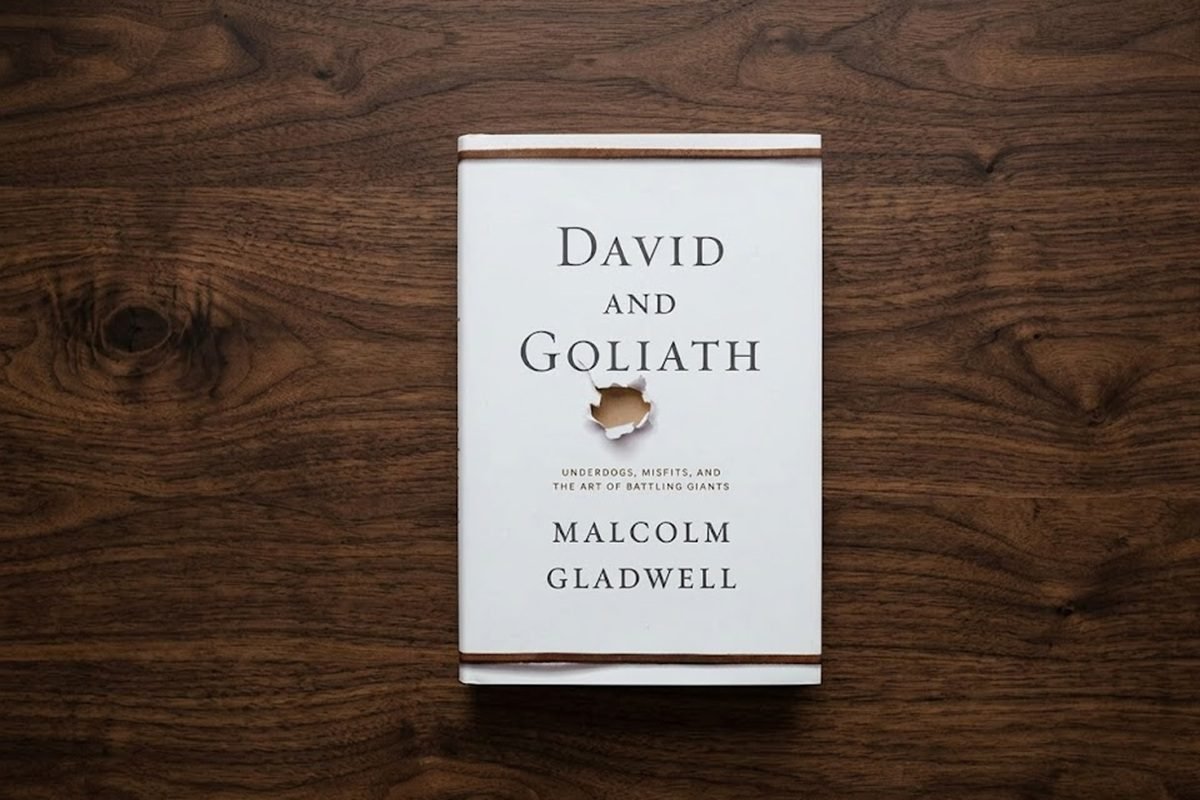
Book review: David and Goliath
Underdogs, Misfits, and the Art of Battling Giants
By Malcolm Gladwell
Genres:
- Social Psychology
- Business
- Self-Improvement
The year it was published:
2013
Number of pages:
320

As an Amazon Associate, I earn from qualifying purchases.
Table of contents:
Introduction: Goliath
Part I – The Advantages of Disadvantages (and the Disadvantages of Advantages)
Chapter 1: Vivek Ranadivé
Chapter 2: Teresa DeBrito
Chapter 3: Caroline Sacks
Part II – The Theory of Desirable Difficulty
Chapter 4: David Boies
Chapter 5: Emil “Jay” Freireich
Chapter 6: Wyatt Walker
Part III – The Limits of Power
Chapter 7: Rosemary Lawlor
Chapter 8: Wilma Derksen
Chapter 9: André Trocmé
Thoughts about the book:
David and Goliath by Malcolm Gladwell is a book about an idea that sounds simple but becomes surprisingly complicated the more Gladwell examines it. What looks like a disadvantage can sometimes become an advantage, while advantages can carry hidden costs. As with much of Gladwell’s work, the real pleasure of David and Goliath is not simply learning a collection of facts. It is being persuaded to look at familiar situations differently. The strongest aspect of the book is Gladwell’s ability to challenge conventional wisdom. We tend to assume that having more money, greater size, better resources, higher status, or more prestigious opportunities automatically makes someone better positioned to succeed. Gladwell repeatedly asks us to reconsider that assumption. The biblical story of David and Goliath becomes a useful metaphor. David appears to be the obvious underdog, while Goliath appears overwhelmingly powerful. Yet Gladwell argues that the apparent advantage of the giant can actually become a weakness, while David’s unconventional approach can give him an unexpected advantage. This idea is developed through a fascinating collection of real-world stories. Gladwell discusses everything from basketball and education to business, crime, disability, and historical conflicts. One of his great strengths is finding unusual examples that make abstract ideas memorable. I particularly enjoyed his discussions of class size and education and the complicated relationship between wealth, opportunity, and happiness. Gladwell is especially good at showing that the relationship between two things is rarely as straightforward as we initially assume. Another strength is his willingness to examine the hidden costs of advantages. More money, for example, can provide enormous benefits, but beyond a certain point it may not produce the additional happiness or psychological advantages we expect. Likewise, attending an elite institution may sound like an unquestionable benefit, but Gladwell explores circumstances in which being surrounded by exceptionally talented people can undermine a student’s confidence.
The biggest weakness of David and Goliath is also one of Gladwell’s greatest strengths, because he is extremely good at constructing a compelling story. Sometimes the storytelling is so effective that the argument feels more certain than the underlying evidence actually warrants. Gladwell takes complex social-science findings and translates them into memorable narratives. That makes the book wonderfully accessible, but it can also make complicated relationships appear cleaner and more definitive than they really are. Some of his conclusions feel deliberately provocative. That is part of what makes the book entertaining, but readers should be careful not to mistake an intriguing interpretation for a settled scientific conclusion. I also found some of the arguments somewhat repetitive. Once you understand the central idea, that disadvantages can sometimes become advantages and advantages can sometimes become disadvantages, the later examples occasionally feel like variations on the same theme. Another limitation is that Gladwell sometimes moves quickly from an individual story to a broader social conclusion. Anecdotes are excellent for illustrating an idea, but they cannot by themselves prove that the idea applies broadly to society. I liked how Gladwell, instead of beginning with a dry explanation of a psychological or economic theory, often begins with a person or a story. You become interested in what happened, and only afterward does Gladwell explain the research or larger principle behind it. The book is very easy to read, and you do not need a background in psychology, economics, sociology, statistics, or history to understand it. There are certainly intellectually challenging ideas in the book, but the writing itself is not difficult.
Who should read this book:
If you are interested in psychology, human behavior, success, education, leadership, or the unexpected forces that shape people’s lives, David and Goliath is a fascinating book to read. Malcolm Gladwell is searching beneath the usual explanations of success and failure, asking us to reconsider what we think we know about advantage and disadvantage. Why does being the smallest person in the room sometimes make someone stronger? Why can attending a prestigious university actually work against certain students? And when does a difficulty become an opportunity rather than an obstacle? What makes the book especially compelling is Gladwell’s ability to take familiar stories like the biblical David and Goliath, for example, and turn them into questions about the way we understand power, competition, education, adversity, and resilience. By reading this book, the reader comes away with a more nuanced understanding of success. David and Goliath encourages you to look beyond obvious advantages and disadvantages and examine the circumstances surrounding them. Gladwell shows that what appears to be a weakness may sometimes force creativity, persistence, independence, or courage, while an apparent advantage can create its own unexpected problems. Most importantly, the book changes the way you interpret your own circumstances and those of other people. If you are searching for a fresh perspective on adversity, opportunity, resilience, education, leadership, and the complicated nature of success, David and Goliath offers plenty to think about. It is a book for readers who enjoy having their assumptions challenged and who want to discover that sometimes the things we believe make someone powerful may be precisely the things that holds them back.
Summary of the book:
Introduction: Goliath
Gladwell begins by retelling the story of David and Goliath, but he challenges the traditional idea that David was the helpless underdog. In ancient warfare, armies sometimes used single combat, where two champions fought on behalf of their sides. Soldiers generally fell into three groups: cavalry, infantry, and projectile warriors such as archers and slingers. Goliath was a heavily armed infantry soldier, built for close combat, while David was an experienced slinger. This meant the two were not really fighting on equal terms. Gladwell suggests that Goliath may also have suffered from acromegaly, a condition caused by excessive growth hormone that can lead to extreme height and vision problems. This could explain why Goliath moved slowly, needed someone to guide him, and seemed unable to understand the threat David posed. When David refused armor and instead used his sling, he turned the battle into a long-range attack. He struck Goliath in the forehead, his most vulnerable point, and brought him down. What looked like David’s weakness, being a young shepherd with no sword or armor, was actually his greatest advantage because his skills were perfectly suited to defeating Goliath. The larger lesson is that we often confuse size, power, and status with actual strength. An advantage in one situation can become a weakness in another, while someone who appears disadvantaged may have an unexpected strength that changes the entire contest. David did not win despite being the underdog; he won because he was never fighting the kind of battle Goliath was prepared for.
Chapter 1: Vivek Ranadivé
Gladwell argues that underdogs often lose because they try to compete on the stronger side’s terms. He illustrates this through Vivek Ranadivé, an Indian software entrepreneur who knew little about basketball but noticed that teams usually gave their opponents most of the court for free after a basket. When he coached his young daughter’s inexperienced team, he taught them to use a full-court press, defending all 94 feet of the court and aggressively contesting every inbounds pass. The girls lacked the skills of their opponents, but their relentless pressure forced turnovers and panic. They regularly jumped to huge leads and eventually came close to reaching the national championship. The same principle appeared in college basketball when underdog Fordham faced a UMass team featuring Julius Erving. Instead of trying to match UMass’s talent, Fordham pressed constantly, wearing down their opponents and continuing to press even as players fouled out. They won 87–79, a lesson that stayed with Rick Pitino, who later became famous for using the same strategy with weaker teams. Gladwell connects this idea to warfare through T. E. Lawrence and the Arab Revolt in World War I. Lawrence’s small force of Bedouin fighters could not defeat the much larger Turkish army in a traditional battle, so they attacked railways, telegraph lines, and isolated positions instead. At Aqaba, they approached from the desert, where the Turks had not expected an attack, and captured the city with remarkably few losses. In both basketball and war, the underdogs succeeded by refusing to fight in the way their stronger opponents expected. The larger lesson is that apparent weakness can become an advantage when it forces people to think differently. Unconventional strategies can give underdogs a real chance because they change the nature of the contest. But these strategies are difficult, they require enormous effort, persistence, and a willingness to look foolish or break with accepted conventions. Most people avoid them because they are exhausting and socially uncomfortable, even when they might give them a better chance of winning.
Chapter 2: Teresa DeBrito
Gladwell uses the idea of the inverted-U curve to show that more is not always better. With many things, adding more initially produces better results, but after reaching an ideal point, additional resources can become harmful. He applies this idea to education, parenting, and wealth. Class size is a good example. We assume smaller classes automatically produce better learning, but research by economist Caroline Hoxby suggests that this is only true when classes are very large. By comparing years when the same Connecticut schools had different enrollment levels, Hoxby found virtually no benefit from reducing classes within the middle range of roughly 15–25 students. Gladwell argues that very small classes can even create problems because students lose the energy, debate, and variety of perspectives that come from having more classmates. At Shepaug Valley Middle School, for example, the principal noticed that larger classes often produced more lively and engaging discussions, while classes of around 12 felt too quiet and intense. This contrasts with elite schools such as Hotchkiss, which charge enormous fees for small classes even though smaller is not necessarily better. Gladwell applies the same principle to wealth and parenting. People often assume that giving children more money, comfort, and opportunities will automatically make them better off. But extreme wealth can remove the struggles that teach motivation, independence, and resilience. A Hollywood executive who grew up poor describes the difficulty of raising children in a world of mansions and private jets while trying to give them the same drive that hardship gave him. Psychologist James Grubman calls people like this “immigrants to wealth,” parents remember the values of scarcity and hard work, while their children grow up in a world where those lessons are much harder to experience. The larger lesson is that advantages have limits. More money, smaller classes, and greater comfort can help up to a point, but beyond the ideal range they can produce diminishing returns or even negative effects. What looks like an advantage can become a disadvantage when there is simply too much of it.
Chapter 3: Caroline Sacks
Gladwell examines the “Big Fish-Little Pond Effect,” the idea that being surrounded by exceptionally talented people can make capable students feel inadequate and less likely to pursue difficult subjects. Caroline Sacks experienced this at Brown University. She had been one of the strongest students in her high school, but at Brown she found herself surrounded by classmates who seemed effortlessly brilliant. Struggling in chemistry made her question her own ability, and she eventually left science. She believed that if she had attended the University of Maryland instead, she would probably have stayed in the field. This effect comes from the way we judge ourselves relative to the people around us. A student who is near the top of a good school may feel confident and capable, while the same student at an elite school may suddenly feel average or even inadequate. Research comparing Harvard and Hartwick College illustrates this clearly: students with similar academic abilities were much more likely to complete STEM degrees at Hartwick, where they were among the strongest students, than at Harvard, where they were near the bottom. Stephen Randolph had a similar experience at Harvard. Despite being a high-school valedictorian with outstanding scores, receiving a B-minus in quantum mechanics convinced him that he was not good enough to become a physicist. He eventually became a tax lawyer instead. Gladwell shows that the same principle can apply beyond education. The Impressionist painters, Manet, Monet, Renoir, and Cézanne, were repeatedly rejected or overshadowed by the prestigious Paris Salon. When they created their own small exhibition in 1874, they were free from the standards of the established art world and developed a new style that eventually transformed modern art. They succeeded by becoming big fish in a smaller pond. The larger lesson is that prestige is not always an advantage. Being surrounded by people who are slightly better than you can motivate you, but being surrounded by people who constantly make you feel inadequate can destroy confidence and ambition. Sometimes a less prestigious environment gives talented people the confidence and encouragement they need to succeed.
Chapter 4: David Boies
Gladwell explores the idea of “desirable difficulties,” the surprising ways in which a disadvantage can force someone to develop strengths that would otherwise never emerge. David Boies, one of America’s most successful trial lawyers, is severely dyslexic and reads extremely slowly. Yet because he could not rely on reading, he learned to listen with extraordinary concentration, remember conversations almost perfectly, and notice subtle changes in people’s voices. His greatest weakness ultimately became one of his greatest advantages in the courtroom. Gladwell distinguishes between people who succeed by building on natural strengths and those who succeed by compensating for weaknesses. Dyslexic people are often forced into the second path. Brian Grazer, for example, struggled academically because of dyslexia but learned to persuade, negotiate, and talk his way through difficult situations. Those skills helped him build a hugely successful career as a Hollywood producer. Gary Cohn similarly learned to take bold risks and improvise after struggling in school. His willingness to bluff his way into a conversation with a Wall Street executive eventually led to a career at Goldman Sachs. Gladwell argues that these experiences can also make people more “disagreeable,” willing to ignore social expectations, take risks, and challenge conventional thinking. Ingvar Kamprad, the dyslexic founder of IKEA, demonstrated this when Swedish manufacturers refused to work with him because of IKEA’s low prices. Instead of giving up, he sourced furniture from Communist Poland during the Cold War, choosing an unconventional solution that others considered unacceptable. The larger lesson is that disadvantages do not always hold people back. Sometimes they force people to develop alternative skills that become more valuable than the ability they originally lacked. A difficulty can be harmful, but under the right circumstances it can also become a source of resilience, independence, creativity, and unusual success.
Chapter 5: Emil “Jay” Freireich
Gladwell explores how surviving extreme hardship can sometimes create an unusual kind of courage. Jay Freireich, one of the pioneers of modern leukemia treatment, grew up in terrible circumstances. His father died by suicide when he was an infant, his mother worked exhausting hours, and he experienced poverty, neglect, and an unhappy home life. These experiences were deeply painful, but they also meant that Freireich had already faced things that would have terrified most people. Gladwell connects this to psychiatrist J. T. MacCurdy’s research on the London Blitz. People caught in bombing raids could experience a direct hit, a near miss that left them traumatized, or a remote miss in which they witnessed the danger but escaped unharmed. The people who experienced remote misses often became unusually confident because they had confronted something terrifying and discovered they could survive it. Gladwell suggests that this helps explain why so many highly successful people, including a surprisingly large number of British prime ministers, lost a parent early in life. Freireich brought this fearlessness into his work with children dying from leukemia. In the 1950s, childhood leukemia was almost always fatal, and doctors believed aggressive treatment could do more harm than good. Freireich refused to accept this. He fought for better blood transfusions, found new ways to preserve platelets, and ignored regulations and threats from his superiors when he believed they were preventing children from being saved. His willingness to challenge medical authority eventually led him and Tom Frei to develop the VAMP chemotherapy regimen, combining four powerful drugs at once. At the time, the approach seemed reckless; today, combination chemotherapy is a standard part of cancer treatment, and childhood leukemia has become highly curable. Gladwell also shows the same pattern in civil rights leader Fred Shuttlesworth. After surviving a Ku Klux Klan bombing that destroyed his home, he immediately declared that the fight was only beginning. Later, after being beaten by a mob, he left the hospital to preach forgiveness that same day. Each experience of surviving extreme danger made him less afraid of the next one. The larger lesson is that hardship can have two very different effects. It can cause lasting damage, but for some people, surviving extreme adversity creates a powerful sense that the worst has already happened and they survived. That freedom from fear can produce extraordinary courage and a willingness to do things others consider impossible.
Chapter 6: Wyatt Walker
Gladwell examines the 1963 Birmingham civil rights campaign and how Martin Luther King Jr.’s strategist Wyatt Walker used unconventional tactics to defeat a much more powerful opponent. The protesters had almost no political or legal power, so Walker turned their apparent weakness into an advantage. Drawing on the African-American tradition of the trickster hero, like Brer Rabbit, he understood that when you cannot beat a powerful opponent through strength, you can sometimes win through cleverness and unpredictability. Walker’s strategy, known as Project C, was designed to provoke Birmingham’s racist Public Safety Commissioner Bull Connor into exposing his own brutality. The campaign began with sit-ins and an economic boycott, followed by mass marches designed to fill the city’s jails. Once the jails were full, Connor would have to confront protesters directly, creating exactly the kind of violent scenes that newspapers and television could broadcast across America. Walker repeatedly used deception to make the movement appear larger than it was. During the Palm Sunday march, for example, only a small number of protesters were actually marching, but Walker delayed the event until thousands of people were watching from the sidewalks. To Connor, the crowd looked like a massive demonstration, and the tactic helped create the impression of a movement far larger than its organized forces. The most powerful moment came when Birmingham schoolchildren joined the demonstrations. Hundreds were arrested on the first day, followed by more than a thousand the next, quickly filling Connor’s jails. With no room left for arrests, Connor ordered police to use fire hoses and dogs against the protesters. Photographs of the violence, including the image of a teenager confronted by a police dog, appeared in newspapers around the country and shocked the American public. President Kennedy was among those disturbed by what he saw. Gladwell reveals that the boy in the famous photograph, Walter Gadsden, was actually a spectator rather than a protester. Even as the dog attacked him, he fought back by grabbing the officer and kicking the dog. The image therefore contained a touch of the trickster tradition, the supposedly powerless victim was not as powerless as he appeared. More importantly, Walker had succeeded in forcing the stronger side to reveal its own brutality. The larger lesson is that underdogs sometimes win by refusing to fight according to the rules set by their opponents. Walker understood that Connor’s power could become a weakness if he could be provoked into using it publicly. The chapter also introduces the principle of legitimacy, authority works best when people feel heard, rules are consistent, and laws are applied fairly. When those conditions disappear, even overwhelming power can create resistance rather than obedience.
Chapter 7: Rosemary Lawlor
Gladwell examines the Troubles in Northern Ireland to show the limits of power when authority lacks legitimacy. In 1969, the British Army was sent into Northern Ireland to keep peace between the Catholic and Protestant communities. Although the British had overwhelming military power, they gradually lost the trust of the Catholic population. Gladwell argues that legitimate authority depends on three things: people must feel they can be heard, rules must be consistent, and the law must apply equally to everyone. When those conditions disappear, force often makes resistance stronger rather than weaker. The Falls Road curfew in 1970 illustrates this problem. After rioting, the British Army sealed off a Catholic neighborhood in Belfast for 36 hours. Soldiers searched homes, destroyed property, arrested hundreds of people, and killed several civilians. The army believed the operation had demonstrated its control, but the opposite happened. Thousands of Catholic women marched into the area to break the curfew, while the IRA began one of its most successful recruitment campaigns. Instead of intimidating the community into obedience, the crackdown convinced more people that resistance was necessary. The same pattern became even more damaging with internment in 1971, when the British began arresting people suspected of terrorism without charges or trial. Thousands of mostly Catholic men were imprisoned, including many who had no involvement in violence. The policy united families and communities against the British and caused violence to increase dramatically. Gladwell contrasts this with the story of Rosemary Lawlor, who had no interest in politics until her home was disrupted, her community was targeted, and her teenage brother was killed by a British soldier. Her radicalization was not something she had originally chosen; she felt that the actions of those in power had forced it upon her. Gladwell contrasts Northern Ireland with the approach of police chief Joanne Jaffe in Brownsville, New York. Instead of treating a troubled community as an enemy, Jaffe recognized that the police had lost legitimacy and worked to rebuild trust. Her program targeted the neighborhood’s most dangerous young offenders but offered their families services, education, jobs, and personal support. Officers even delivered Thanksgiving turkeys and Christmas presents and developed genuine relationships with the teenagers. Crime fell not because the police became more threatening, but because people began to see them as legitimate authorities working on their side. The larger lesson is that power alone cannot create lasting peace or obedience. The British had soldiers, weapons, and legal authority, yet their repeated use of force deepened resentment and helped create more resistance. Gladwell challenges the idea that rebellion can simply be defeated by making it more costly, arguing that people do not make these decisions through cost-benefit calculations alone. When authority is seen as unfair, inconsistent, or abusive, punishment can strengthen the very opposition it is meant to destroy. Real authority depends not just on the ability to enforce rules, but on whether people believe those rules and the people enforcing them are legitimate.
Chapter 8: Wilma Derksen
Gladwell examines the different ways people respond to tragedy through the stories of Mike Reynolds and Wilma Derksen, whose daughters were murdered. Reynolds responded by pushing for tougher punishment and helped create California’s Three Strikes law, while Derksen chose forgiveness. Gladwell uses their stories to explore the limits of punishment and show how even well-intentioned attempts to create safety can eventually produce harmful consequences. Reynolds believed that criminals would stop offending if the consequences became severe enough. His Three Strikes law imposed increasingly harsh sentences, eventually giving people 25 years to life after a third felony. The idea was based on deterrence: if the cost of crime becomes high enough, people will decide that offending is not worth it. But Gladwell argues that this logic has limits because many crimes are committed by people who are impulsive, addicted, desperate, or otherwise unable to make rational calculations. The men who murdered Reynolds’s daughter, Kimber, were crystal meth addicts, and one later said he shot her because of the way she looked at him. It is difficult to argue that a longer prison sentence would have changed that decision. Gladwell connects this to the inverted-U curve. Some enforcement clearly reduces crime, as shown by the chaos that followed the 1969 Montreal police strike, when even a normally safe city experienced robberies and looting within hours. But after a certain point, increasing punishment produces smaller benefits and can eventually make things worse. Criminologist Todd Clear found that heavily imprisoning people can damage families and communities because children of incarcerated parents face much higher risks of delinquency and psychological problems. Prison can also return people to society with fewer opportunities and stronger connections to criminal networks. In this sense, locking up too many people can create the conditions for more crime. California’s Three Strikes law illustrates this problem. Crime fell after the law was introduced, but crime was falling across the United States during the same period, making it difficult to prove that Three Strikes was responsible. One extreme example was Jerry DeWayne Williams, who received 25 years to life for stealing a slice of pizza after having five previous convictions. His sentence was even longer than that of a murderer in the same prison. Cases like this convinced many people that the punishment had become disproportionate, and California eventually scaled the law back in 2012. Wilma Derksen responded to her daughter Candace’s murder in a completely different way. Candace was thirteen when she disappeared in 1984 and was later found bound and frozen to death. Rather than responding with revenge, Derksen chose forgiveness, drawing on her Mennonite faith and its history of persecution. When DNA evidence identified the killer more than two decades later, she faced the same choice again and continued to forgive. She believes that forgiveness helped protect her marriage, her children, and her own mental health. The larger lesson is that there is an ideal level of force and punishment, but beyond that point, more can become harmful. Too little enforcement allows disorder to grow, but too much punishment can damage families and communities and create new problems. Gladwell uses the contrast between Reynolds and Derksen to show that our instinct to respond to tragedy with greater force is understandable, but it does not always produce the safety or healing we expect. Sometimes the strongest response is not more power, but knowing where the limits of power lie.
Chapter 9: André Trocmé
Gladwell closes the book with the story of Le Chambon-sur-Lignon, a small Protestant village in Nazi-occupied France that sheltered thousands of Jewish refugees during World War II. Led by pastor André Trocmé, the villagers openly defied both the Vichy government and the Nazis. They refused to cooperate, rejected loyalty oaths, hid refugees, forged documents, and helped people escape across borders. Their resistance brings together the book’s central themes: the powerful are often less powerful than they appear, while people who seem weak can possess unexpected strengths. Le Chambon’s history helps explain why the villagers were so willing to resist. The community was largely made up of descendants of Huguenots, French Protestants who had endured centuries of persecution. Their ancestors had learned how to hide their beliefs, evade authorities, shelter one another, forge documents, and move secretly across borders. These experiences created habits of resistance that became extremely useful during the war. When a frightened Jewish woman first arrived at the Trocmés’ home, Magda Trocmé did not see her decision as a difficult moral calculation. To her, helping another human being was simply the obvious thing to do. André Trocmé himself was unusually difficult to intimidate. He was outspoken, stubborn, and willing to accept the consequences of his actions. When arrested and offered freedom in exchange for signing a loyalty oath, he refused because the government was helping deport Jews to Germany. He told officials that even after returning home, he would continue to disobey. The authorities eventually gave up. The same attitude appeared throughout the village. Jewish children openly filled the local school, refugees arrived by train, and villagers even made it clear to government officials that they would not hand over the Jews they were protecting. When the Nazis searched the area for three weeks, they found almost no one. Gladwell connects this behavior to the idea of “disagreeableness” introduced earlier in the book. Trocmé was not fearless because he was naturally gentle or passive; he was willing to confront authority and ignore expectations about how a person should behave. People who are strongly motivated by their own principles rather than by self-interest can be difficult for powerful institutions to control. The same quality appears in Dirk Willems, a persecuted Mennonite who escaped from prison but turned back to rescue a guard who had fallen through the ice. He was captured again and executed, but his actions showed that courage and mercy can exist alongside defiance. The chapter ends with a more personal example of suffering. Near the end of the war, Trocmé’s beloved son Jean-Pierre died by suicide. Trocmé described himself as a tree whose top had been cut off, unable to grow upward again. But he also said that such a tree could grow thicker, suggesting that terrible loss can change a person without necessarily destroying them. This reflects the larger message of the entire book: hardship can create damage, but it can also create strength, resilience, courage, and independence. The larger lesson of David and Goliath is that advantages and disadvantages are rarely as simple as they appear. Power has limits, and weakness can contain unexpected strengths. The British could not defeat the resistance in Northern Ireland, California could not eliminate crime simply by increasing punishment, and the Nazis could not easily control a community that had spent centuries learning how to resist authority. Sometimes the people who appear most vulnerable are the hardest to defeat because they have developed skills, courage, and resilience that the powerful do not understand. When people have already survived the worst, attempts to intimidate or control them can sometimes make them even stronger.