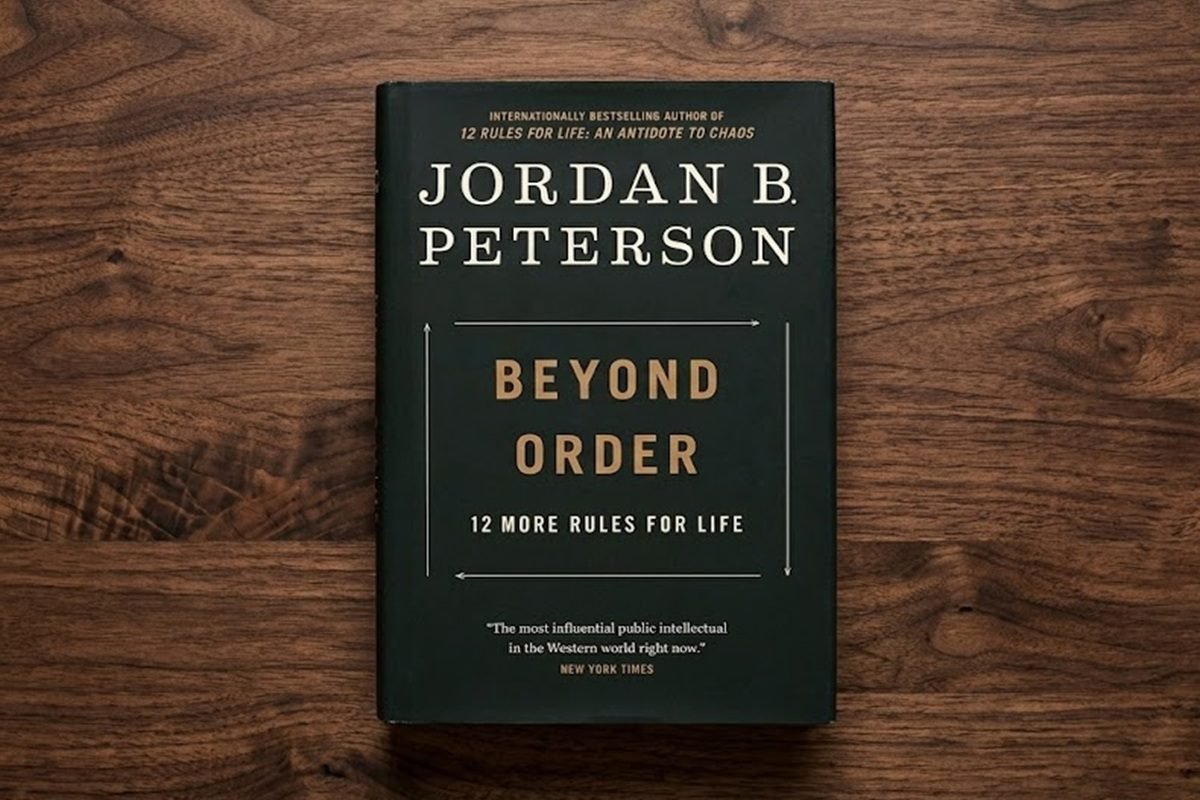
Book review: Beyond Order
12 More Rules for Life
By Jordan B. Peterson
Genres:
- Self-Improvement
- Psychology
The year it was published:
2021
Number of pages:
432

As an Amazon Associate, I earn from qualifying purchases.
Table of contents:
Author’s Note – A message written during the COVID-19 pandemic
Overture – Peterson’s personal story of illness, recovery, and the writing of this book
Rule I – Do Not Carelessly Denigrate Social Institutions or Creative Achievement
Rule II – Imagine Who You Could Be, and Then Aim Single-Mindedly at That
Rule III – Do Not Hide Unwanted Things in the Fog
Rule IV – Notice That Opportunity Lurks Where Responsibility Has Been Abdicated
Rule V – Do Not Do What You Hate
Rule VI – Abandon Ideology
Rule VII – Work as Hard as You Possibly Can on at Least One Thing and See What Happens
Rule VIII – Try to Make One Room in Your Home as Beautiful as Possible
Rule IX – If Old Memories Still Upset You, Write Them Down Carefully and Completely
Rule X – Plan and Work Diligently to Maintain the Romance in Your Relationship
Rule XI – Do Not Allow Yourself to Become Resentful, Deceitful, or Arrogant
Rule XII – Be Grateful in Spite of Your Suffering
Thoughts about the book:
The book offers twelve additional principles for navigating life, with a more explicit focus on avoiding rigidity and stagnation. Peterson argues that too much order can become constraining, even destructive, and that a meaningful life requires engagement with uncertainty and novelty. In the book, I really liked how Peterson emphasizes the necessity of balance rather than pure discipline. Some chapters contain compelling reflections on creativity, courage, and the psychological cost of avoidance. The book is moderately challenging to read because of Peterson’s writing style, which demands your full attention. The arguments in the book are layered, and the reader is often required to follow long conceptual threads that combine psychology, mythology, and philosophical interpretation. Like in his previous book, Peterson blends research-informed ideas with philosophical and symbolic interpretation. tically rich book. It is written in formal, often academic language, moderately to difficultly readable, and grounded in a mixture of psychology and philosophical interpretation. While not strictly scientific, it offers a serious and reflective examination of how meaning is constructed through the balance of order and uncertainty.
Who should read this book:
This is a book for readers who have begun to organize their lives but now sense the need for growth beyond just stability. This book offers a deeper, more nuanced framework for living, one that accepts that meaning is found not only in order, but also in the courage to step beyond it. It speaks to those interested in psychology, meaning, responsibility, and personal development. Too much structure can become limiting, and too much chaos can become overwhelming. The real challenge is learning how to navigate between the two. In this book, Peterson is searching for a way to live meaningfully without becoming trapped in either extreme. His interest lies in the tension between stability and exploration, between discipline and creativity, tradition and change. Where his previous book emphasized the necessity of order, this book explores the equally important role of voluntary risk, innovation, and openness to the unknown. What this book will help you do is refine how you engage with uncertainty. It encourages you to take calculated risks, embrace responsibility even when outcomes are unclear, and avoid the stagnation that can come from over-structuring life. The “rules” are designed to help you expand rather than contract your possibilities, while still maintaining psychological grounding.
Summary of the book:
Author’s Note: A Message in the Time of the Pandemic
Peterson briefly addresses the challenge of writing a book during COVID-19. He decided to proceed with his original plan rather than make the pandemic the book’s focus, reasoning that the virus will pass but the deeper problems of human life will remain.
Overture – Peterson’s personal story of illness, recovery, and the writing of this book
In the Overture, Jordan Peterson gives a deeply personal account of the period leading up to the writing of the book, marked by severe illness in his family and a serious medical crisis in his own life. His wife, Tammy, was diagnosed with a rare and life-threatening kidney cancer, requiring major surgery and intensive care. During this same period, Peterson suffered a severe and unexpected reaction to prescribed benzodiazepine medication, which led to prolonged withdrawal and extreme physical and psychological distress. His condition deteriorated to the point that he experienced debilitating anxiety, inability to sleep, and profound instability. He was hospitalized in multiple countries, including Canada, Russia, and Serbia, in search of treatment. At one point, he was placed in a medically induced coma in Russia to manage the severity of the withdrawal. After waking, he had to relearn basic functions such as walking and typing. Peterson is careful not to frame this suffering as inherently “meaningful” in a simplistic way, but he does describe how writing the book provided structure and direction during a period of collapse. It became a way of holding onto purpose when everything else was uncertain. From this experience, he introduces the book’s central framework, the tension between order and chaos. Order represents stability, predictability, and structure, the known world where things function as expected. Chaos represents unpredictability, breakdown, and the unknown, where existing structures fail or no longer apply. Peterson argues that neither is inherently good or bad; too much order leads to rigidity and stagnation, while too much chaos leads to disorder and suffering.
Rule I – Do Not Carelessly Denigrate Social Institutions or Creative Achievement
In this chapter, Jordan Peterson argues that social institutions like families, workplaces, traditions, and governments exist because they solve real human problems and have been refined over long periods of time. Criticizing them without understanding their function can be harmful, since they provide the structure that makes stable life possible. He describes human development as movement through social hierarchies, starting as a beginner who must learn with humility, becoming an equal among peers, and potentially taking on authority and responsibility for others. Each stage requires a different attitude, from openness to learning, to reciprocity, to care and accountability. Peterson also emphasizes that creativity and improvement depend on understanding rules before changing them. Blind rebellion destroys structure, but informed deviation can improve it. Closely related is the idea of “outsourcing sanity,” meaning people rely on social interaction and feedback from others to think clearly and stay grounded.
Rule II – Imagine Who You Could Be, and Then Aim Single-Mindedly at That
In this chapter, Jordan Peterson argues that myths, religious stories, and modern fiction are not just entertainment but encoded guides to human development. Across cultures, stories repeat a common pattern, the hero confronts chaos, takes on responsibility, and grows into a more capable version of themselves. He connects ancient myths like the Enuma Elish and the story of Marduk with modern examples such as Harry Potter and Iron Man, showing that the same structure persists, order is disrupted, chaos is faced, and something new is created. The implication is that human potential is developed through voluntarily taking on meaningful challenges. A central idea is that having a direction matters more than having perfect clarity. Acting toward a goal, even imperfectly, allows for correction and growth over time. Avoiding direction entirely leads to stagnation. He uses symbolic frameworks to express this process, the alchemical “materia prima” represents raw human potential, while the Golden Snitch in Harry Potter symbolizes the pursuit of meaning within ordinary life. Myths like Marduk’s victory over chaos represent the idea that confronting disorder is what allows new order to emerge.
Rule III – Do Not Hide Unwanted Things in the Fog
In this chapter, Jordan Peterson warns against willful blindness, the habit of avoiding uncomfortable truths in the hope they will resolve themselves. He argues that this avoidance, or “fog,” is psychologically costly, small ignored problems accumulate into major crises, whether in relationships, mental health, or life direction. The core idea is that people often refuse to clearly state what they want, what bothers them, or what needs to change. This lack of clarity prevents problems from being addressed early, when they are still manageable. Instead, they grow until they become overwhelming. Peterson distinguishes between sins of commission (things actively done wrong) and sins of omission (things deliberately ignored). He argues that what we fail to notice or address can be just as damaging as what we actively do. He also introduces the idea of performative contradiction, where a person’s stated values conflict with their behavior, creating internal tension and distress. The examples in this chapter illustrate how small avoidances compound over time. A long-unspoken irritation about something as minor as “tiny plates” eventually erupts after years of suppressed frustration, showing how unresolved issues build pressure. In another case, a woman quietly tolerates a home filled with furniture and art she dislikes for decades, gradually losing her sense of ownership and identity in the process. Peterson uses these cases to show that avoiding small confrontations leads to larger losses of self over time.
Rule IV – Notice That Opportunity Lurks Where Responsibility Has Been Abdicated
In this chapter, Jordan Peterson argues that meaning in life comes primarily from taking on real responsibility rather than pursuing happiness directly. When a person notices something important that is neglected and chooses to address it, they develop competence, character, and a sense of purpose. He argues that happiness is not something that can be pursued directly. Instead, it emerges as a byproduct of engaging in meaningful goals and seeing progress through sustained effort. What stabilizes people through difficulty is the sense that their actions matter and are aligned with a valuable direction. A key concept is derived from the Buddhist idea of duḥkha, often translated as suffering, which originally refers to a wheel that is off-center and produces a bumpy ride. Peterson uses this as a metaphor for human life, suffering increases when people are misaligned with their purpose. Similarly, the Greek idea of “sin” as missing the mark emphasizes failure of direction rather than moral condemnation. He also introduces the idea of the “iterated game,” where life is understood as an ongoing interaction with oneself, others, and the future. Actions that prioritize short-term gain at the expense of long-term stability undermine both personal and collective well-being.
Rule V – Do Not Do What You Hate
In this chapter, Jordan Peterson argues that a major source of psychological and moral damage comes from participating in actions you believe are wrong. When people comply with demands that violate their values, whether due to workplace pressure, social expectation, or fear of conflict, they gradually undermine their own integrity. This leads to resentment, cynicism, and a weakened sense of self. His central claim is that the solution is not reckless defiance, but the ability to say no when necessary. This may involve practical changes such as developing new skills, changing jobs, or distancing oneself from dysfunctional environments. The key distinction is between unavoidable hardship and voluntary participation in actions that one genuinely believes are wrong. A key idea is that harmful systems often expand gradually. Small acts of compliance make larger ones easier over time, so that what once seemed unacceptable becomes normalized. Peterson argues that resistance is most effective early, when the demands are still relatively minor. The example of a corporate client illustrates this situation. A woman working in a large organization encountered increasingly strange and ideological workplace rules, such as banning the term “flip chart” for supposed sensitivity reasons. While individually minor, these changes reflected a broader pattern of expanding bureaucratic and ideological control. Rather than confronting it directly in a way that would risk her position, she chose a more strategic response, speaking publicly against what she saw as pseudoscientific HR practices and writing about these trends in other contexts.
Rule VI – Abandon Ideology
In this chapter, Jordan Peterson critiques ideological thinking as a dangerous simplification of complex reality. He argues that ideologies reduce multifaceted problems to a single cause and assign blame to a single group or factor. While they often begin with partial truths, they become distorted when expanded into total explanations for all social and personal problems. He connects this tendency to Nietzsche’s idea of the “death of God,” which he interprets as the loss of shared moral frameworks. Without such frameworks, people tend either toward nihilism, where nothing has meaning, or toward rigid ideology, where one explanation is treated as sufficient for everything. Peterson argues both paths are psychologically and socially destructive. Instead, he proposes a focus on individual responsibility, improving one’s own life, addressing what is immediately within one’s control, and avoiding the temptation to externalize blame for all suffering onto a single group or system. A key concept is ressentiment, from Nietzsche, which describes a form of resentment in which personal frustration is transformed into moral accusation against others. Another is the idea of “blanket univariate causes,” the mistaken belief that one factor such as class, gender, or power can fully explain complex human and social phenomena. The examples in this chapter illustrate the dangers of ideological simplification. Nietzsche and Dostoevsky both predicted that the collapse of shared moral structures would lead either to nihilism or authoritarian systems, a pattern reflected in the 20th century through regimes such as Nazi Germany and Soviet communism. The Soviet collectivization of agriculture is used as a concrete case, where ideological attempts to simplify economic reality led to mass starvation and the destruction of productive farming systems.
Rule VII – Work as Hard as You Possibly Can on at Least One Thing and See What Happens
In this chapter, Jordan Peterson argues that lasting psychological strength comes from committing fully to a single meaningful direction. When a person spreads their energy across too many competing aims or avoids commitment altogether, their life becomes fragmented and unstable. In contrast, sustained effort along one path integrates personality and builds competence. He uses the metaphor of coal becoming a diamond, pressure and sustained effort do not destroy a person but refine them. In the same way, disciplined work forces competing impulses into alignment, gradually producing a more coherent and capable individual. A central idea is apprenticeship. Peterson describes this as the voluntary acceptance of structure, discipline, and hierarchy while learning a craft or skill. Through this process, individuals internalize rules so deeply that they eventually gain the ability to use them flexibly and creatively. He also warns that avoiding commitment in the name of freedom often leads to the opposite of freedom, a directionless and weakened life. Choosing nothing may feel safe, but it results in fragmentation and dissatisfaction over time. Commitment, even when difficult, provides structure and meaning. The examples in the chapter reinforce this logic. The Ten Commandments are interpreted as basic rules that allow social systems to function, much like rules in a game that make participation possible in the first place. The teaching of Christ’s “great commandment” is presented as a unifying principle, disciplined commitment to higher values ultimately leads to love of others and a more integrated way of living.
Rule VIII – Try to Make One Room in Your Home as Beautiful as Possible
This rule is about treating beauty as something necessary rather than optional. Peterson argues that beauty and art connect people to something beyond usefulness and efficiency, to aspects of life that feel deeper and more meaningful. As people grow older, they tend to stop seeing the world directly and instead rely on quick categories and habits of perception. Art helps reverse that by forcing attention back onto what is actually there, restoring a more immediate and childlike way of seeing. He describes artists as people who operate at the edge of the known world. They move through confusion, half-formed impressions, and uncertain ideas, and sometimes manage to bring something back that others can recognize and understand. In that sense, they are not simply decorators but explorers of human perception. This ties into the idea that children naturally see the world with freshness and detail, while adults become more efficient but also more blind to uniqueness. Beauty in art interrupts that efficiency and makes people look again. Peterson illustrates this with his own effort to collect Soviet-era paintings, spending long periods searching through large volumes of work to find a few pieces that genuinely moved him. He brought these into his home and tried to introduce similar changes into his work environment, even when faced with institutional resistance. That resistance became more visible when he attempted to improve his university office. After running into bureaucratic objections and the argument that improving one office would create expectations for others, he still found ways to change it using simple materials. Over time, that space became so distinctive that it was later shown to others as an example of what was possible, showing that environments tend to stay ordinary unless someone deliberately pushes against that tendency. He also uses the example of a wildebeest marked with a red spot, which was quickly singled out by predators. The point is that standing out carries risk in nature, which encourages blending in. But he contrasts this with the human choice of whether to remain safely indistinct or to engage fully with individuality and meaning. Taken together, these examples support his argument that making life and surroundings more beautiful is not superficial. It is an active choice to resist dullness, pay attention more deeply, and participate in something larger than mere function.
Rule IX – If Old Memories Still Upset You, Write Them Down Carefully and Completely
This rule is about integrating the past so that painful or traumatic memories stop acting like unresolved fragments in the present. Peterson argues that when certain experiences continue to cause distress, it is often because they haven’t been fully understood or placed into a coherent narrative. The goal is not avoidance but careful confrontation, where the meaning of what happened can be extracted and incorporated into your understanding of yourself and the world. Writing plays a central role in this process because it forces vague emotions into precise language. When fears, resentments, and memories are written down clearly, they can be examined rather than simply felt. This often reveals that the underlying issue is not just the event itself, but an incomplete or inaccurate “map” of how the world works. Updating that map is what allows the memory to stop being psychologically active in a harmful way. Peterson uses a case where a woman described childhood sexual abuse in terms shaped entirely by the terror of being a small child. Her abuser was experienced as monstrous and overwhelming, but when it was clarified that the person involved was also a child, the narrative shifted. Understanding the event through adult perception rather than childhood fear fundamentally changed how she experienced the memory. The lesson is that memories can remain distorted when they are never reinterpreted with a more accurate framework. In another case, a young man experienced nightly convulsions for years after leaving a violent relationship. He had been raised with the belief that adults are harmless, which made it impossible for him to consciously integrate the reality of what had happened to him. When he was finally able to recall and accept the threat he had faced, the physical symptoms stopped soon after. The point is that when reality is psychologically disallowed, the body can end up expressing what the mind refuses to recognize. A similar pattern appeared in a student who developed severe psychological symptoms after prolonged bullying. By systematically writing through his life story and including the actions and motivations of those who harmed him, he was able to reorganize his understanding of the experience. As the narrative became more coherent, his symptoms resolved and he returned to normal functioning. Across these examples, the underlying idea is that structured reflection and writing allow past events to be integrated rather than continually re-experienced as unprocessed threat.
Rule X – Plan and Work Diligently to Maintain the Romance in Your Relationship
This rule is about sustaining intimate relationships through deliberate, ongoing effort rather than assuming they will function on their own. Peterson argues that romance and partnership require continuous maintenance, because most conflict comes from unspoken expectations and assumptions that slowly turn into resentment. The solution is explicit negotiation. Couples should regularly and clearly discuss responsibilities, finances, intimacy, parenting, and time together instead of guessing each other’s needs. The aim is not rigidity, but preventing misunderstandings from accumulating. He describes a relationship as needing four ongoing elements, shared romantic time, effective cooperation in daily life, a healthy sexual relationship, and honest communication about all of these. Each requires attention and adjustment over time. In practice, couples who feel disconnected are encouraged to restart simple shared activities like dating, even if it feels awkward at first. Early attempts are often poor, but repetition gradually restores connection. The key idea is that romance is a skill that improves with practice. Peterson frames marriage as a long-term process with thousands of interactions, not a single success or failure. Seen this way, early difficulties don’t justify giving up; they are part of a much longer pattern that depends on persistence and continual renegotiation.
Rule XI – Do Not Allow Yourself to Become Resentful, Deceitful, or Arrogant
This rule is about three interconnected psychological dangers like resentment, deceit, and arrogance, which Peterson sees as key sources of personal and social dysfunction. Resentment arises when someone concludes that life has treated them unfairly, leading to blame and a desire for retaliation. Deceit involves distorting reality to serve immediate goals, which gradually weakens one’s ability to perceive truth clearly. Arrogance is the assumption that one can ignore conscience or consequences and still remain in control. He distinguishes between active dishonesty, where you knowingly lie, and passive avoidance, where you fail to acknowledge or confront what you already know. Both gradually distort judgment. The underlying idea is that conscience is a kind of internal guidance system, but it only remains reliable if it is consistently respected rather than ignored or overridden. This connects to the principle of “garbage in, garbage out”. If you repeatedly lie to yourself or others, your instincts and moral sense become unreliable. Over time, the very systems you depend on to navigate difficult situations lose accuracy, and you become more likely to make worse decisions precisely when clarity matters most. He also interprets the idea of “blasphemy against the Holy Spirit” as the deliberate silencing of conscience, the point at which a person persistently refuses to acknowledge what they know to be true. In this view, it is not punished externally but becomes self-destructive, because the capacity for correction is gradually eroded. Peterson illustrates this pattern with the biblical story of Adam and Eve, where responsibility is immediately deflected onto others rather than accepted. He also connects it to addiction, where relapse is often preceded by small justifications, resentment, and self-pity that accumulate over time. Each minor compromise makes the next one easier, eventually leading to a complete breakdown of self-control. The central message is that even small acts of dishonesty or avoidance matter, because they shape the trajectory of future decisions.
Rule XII – Be Grateful in Spite of Your Suffering
This final rule is about gratitude as a deliberate, hard-won moral stance rather than simple optimism. Peterson argues that even with full awareness of suffering, betrayal, and injustice, choosing to affirm life is one of the most important ethical acts a person can make. He takes seriously the strongest case against existence, including antinatalist arguments such as those associated with David Benatar, which suggest that non-existence might be preferable. His response is that rejecting life in principle leads toward resentment, nihilism, and ultimately a destructive orientation toward the world. The alternative is not denial of suffering, but the refusal to let suffering have the final word. Gratitude, in this sense, is an active choice to treat existence as something worth engaging with, other people as worth caring for, and the world as worth improving despite its flaws. Grief plays a central role in this argument, the intensity of grief shows that something was deeply valued, which means that at a fundamental level you already affirmed its worth. Loss reveals, rather than contradicts, the underlying commitment to life. He contrasts this with what he calls a Mephistophelian impulse, drawn from figures like Goethe’s Mephistopheles and reflected in extreme cases such as the Columbine shooters, where suffering is used as justification for rejecting existence itself. Peterson treats this as a distorted but coherent worldview that arises when resentment is allowed to fully develop into moral rejection of being. He also points to people working in palliative and end-of-life care as evidence that it is possible to remain engaged, compassionate, and purposeful in the presence of constant suffering. Their continued ability to act responsibly in such conditions illustrates that meaning does not depend on the absence of pain. Finally, he reframes strength in moments of tragedy as a form of responsibility toward others. Being the person who can remain steady when others are overwhelmed is not a denial of grief, but a way of giving it structure and preventing it from becoming chaos. The overall message is that gratitude is not ignorance of suffering, but the decision to affirm life in spite of it, and to act in a way that makes that affirmation real.