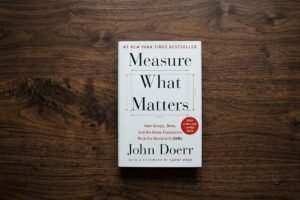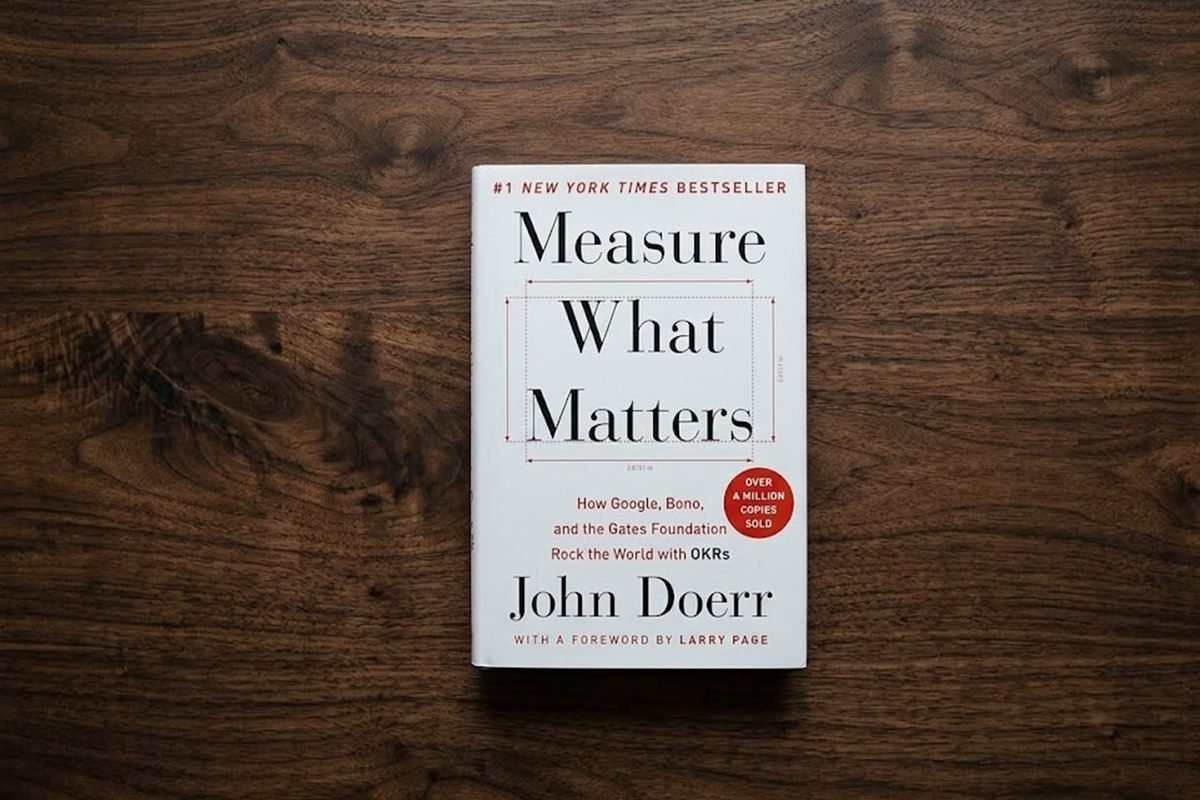
Book review: Measure What Matters
How Google, Bono, and the Gates Foundation Rock the World with OKRs
By John Doerr & Larry Page
Genres:
- Business
- Strategy
- Leadership
The year it was published:
2018
Number of pages:
320

As an Amazon Associate, I earn from qualifying purchases.
Table of contents:
FOREWORD – Larry Page, Google Co-founder
Part I – OKRs in Action
Chapter 1: Google, Meet OKRs
Chapter 2: The Father of OKRs
Chapter 3: Operation Crush – An Intel Story
Chapter 4: Superpower #1 – Focus and Commit to Priorities
Chapter 5: Focus – The Remind Story
Chapter 6: Commit – The Nuna Story
Chapter 7: Superpower #2 – Align and Connect for Teamwork
Chapter 8: Align – The MyFitnessPal Story
Chapter 9: Connect – The Intuit Story
Chapter 10: Superpower #3 – Track for Accountability
Chapter 11: Track – The Gates Foundation Story
Chapter 12: Superpower #4 – Stretch for Amazing
Chapter 13: Stretch – The Google Chrome Story
Chapter 14: Stretch – The YouTube Story
Part II – The New World of Work
Chapter 15: Continuous Performance Management – OKRs and CFRs
Chapter 16: Ditching Annual Performance Reviews – The Adobe Story
Chapter 17: Baking Better Every Day – The Zume Pizza Story
Chapter 18: Culture
Chapter 19: Culture Change – The Lumeris Story
Chapter 20: Culture Change – Bono’s ONE Campaign Story
Chapter 21: The Goals to Come
Thoughts about the book:
The book Measure What Matters is an introduction and advocacy for the OKR system, the Objectives and Key Results. The central idea is straightforward, organizations and individuals perform better when they define clear objectives and measurable outcomes, and then align their efforts around them. Doerr supports this framework with case studies from companies like Google, Intel, and Bono’s ONE Campaign, showing how OKRs can drive focus, transparency, and accountability at scale. The examples are compelling and diverse, spanning technology giants, startups, nonprofits, and even government initiatives. This breadth gives the OKR system credibility as more than just a Silicon Valley management tool. It becomes a general-purpose framework for goal setting and execution. The emphasis on alignment, ensuring that teams and individuals are working toward shared priorities, is particularly strong and persuasive. The book is easy to read, the chapters are organized around stories and examples, and the framework is repeated often enough to be memorable. This repetition reinforces understanding, though at times it can feel slightly redundant for readers already familiar with goal-setting systems.
Who should read this book:
If you are trying to turn ambition into real, measurable progress and you are tired of goals that sound inspiring but fail in execution, then Measure What Matters by John Doerr is a book that deserves your attention. This is a book for readers who are searching for clarity, alignment, and results. It speaks to those interested in leadership, startups, productivity, and organizational performance but also know that most failure is not due to lack of ideas, but lack of focus and follow-through. It is especially relevant if you’ve ever worked in a team where goals exist, but momentum doesn’t. Doerr is searching for a system that turns vision into execution. His interest lies in the power of Objectives and Key Results (OKRs), which is a goal-setting framework used by some of the most successful companies in the world. He explores how clarity of purpose, combined with measurable outcomes, can align entire organizations and unlock extraordinary performance. What this book will help you do is translate ambition into structure. It shows how to define what truly matters, break it into concrete, trackable results, and maintain accountability without losing flexibility or creativity. Through real-world examples from companies like Google, it demonstrates how disciplined goal-setting can scale from small teams to global organizations. By reading Measure What Matters, you will learn how to stop confusing activity with progress. For anyone who wants to build, lead, or improve systems that actually deliver outcomes, this book offers a practical and proven framework for turning intention into impact.
Summary of the book:
FOREWORD – Larry Page, Google Co-founder
Google’s co-founder opens the foreword by reflecting on the early days of the company and how important structured goal-setting became to its growth. He notes that he wishes he had known about OKRs (Objectives and Key Results) even before founding the company. In 1999, when John Doerr visited the still-very-small Google, he introduced the team to the OKR framework. Larry Page and Sergey Brin decided to adopt it, and it quickly became a core part of how Google set priorities and measured progress. The foreword explains that OKRs gave Google clearer visibility into what teams were working on and created a shared language for deciding what mattered most. It also helped leadership challenge priorities in a structured way, which became especially important as the company scaled rapidly. According to Page, the system played a meaningful role in Google’s repeated periods of exponential growth and helped maintain focus during years of fast expansion and increasing complexity. He closes by explaining why he agreed to write the foreword, because John Doerr’s introduction of OKRs was, in his view, a foundational contribution to Google’s success, something he describes as a lasting and transformative gift to the company.
Chapter 1: Google, Meet OKRs
The chapter opens in 1999, when Google is only about a year old and still operating out of a small, improvised office. John Doerr, who had recently invested $11.8 million in the company, arrives to introduce the team to a management system called OKRs. He explains the framework in simple terms. Objectives define what you want to achieve. They should be clear, meaningful, and motivating. Key Results define how you measure progress they must be specific, measurable, and either achieved or not, leaving no ambiguity. Together, they turn broad ambitions into trackable commitments. Doerr reinforces the idea with examples, including lessons drawn from Intel’s past, and even sets OKRs for his own presentation to demonstrate how the system works in practice. The goal is to show that even abstract intentions can be made concrete and measurable. The chapter also situates OKRs in broader research on goal-setting. Studies by psychologist Edwin Locke show that specific, challenging goals consistently improve performance compared to vague or easy ones. At the same time, Galloway notes warnings such as the “Goals Gone Wild” research from Harvard Business School, which shows that poorly designed goals can lead to harmful outcomes when incentives override judgment. Google’s founders respond quickly and positively. Larry Page and Sergey Brin recognize the need for a clear organizing principle and decide to adopt OKRs early on, embedding them into the company’s operating system from the beginning. The system is introduced at a time when Google has only around 30 employees and no fully defined business model. The presentation takes place in a makeshift setting, but the idea is immediately understood, write goals down, make them visible, and hold everyone accountable to measurable outcomes. Over time, OKRs become a central discipline in Google’s growth. They help guide the company as it scales into a global giant, eventually supporting the development of products used by billions of people, including Search, Chrome, Android, Maps, YouTube, Google Play, and Gmail. Leaders like Eric Schmidt later credit the framework with fundamentally shaping Google’s trajectory.
Chapter 2: The Father of OKRs
This chapter traces the origins of OKRs back to Andy Grove, the influential CEO of Intel. John Doerr first encountered Grove’s system in 1975 while working there as a summer intern. Grove, a Hungarian refugee who escaped the Nazi regime as a child, rose through determination and intellect to become Intel’s president and later CEO. Under his leadership, Intel delivered extraordinary shareholder returns, and he developed a management philosophy centered on measurable outcomes rather than titles or credentials. He believed that knowledge workers, paid to think rather than perform physical labor, needed structured goals just as much as factory workers did. His system, originally called “iMBOs” (Intel Management by Objectives), evolved into what is now known as OKRs. It was influenced by Peter Drucker’s earlier concept of Management by Objectives, but Grove redesigned it to fix its weaknesses. Traditional MBOs were typically annual, top-down, tied to compensation, and often lacked transparency. Grove changed this by making goals shorter-term, more flexible, decoupled from pay, and visible across the organization. The chapter also connects this theory to Doerr’s personal experience as an intern. At Intel in 1975, he was tasked with benchmarking the 8080 microprocessor against a competing chip from Motorola. He structured his work as an OKR, a clear objective focused on demonstrating performance superiority, supported by specific, measurable key results such as delivering benchmarks, building a demo, creating sales materials, and testing them with customers. Writing it down and posting it publicly gave him unexpected clarity and confidence. Even as a 24-year-old intern, the framework helped him prioritize work, decline distractions, and stay focused on what mattered. The experience became a foundational moment in his understanding of how powerful structured goals can be in shaping performance and decision-making.
Chapter 3: Operation Crush – An Intel Story
This chapter, narrated by former Intel VP Bill Davidow, presents one of the most vivid real-world examples of OKRs in action. In 1979, Intel was under serious threat as its 16-bit microprocessor, the 8086, began losing ground to competitors like Motorola and Zilog. The company’s position in the market and potentially its future was in danger. In response, Intel launched “Operation Crush,” a coordinated, company-wide effort to regain dominance. The goal was highly specific and ambitious, secure 2,000 “design wins” in a single year, meaning agreements from customers to build the 8086 into their products far exceeding the company’s previous performance. What made the campaign powerful, according to the chapter, was not just the goal itself but the alignment it created. Within weeks, the entire organization, be it engineering, sales, marketing, manufacturing, and communications, was focused on the same objective. Andy Grove personally drove the urgency, using OKRs as the system to synchronize thousands of employees across functions and regions. By the end of the year, Intel had exceeded 2,300 design wins, reclaiming roughly 85% of the 16-bit market. The campaign also helped pave the way for the 8088 chip, which would later be used in the first IBM PC, shaping the direction of the personal computer industry. The chapter also describes a critical turning point in late 1979, when Intel faced mounting pressure from Motorola’s faster and easier-to-use 68000 chip. A field sales manager raised an urgent warning that forced leadership to act quickly. Instead of redesigning the product, Intel reframed its strategy, it shifted from selling to individual programmers to selling to decision-makers, positioning microprocessor adoption as a long-term strategic choice supported by Intel’s broader ecosystem. The OKR for the following quarter reflected this focus, establish the 8086 as the leading 16-bit microprocessor family, supported by specific measurable outcomes such as publishing benchmarks, restructuring the product line, accelerating production of a faster version, and delivering key components on a strict timeline. The broader lesson is that OKRs did not just track performance, they created alignment, urgency, and coordinated action at scale, allowing a large organization to respond quickly and decisively under competitive pressure.
Chapter 4: Superpower #1 – Focus and Commit to Priorities
This is the first of four chapters on the “superpowers” of OKRs. Superpower #1 is focus—the discipline of deciding what matters most and deliberately ignoring everything else. The central idea is that most organizations don’t fail because they lack ideas, but because they try to pursue too many at once. OKRs force prioritization. When everything is important, nothing actually is. The system imposes strict limits to enforce that focus, ideally only three to five Objectives per quarter, each supported by no more than five Key Results. Those Key Results should be precise, measurable, and time-bound, combining both inputs (what actions are taken) and outputs (what results are achieved). The chapter uses historical failures to show what happens when focus breaks down. One example is the Ford Pinto case, where Ford Motor Company set aggressive cost and weight targets for the Pinto, keeping it under 2,000 pounds and under $2,000. Under pressure to meet those goals, engineers overlooked a critical safety flaw, a poorly designed fuel tank that could ignite in rear-end collisions. Despite internal awareness of the risk, the company proceeded, leading to fatal accidents and eventually a massive recall of 1.5 million vehicles. Another example is the Wells Fargo scandal, where the bank set extreme sales targets that incentivized employees to open millions of unauthorized accounts just to meet quotas. The result was widespread fraud, thousands of firings, and long-term reputational damage. Together, these cases illustrate a core warning, when organizations obsess over a narrow set of metrics without balancing them with broader judgment, they can achieve their targets while destroying trust, safety, or integrity. OKRs are designed to prevent this by forcing clarity on what truly matters and by limiting how much can be pursued at once.
Chapter 5: Focus – The Remind Story
This chapter is told by Brett Kopf, co-founder of Remind, a platform designed to help teachers, students, and parents communicate safely and efficiently. Kopf’s personal experiences with ADHD and dyslexia shaped his understanding of how overwhelming school communication and deadlines can be, and directly influenced the problem Remind was built to solve. As a student at Michigan State, he often struggled to manage assignments and information across multiple classes. Together with his brother David, he created an early version of Remind as a simple text-based reminder system for students. The company went through several pivots and nearly ran out of money before eventually joining a Silicon Valley education accelerator. A key lesson from their early journey was that focus is not automatic it has to be enforced. Like many startups, they initially tried to do too many things at once, which diluted their progress. OKRs became the mechanism that forced discipline, helping them identify and commit to the one most important goal each quarter. During the Imagine K12 accelerator, they set a defining early OKR, interview 200 teachers across North America to understand their biggest challenges. They exceeded it, speaking with 250 teachers, and those conversations shaped the core product direction. They discovered that teachers could not safely text students directly due to privacy concerns and that existing school communication systems were unreliable. This insight led to Remind’s core solution, a secure messaging system that allowed teachers to communicate with students and parents without exposing personal phone numbers. The product spread quickly through word of mouth within schools, driven by its practical usefulness. With investment from Kleiner Perkins in 2014, Remind scaled rapidly from 14 employees to 60—and raised $40 million in Series C funding within a few quarters. By the end of that period, the app was seeing hundreds of thousands of daily downloads and reached the top tier of the App Store rankings. The chapter reinforces the idea that OKRs are not just a corporate tool, but a survival mechanism for young companies, they force clarity, eliminate distraction, and turn limited resources into focused execution.
Chapter 6: Commit – The Nuna Story
This chapter is told by Jini Kim, CEO of Nuna, which builds data systems for healthcare programs in the United States. Her motivation is deeply personal: her brother Kimong has severe autism, and when she was nine years old, she helped her Korean immigrant family enroll in Medicaid. That early experience shaped her commitment to improving how public healthcare systems serve vulnerable people. After working at Google, where she learned OKRs firsthand, she founded Nuna in 2010 to apply data systems to healthcare at scale. The company eventually won a major government contract to build the first unified database for all 74.5 million Medicaid recipients across all 50 states an effort that had repeatedly failed in the past. The chapter emphasizes that Nuna’s early attempts to use OKRs failed because they were treated as a formality rather than a commitment. Nobody consistently used them. When leadership later adopted OKRs visibly and seriously, modeling the behavior themselves, the system began to work. The lesson is that OKRs only function when leaders actively engage with them, not when they are delegated or symbolic. Building the Medicaid system was extremely complex. The team had to modernize infrastructure, meet strict security and privacy requirements, scale from 15 to 75 employees, and maintain existing operations all within a single year. It represented both a technical and organizational stress test. Jini’s own hiring OKR during this period reflected the structure of the system, her objective was to build a world-class team, with measurable key results such as hiring 10 engineers, recruiting a commercial sales leader, and ensuring that every candidate felt respected during the hiring process, even if they were not selected. The results were mixed, highlighting how OKRs also expose gaps, not just successes. The chapter concludes by noting that the Medicaid database created by Nuna was described by The New York Times as a near-historic achievement—transforming fragmented state-level systems into a unified, nationwide view of one of the largest public health programs in the world.
Chapter 7: Superpower #2 – Align and Connect for Teamwork
Superpower #2 is alignment, ensuring that everyone in an organization, from leadership to individual contributors, is working toward the same goals and can clearly see how their work contributes to the bigger picture. Galloway points out a striking problem in most companies, research suggests that only a small fraction of employees around 7% fully understand their company’s strategy and what is actually expected of them. As a result, many people work hard, but not necessarily on the right things. OKRs, when made transparent across the organization, are designed to solve this disconnect by making priorities visible and shared. The chapter contrasts two approaches to setting goals. The traditional model is purely top-down cascading, where leadership defines objectives and passes them down through every level of the organization. This creates consistency but can also be rigid and slow, with little room for initiative. The more effective model, Galloway argues, is a hybrid, roughly half of OKRs should come from the top, while the rest can be proposed from the bottom up, as long as they align with company priorities. A case study from YouTube illustrates how this works in practice. A product manager, Rick Klau, noticed that many users were not logging in to the platform, which limited personalization and reduced engagement data. His team set a six-month OKR to improve the login experience and address the issue. When the plan was reviewed by Larry Page, it was immediately elevated into a company-wide priority, but with a shortened deadline of three months. What had started as a single team’s initiative suddenly became an organization-wide effort, with multiple teams coordinating to ensure success. The project was ultimately completed slightly behind the revised schedule, but it succeeded in improving the login system. More importantly, it demonstrated the power of alignment, when OKRs are shared and visible, individual goals can quickly scale into coordinated action across an entire company.
Chapter 8: Align – The MyFitnessPal Story
Mike Lee, co-founder of MyFitnessPal, uses his story to illustrate how alignment changes as a company scales. What began as a small startup built by two brothers was initially easy to coordinate decisions were made through direct conversation, and priorities were naturally shared. As the company grew and was later acquired by Under Armour, alignment became far more complex. MyFitnessPal now had to coordinate across a large corporate structure with multiple departments, priorities, and planning cycles. OKRs became the mechanism that allowed the startup to integrate into a much larger organization without losing focus or speed. Lee’s central insight is that most companies without structured goal-setting suffer from poor alignment, teams unknowingly work in different directions, duplicating effort or undermining each other’s progress. OKRs solve this by creating a shared language and a visible system of priorities, ensuring that everyone is working toward the same outcomes. Before the acquisition, MyFitnessPal operated in a simple but effective rhythm, identify a single key goal, such as launching on a new platform, execute it, and then move on to the next priority. This kept focus extremely tight, but worked because the company was small and centralized. After the acquisition, the scale of coordination increased dramatically. MyFitnessPal had to align with marketing, product, branding, and engineering teams across a global corporation while maintaining its own culture and speed. OKRs provided a bridge between the startup and the parent company, allowing both to stay synchronized without forcing full structural integration. Under this model, the app scaled to over 120 million users, and its community collectively reported hundreds of millions of pounds of weight loss. The chapter uses this as an example of how alignment, when properly structured, can preserve focus while enabling massive organizational growth.
Chapter 9: Connect – The Intuit Story
This chapter focuses on Intuit and how its CTO, Atticus Tysen, used OKRs to deepen a culture of transparency and improve coordination across the organization. Intuit had already made transparency a core value, but in practice, information still didn’t flow easily between teams. OKRs helped fix this by making goals visible across the entire company. Once everyone could see what others were working on, teams began to naturally connect, identify overlap, and collaborate more effectively. Duplication decreased, and alignment improved without forcing top-down coordination. The chapter emphasizes that OKRs are not just a management tool for setting direction they also function as a horizontal system that connects teams across departments. When objectives are public, collaboration becomes easier because people can see where their work intersects. An example comes from an Intuit IT team working under a clearly defined OKR. Their objective was to build a stable, secure, and agile infrastructure. To achieve this, they defined specific key results such as migrating Oracle systems to R12, delivering wholesale billing as a platform, completing onboarding to Salesforce, retiring legacy systems, and developing a broader workforce technology strategy. These measurable commitments made expectations explicit for everyone involved. Stakeholders could clearly see what the team was responsible for, track progress, and coordinate their own work accordingly. The result was not just better execution, but a more connected and transparent organization overall.
Chapter 10: Superpower #3 – Track for Accountability
Superpower #3 is tracking the continuous monitoring of progress against OKRs through regular check-ins, honest scoring, and the willingness to adjust direction when reality changes. Unlike traditional annual goals, which are often set once and revisited only at the end of the year, OKRs are treated as living systems. Each one moves through a clear cycle. First is setup, where objectives and key results are defined. Then comes midlife tracking, where progress is reviewed weekly or monthly so teams can spot issues early. Finally, there is wrap-up, where results are scored honestly and the team reflects on what worked and what didn’t. A key feature of this system is simple color-coded status tracking. Green means on track, yellow signals caution, and red means at risk. This makes problems visible in real time, instead of letting them quietly accumulate until they become failures. The chapter returns to Intel’s Operation Crush as a concrete example of how this works in practice. At the end of the quarter, the OKRs were scored with brutal honesty, benchmark goals were partially met (0.6), product repackaging was fully completed (1.0), the 8MHz chip slipped due to manufacturing delays (0.0), and the arithmetic coprocessor was nearly complete (0.9). The overall average score came to 0.625. Rather than treating this as a failure, Intel saw it as a healthy outcome. The goals had been deliberately ambitious, and missing some targets was expected. In fact, if every OKR had scored a perfect 1.0, leadership would have concluded the goals were not challenging enough. The underlying idea is that tracking is not about punishment or perfection—it is about visibility, learning, and maintaining momentum. Regular check-ins ensure that small problems are surfaced early, and honest scoring ensures that organizations don’t confuse effort with success.
Chapter 11: Track – The Gates Foundation Story
This chapter focuses on the Bill & Melinda Gates Foundation, which Doerr describes as “a $20 billion startup.” The organization applies OKR thinking to global health problems like malaria, polio, and HIV, working in some of the poorest regions in the world where reliable data is often scarce and outcomes are difficult to measure. Because it is a nonprofit, the foundation cannot rely on revenue or profit as indicators of success. Instead, it defines progress through concrete, measurable outcomes such as reducing child mortality, expanding access to treatment, or increasing the number of people receiving lifesaving medication. OKRs help translate broad humanitarian goals into specific targets that can be tracked and evaluated. The chapter highlights how OKRs enable faster, evidence-based decision-making at a massive scale. By continuously measuring progress, the foundation can shift funding toward programs that work and away from those that do not, improving impact over time and saving lives more effectively. A key example is its work on malaria. One objective was to prove that a cure-focused strategy could eliminate the disease in a defined region. The key results included achieving zero malaria deaths in a test area within a set timeframe, developing tools needed to scale the approach globally, and maintaining broader progress in prevention efforts. The chapter also shows how OKR thinking influenced public institutions. Sylvia Mathews Burwell, a former Gates Foundation executive, brought similar practices into U.S. government agencies, including the Office of Management and Budget and later the Department of Health and Human Services, where structured goal tracking helped improve coordination during the Ebola response. Overall, the chapter emphasizes that OKRs are not limited to business they are equally powerful in environments where the stakes are human lives, and where clarity, measurement, and focus are essential for impact.
Chapter 12: Superpower #4 – Stretch for Amazing
Superpower #4 is stretching, the practice of setting goals that are deliberately ambitious enough to change how people think and work. These are often described as “moonshot” goals or BHAGs (Big Hairy Audacious Goals, a term popularized by Jim Collins in Good to Great). The chapter argues that comfortable goals tend to produce average performance. In contrast, extremely difficult goals push individuals and teams to discover new approaches and unlock higher levels of output, even if the final target is not fully achieved. Research by Edwin Locke supports this idea, showing a strong relationship between goal difficulty and performance as goals become more challenging, performance tends to improve. Within this framework, Galloway explains how Google structures its OKRs. The company separates them into two types, committed goals, which are expected to be achieved at 100%, and aspirational goals, which are intentionally ambitious and are typically achieved only 60–70% of the time. If teams consistently reach 100% on aspirational goals, it usually means the targets were not bold enough. A key example comes from Intel’s Operation Crush, which used a highly ambitious target of 2,000 design wins in a single year far above the previous pace. The goal initially seemed unrealistic, but it created intense focus across the organization. To increase motivation, Intel even added a strong incentive, a trip to Tahiti for teams that met their quotas, with a strict rule that if any individual in a district failed to meet their target, the entire office would lose the reward. This structure created both aspiration and peer accountability. By the end of the year, the company exceeded 2,300 design wins, surpassing the original goal. The result illustrated the core idea of this superpower when stretch goals are combined with clear measurement and aligned incentives, they can drive performance far beyond what people initially believe is possible.
Chapter 13: Stretch – The Google Chrome Story
This chapter uses Sundar Pichai’s experience building Google Chrome to show how stretch OKRs can reshape what teams believe is possible. In 2008, Google had no web browser and was entering a market dominated by Internet Explorer. Building a competitive browser from scratch was an enormous gamble. Pichai’s team set an aggressive OKR, reach 20 million users in the first year. For a new product from a company with no prior browser experience, the target was widely seen as unrealistic. They did not fully hit the goal, finishing at roughly half the target. But the stretch itself changed their behavior in meaningful ways. It pushed the team to prioritize speed, invest heavily in performance, and pursue aggressive distribution partnerships they might not have considered under more conservative targets. In other words, the ambition of the goal shaped the strategy. The following year, they set an even higher target of 50 million users and exceeded it by reaching 111 million. Over time, Chrome became the most widely used browser in the world. The key point of the chapter is that stretch OKRs are not judged solely by whether they are fully achieved. Their value lies in forcing organizations to think differently, take smarter risks, and expand their sense of what is possible. Even when teams fall short of the target, the stretch often produces results far beyond what safer goals would have delivered.
Chapter 14: Stretch – The YouTube Story
This chapter focuses on Susan Wojcicki’s leadership of YouTube and one of its most ambitious stretch OKRs reaching one billion hours of daily watch time. At the time the goal was set, YouTube was already a large platform but still far from that scale, with roughly 100 million hours of daily viewing. The target required a tenfold increase, which many inside the company considered unrealistic. Achieving it would demand improvements across almost every part of the product from recommendation systems to content strategy to infrastructure. Despite the skepticism, Wojcicki and her team committed to the goal. Over time, the stretch objective reshaped the entire organization’s priorities. Engineering teams focused heavily on improving the recommendation algorithm, product teams expanded into new formats like live streaming and kids’ content, and the company invested in emerging areas such as VR video. Each of these efforts was tied back to increasing total watch time. A representative OKR from this period had the objective of increasing viewing, with key results focused on growing engagement in the main app and search experience, expanding kids’ and gaming content, and launching new viewing experiences such as VR. These sub-goals all fed into the larger stretch target. Eventually, YouTube achieved the milestone of one billion hours of daily watch time. The chapter’s main point is that the power of such a goal is not just in reaching it, but in how it forces an organization to reorganize itself technically, strategically, and culturally around a single, ambitious outcome that would otherwise seem out of reach.
Chapter 15: Continuous Performance Management – OKRs and CFRs
This chapter introduces CFRs, Conversations, Feedback, and Recognition as the essential companion to OKRs. If OKRs define where an organization is going and how progress is measured, CFRs describe how people stay aligned, improve, and stay motivated along the way. The central critique is aimed at traditional annual performance reviews. The chapter argues they are slow, resource-heavy, and often inaccurate, relying on memory rather than real-time observation. Managers spend significant time compiling them, yet they typically arrive too late to meaningfully influence performance. Only a small fraction of HR leaders consider them truly effective. The alternative is continuous performance management, regular one-on-one conversations, immediate and specific feedback, and consistent recognition of contributions as they happen. This approach reflects how modern work actually operates fast-moving, collaborative, and iterative. A case study from Pact illustrates this shift. The organization replaced its annual review process with a system called “Propel.” Instead of waiting for yearly evaluations, employees participate in monthly one-on-ones with managers, quarterly reviews tied to OKR progress, and semi-annual conversations focused on career development. Feedback is also encouraged in real time after key work moments, with a focus on specific and actionable input rather than vague praise. For example, after a presentation or deliverable, employees are encouraged to ask targeted questions like what one thing worked well, making feedback immediate and usable rather than retrospective and general. The chapter’s main idea is that performance improves when feedback is continuous rather than periodic, and when recognition and correction are embedded into everyday work instead of reserved for formal reviews.
Chapter 16: Ditching Annual Performance Reviews – The Adobe Story
Adobe’s transformation begins with what might be called an accidental confession. In 2012, Adobe executive Donna Morris, while jet-lagged in India, told a journalist that the company was planning to eliminate annual performance reviews. The problem was that she had not yet fully coordinated this with leadership. Once she returned, instead of walking the statement back, Adobe decided to follow through. The company replaced traditional annual reviews with a system called “Check-in,” built around continuous performance management. The new model removed ratings, rankings, and formal review forms entirely. Instead, employees and managers focused on ongoing conversations about goals, performance, and career development. Progress was reviewed quarterly, feedback happened regularly, and compensation discussions were handled more directly by managers based on real-time understanding rather than once-a-year evaluations. The impact was immediate and measurable. Manager time spent on performance reviews dropped dramatically about 80,000 hours per year, previously the equivalent of dozens of full-time roles, was freed from administrative review work. More importantly, employee sentiment improved. Voluntary turnover, which had previously spiked after annual review season, declined significantly. A key example from Adobe shows how deeply inefficient the old system had been. Before the change, employees often experienced reviews as stressful, backward-looking events that did little to improve actual performance. After the shift to Check-in, employees reported feeling more supported, more informed about expectations, and more in control of their growth. The broader lesson of the chapter is that performance systems work best when they are continuous rather than episodic. By embedding feedback and goal alignment into everyday work instead of concentrating it into a single annual moment, Adobe created a culture that was more responsive, more humane, and ultimately more effective.
Chapter 17: Baking Better Every Day – The Zume Pizza Story
The chapter uses Zume Pizza as a case study to show how OKRs and CFRs can work together as a full operating system for a company. Zume Pizza was a robotics-driven pizza company that used automated systems to prepare and deliver fresh pizza from mobile kitchens. Founders Alex Garden and Julia Collins applied OKRs not just at the strategy level, but across every part of the business from robotic kitchen processes to sales conversations with corporate clients. The company’s culture was built around transparency and recognition. OKRs were visible across teams, so everyone could see what others were working on and how their work connected to broader goals. At the same time, CFR practices reinforced engagement and motivation through regular peer recognition. A defining ritual was the weekly all-hands “roundup” meeting. Each Friday, the session ended with open shout-outs, where any employee could publicly recognize another colleague for meaningful contributions that week. This simple practice of peer-to-peer appreciation created a strong sense of visibility and belonging. The company’s OKRs reflected its experimental and systems-oriented approach. Some goals focused on engineering milestones, such as increasing the percentage of pizza assembly handled by robotic systems within a set timeframe. Others addressed customer experience and operational scaling, while still others reinforced cultural development. The combination of transparent OKRs and continuous recognition helped build a highly engaged workforce in a fast-moving, experimental environment. The chapter’s core point is that performance systems are most powerful when they combine clear goals with consistent human feedback linking execution (OKRs) with motivation and culture (CFRs).
Chapter 18: Culture
This chapter focuses on how OKRs relate to organizational culture. The core idea is that OKRs don’t create culture on their own, but they strongly amplify whatever culture already exists. CFRs then reinforce that culture day by day through feedback, conversation, and recognition. The book points to Andy Grove’s Intel as the clearest example of a strong OKR-driven culture. It was defined by directness, a focus on results over politics, and an unusual comfort with bad news arriving early. At Intel, surfacing problems quickly was not punished it was valued, because it helped the company correct course faster. A central insight is that culture cannot be built through slogans or internal memos. It has to be demonstrated through behavior. Leaders shape culture most powerfully when they publicly set their own OKRs, share progress openly, and admit failures just as transparently as successes. In that sense, OKRs act less like a management tool and more like a mirror they reflect what an organization truly values in practice. CFRs sustain that system by ensuring that communication, feedback, and recognition happen continuously rather than only at formal checkpoints.
Chapter 19: Culture Change – The Lumeris Story
This chapter uses Lumeris to show how OKRs can be used to reset a struggling organizational culture. Lumeris focuses on value-based care, helping healthcare providers and insurers shift from paying for procedures to paying for patient outcomes. When a new CEO and COO arrived, they found a company divided into silos, with weak accountability and no shared system for defining or tracking goals. The new leadership introduced OKRs as the foundation for cultural change. A key principle was what they called “brutal transparency without judgment.” Every OKR had to be clearly marked as either green (on track) or red (at risk), with no middle category to soften or obscure reality. This made performance visible and unavoidable across the organization. A distinctive practice was “selling your reds.” In monthly reviews, leaders had to openly explain which goals were at risk, why they were off track, and what support they needed from others to recover. This turned accountability into a collaborative process rather than a punitive one. A pivotal moment came when COO Art Glasgow announced at an all-hands meeting that OKRs would not only measure employees but also be used to evaluate managers. That signal gave the system credibility and helped secure buy-in across the organization. Within a quarter of implementation, about 75% of Lumeris’s 800 employees were using OKRs. Over time, retention improved, and execution became more coordinated. The company expanded rapidly, launching partnerships across 18 states and covering more than a million people. The chapter’s broader point is that OKRs can reshape culture only when they are enforced consistently, applied transparently, and supported by leadership behavior that treats accountability as shared rather than hierarchical.
Chapter 20: Culture Change – Bono’s ONE Campaign Story
This chapter features Bono and the ONE Campaign, a global advocacy organization focused on fighting extreme poverty. He explains that in its early days, ONE tried to tackle too many global problems at once AIDS, malaria, girls’ education, climate change, energy poverty, and more. The passion was there, but the focus wasn’t. OKRs forced a difficult but necessary shift. Instead of spreading attention across many causes, the organization had to define a smaller number of priorities it could realistically influence and measure progress against. This meant translating broad moral goals into specific, trackable outcomes. A turning point came when John Doerr asked a blunt question at ONE’s first board meeting who are you working for, and do they have a seat at the table? That question exposed a gap between intention and structure. The organization realized it was primarily speaking about Africa, rather than working with African voices directly. That insight triggered a strategic pivot from working on Africa to working with Africa. Bono credits OKRs with helping transform ONE from an idealistic but diffuse advocacy group into a focused, results-driven campaign. Over time, this discipline contributed to influencing nearly $50 billion in global health funding. A key OKR captured this shift in practical terms. The objective was to integrate African perspectives more directly into ONE’s work and align more closely with priorities set on the continent itself. The key results made this concrete hiring and onboarding African-based staff, adding African members to the board, establishing an African advisory group that met regularly, and building relationships with leading African thinkers. The chapter’s central point is that OKRs can turn values into execution. In ONE’s case, a philosophical commitment to inclusion became a measurable set of actions that reshaped the organization’s structure, focus, and impact.
Chapter 21: The Goals to Come
The final chapter lays out John Doerr’s vision for what could happen if OKRs were adopted far beyond the corporate world and used in governments, schools, hospitals, and nonprofits. He imagines a future where structured goal-setting becomes a basic skill, taught even in elementary school, something that has already begun in places like Mountain View, California. In this world, students would learn early how to define clear objectives, measure progress, and reflect on outcomes. Doerr extends the idea further into public institutions. Governments, he argues, could become more accountable and effective if they used transparent, measurable goals to guide policy and spending. Instead of vague promises, leaders would be evaluated against clearly defined results. He also applies the same logic to global challenges like climate change, poverty, and public health. The argument is that these problems are not limited by lack of intelligence or resources, but by lack of coordination and focus. OKRs, he suggests, could bring the same discipline that companies like Google used to build products like Chrome to efforts that affect entire populations. The chapter’s closing idea is that OKRs are not just a management system for businesses, but a way of organizing collective effort. Doerr’s ultimate ambition is a kind of shared framework that helps people and institutions work together more effectively on problems that feel too large or complex to solve.