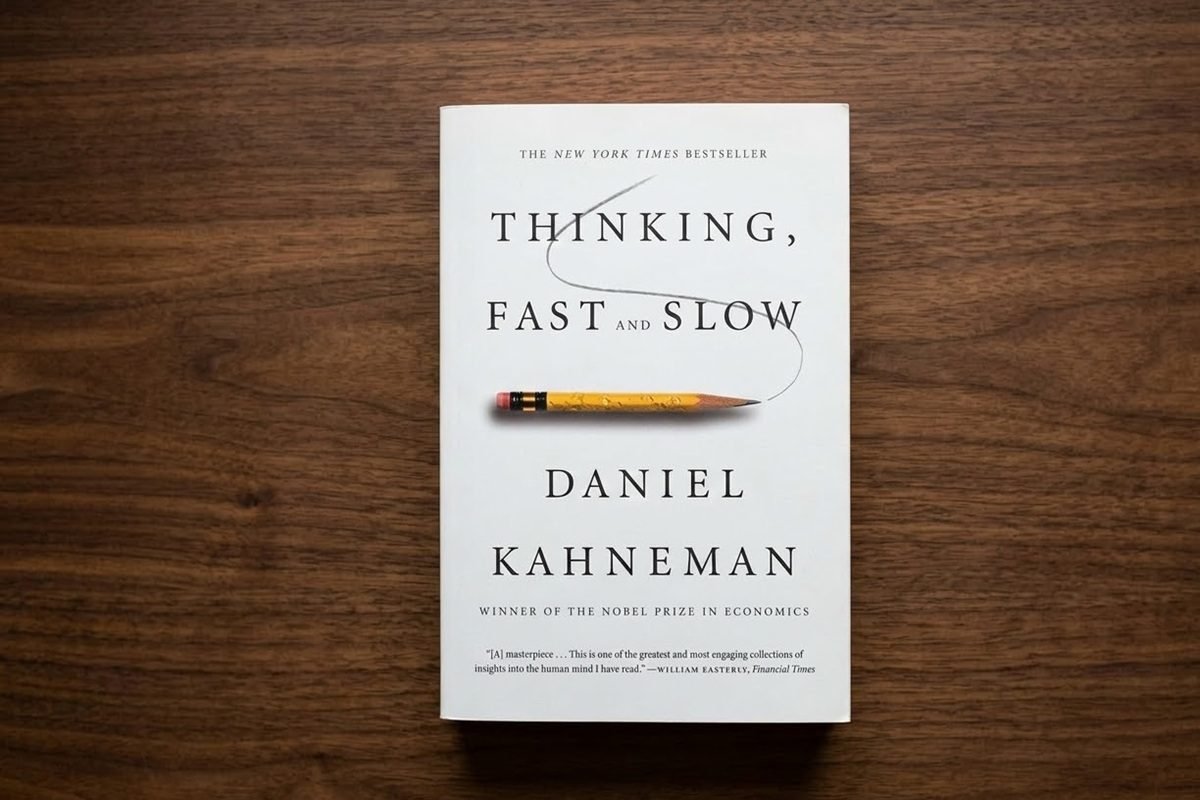
Book review: Thinking, Fast and Slow
By Daniel Kahneman
Genres:
- Decision-Making
- Problem Solving
- Psychology
The year it was published:
2011
Number of pages:
512

As an Amazon Associate, I earn from qualifying purchases.
Table of contents:
Introduction
Part I – Two Systems
Chapter 1: The Characters of the Story
Chapter 2: Attention and Effort
Chapter 3: The Lazy Controller
Chapter 4: The Associative Machine
Chapter 5: Cognitive Ease
Chapter 6: Norms, Surprises, and Causes
Chapter 7: A Machine for Jumping to Conclusions
Chapter 8: How Judgments Happen
Chapter 9: Answering an Easier Question
Part II – Heuristics and Biases
Chapter 10: The Law of Small Numbers
Chapter 11: Anchors
Chapter 12: The Science of Availability
Chapter 13: Availability, Emotion, and Risk
Chapter 14: Tom W’s Specialty
Chapter 15: Linda: Less is More
Chapter 16: Causes Trump Statistics
Chapter 17: Regression to the Mean
Chapter 18: Taming Intuitive Predictions
Part III – Overconfidence
Chapter 19: The Illusion of Understanding
Chapter 20: The Illusion of Validity
Chapter 21: Intuitions vs. Formulas
Chapter 22: Expert Intuition: When Can We Trust It?
Chapter 23: The Outside View
Chapter 24: The Engine of Capitalism
Part IV – Choices
Chapter 25: Bernoulli’s Errors
Chapter 26: Prospect Theory
Chapter 27: The Endowment Effect
Chapter 28: Bad Events
Chapter 29: The Fourfold Pattern
Chapter 30: Rare Events
Chapter 31: Risk Policies
Chapter 32: Keeping Score
Chapter 33: Reversals
Chapter 34: Frames and Reality
Part IV – Choices
Chapter 35: Two Selves
Chapter 36: Life as a Story
Chapter 37: Experienced Well-Being
Chapter 38: Thinking about Life
Conclusions
Thoughts about the book:
In Thinking, Fast and Slow Daniel Kahneman draws on decades of research in psychology and behavioral economics to explain how people think, judge, and decide. The result is a book that is deeply informative, often unsettling, and occasionally demanding but ultimately rewarding. One of the book’s greatest strengths is its conceptual clarity. The central distinction between System 1 (fast, intuitive thinking) and System 2 (slow, deliberate reasoning) is elegant and powerful. Kahneman uses this framework consistently, allowing readers to understand a wide range of cognitive phenomena such as biases, heuristics, overconfidence, and framing—through a single unifying lens. Once introduced, these concepts are hard to forget, and they permanently change how the reader interprets everyday decisions.
The book is highly scientific, but not in an inaccessible way. Kahneman grounds his claims in experimental evidence, often describing classic studies in psychology and economics. The research is rigorous, carefully explained, and transparent about its limitations. At the same time, the book avoids technical jargon whenever possible. The language is largely clear, precise, and conversational, leaning toward educated everyday language rather than dense academic writing. That said, the intellectual demands are real. This is not a book to skim casually, as it requires attention, rereading, and reflection to get as much as you can from it. In terms of readability, the book is both engaging and challenging. Kahneman often uses short examples, thought experiments, and familiar scenarios to illustrate abstract ideas. However, the book’s length can feel overwhelming. Many concepts are closely related, and at certain times you can get a feeling like things are repeating.
The book is not without weaknesses. Some readers may find it too long and methodical. Overall, Thinking, Fast and Slow is a great book, serious, influential, and enduring. It is not light reading, but it is profoundly enlightening. It leaves readers with a deeper understanding of their own minds and with a lasting sense of humility about the limits of human judgment. So if you are looking for a book on decision-making, or how your brain works then this is one of those gems you should definetly pick up.
Who should read this book:
You should read Thinking Fast and Slow if you are curious about how human thinking really works and why intuition so often leads us astray. The book is for readers interested in psychology, decision-making, and behavioral economics, as well as anyone who wants to understand the hidden forces behind everyday choices. This book is especially valuable if you want to learn why confidence does not equal accuracy, why people misjudge risk, and why even experts make systematic errors. It offers scientific insight rather than self-help advice, encouraging reflection rather than quick fixes. In short, read this book if you are searching for a deeper understanding of judgment, reasoning, and human behavior, and if you are willing to engage with ideas that challenge how you think about thinking itself.
Summary of the book:
Introduction
In the introduction, Kahneman presents the central idea of the book which is that the human mind operates using two distinct modes of thinking, which he calls System 1 and System 2. System 1 is fast, automatic, and intuitive, while System 2 is slow, deliberate, and effortful. Although System 2 is responsible for reasoning and self-control, it often relies heavily on the impressions generated by System 1. The introduction sets up the book’s main argument, that many errors in judgment arise because people overtrust intuitive thinking and underestimate its flaws.
Chapter 1: The Characters of the Story
This chapter formally introduces System 1 and System 2 as the two “characters” driving human thought. System 1 operates quickly and effortlessly, handling everyday tasks like recognizing faces or understanding simple sentences. System 2 is activated for complex reasoning, calculations, and conscious decision-making. Kahneman emphasizes that System 1 is always active and influential, while System 2 is often passive and reluctant to intervene. This imbalance explains why people frequently make intuitive judgments without careful analysis.
Chapter 2: Attention and Effort
Chapter 2 explores how mental effort works and why System 2 is easily fatigued. Kahneman explains that attention is a limited resource, and demanding tasks compete for it. When System 2 is busy or tired, people rely more heavily on System 1. The chapter uses experiments and everyday examples to show that effortful thinking feels unpleasant, which encourages people to avoid it. This tendency increases reliance on intuition, even when careful reasoning would lead to better outcomes.
Chapter 3: The Lazy Controller
In this chapter, Kahneman describes System 2 as a “lazy controller” that often accepts suggestions from System 1 without scrutiny. While System 2 has the ability to correct intuitive errors, it frequently chooses not to. The chapter demonstrates how people default to minimal mental effort, allowing quick impressions to guide beliefs and decisions. Kahneman argues that many cognitive errors occur not because people are incapable of reasoning, but because they fail to engage it when needed.
Chapter 4: The Associative Machine
Chapter 4 focuses on how System 1 operates through associations. Ideas, images, and emotions are automatically linked, shaping how people interpret information. This associative process allows for quick understanding but also leads to distorted judgments. Kahneman explains how context strongly influences perception and belief, often without conscious awareness. The chapter shows that System 1 constructs coherent stories from limited information, even when those stories are inaccurate.
Chapter 5: Cognitive Ease
This chapter introduces the concept of cognitive ease, the feeling of effortlessness when information is familiar, clear, or repeated. When things feel easy to process, people are more likely to believe them, like them, and trust them. Kahneman explains that cognitive ease influences judgments of truth, risk, and confidence. Conversely, cognitive strain triggers more careful thinking but is often avoided. The chapter highlights how presentation and repetition can shape beliefs independently of accuracy.
Chapter 6: Norms, Surprises, and Causes
Chapter 6 examines how System 1 interprets events by comparing them to what is considered normal. When something deviates from expectations, it captures attention and prompts a search for causes. Kahneman explains that people are quick to assign causal explanations, even when events are random. This tendency helps make sense of the world but also leads to overconfidence in explanations. The chapter shows how humans naturally prefer coherent stories over uncertainty.
Chapter 7: A Machine for Jumping to Conclusions
In this chapter, Kahneman describes System 1 as a machine that rapidly forms conclusions based on limited evidence. People often accept these conclusions without questioning their validity. The chapter introduces the idea that what people see is often all they consider, ignoring missing information. This habit leads to overconfidence and poor judgment. Kahneman argues that the mind prioritizes coherence over accuracy, favoring quick answers over careful analysis.
Chapter 8: How Judgments Happen
Chapter 8 explains how intuitive judgments are formed through impressions rather than deliberate reasoning. People quickly generate evaluations of situations, people, and ideas, which then guide decisions. Kahneman shows that these impressions feel immediate and convincing, even when they are based on weak evidence. System 2 typically endorses these judgments unless there is a strong reason to doubt them. This process explains why intuition feels reliable, even when it is not.
Chapter 9: Answering an Easier Question
In this chapter, Kahneman introduces the concept of substitution, in which difficult questions are unconsciously replaced with easier ones. Instead of answering a complex question directly, System 1 provides a simpler answer that feels sufficient. For example, people may substitute a question about happiness with one about current mood. The chapter argues that substitution is a major source of judgment errors. It illustrates how intuitive thinking simplifies complexity at the cost of accuracy.
Chapter 10: The Law of Small Numbers
In this chapter, Kahneman explains that people tend to draw strong conclusions from very small samples, mistakenly believing they are representative of larger populations. This tendency, which he calls belief in the “law of small numbers,” leads people to see patterns where none exist. The chapter shows how professionals, including researchers, often underestimate the role of chance. Kahneman argues that this error contributes to overconfidence in predictions and false causal explanations.
Chapter 11: Anchors
Chapter 11 introduces the anchoring effect, in which judgments are heavily influenced by initial numbers or information, even when they are irrelevant. Kahneman shows that once an anchor is presented, people adjust away from it, but not nearly enough. This effect occurs unconsciously and affects experts and non-experts alike. The chapter demonstrates how arbitrary starting points can shape estimates, negotiations, and decisions in powerful ways.
Chapter 12: The Science of Availability
This chapter explains the availability heuristic, where people judge frequency or probability based on how easily examples come to mind. Events that are vivid, recent, or memorable feel more common than they actually are. Kahneman shows that ease of recall is often mistaken for importance or likelihood. The chapter highlights how this shortcut can distort judgments about risk, trends, and social issues.
Chapter 13: Availability, Emotion, and Risk
Chapter 13 builds on availability by showing how emotion amplifies its effects. When events evoke strong feelings such as fear or outrage, they become more mentally available and seem more likely to occur. Kahneman explains that emotional reactions often drive risk perception more than statistical evidence. This leads people to overestimate dramatic dangers and underestimate more common but less vivid risks. The chapter illustrates how emotion and intuition jointly shape judgment.
Chapter 14: Tom W’s Specialty
In this chapter, Kahneman presents a famous experiment involving a fictional character named Tom W. Participants rely on stereotypes to judge Tom’s academic background, ignoring base-rate statistics. The chapter shows how representativeness often overrides probability. Kahneman argues that people naturally favor descriptive similarity over logical reasoning. This tendency leads to systematic errors in prediction and categorization.
Chapter 15: Linda: Less is More
Chapter 15 introduces the conjunction fallacy through the well-known “Linda problem.” People judge a detailed, specific description as more likely than a broader, statistically more probable one. Kahneman explains that coherence and narrative plausibility matter more to intuition than logic. The chapter demonstrates how System 1 prioritizes storytelling over probability rules. This example highlights a fundamental flaw in intuitive reasoning.
Chapter 16: Causes Trump Statistics
In this chapter, Kahneman explains that people prefer causal explanations over statistical reasoning. When given a compelling story, individuals are willing to ignore numerical evidence. The chapter shows how causal thinking makes events feel more understandable and predictable, even when chance plays a major role. Kahneman argues that this preference leads to overconfidence and poor forecasting. Statistics, though more accurate, feel less satisfying than stories.
Chapter 17: Regression to the Mean
Chapter 17 introduces regression to the mean, a statistical concept that is often misunderstood. Kahneman explains that extreme outcomes are usually followed by more average ones, not because of intervention, but because of randomness. People mistakenly attribute improvement or decline to specific causes, such as praise or punishment. The chapter shows how failure to understand regression leads to false beliefs about effectiveness and control.
Chapter 18: Taming Intuitive Predictions
This chapter focuses on improving intuitive predictions by correcting for bias and overconfidence. Kahneman introduces methods such as considering base rates and adopting an “outside view.” He argues that while intuition is powerful, it needs discipline and structure to be reliable. The chapter emphasizes that better predictions come from combining intuition with statistical reasoning. This marks a shift from diagnosing errors to offering partial solutions.
Chapter 19: The Illusion of Understanding
Chapter 19 explores people’s tendency to believe they understand the past better than they actually do. Kahneman explains how hindsight bias creates coherent stories that make events seem predictable in retrospect. These stories inflate confidence and obscure uncertainty. The chapter argues that this illusion of understanding prevents learning from experience. People remember explanations, not randomness.
Chapter 20: The Illusion of Validity
In this chapter, Kahneman describes the illusion of validity, where people feel confident in judgments based on weak or unreliable evidence. Consistency in information creates a sense of accuracy, even when the information itself is flawed. The chapter shows that confidence is often driven by coherence rather than correctness. Kahneman warns that this illusion is especially dangerous in professional judgment, where confidence is often mistaken for competence.
Chapter 21: Intuitions vs. Formulas
In this chapter, Kahneman compares human intuition with simple statistical formulas. He shows that formulas consistently outperform intuitive judgment in prediction tasks because they are more consistent and less biased. Despite this evidence, people strongly resist replacing intuition with algorithms. Kahneman argues that trust in intuition is emotionally compelling but often unjustified, especially in complex or uncertain environments.
Chapter 22: Expert Intuition: When Can We Trust It?
Chapter 22 examines the conditions under which expert intuition is reliable. Kahneman argues that intuition is trustworthy only in environments that are regular and provide clear, immediate feedback. Many professional fields lack these conditions, yet experts remain confident in their judgments. The chapter challenges the assumption that experience alone leads to accurate intuition. Kahneman concludes that confidence should not be confused with expertise.
Chapter 23: The Outside View
This chapter introduces the outside view, a method for improving predictions by looking at similar past cases rather than focusing on the details of the current one. Kahneman contrasts this with the inside view, which relies on plans, intentions, and narratives. The outside view reduces optimism and overconfidence by grounding predictions in base rates. The chapter presents this approach as a practical tool for better forecasting and planning.
Chapter 24: The Engine of Capitalism
Chapter 24 explores optimism and overconfidence in entrepreneurship. Kahneman explains that most startups fail, yet entrepreneurs consistently underestimate risk. While this leads to many failures, it also drives innovation and economic growth. The chapter presents a nuanced view, arguing that cognitive biases can have both negative and positive consequences. Overconfidence, though costly, helps fuel progress.
Chapter 25: Bernoulli’s Errors
In this chapter, Kahneman critiques traditional economic assumptions about rational decision-making. He explains that people do not evaluate outcomes based solely on final wealth, as classical theory suggests. Instead, they focus on gains and losses relative to a reference point. This insight exposes key flaws in expected utility theory. The chapter sets the stage for a new model of decision-making under risk.
Chapter 26: Prospect Theory
Chapter 26 introduces prospect theory, Kahneman and Tversky’s alternative to traditional economic models. The theory shows that people are loss-averse, valuing losses more strongly than equivalent gains. It also explains why people are risk-averse in gains but risk-seeking in losses. Prospect theory better accounts for real-world decision behavior. This chapter represents a major contribution to behavioral economics.
Chapter 27: The Endowment Effect
This chapter explores the endowment effect, in which people value objects more once they own them. Kahneman explains that ownership creates a reference point, making loss feel more painful than gain feels pleasurable. This effect helps explain resistance to trade and negotiation difficulties. The chapter shows how emotional attachment distorts economic decisions. Ownership, rather than objective value, drives preference.
Chapter 28: Bad Events
Chapter 28 examines how people evaluate negative experiences. Kahneman explains that judgments of pain and suffering are influenced more by peak moments and endings than by total duration. This leads to distorted memories of experiences. The chapter shows how decision-making based on memory differs from actual experience. This insight has important implications for medical and policy decisions.
Chapter 29: The Fourfold Pattern
In this chapter, Kahneman describes the fourfold pattern of risk preferences. People are risk-averse for high-probability gains and risk-seeking for high-probability losses. Conversely, they are risk-seeking for low-probability gains and risk-averse for low-probability losses. This pattern explains behaviors such as gambling and insurance purchases. The chapter demonstrates how probability weighting affects choices.
Chapter 30: Rare Events
Chapter 30 focuses on how people respond to rare events. Kahneman explains that people both neglect and exaggerate rare risks, depending on how they are presented. Dramatic, rare events receive disproportionate attention, while less vivid ones are ignored. This inconsistency leads to flawed risk management. The chapter highlights the tension between intuition and statistical reasoning.
Chapter 31: Risk Policies
In this chapter, Kahneman introduces risk policies, which are consistent rules for handling risky decisions. Instead of evaluating each decision individually, people can adopt policies that reduce emotional reactions and inconsistency. Risk policies help counteract loss aversion and framing effects. The chapter presents them as a practical strategy for better decision-making. Consistency is emphasized over case-by-case intuition.
Chapter 32: Keeping Score
Chapter 32 explores mental accounting, or how people track gains and losses in separate “accounts.” Kahneman explains that the way outcomes are framed affects satisfaction more than total wealth. People prefer small, frequent gains and dislike frequent losses. This chapter shows how accounting rules shape financial and emotional decisions. Perception, not objective value, determines satisfaction.
Chapter 33: Reversals
This chapter examines preference reversals, where people change their choices when the same options are framed differently. Kahneman argues that preferences are not stable but constructed in the moment. This challenges the idea of consistent rational choice. The chapter demonstrates how context shapes decisions. Stability in preference is often an illusion.
Chapter 34: Frames and Reality
Chapter 34 focuses on framing effects, showing that how choices are presented strongly influences decisions. Even logically equivalent frames can produce opposite preferences. Kahneman argues that framing exposes the power of System 1 over judgment. The chapter shows that people rarely notice frames or correct for them. Reality is interpreted through presentation, not logic.
Chapter 35: Two Selves
In this chapter, Kahneman introduces the experiencing self and the remembering self. The experiencing self lives moment to moment, while the remembering self constructs stories about the past. Decisions are usually guided by the remembering self, not actual experience. This split explains why memory and happiness often diverge. The chapter reframes how well-being should be understood.
Chapter 36: Life as a Story
Chapter 36 expands on the role of the remembering self. Kahneman argues that people value the story of their life more than the quality of moment-to-moment experience. Endings and highlights shape life narratives disproportionately. This leads people to make choices that favor memorable moments over sustained well-being. Life satisfaction is shaped by memory, not duration.
Chapter 37: Experienced Well-Being
This chapter focuses on measuring happiness through lived experience rather than memory. Kahneman discusses methods for assessing experienced well-being and contrasts them with traditional surveys. He argues that policy and personal decisions often rely too heavily on remembered satisfaction. The chapter emphasizes the importance of considering real-time experience. Happiness, he suggests, is more complex than people assume.
Chapter 38: Thinking about Life
In the final chapter, Kahneman reflects on the implications of the two selves for life decisions. He argues that no single measure of happiness is sufficient. People must balance meaningful memories with everyday experience. The chapter encourages thoughtful reflection on what truly matters in life. It closes the book on a philosophical note.
Conclusions
In the conclusion, Kahneman summarizes the book’s central themes, which is the power of intuitive thinking, the limitations of deliberate reasoning, and the many ways judgment goes wrong. He emphasizes that understanding these flaws does not eliminate them, but it can improve awareness and decision-making. The book concludes that better thinking requires humility, structure, and skepticism of intuition.





[…] that has already been covered. Also, if you’ve already read Kahneman’s earlier work “Thinking Fast and Slow“, Noise feels more like a deep extension than a paradigm shift. The “wow” moments are […]