The Lion and the Mouse: Aesop’s Fable on Helping Others
On the vast plains of Africa lived a little mouse with eight hungry children, always squeaking for food. Every night, when the air was clear, she crept from her burrow to forage for corn and rice grains, sunflower seeds carried on the wind, and grapes from a wild vine rooted in the dry soil. Some nights she came home with a feast. Other nights, she came home with nothing. One night she followed a traveler down a dusty road, snatching up the crumbs of bread and cheese that fell as he walked and ate. By the time she noticed the sky lightening, she had wandered far from home and had to race the sunrise back. In her hurry, the mouse ran straight into a towering hill of golden-yellow grass, swaying in the wind. Wheat? Corn? Not-quite-ripe millet? She nibbled too tough and climbed higher to investigate. Then the ground shook. An earthquake, she thought, as she was swept up in a grip like an iron vice, claws like razors pinning her fur, a roar deafening her ears, two eyes glowing like full moons above her. The “hill” was no hill at all — it was a lion’s mane, and she had woken him from his sleep. He was in no mood to be trifled with. The night before, he’d failed to catch a gazelle, a humiliation he was relieved no one had witnessed, and he was touchy about being called anything that suggested age. When the mouse called his mane a “hill,” he took it as an insult to his years. “Small, indeed,” he said, lifting her toward his mouth, “but good enough for breakfast.” “Please,” the mouse begged. “I have eight children. They’ll starve without me. Spare me, and I promise I will repay your kindness someday.” The idea of a rodent repaying the king of beasts struck the lion as so absurd that he laughed until he simply opened his paw and let her go. She vanished into the grass. He yawned, and went back to sleep. By the time he woke again, the sun was setting, and his stomach was empty, and he regretted letting a free meal, however small, get away. Then he heard a goat bleating, tied to a tree, clearly bait left behind by a farmer. He didn’t stop to wonder why a goat would be left alone and unguarded. Hungry and still smarting from his bruised pride, he sprang toward it without a second thought, and the ground vanished beneath him. He crashed onto the rocky floor of a hunters’ pit. The goat had never been abandoned at all, it was bait, and the lion had taken it. Above him, hunters laughed and hauled on hidden ropes, and a net closed tight around him, pinning his jaws shut. They tied him to a pole and carried him off, singing as they went, while the lion cursed his own carelessness.
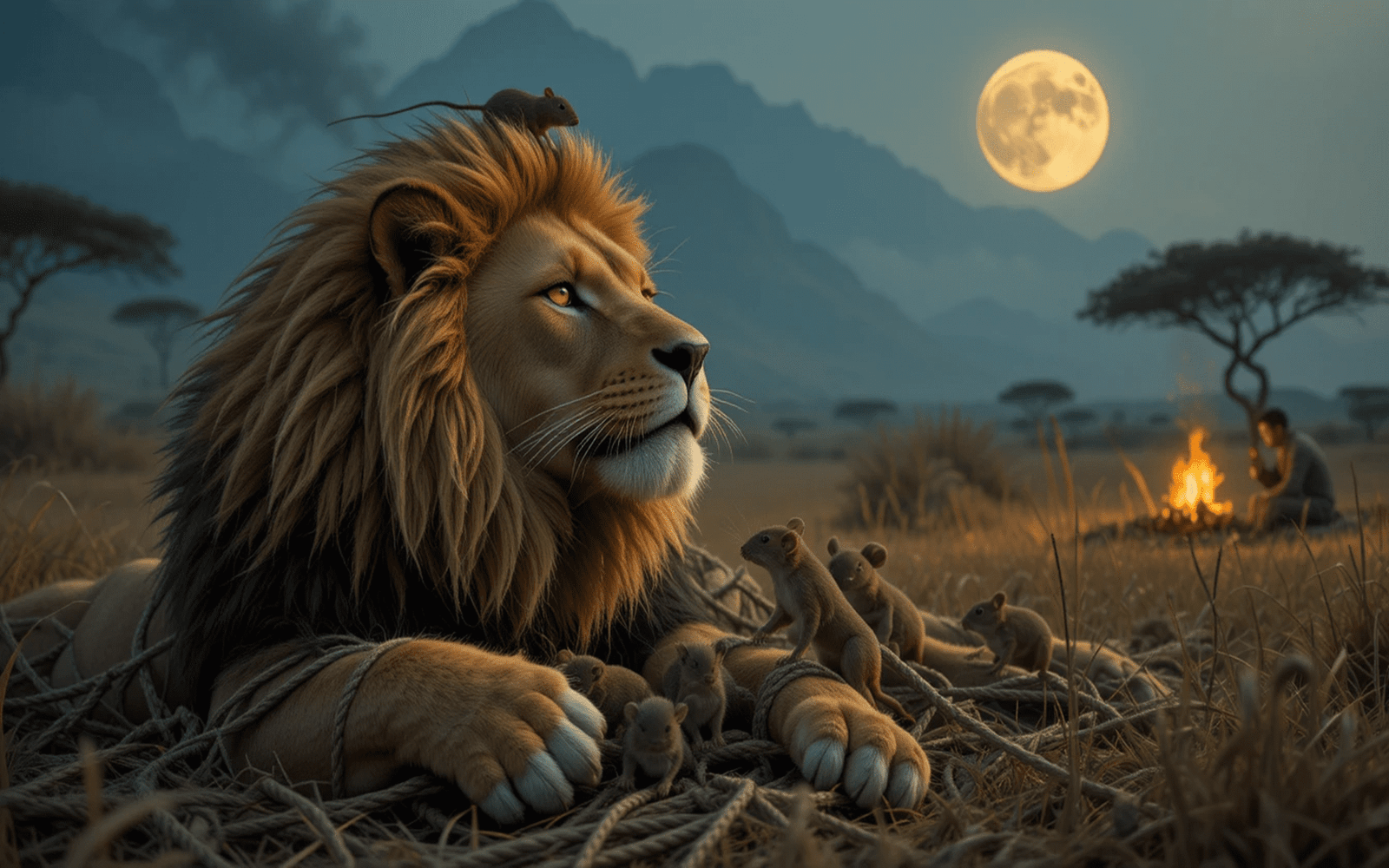
By morning the hunters, exhausted, stopped to rest, lit a fire, ate, and fell asleep. The lion, trussed and helpless, felt something crawling through his mane and itching at his fur. Fleas, he thought bitterly. What a miserable end for the king of beasts. But it wasn’t fleas. It was faster, and smaller, and it spoke. “Do you remember me?” a tiny voice said. “I heard the hunters singing your name as they passed my burrow. So I brought my children.” It was the same mouse, and now dozens of small teeth were gnawing through rope at once. The net slipped from his head. His jaws came free. Then his paws. He shook himself, and the last bindings fell away as tiny mice, strands of rope still clenched in their teeth, tumbled out of his mane. The lion rose to his feet, freed, with the hunters still asleep just feet away. He looked at the mouse and her children, creatures he could have crushed without a thought less than a day before. “Thank you,” he said. “I will never forget this.” Then he slipped into the tall grass and was gone before the hunters woke to find their catch and their rope missing. The mouse returned to her burrow with her children, and the lion returned to his pride, older, humbler, and free. Neither ever forgot the other. And from that day on, whenever the lion heard the rustle of something small in the grass, he no longer thought prey he thought maybe a friend. The smallest creature had saved the greatest. Kindness, it turned out, was never wasted it was only ever waiting to be repaid.