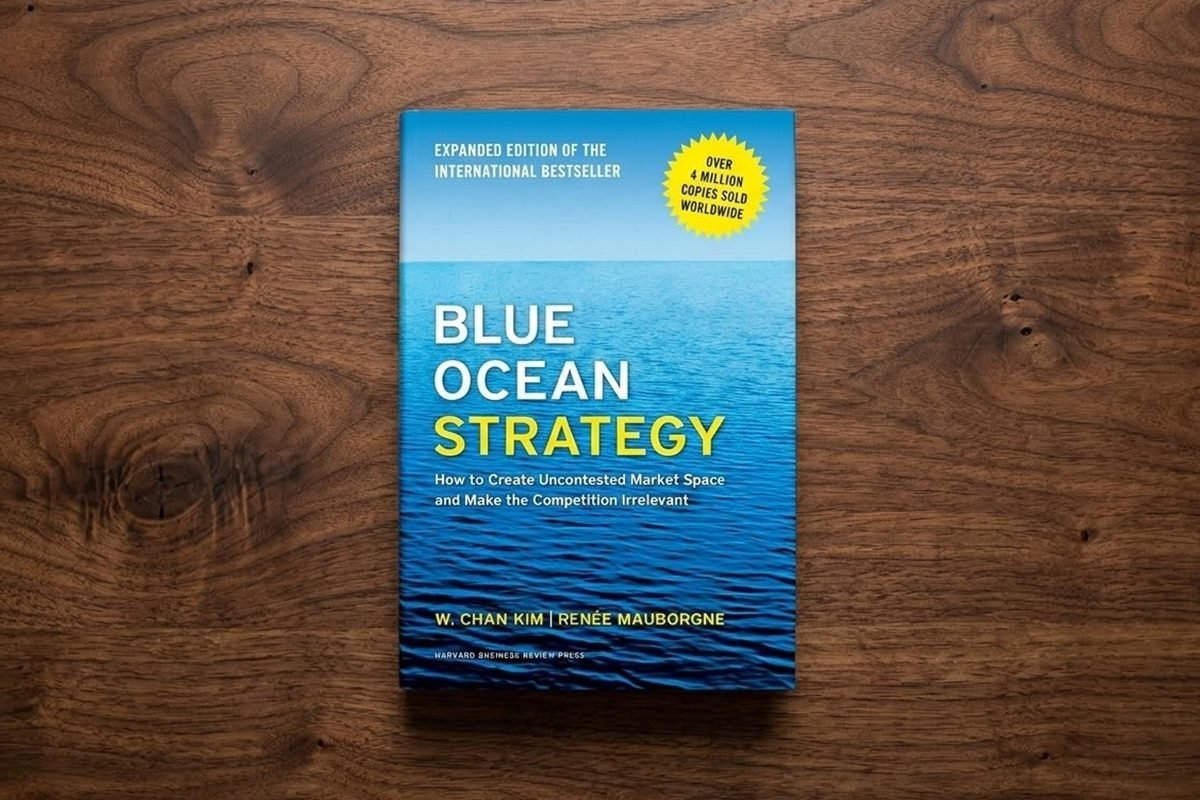
Book review: Blue Ocean Strategy
How to Create Uncontested Market Space and Make the Competition Irrelevant
By W. Chan Kim and Renée A. Mauborgne
Genres:
- Business
- Entrepreneurship
The year it was published:
2015
Number of pages:
320

As an Amazon Associate, I earn from qualifying purchases.
Table of contents:
Part I – Blue Ocean Strategy
Chapter 1: Creating Blue Oceans
Chapter 2: Analytical Tools and Frameworks
Part II – Formulating Blue Ocean Strategy
Chapter 3: Reconstruct Market Boundaries
Chapter 4: Focus on the Big Picture, Not the Numbers
Chapter 5: Reach Beyond Existing Demand
Chapter 6: Get the Strategic Sequence Right
Part III – Executing Blue Ocean Strategy
Chapter 7: Overcome Key Organizational Hurdles
Chapter 8: Build Execution into Strategy
Chapter 9: Align Value, Profit, and People Propositions
Chapter 10: Renew Blue Oceans
Chapter 11: Avoid Red Ocean Traps
Thoughts about the book:
At its core, the book Blue Ocean Strategy argues that companies should stop competing in saturated, cutthroat markets, what the authors call “Red Oceans,” and instead create entirely new market spaces, what they call “Blue Oceans,” where competition becomes irrelevant. It is a compelling and elegant idea, don’t fight over existing demand, create new demand. The concept is simple enough to grasp immediately, yet broad enough to feel new. What I appreciated most about the book is the clarity of its central framework. Kim and Mauborgne excel at distilling strategy into visual and practical tools, such as the “strategy canvas” and the “four actions framework.”I also liked the wide range of case studies that give the concept life and demonstrate how companies can redefine industries by shifting the value they offer. The writing itself is structured, methodical, and purposeful. It carries the tone of a well-crafted business school lecture, clear, organized, and focused on application. The language is accessible, though slightly more formal than conversational and readers can follow it without difficulty.
One of the things that I found a bit concerning is that the book occasionally underplays the risks, complexities, and uncertainties involved in trying to reshape a market. Not every company can simply step out of competition and invent a new space. That said, the message of the book is strong, and once you read it, it will change your mindset on how you think about competition. Instead of asking, “How do we beat our rivals?” it encourages a more creative question. “How do we make rivals irrelevant?” That shift, from competition to creation, is the book’s most important message. The thing that I loved the most about this book is that it provides a different lens through which to view business.
Who should read this book:
If you are drawn to innovation, business strategy, and discovering opportunities where others see only competition, then Blue Ocean Strategy by W. Chan Kim and Renée A. Mauborgne is essential reading. You should read it if you are interested in moving beyond crowded markets, escaping the cutthroat “Red Ocean” of competition, and creating new demand in untapped spaces. This is a book for those who want to think differently about value creation, differentiation, and growth, not by fighting rivals, but by making them irrelevant. Kim and Mauborgne are searching for principles, patterns, frameworks, and practical tools that turn abstract strategy into actionable steps, helping businesses innovate without taking unnecessary risks. This book is for leaders, entrepreneurs, and innovators who want to understand how to create lasting impact, transform industries, and rethink what is possible in business.
Summary of the book:
Chapter 1: Creating Blue Oceans
Most businesses compete relentlessly over the same customers, cutting prices, eroding profits, and producing increasingly similar products, a scenario the authors call a “Red Ocean,” where competition is so fierce it turns the water bloody. In contrast, a “Blue Ocean” is a market space you create yourself, free from competition. Here, you set the rules, attract new customers, and can achieve high profits by simultaneously creating value and lowering costs, thus eliminating what customers don’t want and offering what they do. A classic example is Cirque du Soleil. In the 1980s, the circus industry was declining, children preferred video games, animal rights protests were rising, and Ringling Bros. dominated, leaving smaller circuses to compete on low quality and price. Instead of trying to outdo existing circuses, Guy Laliberté and his team reimagined the concept entirely. They combined circus athleticism with theatrical storytelling, eliminated costly animals and celebrity clowns, and elevated performances to Broadway-level artistry with original music and themed productions. This approach appealed to adults and corporate clients willing to pay five to ten times more than a traditional circus ticket. By creating a new form of entertainment rather than competing, Cirque du Soleil made rivals irrelevant and reached revenue in under 20 years that Ringling Bros. had taken over a century to achieve.
Chapter 2: Analytical Tools and Frameworks
Most business strategy tools are designed for competing in existing markets, but the “Blue Ocean” strategy provides practical tools to help companies discover and create entirely new markets. Developed over a decade of working with real companies, these tools make the process structured and repeatable, rather than relying on luck or creativity alone. The first tool is the Strategy Canvas, a visual chart that maps the key factors companies compete on, such as price, quality, variety, or service, on the horizontal axis, with each competitor’s offering rated on the vertical axis. Plotting these ratings creates a “value curve,” showing how a company’s strategy compares and highlighting opportunities to differentiate. The second tool is the Four Actions Framework, which asks four questions: Which factors should be eliminated because they add cost but little value? Which should be reduced below industry standards because the industry overdelivers on them? Which should be raised to exceed customer expectations? And which should be created to unlock entirely new value? The third tool is the ERRC Grid (Eliminate-Reduce-Raise-Create), a simple table to capture these decisions. It forces companies to make clear choices instead of just adding features, ensuring the strategy simultaneously reduces costs and increases value.
A classic example is Yellow Tail Wine by Casella Wines. In 2000, the US wine market was crowded and complex, dominated by premium wines with intimidating labels, expert terminology, and a wide variety. Casella noticed that beer and ready-to-drink cocktails outsold wine threefold because Americans found wine confusing. They eliminated complexity, prestige imagery, and unnecessary variety, reduced price and range, raised ease of selection, and created fun, approachable wines with bold, colourful packaging. The result was phenomenal: Yellow Tail became the fastest-growing wine brand in US history, attracting new customers to the wine market, and within a decade, it was sold in over 50 countries, with millions of glasses consumed daily. This example shows how the strategy canvas, Four Actions Framework, and ERRC Grid can help companies systematically break from the competition and create new demand.
Chapter 3: Reconstruct Market Boundaries
Finding a “Blue Ocean” requires looking at your industry in entirely new ways. The authors offer the Six Paths Framework, a systematic approach to uncover opportunities competitors overlook. The first path is to look across alternative industries. Customers compare your offering not just with direct competitors, but with any solution that meets the same basic need. For example, a restaurant competes with cinemas for “a fun evening out.” Understanding why customers choose one over another lets you combine the best elements and eliminate unnecessary features. The second path is to look across strategic groups within industries. Most industries have premium, mid-range, and budget segments that rarely overlap. By studying why customers move between these groups, you can offer the key benefits of both while eliminating what doesn’t add value. The third path is to look across the chain of buyers. Companies often focus on one type of buyer, such as a purchasing manager, while the actual users have different needs. Shifting focus along the buyer chain can reveal untapped value. The fourth path is to look across complementary products and services. Products are rarely used in isolation, and pain points in the activities surrounding your offering often hide opportunities for innovation. The fifth path is to look across functional or emotional appeal. Industries tend to compete on either practicality or emotion. Moving in the opposite direction can open new markets by addressing neglected motivations. The sixth path is to look across time. Trends, be it technological, regulatory, or social, create predictable changes. Instead of reacting, blue ocean strategists anticipate the future state and develop offerings today that capture tomorrow’s demand. By applying these six perspectives, companies can systematically discover “Blue Oceans” rather than relying on luck or incremental improvement.
Chapter 4: Focus on the Big Picture, Not the Numbers
This chapter talks about how most strategic planning processes produce documents filled with numbers, spreadsheets, graphs, and jargon, but no real strategy. Teams spend too much time filling in boxes, and they never step back to ask if they are doing something truly different. The authors propose replacing the standard planning document with a visual approach, drawing a strategy canvas that forces a company to see the big picture. A good strategy has three qualities that companies need to take into account. The first is focus. Companies need a clear sense of priority, not investing in everything equally, but making deliberate choices about where to stand out. The second is divergence. A strategy curve that looks noticeably different from competitors and not just a slightly better version of the same thing. And the final quality is a compelling tagline. One sentence that captures the essence of the strategy and speaks directly to buyers.
Chapter 5: Reach Beyond Existing Demand
In this chapter, the authors talk about how many companies focus heavily on serving existing customers, refining their offerings, and targeting increasingly narrow segments. While this improves precision, it often limits growth. A blue ocean approach shifts the focus outward, toward non-customers, to uncover larger opportunities. Non-customers provide valuable insight because they highlight what the industry fails to deliver. Unlike existing customers, who have adapted to its limitations, non-customers reveal unmet needs and frustrations more clearly. Understanding why they don’t buy can expose the biggest opportunities for expansion. There are three main groups of non-customers. The first are those who reluctantly use the industry’s offerings but are ready to leave as soon as a better option appears. By addressing their frustrations, companies can retain them and attract similar users. The second group consists of those who have consciously rejected the industry, choosing alternatives or going without. Their reasons point directly to gaps in value. The third group includes people who have never considered the industry at all, often because they see it as irrelevant. With the right innovation, this group can represent a significant new source of demand. By looking beyond existing customers and understanding these three groups, companies can identify ways to unlock entirely new markets rather than competing within existing ones.
Chapter 6: Get the Strategic Sequence Right
Once a “Blue Ocean” opportunity is identified, the challenge is to ensure it is commercially viable, customers must want it, it must be priced attractively, produced profitably, and supported by stakeholders. The authors propose four sequential tests to validate this. First, the offering must deliver exceptional value. There needs to be a compelling reason for a broad group of buyers to choose it. A common mistake is creating something technologically impressive that doesn’t meaningfully improve the customer’s experience. Next comes strategic pricing. The price should attract the mass of buyers from the start, not just early adopters. This is determined by looking beyond direct competitors to alternatives and substitutes, identifying a price range that draws the widest audience. After setting the price, the focus shifts to cost. Instead of adding a margin to costs, the approach is reversed: subtract the desired profit from the price to determine the target cost, then figure out how to meet it. This can be achieved by streamlining operations, partnering with other firms, or rethinking the industry’s pricing model. Finally, organisational and external resistance must be addressed. Blue ocean strategies often disrupt the status quo, creating fear and pushback from employees, partners, regulators, and the public. Gaining their understanding and support early is essential, as even a strong strategy can fail without internal and external alignment.
Chapter 7: Overcome Key Organizational Hurdles
Even with a strong “Blue Ocean” strategy, organisations often struggle to change direction because execution and not strategy is the main challenge. Four key hurdles stand in the way, and while conventional thinking calls for more time and resources, Tipping Point Leadership focuses instead on achieving impact through targeted, high-leverage actions. A major barrier is that people don’t see the need for change, as familiar routines and acceptable results reinforce complacency. Data alone rarely shifts this mindset; direct experience is far more effective in making problems real and urgent. Another challenge is the perceived lack of resources. Rather than seeking more, organisations should reallocate existing ones by focusing on high-impact activities and cutting those with little return, while also leveraging internal resource exchanges. Motivation is also difficult, especially when people are comfortable with the status quo. Instead of trying to influence everyone, it is more effective to focus on key individuals whose behaviour shapes others, using visibility and accountability to reinforce change. Finally, internal politics can hinder progress, as some individuals support change while others resist it to protect their interests. Identifying and empowering supporters while exposing and addressing resistance is essential. Overall, Tipping Point Leadership succeeds by focusing effort on the few critical people and actions that create disproportionate impact, enabling effective change without heavy resource investment.
Chapter 8: Build Execution into Strategy
A strategy cannot simply be imposed from the top and expected to succeed. When people are excluded from the process, don’t understand the reasoning, or feel ignored, they are far more likely to resist or disengage. The authors propose “Fair Process” as a way to build trust and secure genuine commitment, even when not everyone agrees with the outcome. The key idea is that people are more willing to support decisions when they perceive the process as fair. They may accept outcomes they disagree with if they feel heard and respected, but they will resist even good decisions if the process feels unjust. Fair Process rests on three principles. First, engagement. Involve those affected by the decision, invite their input, and allow them to question assumptions. This doesn’t mean giving them decision-making power, but it ensures their perspectives are genuinely considered. Second, explanation. Once decisions are made, clearly communicate the reasoning behind them so people understand how the conclusions were reached. Third, expectation clarity. Define the new rules clearly, what goals are, who is responsible, and how performance will be measured so that there is no ambiguity that could lead to confusion or resistance. By following these principles, organisations can turn strategy execution from a source of friction into one of alignment and cooperation.
Chapter 9: Align Value, Profit, and People Propositions
In this chapter, the authors talk about how A “Blue Ocean” strategy is built on three interconnected elements that must be aligned. If one is weak or inconsistent with the others, the entire strategy is likely to fail. The first is the value proposition, which defines what is offered to buyers. It must be both clearly differentiated from alternatives and affordable enough to attract a broad market, not just a niche. The second is the profit proposition, which ensures the strategy is financially viable. The company must be able to deliver its value at a cost that allows for strong margins. The third is the people proposition, which focuses on whether employees, partners, and other stakeholders are motivated to support and execute the strategy rather than resist it. The key is that all three must work together to achieve both differentiation and low cost. When a compelling value proposition is supported by a profitable cost structure and driven by motivated people, the result is a sustainable and effective blue ocean strategy.
Chapter 10: Renew Blue Oceans
This chapter talks about how creating a “Blue Ocean” is not a one-time success. As its value becomes visible, competitors begin to imitate it, gradually turning the market “red” again. The key is to manage this cycle, knowing when to defend your position and when to innovate again. “Blue Ocean” strategies are initially hard to copy because of built-in barriers. Their strength lies in a tightly aligned system of value, profit, and people propositions, which is difficult to replicate as a whole. Competitors may also dismiss the idea at first, brands can be constrained by their existing identity, and economic factors such as network effects, scale advantages, or patents can slow imitation. Rather than constantly chasing new ideas, companies should remain in their “Blue Ocean” as long as it is clearly differentiated. By monitoring the strategy canvas, they can see whether their value curve still stands apart. If it shows focus, divergence, and a strong offering, the priority should be to strengthen and expand the current position. However, when the value curve begins to converge with competitors and loses its distinctiveness, it signals the need to create a new”Blue Ocean”. For companies managing multiple businesses, this cycle must be handled at a portfolio level. Over time, successful offerings evolve from innovative “pioneers” into more standard “migrators,” and eventually into commoditized “settlers.” A healthy portfolio continuously develops new pioneers to replace aging ones, ensuring long-term growth and renewal.
Chapter 11: Avoid Red Ocean Traps
In the last chapter, the authors, based on a decade of applying the “Blue Ocean” strategy across many organisations, share ten common misunderstandings that pull companies back into competitive “red oceans,” even when they aim to break away. A frequent mistake is focusing too much on existing customers, who typically ask for incremental improvements rather than transformative change. Real insight comes from non-customers, whose reasons for rejecting the industry reveal unmet opportunities. Another misconception is that creating a blue ocean requires moving far beyond the core business, when in reality, most successful examples build within or close to existing industries. Many also assume new technology is essential, but what matters is not the technology itself, it is whether it creates a significant leap in value for buyers. Similarly, being first to market is often overrated, success comes from getting the value proposition right, not from being first.
A critical misunderstanding is equating blue ocean strategy with either differentiation or low cost alone. Traditional differentiation focuses on being better but more expensive, while low-cost strategies compete on price. Blue ocean strategy requires both simultaneously, delivering higher value while reducing costs. Innovation alone is also insufficient, since without clear buyer value, even groundbreaking ideas can fail. Some organisations treat “Blue Ocean” strategy as a marketing tool or niche approach, when in fact it is a comprehensive strategy that must align value, profit, and people to target the mass market. Others misunderstand the role of competition, assuming it must always be fought directly. Instead, when markets become overcrowded, the goal should be to expand demand rather than compete over existing customers. Finally, a “Blue Ocean” strategy is often confused with disruption. While disruption focuses on replacing existing offerings with cheaper alternatives, the “Blue Ocean” strategy is broader as it frequently creates entirely new demand without necessarily displacing what already exists.