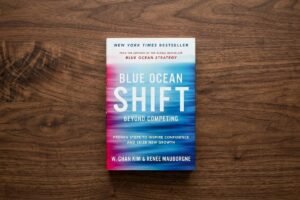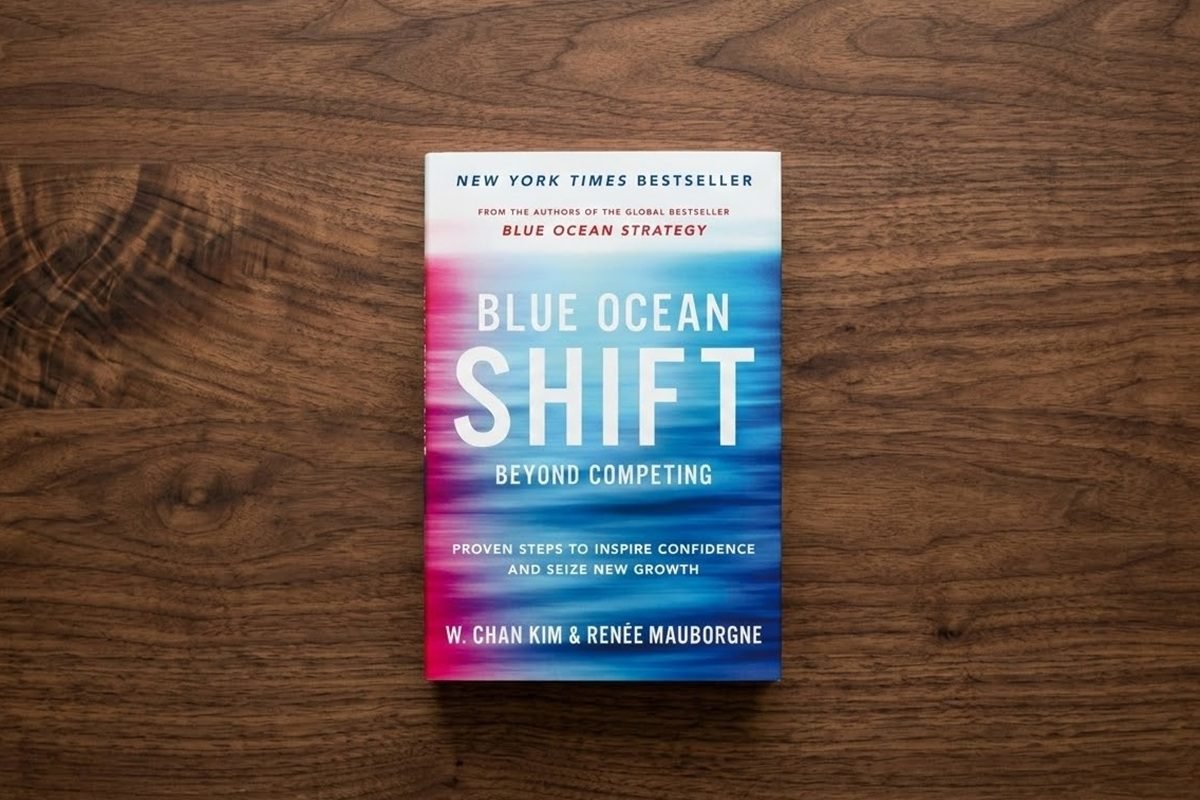
Book review: Blue Ocean Shift
Beyond Competing - Proven Steps to Inspire Confidence and Seize New Growth
By W. Chan Kim, Renée A. Mauborgne
Genres:
- Business
- Entrepreneurship
The year it was published:
2017
Number of pages:
336

As an Amazon Associate, I earn from qualifying purchases.
Table of contents:
Preface
Part I – Blue Ocean Shift
Chapter 1: Reach Beyond the Best
Chapter 2: The Fundamentals of Market-Creating Strategy
Chapter 3: The Mind of a Blue Ocean Strategist
Chapter 4: Humanness, Confidence, and Creative Competence
Part II – The Five Steps to Making a Blue Ocean Shift
Chapter 5: Choosing the Right Place to Start
Chapter 6: Constructing the Right Blue Ocean Team
Chapter 7: Getting Clear About the Current State of Play
Chapter 8: Uncovering the Hidden Pain Points That Limit the Size of Your Industry
Chapter 9: Discovering an Ocean of Noncustomers
Chapter 10: Reconstructing Market Boundaries—Systematically
Chapter 11: Developing Alternative Blue Ocean Opportunities
Chapter 12: Selecting Your Blue Ocean Move and Conducting Rapid Market Tests
Chapter 13: Finalizing and Launching Your Blue Ocean Move
Thoughts about the book:
While Blue Ocean Strategy introduced the powerful idea of creating uncontested market space, Blue Ocean Shift focuses on execution. It is less about what the concept is and more about how to actually achieve it. The authors present a structured, step-by-step process designed to help organizations move from competitive “red oceans” into new, value-creating spaces. In that sense, this book feels more practical, more grounded, and more concerned with implementation. What I appreciated most is this emphasis on process. Kim and Mauborgne clearly recognized that many readers of their earlier work were inspired but left wondering how to apply the ideas in real organizations. Here, they attempt to close that gap. The inclusion of real case studies of companies, nonprofits, and even government entities adds credibility and makes the framework feel more attainable. The human element is also more pronounced as there is greater attention to organizational resistance, internal alignment, and the psychology of change. The writing is structured, disciplined, and highly methodical. Each step builds on the previous one, with clear explanations and practical tools. In terms of readability, it is relatively easy to follow, though it requires engagement. This is not a book you skim for inspiration, it is one you work through. The frameworks, exercises, and visual tools demand attention, but they are also what make the book useful. Compared to the original, this one feels slightly more hands-on and structured, and slightly less conceptual.
Blue Ocean Shift relies heavily on case studies and observed patterns rather than rigorous empirical testing. If there is a weakness, it lies in a certain level of repetition not only within the book itself, but in relation to the original Blue Ocean Strategy. Many of the core ideas remain the same, and for readers already deeply familiar with the first book, parts of this one may feel familiar. Additionally, while the process is clearer, the inherent difficulty of creating a true “blue ocean” is still somewhat understated. Strategy, in reality, is messy, and not every organization can successfully execute such a shift. That said, Blue Ocean Shift succeeds in making an influential idea more actionable. It transforms a compelling concept into a more structured journey. It may not feel as groundbreaking as the original, but it is arguably more useful for practitioners who want to do more than just understand the theory.
Who should read this book:
You should read Blue Ocean Shift by W. Chan Kim and Renée A. Mauborgne if you are interested in how companies, teams, and even individuals can move from crowded, competitive spaces into new arenas of growth. This book is for anyone who doesn’t just want to understand strategy but wants to know how to apply it, step by step, in the real world.
Summary of the book:
Preface
The authors, W. Chan Kim and Renée Mauborgne, begin by explaining their motivation for this book, which is the belief that organisations should focus less on competing for limited demand and more on creating entirely new opportunities. They describe these opportunities as “blue oceans,” which are open market spaces with no competition. Drawing on nearly 30 years of research, they show that successful organisations don’t just rely on bold ideas or clever strategies to achieve this shift. They also ensure their people are engaged, confident, and equipped with clear processes and practical tools. The core message is that strategy alone is not enough. Like a map, it only becomes useful when people are willing and able to act on it. The book aims to provide both a clear path to creating new markets and the confidence needed to pursue them.
Chapter 1: Reach Beyond the Best
This chapter introduces the core idea of the book, which is that, instead of competing more aggressively in crowded markets, organisations should move into entirely new spaces where competition does not yet exist. Most businesses operate in “red oceans,” where rivals fight over the same customers, imitate each other, and drive prices and profits down. In contrast, “blue oceans” are untapped markets that organisations create for themselves, where competition is irrelevant and growth potential is much higher. A central concept is breaking the traditional value–cost trade-off. Conventional thinking assumes a company must choose between offering higher value at a higher cost or lower prices with reduced value. Blue ocean strategy challenges this by aiming to achieve both at once, delivering a significant leap in value while simultaneously lowering costs. This combination makes it difficult for competitors to follow. To successfully make this shift, three elements are essential. First is adopting a blue ocean perspective, which means looking beyond existing industry boundaries to spot new opportunities. Second is using practical, structured tools that help turn ideas into real market offerings. Third is recognising the human side of strategy, which is engaging people, building trust, and ensuring they feel part of the change process. Together, these elements enable organisations to move away from competition and systematically create
Chapter 2: The Fundamentals of Market-Creating Strategy
Before explaining how to create a blue ocean, the authors clarify what it really means to “create a new market.” Many assume it requires breakthrough technology, disruption, or exceptional entrepreneurial talent, but these views are incomplete. New markets can emerge through disruptive creation, where a new offering replaces an existing one, such as digital photography overtaking film or MP3 players replacing CDs. However, there is also nondisruptive creation, where entirely new demand is unlocked without displacing anything. Examples include Viagra creating a new category of lifestyle drugs, Sesame Street defining educational entertainment for children, and Grameen Bank bringing financial services to people that traditional banks had ignored. From their research, the authors identify three main ways to create new markets: solving an existing problem in a breakthrough way (often disruptive), redefining the problem itself, or addressing a completely new problem (nondisruptive). A key insight is that market creation is driven by value innovation, not technology alone. Technology only matters when it meaningfully improves people’s lives. Companies like Apple succeeded not by inventing new technology, but by making it accessible and useful, while technically impressive products like the Segway failed because they lacked clear buyer value. The authors emphasise that creating new markets is not limited to visionary founders or startups. With the right tools and mindset, it is a systematic process that managers in any organisation can apply.
Chapter 3: The Mind of a Blue Ocean Strategist
This chapter explains that blue ocean strategists don’t succeed by being more creative, but by thinking differently and questioning the basic assumptions of their industry. Instead of accepting industry conditions as fixed, they see them as changeable. Most managers treat competition, customer expectations, and industry rules as given, but blue ocean thinkers recognise these are shaped by past decisions and can be redefined. Companies like Ford Motor Company and Apple didn’t just compete within existing boundaries, they reshaped them and created new markets. Rather than trying to outperform competitors, they aim to make competition irrelevant. Focusing on competitive advantage leads to benchmarking and incremental improvements, while blue ocean thinking shifts the question to how to create such compelling value that customers are naturally drawn to it. This moves the focus away from rivals and toward unlocking entirely new demand. A key part of this mindset is looking beyond existing customers. Most organisations concentrate on satisfying current buyers, but the greatest opportunities lie with non-customers, those who have rejected or never considered the industry. Their unmet needs reveal where new value can be created. Finally, blue ocean strategists reject the traditional trade-off between value and cost. Instead of choosing between differentiation and low price, they pursue both at the same time by eliminating and reducing what doesn’t matter to customers while investing in what truly does. This shift in thinking allows organisations to break out of competition and create new market space.
Chapter 4: Humanness, Confidence, and Creative Competence
This chapter explains why most change efforts fail. The simple truth is that they overlook the human side. Organisations often separate strategy from execution, with leaders designing plans and others expected to implement them. Without involvement or ownership, people disengage, and traditional motivators like incentives or pressure rarely create real commitment. Blue ocean shift takes a different approach by centering on humanness, treating people as individuals with fears, aspirations, and a need for respect. When these human factors are acknowledged, people are more willing to take risks, contribute ideas, and support change. A key principle is atomization, breaking a large, intimidating goal into small, manageable steps. Each step feels achievable, building momentum and confidence over time. Alongside this is firsthand discovery, where people experience problems directly through customer interactions and real-world observation rather than being told what to think. This makes the need for change more convincing and personal. The chapter also reinforces fair process, ensuring people feel respected through involvement, clear explanations, and well-defined expectations. When people trust the process, they are far more likely to support the outcome, even if it’s not their preferred one. Ultimately, the goal is to build creative competence, which is a combination of confidence and practical know-how. By developing both together, the blue ocean process enables people not just to understand change, but to actively drive it.
Chapter 5: Choosing the Right Place to Start
Before launching a blue ocean initiative, organisations must decide where to focus. This is a critical step, especially when managing multiple products or services. This chapter introduces a simple visual tool to guide that decision. The Pioneer–Migrator–Settler Map categorises offerings based on their value and growth potential. Pioneers deliver a clear leap in value and inspire strong customer loyalty, making them future growth engines. Migrators offer improvements over competitors but remain comparable, competing on better quality or service. Settlers are largely indistinguishable from alternatives, competing mainly on price with limited growth prospects. By mapping offerings and sizing them by revenue, companies can see not just where they are today, but where their future is headed. This perspective highlights why the current market share can be misleading. A dominant product may actually be a declining “settler,” while a small, innovative offering could represent the company’s future. The goal is to shift focus from present performance to long-term potential.
Chapter 6: Constructing the Right Blue Ocean Team
In this chapter, the authors talk about the importance of who you put on a blue ocean team. This choice is critical because the team not only develops the strategy but also builds the organisational support needed to execute it. The team should be cross-functional, including representatives from all key areas involved in delivering the offering, such as marketing, finance, operations, and frontline roles. This ensures diverse perspectives are considered and prevents other departments from feeling excluded or resisting later. An effective team is typically small, around 10–15 people, yet still large enough to cover essential viewpoints, but small enough to stay agile and focused. It’s also important to include a small number of skeptics. While they may challenge ideas, their involvement strengthens the process, and if they become convinced, they can turn into strong advocates for the change. Leadership matters as well. The team should be led by a senior figure with enough authority to guide decisions and ensure alignment. In more political organisations, it’s also valuable to have a trusted insider who understands internal dynamics and can help navigate resistance and secure support behind the scenes. Overall, the goal is to build a team that combines credibility, diversity, and influence so it can both create a strong strategy and drive its acceptance across the organisation.
Chapter 7: Getting Clear About the Current State of Play
Before defining a future strategy, organisations need a clear and shared understanding of their current position. This chapter introduces the Strategy Canvas, the central tool of the blue ocean shift process. The strategy canvas is a simple visual map of an industry. It shows the key factors companies compete on, how much each competitor invests in those factors, and how your own offering compares. When plotted, it creates a “strategic profile” that reflects how buyers actually experience your offering. What makes the canvas powerful is what it reveals. In most cases, teams discover that competitors’ profiles look almost identical, differing only slightly in degree. This visualisation exposes how much of the industry is stuck in “me-too” competition and often creates a stronger realisation than any analysis or presentation. A strong blue ocean profile stands out in three ways: it clearly diverges from the industry norm, it is focused rather than trying to excel at everything, and it can be captured in a simple, compelling tagline that reflects its unique value. The process of building the canvas is just as important as the result. Team members first map their views individually, then compare and discuss them as a group. This often uncovers internal misalignment and forces a shared understanding of the current strategy, an essential foundation for creating something new.
Chapter 8: Uncovering the Hidden Pain Points That Limit the Size of Your Industry
Industries often create hidden pain points that frustrate customers and keep many potential buyers away. This chapter introduces the Buyer Utility Map, a tool for systematically uncovering these obstacles and identifying opportunities for new value. Pain points are aspects of a product or service that customers tolerate but don’t want, so normalized that they may not even complain. For example, buying wine can be confusing due to thousands of labels, the need for a corkscrew, and the fear of choosing the wrong bottle. The Buyer Utility Map is a grid with two axes, the six stages of the buyer experience (Purchase, Delivery, Use, Supplements, Maintenance, Disposal) and six utility levers (Productivity, Simplicity, Convenience, Risk Reduction, Fun & Image, Environmental Friendliness). This creates 36 “utility spaces.” Teams explore each space by asking, “What is the biggest obstacle to value here?” Most industries address only a few of these spaces, leaving many untapped opportunities for creating blue oceans. The most effective way to use the map is firsthand discovery. Teams experience the product or service as a customer does rather than theorizing in a meeting. For example, a pharmacy executive team spent a day following a customer treating a sore throat, uncovering insights that transformed their understanding of the buyer experience and revealed new opportunities for innovation.
Chapter 9: Discovering an Ocean of Noncustomers
Blue ocean strategy flips the usual mantra of “customer first” to “noncustomer first.” The people who don’t buy from your industry and why is that offer the richest clues for creating new growth. The authors identify three tiers of non-customers. First-tier (soon-to-be) are reluctant users who tolerate the industry only because they must; they’ll switch immediately if a better option appears. Second-tier (refusing) have actively evaluated the industry and rejected it, often due to price, complexity, or poor experience. Third-tier (unexplored) have never considered the industry relevant to them. Noncustomers matter more than existing customers. While customers show how to improve what you already offer, noncustomers reveal what the industry is missing and where entirely new demand can be created.
Chapter 10: Reconstructing Market Boundaries—Systematically
In the research phase of a blue ocean journey, teams go into the real world with structured lenses to uncover opportunities that competitors overlook. The Six Paths Framework challenges conventional boundaries such as industry, strategic group, buyer group, scope of the offering, functional versus emotional appeal, and time, helping teams see the market in entirely new ways. Teams explore what other industries solve the same problem and why buyers choose alternatives, revealing what the industry should focus on or eliminate. They examine different groups within the industry, like budget versus premium segments, to uncover unmet needs that no single group fully addresses. Shifting attention across the chain of buyers, including users, purchasers, and influencers, can reveal overlooked sources of value. They also consider complementary products and services, identifying frustrations that occur before, during, or after use, such as how Philips addressed lime scale for kettle users. Rethinking functional versus emotional appeal can unlock demand by adding emotional resonance to a functional offering or simplifying an emotional one. Finally, anticipating external trends allows teams to design offerings for what buyers will value in the future, as Netflix did by building its streaming model before broadband was widespread. By systematically applying these perspectives, organizations uncover blue ocean opportunities that standard competitive analysis completely misses.
Chapter 11: Developing Alternative Blue Ocean Opportunities
In this chapter, the authors share what happens after the fieldwork and interviews are done. After all that research, teams turn raw market insights into concrete strategic options using the Four Actions Framework and the ERRC Grid. The framework asks which industry factors should be eliminated because they add cost but little value, which should be reduced below the standard because the industry over-delivers, which should be raised well above the norm because buyers currently compromise, and which should be created entirely to offer new sources of value. The ERRC Grid organizes these four actions into a simple diagram, ensuring the team considers elimination and reduction alongside raising and creating. Teams typically generate up to six strategic options, one per path from prior research, with two or three emerging as genuinely compelling blue ocean opportunities. This process ensures all possibilities are explored before selecting the most promising strategies.
Chapter 12: Selecting Your Blue Ocean Move and Conducting Rapid Market Tests
The team now has up to six blue ocean options. This chapter explains how to choose the best one — and how to do it in a way that builds maximum buy-in, surfaces hidden concerns, and creates a groundswell of organizational commitment to execution. Each option is presented briefly with a tagline, the proposed Strategy Canvas, the ERRC Grid, a summary of buyer benefits, and the expected economic impact. Attendees circulate, ask questions, provide feedback, and vote. Executives then deliberate and publicly explain their decision. After the event, the chosen option is rapidly tested with real buyers using a rough prototype. The goal is to confirm assumptions and refine the offering quickly and inexpensively, not to achieve perfection on the first try.
Chapter 13: Finalizing and Launching Your Blue Ocean Move
Once the blue ocean move is chosen and tested, the focus shifts to building the economic logic and launching in a way that maximizes success while minimizing risk. The big-picture business model shows how the value offered to buyers and the organization’s cost structure work together to generate profitable growth, providing overarching economic logic without getting lost in operational detail. Instead of cost-plus pricing, teams use target costing (price-minus costing), setting the strategic price buyers will pay and working backward to the target cost. This encourages creative ways to deliver value affordably. Organizations can hit challenging cost targets by partnering with others who already have needed capabilities, streamlining and innovating operations, or empowering frontline staff to maximize their impact. The launch follows a “start small, then go fast” approach. Pilot in one or two locations, resolve glitches, and then scale rapidly.