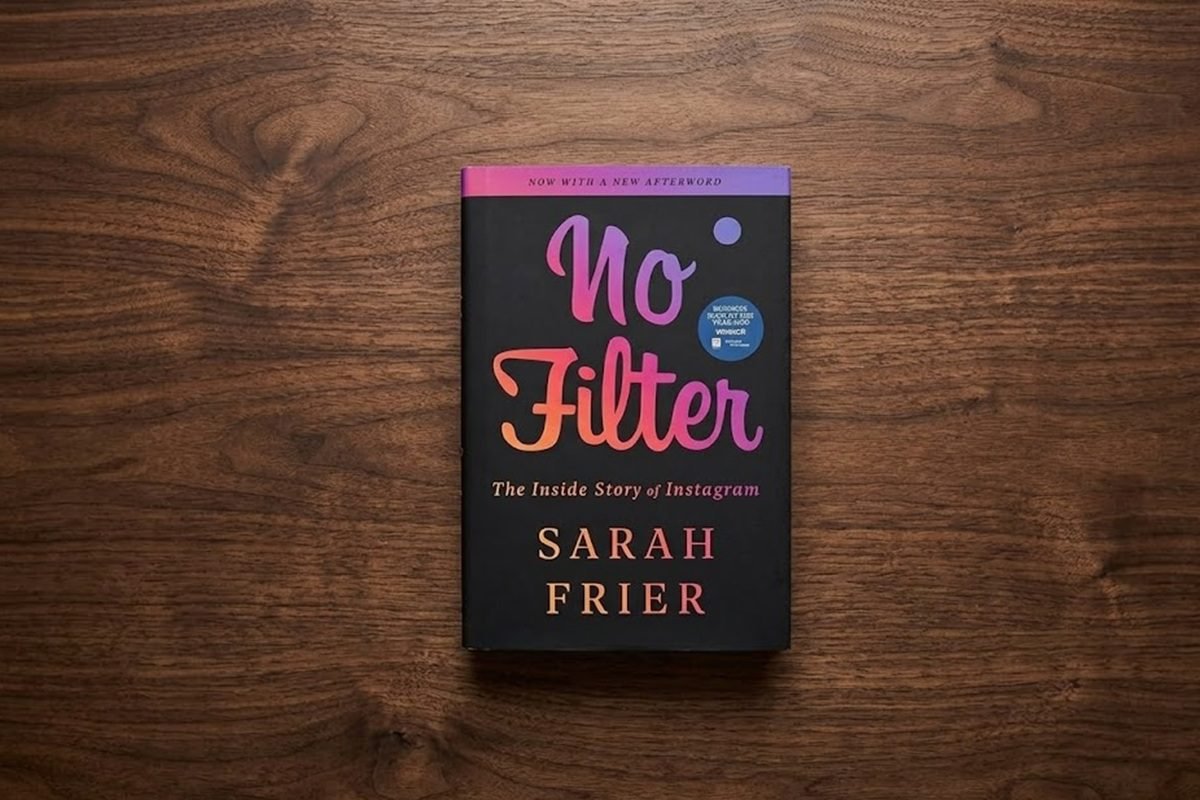
Book review: No Filter
The Inside Story of Instagram
By Sarah Frier
Genres:
- Entrepreneurship
- Business
The year it was published:
2020
Number of pages:
352

As an Amazon Associate, I earn from qualifying purchases.
Table of contents:
Introduction: The Ultimate Influencer
Chapter 1: Project Codename
Chapter 2: The Chaos of Success
Chapter 3: The Surprise
Chapter 4: The Summer in Limbo
Chapter 5: Move Fast and Break Things
Chapter 6: Domination
Chapter 7: The New Celebrity
Chapter 8: The Pursuit of the Insta-Worthy
Chapter 9: The Snapchat Problem
Chapter 10: Cannibalization
Chapter 11: The Other Fake News
Chapter 12: The CEO
Epilogue: The Price of the Acquisition
Thoughts about the book:
No Filter is a story about the rise of Instagram, but more importantly, it is a story about tension between creativity and scale, idealism and monetization, independence and corporate control. The narrative arc follows Instagram’s founders, Kevin Systrom and Mike Krieger, from the app’s early days through its acquisition by Facebook and the gradual shifts that followed. What emerges is not just a company history, but a study of how products evolve once they become part of something larger. What I liked most about the book is its reporting. Frier’s access to sources and her ability to reconstruct internal dynamics give the story credibility and depth. The behind-the-scenes details, product decisions, leadership conflicts, and cultural clashes are where the book truly comes alive. The portrayal of the relationship between Instagram and Facebook is particularly compelling, revealing how strategic priorities can reshape a platform’s identity over time. The writing style is clear, fluid, and narrative-driven. Frier writes like a seasoned journalist, balancing storytelling with factual detail. You do not need prior knowledge of the tech industry to follow the story, though familiarity with the platforms adds an extra layer of appreciation. No Filter succeeds in capturing the human story behind a global platform. It reminds the reader that behind every app are individuals making decisions often imperfectly, often under pressure, that shape how millions of people interact with the world.
Who should read this book:
If you’ve ever wondered how a simple photo-sharing app grew into one of the most powerful cultural and business forces of our time, then No Filter by Sarah Frier is a book that will give you a glimpse behind the scenes. This is a book for readers who are searching to understand the intersection of technology, power, and human behavior. It will resonate with those interested in startups, social media, innovation, and the unseen decisions that shape the platforms we use every day. But it is equally compelling for anyone curious about influence and how digital environments quietly reshape identity, status, and connection. Frier is searching for the real story behind Instagram’s rise. Her interest lies not just in the product, but in the people, tensions, and trade-offs that defined it, from its founders to its acquisition by Meta Platforms. What this book offers is perspective. It helps you see social media not as a neutral tool, but as something shaped by incentives, leadership decisions, and competing visions. You begin to understand why the platform looks and feels the way it does and what was gained and lost along the way.
Summary of the book:
Introduction: The Ultimate Influencer
The book opens with a scene in São Paulo, where crowds gather in Beco do Batman, a street art alley that has become famous less for the art itself and more for the photos people take there. Visitors even pay for photographers to capture the perfect Instagram shot, showing how the app has reshaped not just online behavior but real-world spaces. Sarah Frier uses this example to introduce a broader point, more than a billion people now use Instagram to document their lives, often experiencing moments through their phones in search of likes, comments, and followers. She argues that Instagram was one of the first platforms to fully tap into this dynamic, turning everyday experiences into content and attention into a kind of currency. The app’s internal decisions on what users see, how success is measured, and which features are prioritized have had far-reaching effects on culture and the economy. This influence is clear in cases like Kylie Jenner’s 2015 lip kit launch, where a single Instagram post led to an instant sellout and helped build a massive business, highlighting how visibility on the platform can translate directly into financial success. At the same time, the introduction sets up a central tension: Instagram’s founders, Kevin Systrom and Mike Krieger, sold the company to Facebook in 2012 with the hope of maintaining independence. Over the next six years, that independence gradually eroded, ultimately leading to their departure in 2018 and raising questions about control, growth, and the true cost of the platform’s global influence.
Chapter 1: Project Codename
Chapter 1 follows Kevin Systrom’s path to building Instagram, starting with a chance encounter with Mark Zuckerberg in 2005, when Systrom turned down an early opportunity to work on Facebook photos. Instead, he studied in Florence, where a photography teacher took away his high-end camera and gave him a cheap Holga that produced blurry, square images. That experience shaped a key idea behind Instagram: imperfection can be appealing, and simple tools can still create something people love. After uninspiring time at Google and a stint at the startup Nextstop, Systrom built a side project called Burbn, a cluttered location-based app that never quite caught on. Around this time, he had already seen how startups can reinvent themselves when he interned at Odeo and watched Jack Dorsey help pivot the company into what became Twitter, showing that abandoning an original idea can be the smartest move. When Systrom teamed up with Mike Krieger, a skilled engineer, they took a hard look at Burbn and realized the only feature people really cared about was sharing photos. They stripped everything else away and focused on making that one experience simple and compelling. That focus carried through to the earliest moments of the app, including Systrom’s first test photo taken on vacation in Mexico a casual shot of a dog by a taco stand, filtered to look better than it really was. It captured the essence of what Instagram would become, ordinary moments, enhanced and shared. When they launched the app in October 2010, growth was immediate, helped in part by early supporters like Jack Dorsey, who invested in the company, became hooked on using it, and promoted it to his large Twitter following. Within days, tens of thousands joined; within weeks, it was clear they had built something people didn’t just use, but wanted to keep coming back to.
Chapter 2: The Chaos of Success
Chapter 2 shows how quickly Instagram’s early success turned into chaos. When the app launched in October 2010 and users flooded in, Systrom and Krieger weren’t ready. With just one server struggling to keep up, the app crashed constantly, and Mike Krieger had to carry his laptop everywhere to fix problems in real time. The team was tiny, working out of a makeshift space in San Francisco, living on cheap food and figuring things out as they went. In the middle of that scramble, they made a few key decisions that shaped Instagram’s identity. They handpicked “suggested users” to influence what the community would look like, organized real-world meetups to turn the app into a social movement, and allowed brands like Pepsi and Starbucks to join early, laying the groundwork for future advertising. At the same time, contributors like photographer Cole Rise helped define the app’s visual style by creating filters such as Amaro, Hudson, and Sutro, reinforcing the idea that simple edits could transform ordinary photos into something compelling. This period also marked the start of Instagram’s relationship with influence and advertising, even before anyone fully understood it. Early adopters like Snoop Dogg posted content that blurred the line between personal sharing and promotion, such as a photo featuring Colt 45 that may or may not have been sponsored. There were no clear rules yet, but it hinted at what Instagram would become a place where attention, creativity, and commerce would increasingly overlap, often in ways no one had planned for.
Chapter 3: The Surprise
Chapter 3 captures the shock of Instagram’s $1 billion acquisition in April 2012, when its 13 employees showed up to work and learned that Mark Zuckerberg had agreed to buy the company. The deal came together over a single weekend after Zuckerberg, increasingly worried about Instagram’s rapid growth, called Kevin Systrom with a simple offer, he would pay double the company’s recent valuation. Negotiations unfolded at Zuckerberg’s home, informal and intense, and hinged on one key promise that Instagram would remain independent within Facebook. That promise helped seal the deal, especially as other potential buyers like Twitter hovered in the background. Systrom kept those conversations at a distance, but the fallout was personal. Jack Dorsey, who had invested early in Instagram and helped promote it, felt blindsided by the sale to Facebook and cut ties, highlighting how high the stakes had become in the competition between platforms. Inside Facebook, the rivalry was just as clear, its engineers had already built a competing app designed to replace Instagram if an acquisition failed, underscoring how seriously Zuckerberg viewed the threat. When the deal closed, Instagram’s small team entered Facebook’s massive campus to applause, fully aware of the scale of what had just happened. Yet the moment was oddly understated, they ended up celebrating at a Cheesecake Factory, a low-key and almost surreal ending to one of the biggest tech acquisitions ever. Beneath the excitement, though, the chapter hints at what’s to come: Instagram had secured resources and protection, but its independence now depended entirely on whether Facebook would keep its word.
Chapter 4: The Summer in Limbo
Chapter 4 follows the uneasy months after the acquisition announcement, when Instagram was stuck waiting for regulators in the U.S. and Europe to approve the deal. During this period, the team couldn’t fully operate independently or tap into Facebook’s resources, leaving them in a strange standstill. At the same time, tensions grew internally as the financial reality of the deal became clear, while Kevin Systrom and Mike Krieger walked away with enormous payouts, many early employees had too little vested equity to benefit in a meaningful way, leading to frustration and a sense of unfairness that surfaced in direct confrontations. Outside the company, the situation was just as unstable. Facebook was preparing for its massive IPO, but when the stock price quickly dropped, the value of Instagram’s billion-dollar sale, partly paid in Facebook shares, fell with it. Despite the scale of the deal, regulators approved it with little resistance, largely because they didn’t see Instagram as a true competitor to Facebook, a decision that would later be widely criticized as short-sighted. Meanwhile, the day-to-day reality of running Instagram exposed how fragile the company still was. When an Amazon Web Services outage took the app offline, the small engineering team had to scramble from wherever they were, vacations, family events, to rebuild and restore service, highlighting how badly they needed the infrastructure Facebook could provide. Yet even in this uncertain period, Instagram’s original vision still showed through in moments like the discovery of a teacher in North Korea using the app to share small glimpses of everyday life, quietly connecting people across political boundaries. These contrasting experiences captured the company at a turning point, caught between its idealistic beginnings and the growing pressures of scale, money, and corporate control.
Chapter 5: Move Fast and Break Things
Chapter 5 explores what happened when Instagram finally joined Facebook’s campus and had to adapt to a completely different way of operating. The contrast was immediate. Instagram had been built around simplicity, creativity, and a careful user experience, while Facebook focused on rapid growth, constant experimentation, and aggressive data-driven tactics. Instagram’s team began learning how Facebook scaled its products through notifications, frictionless sign-ups, and detailed tracking of user behavior but they were uneasy with some of these methods, especially when they felt intrusive or at odds with the app’s tone. This tension showed up in everyday decisions. Instagram resisted features that might annoy users, like extra notification emails, and pushed back against pressure to prioritize growth at all costs. At the same time, Facebook teams openly treated Instagram as both an asset and a threat, with internal projects already built to compete with it if necessary. To stay grounded, Instagram’s early employees tried to define their own principles, focusing on community, simplicity, and creativity even as they were increasingly expected to justify decisions in terms of metrics and growth. The clash became public during Instagram’s first major crisis, when updated terms of service written with Facebook’s legal approach made it seem like user photos could be sold for advertising. The backlash was immediate, with users and celebrities threatening to leave and the hashtag #deleteinstagram spreading quickly. Systrom was forced to respond with a public apology and reverse the changes, realizing that Instagram’s users saw the platform not just as a utility, but as a creative space they cared deeply about. The episode made clear that integrating with Facebook would not just be a technical challenge, but a cultural one, with ongoing trade-offs between growth and trust.
Chapter 6: Domination
Chapter 6 shows how Instagram moved from survival mode to outright dominance by facing down serious competition and moving quickly when it mattered. The biggest threat came from Snapchat, which positioned itself as the opposite of Instagram, casual instead of polished, temporary instead of permanent. As Snapchat’s popularity surged, Mark Zuckerberg first tried to copy it with an app called Poke and then attempted to buy the company for $3 billion. When Snapchat’s founders refused, even after being warned they could be crushed, Facebook’s effort backfired, Poke briefly topped the App Store before disappearing, while Snapchat kept growing. That moment made it clear Instagram had to respond fast. The team rallied to launch a video in just six weeks, adding 15-second clips that fit naturally into the app. This move didn’t just keep Instagram competitive, it effectively wiped out Vine, Twitter’s video platform, as creators quickly shifted their audiences to Instagram, recognizing where the momentum was going. The episode showed how Instagram could combine its design focus with Facebook’s speed when under pressure. At the same time, Facebook was making even bigger strategic bets, including its $19 billion acquisition of WhatsApp. Kevin Systrom played a role in reassuring WhatsApp’s founders that Facebook would respect their independence and values, especially their stance against ads and data collection. But just like with Instagram, those promises would later come under strain, and WhatsApp’s founders eventually left, frustrated by Facebook’s push to monetize. Together, these stories highlight a pattern: Facebook and Instagram were willing to compete aggressively, copy when necessary, and acquire when possible, steadily consolidating power across the social media landscape.
Chapter 7: The New Celebrity
Chapter 7 traces how Instagram evolved from a photography app into the center of modern celebrity culture, largely through the efforts of Charles Porch, a former music executive who focused on convincing high-profile figures to join the platform. His core idea was that Instagram gave celebrities something traditional media couldn’t, direct control over their image, without relying on paparazzi or press coverage. He and his team aggressively recruited stars across entertainment, sports, and fashion, reshaping Instagram into a place where fame itself began to live. This shift became especially clear with the rise of the Kardashian-Jenner family, who used Instagram as both a publicity tool and a business engine. Building on earlier patterns of carefully managed public image seen in figures like Paris Hilton, Kim Kardashian, and later Kylie Jenner, they turned Instagram presence into massive commercial success, including billion-dollar business ventures driven almost entirely by online attention. At the same time, the platform also created unexpected stars outside traditional celebrity circles, such as Courtney Dasher, whose dog Tuna became an internet sensation after being featured by Instagram’s community team, ultimately transforming her personal life and career. By the mid-2010s, Instagram had overtaken Twitter in total users, even as Twitter still shaped real-time news and conversation. The platform’s influence was also being formally recognized by the culture industry, as seen when Vogue’s September issue featured “Instagirls,” models chosen partly for their Instagram followings. Around the same time, Instagram began shaping celebrity culture more deliberately, including curated photo opportunities at major events like the Oscars. Together, these developments marked a turning point, Instagram was no longer just reflecting fame, but actively defining who became famous and how that fame was built.
Chapter 8: The Pursuit of the Insta-Worthy
Chapter 8 focuses on a growing tension inside Instagram, as the platform became more polished and influential, ordinary users began to feel like they couldn’t keep up. By 2015, posts were increasingly curated, edited, and performance-driven, shaped by celebrities and influencers who set unrealistic standards for what “good” content should look like. As a result, regular users often posted less or felt pressure to present idealized versions of their lives. Instagram’s leadership wanted the platform to remain beautiful and aspirational, but it was becoming clear that this vision didn’t always match how people actually used it. Inside the company, this led to a series of product and policy shifts aimed at broadening participation. Instagram introduced features like the algorithmic feed and support for rectangular photos, and debated how far it should go in prioritizing quality over everyday expression. At the same time, internal research revealed uncomfortable truths about user behavior. In “Third Thursday Teens” sessions, executives observed teenagers managing multiple accounts, including private “finstas” where they could be more authentic, while carefully curating their public profiles. Many were also deleting posts that didn’t get enough likes, showing how deeply the app was affecting self-image and social behavior. These pressures played out publicly in different ways. When Miley Cyrus considered leaving Instagram over bullying and negative comments, the company worked with her instead, turning her concern into a joint campaign supporting her Happy Hippie Foundation and reframing her influence in a more positive direction. Around the same time, Instagram helped Kylie Jenner respond to criticism about beauty standards by supporting a campaign that highlighted body-image stories from others, turning a potential backlash into a message about self-acceptance. At the same time, the platform was quietly reshaping entire industries. Early influencers like Paige Hathaway, who documented her fitness journey from a modest background, gained millions of followers and attracted brand deals that turned personal content into full-scale businesses. These cases showed both sides of Instagram’s power, it could amplify voices and create opportunities, but it was also accelerating a culture where visibility, appearance, and validation increasingly defined value.
Chapter 9: The Snapchat Problem
Chapter 9 describes Instagram’s growing crisis as Snapchat emerged as its most serious competitor. Snapchat’s “Stories” feature disappearing photos and videos arranged in a simple feed, offered something Instagram didn’t, a way to share everyday moments without pressure, permanence, or perfection. It directly challenged Instagram’s identity, and internally sparked a heated debate about whether copying it was necessary or beneath the company. Kevin Systrom initially resisted the idea, seeing it as a departure from Instagram’s principles and a sign of imitation rather than innovation. While he hesitated, some engineers quietly built early prototypes of a Stories-like feature, frustrated that the company was falling behind. At the same time, Snapchat’s leadership, especially Evan Spiegel, framed their product as fundamentally different from Facebook and Instagram, dismissing them as platforms for older users and doubling down on disappearing content and minimal data use. The turning point came when Systrom attended major cultural events like the Oscars and noticed a clear shift: celebrities were still posting on Instagram, but directing audiences to Snapchat for real-time, behind-the-scenes moments. That realization made it clear Instagram was losing something central to its relevance. He quickly reversed his position, called an emergency meeting, and committed to building Stories. The team moved fast, and in 2016, they launched it across Instagram’s entire user base at once, in what they internally treated as a high-risk, all-in rollout. The decision was reinforced by internal momentum that had already been building, including a secretly developed prototype created by frustrated employees that closely resembled the final product. Around the same time, Instagram also felt the impact of losing key talent to Snapchat, including trusted advisor Emily White, whose departure signaled that Snapchat was no longer a fringe competitor but a serious threat. Together, these moments pushed Instagram to make one of its most important strategic decisions: not to stay distinct from Snapchat, but to absorb what made it successful and bring it into Instagram itself.
Chapter 10: Cannibalization
Chapter 10 shows Instagram at its peak success while Facebook was dealing with a growing crisis. After the 2016 U.S. election, Facebook faced intense scrutiny over misinformation, foreign interference, and the ways its advertising system had been exploited. Instagram, by contrast, remained largely untouched by the controversy. It was seen by many users as a lighter, more visual escape from Facebook’s political and argumentative atmosphere, and many didn’t even realize the two platforms were owned by the same company. Behind the scenes, however, Mark Zuckerberg began to worry that Instagram’s rapid growth was coming at Facebook’s expense a problem he referred to as “cannibalization.” A formal review reinforced that concern, leading to a series of internal decisions designed to slow Instagram’s independence and reconnect its growth to Facebook. Features that had quietly helped Instagram expand like Facebook-powered friend suggestions and prominent cross-promotion, were reduced or removed, and Instagram was required to send more users back toward Facebook. These changes had an immediate impact, slowing Instagram’s growth and forcing the team to adopt more aggressive tactics they had previously avoided, such as increased notifications and broader account recommendations. In trying to compensate, Instagram gradually began to resemble the very system it had once tried to distance itself from. At the same time, external scrutiny revealed that Instagram had not escaped the darker dynamics affecting Facebook. Investigations showed that Russian influence operations had actually been highly effective on Instagram, where large followings were built around misleading political content and targeted messaging. Although Instagram avoided the worst of the public backlash, the findings made it clear that it was not insulated from the same vulnerabilities. Together, these developments marked a turning point, Instagram was no longer just a successful app inside Facebook’s ecosystem, but a product whose growth and independence were increasingly seen as a strategic risk by its parent company.
Chapter 11: The Other Fake News
Chapter 11 looks at how Instagram’s core design, likes, followers, and comments created powerful incentives that shaped behavior far beyond what its creators intended. When Instagram adjusted its feed in 2016 to prioritize posts from close relationships over chronological order, it didn’t just change what people saw, it reshaped how people posted, what they valued, and how attention was distributed across the platform. Over time, this system helped fuel a large influencer economy, along with practices like fake followers and engagement groups designed to game visibility. As the platform matured, it became clear that Instagram wasn’t just reflecting culture, it was actively distorting it in some cases. The most extreme example was the Fyre Festival, a luxury music event promoted almost entirely through Instagram influencers. Carefully staged posts from models and celebrities created an image of exclusivity and paradise, convincing thousands of people to pay for expensive tickets. When attendees arrived, they found chaos instead of luxury, making the event one of the most infamous examples of how Instagram could turn marketing into a convincing illusion. Other cases show the same dynamics at a smaller scale. Influencers like Camille Demyttenaere and Jean Hocke built viral content through highly staged “authentic” moments, such as a dramatic train-side kiss that was carefully planned, filmed, and edited to look spontaneous. The attention it generated translated directly into followers and sponsorships, reinforcing a cycle where risk and spectacle were rewarded. At the same time, entire businesses were being built around Instagram-native behavior. Brands like Glossier used the platform not just as a marketing channel but as their foundation, relying on real users, shareable aesthetics, and community-driven content instead of traditional advertising. These examples show how Instagram’s system didn’t just influence individual behavior, it helped create new industries built entirely around visibility, performance, and the pursuit of attention.
Chapter 12: The CEO
Chapter 12 covers the final breakdown between Instagram’s founders and Facebook, ending with Kevin Systrom and Mike Krieger’s resignation in September 2018. By this point, Instagram had reached 1 billion users and was generating around $10 billion in annual revenue for Facebook, yet its leadership felt increasingly constrained. Despite its success, Instagram faced strict limits on hiring, reduced access to internal growth tools, and repeated pressure to direct users back toward Facebook. Systrom and Krieger found themselves responsible for one of the most valuable products in the company, while still struggling to secure the resources and independence they believed it needed. Tensions continued to build as Zuckerberg publicly credited Instagram’s growth to Facebook’s influence, reinforcing Systrom’s sense that Instagram was being treated as dependent rather than autonomous. Internal frustrations mounted over uneven support compared to other Facebook projects, and both founders increasingly felt they had little real control over the product they had built. After months of growing dissatisfaction, Systrom extended his paternity leave and eventually returned only to inform his team that he and Krieger were stepping down, ending their leadership without publicly criticizing Zuckerberg. The separation was formal but pointed. Their resignation statement carefully avoided mentioning Zuckerberg and even framed Instagram and Facebook as distinct companies, despite years of integration. Behind the scenes, the departure reflected years of tension over control, priorities, and identity. Even in the final stages, the friction between the companies was visible. A last-minute issue over the IGTV launch centered not on strategy or product vision but on a concern about a logo resembling Facebook Messenger’s became symbolic of how disconnected leadership had become from Instagram’s day-to-day reality. Soon after, Adam Mosseri, a longtime Facebook executive, was appointed as Instagram’s new head, marking the end of founder-led leadership. What appeared externally as a smooth transition was, internally, the culmination of a long and quiet power struggle over what Instagram had become and who it ultimately served.
Epilogue: The Price of the Acquisition
The epilogue moves to the end of 2019, when Instagram made a symbolic attempt to reduce the pressure it had helped create by hiding like counts on posts. The change was widely praised as a way to ease competition, comparison, and anxiety on the platform, and to shift attention away from validation metrics. But the book also suggests that this kind of adjustment can only go so far. Instagram had already become deeply embedded in how people communicate, present themselves, and build businesses, shaping culture in ways that couldn’t be easily reversed with a product update. Even as the company tried to soften some of its effects, it remained a dominant force in media, commerce, and personal identity, with both positive and negative consequences continuing to unfold. Looking back, the epilogue frames Instagram’s journey as a trade-off. Selling the company to Facebook allowed it to scale to a billion users and become globally influential, but it also meant surrendering long-term control over its direction. The founders built it with a clear vision of simplicity and creativity, yet over time, it was shaped by the priorities of a much larger parent company. The result is a platform that reflects both its original ideals and the system it was absorbed into, powerful, widely used, and ultimately not entirely in the hands of the people who created it.