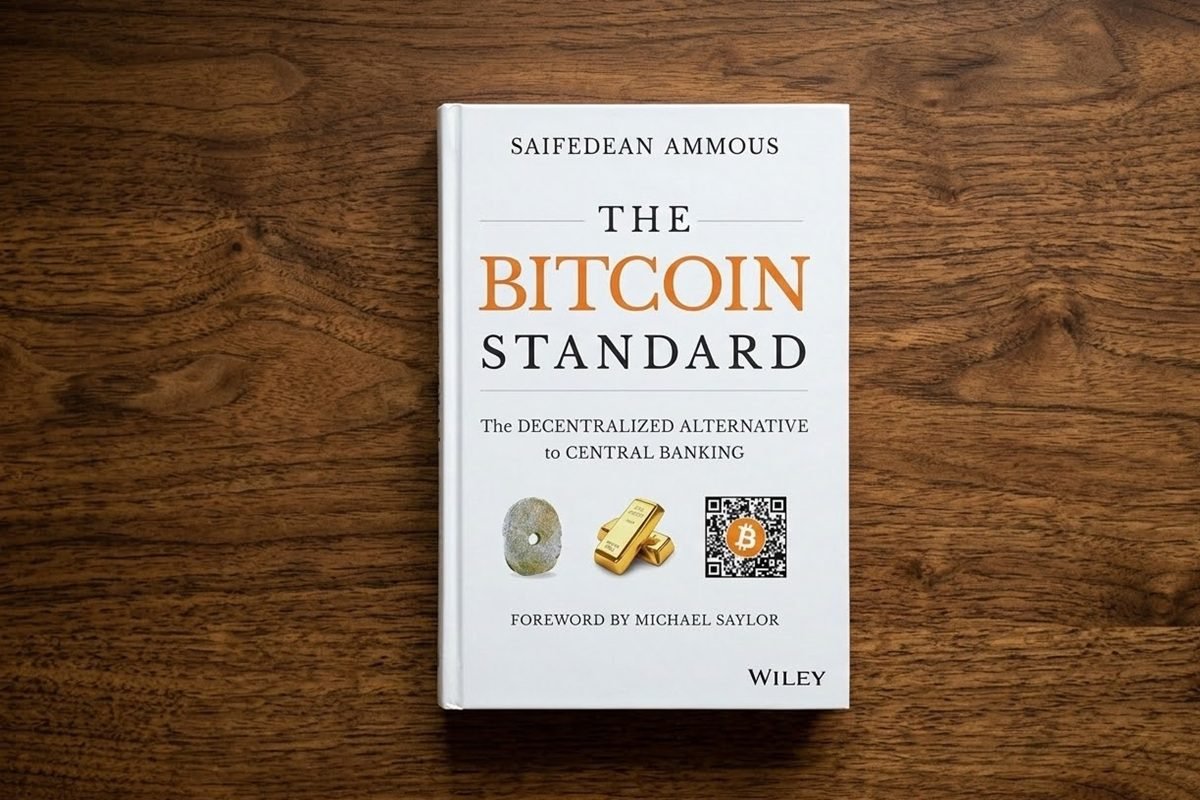
Book review: The Bitcoin Standard
The Decentralized Alternative to Central Banking
By Saifedean Ammous
Genres:
- Bitcoin & Cryptocurrencies
- Money
The year it was published:
2018
Number of pages:
304

As an Amazon Associate, I earn from qualifying purchases.
Table of contents:
Prologue
Chapter 1: Money
Chapter 2: Primitive Moneys
Chapter 3: Monetary Metals
Chapter 4: Government Money
Chapter 5: Money and Time Preference
Chapter 6: Capitalism’s Information System
Chapter 7: Sound Money and Individual Freedom
Chapter 8: Digital Money
Chapter 9: What Is Bitcoin Good For?
Chapter 10: Bitcoin Questions
Thoughts about the book:
Few books about Bitcoin attempt to place the technology within a sweeping historical and economic narrative. Ammous does exactly that, and the result is a work that is as much about the history of money as it is about cryptocurrency. Ammous structures the book as a story of monetary evolution. The journey from barter to primitive money, from metals to fiat currency, and finally to digital scarcity is presented as a logical progression. This narrative structure makes the book engaging and easy to follow. Instead of presenting Bitcoin as an isolated invention, Ammous situates it within the broader history of economic systems. Ammous writes in a clear, direct style that prioritizes explanation over academic complexity. The language is accessible, and the pacing moves steadily from historical narrative to economic theory. Unlike academic economic texts, the book avoids heavy mathematical modeling and focuses on conceptual understanding. The writing itself is generally clear and confident. Ammous writes in a straightforward, assertive style that balances accessibility with intellectual depth. The language is not heavily academic. Readers without an economics background can follow the argument, though some familiarity with economic concepts certainly helps. It is not a difficult book to read, but it does demand attention, particularly in the sections dealing with monetary theory and macroeconomic history.
Who should read this book:
This book is for investors, entrepreneurs, and crypto enthusiasts who want to understand the philosophy behind Bitcoin, not just trade it. It’s for anyone concerned about wealth preservation and the long-term value of money in an era of fiat inflation. It’s not ideal for readers looking for technical trading advice or short-term cryptocurrency tips since the book is conceptual, historical, and philosophical. If you want to grasp how money shapes society, behavior, and freedom, and why Bitcoin represents a new chapter, then it is an essential read.
Summary of the book:
Prologue
The prologue introduces the central question of the book, and that is, what makes money good money? Ammous argues that money is one of humanity’s most important technologies because it enables cooperation across time and space. Throughout history, societies have experimented with different forms of money, and the ones that survive are those that best preserve value and facilitate exchange. He frames the book as both a history of money and an explanation of why Bitcoin emerged. According to Ammous, modern monetary systems are fragile because they rely on government control and expanding supply. Bitcoin, he suggests, represents a potential return to “sound money,” similar in principle to gold but implemented through digital technology.
Chapter 1: Money
Ammous begins by defining money as the most saleable good in a society. It is the item most easily exchanged for other goods and services. Early economies relied on barter, but barter suffers from the “double coincidence of wants.” Money solves this problem by becoming an intermediary in trade. Over time, certain goods naturally become money because they possess characteristics that make them easier to trade. These include durability, divisibility, portability, and scarcity. Ammous emphasizes that money is not necessarily created by governments but emerges organically from market processes. The chapter sets the theoretical foundation for how money evolves through competition, and the best monetary technologies eventually dominate economic systems.
Chapter 2: Primitive Moneys
This chapter examines early forms of money used by premodern societies. Items such as shells, beads, salt, and livestock served monetary roles because they were widely desired and relatively scarce. However, primitive monies had limitations. Many were difficult to transport, could degrade over time, or were vulnerable to sudden increases in supply. Ammous highlights historical examples where the discovery of new supplies of a monetary good destroyed its value. One well-known case involves the Pacific island of Yap, where large stone disks served as money. Their scarcity initially preserved value, but when new stones became easier to quarry and transport, the system destabilized. The lesson is that a good monetary system must resist sudden increases in supply.
Chapter 3: Monetary Metals
Ammous argues that precious metals, especially gold and silver, became dominant forms of money because they best satisfied monetary requirements. They are durable, divisible, easily recognizable, and extremely costly to produce. Gold, in particular, has a stable supply growth rate because mining is difficult and expensive. This property gives it a high “stock-to-flow ratio,” meaning the existing supply is large relative to the amount produced each year. Historically, this stability allowed gold-based monetary systems to maintain purchasing power over long periods. Ammous claims that gold’s scarcity made it the most reliable store of value humanity had discovered before Bitcoin.
Chapter 4: Government Money
The book then examines how governments gradually replaced metallic money with state-controlled currency. Initially, paper notes were simply claims on gold held in banks. Over time, however, governments severed the link between currency and precious metals. Ammous describes this transition as the shift from commodity money to fiat money. Fiat currency derives value from a government decree rather than inherent scarcity. He argues that once governments gained the ability to create money freely, they used it to finance wars, deficits, and political programs. The abandonment of the gold standard in the 20th century marked the full transition to fiat monetary systems.
Chapter 5: Money and Time Preference
This chapter introduces the concept of time preference, a key idea from Austrian economics. Time preference refers to how strongly individuals prefer present consumption over future consumption. Ammous argues that sound money encourages long-term thinking. When money reliably holds its value, people are more likely to save, invest, and plan for the future. By contrast, inflationary money encourages short-term thinking because holding cash becomes costly. According to Ammous, societies operating under sound money tend to produce more capital accumulation, innovation, and cultural development.
Chapter 6: Capitalism’s Information System
In this chapter, Ammous describes money as the information system of the economy. Prices transmit signals about scarcity, demand, and resource allocation. When money retains stable value, price signals become clearer. Businesses and investors can make decisions with greater confidence. However, when monetary supply is manipulated, price signals become distorted. Ammous argues that inflation interferes with this information system, causing misallocation of capital and economic instability.
Chapter 7: Sound Money and Individual Freedom
Ammous connects monetary stability to political freedom. When governments control the money supply, they gain powerful tools for surveillance, taxation, and economic manipulation. Sound money limits this power because it cannot be easily expanded or controlled by central authorities. Historically, gold played this role by restricting government spending and monetary policy. The main message of the chapter is that monetary independence strengthens individual sovereignty, while inflationary systems concentrate power in central institutions.
Chapter 8: Digital Money
Ammous then turns to the problem of creating digital money. Digital information can be copied infinitely, which historically prevented purely digital currencies from functioning as money. Bitcoin solves this problem through a decentralized network that verifies transactions and prevents double-spending. Instead of relying on a central authority, Bitcoin uses cryptographic proof and distributed consensus. The innovation lies in combining cryptography, network incentives, and computational work to enforce scarcity in a digital environment.
Chapter 9: What Is Bitcoin Good For?
This chapter explores Bitcoin’s practical role. Ammous argues that Bitcoin functions primarily as digital sound money, similar to gold but easier to store and transfer. Because its supply is capped and predictable, Bitcoin cannot be inflated arbitrarily. This property makes it attractive as a long-term store of value. Ammous also highlights Bitcoin’s censorship resistance. Transactions can occur without permission from banks or governments, allowing individuals to move wealth across borders and political systems.
Chapter 10: Bitcoin Questions
The final chapter addresses common criticisms of Bitcoin. Ammous discusses concerns about volatility, energy consumption, scalability, and competition from other cryptocurrencies. He argues that volatility is natural for a new monetary asset still discovering its market value. Over time, adoption could stabilize prices. Regarding energy usage, he claims the energy cost of mining is the mechanism that secures the network and enforces scarcity. In his view, this cost is comparable to the resources historically spent mining gold. The chapter concludes by suggesting that Bitcoin represents a new phase in the evolution of money, a digital alternative to both gold and government-issued currencies.