Book review: Noise
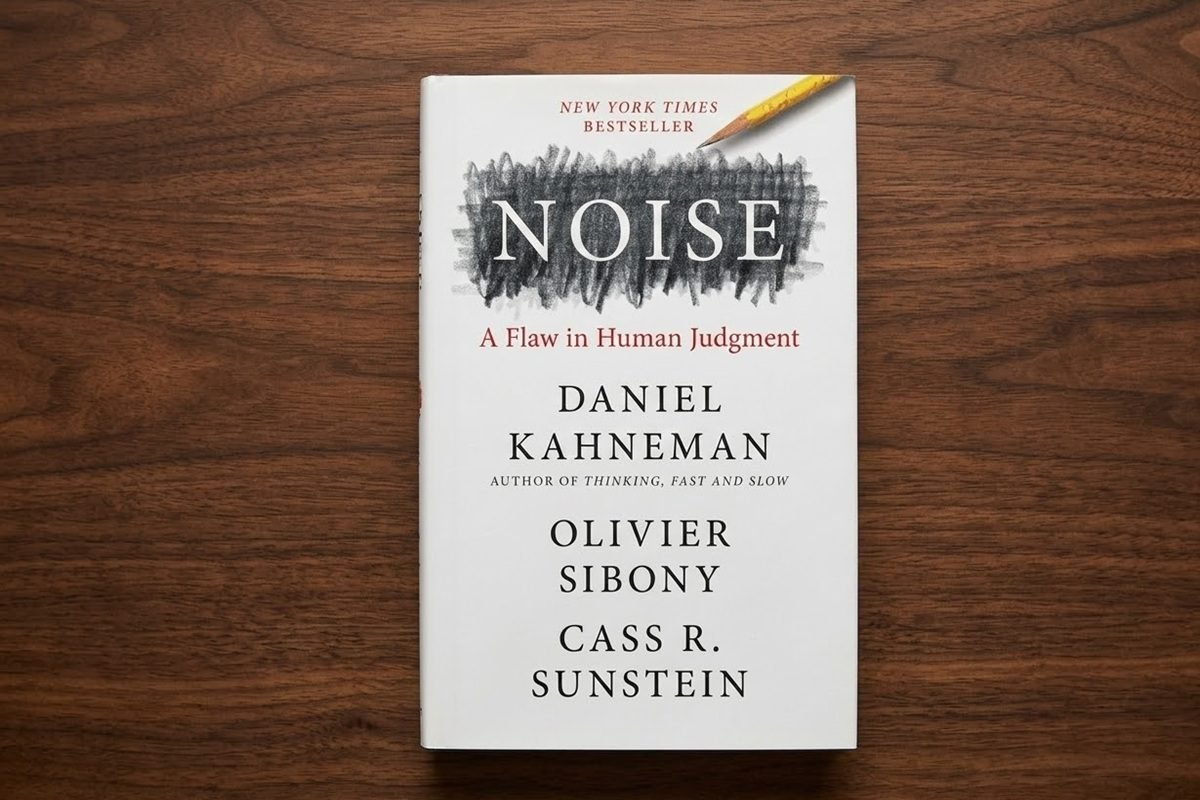
A Flaw in Human Judgment
By Daniel Kahneman, Olivier Sibony, and Cass R. Sunstein
Genres:
- Decision-Making
- Problem Solving
- Psychology
The year it was published:
2021
Number of pages:
464

As an Amazon Associate, I earn from qualifying purchases.
Table of contents:
Introduction: Two Kinds of Error
Part I – Finding Noise
Chapter 1: Crime and Noisy Punishment
Chapter 2: A Noisy System
Chapter 3: Singular Decisions
Part II – Your Mind Is a Measuring Instrument
Chapter 4: Matters of Judgment
Chapter 5: Measuring Error
Chapter 6: The Analysis of Noise
Chapter 7: Occasion Noise
Chapter 8: How Groups Amplify Noise
Part III – Noise in Predictive Judgments
Chapter 9: Judgments and Models
Chapter 10: Noiseless Rules
Chapter 11: Objective Ignorance
Chapter 12: The Valley of the Normal
Part IV – How Noise Happens
Chapter 13: Heuristics, Biases, and Noise
Chapter 14: The Matching Operation
Chapter 15: Scales
Chapter 16: Patterns
Chapter 17: The Sources of Noise
Part V – Improving Judgments
Chapter 18: Better Judges for Better Judgments
Chapter 19: Debiasing and Decision Hygiene
Chapter 20: Sequencing Information in Forensic Science
Chapter 21: Selection and Aggregation in Forecasting
Chapter 22: Guidelines in Medicine
Chapter 23: Defining the Scale in Performance Ratings
Chapter 24: Structure in Hiring
Chapter 25: The Mediating Assessments Protocol
Part VI – Optimal Noise
Chapter 26: The Costs of Noise Reduction
Chapter 27: Dignity
Chapter 28: Rules or Standards?
Review and Conclusion: Taking Noise Seriously
Epilogue: A Less Noisy World
Thoughts about the book:
The book Noise is about a problem most of us didn’t even realize had a name, which is the unwanted variability in human judgment. While bias has been discussed to death, noise is subtler and, arguably, just as damaging. Two judges, two doctors, or two hiring managers can look at the same case and make wildly different decisions not because of ideology or prejudice, but because of randomness, mood, or context. That’s noise. This central insight is strong, important, and once you see it, impossible to unsee. The book succeeds at reframing how we think about errors in decision-making. Bias asks, “Are we systematically wrong?” Noise asks, “Why are we inconsistent?”
What I didn’t like is that the core idea is hammered home again and again. While this helps clarity, it sometimes feels like the authors don’t fully trust the reader to remember the point. Many chapters that could have been five pages are fifteen. Examples are repeated, concepts are re-explained, and the reader is periodically walked back through terrain that has already been covered. Also, if you’ve already read Kahneman’s earlier work “Thinking Fast and Slow“, Noise feels more like a deep extension than a paradigm shift. The “wow” moments are fewer, replaced by careful and sometime repetative elaboration. The language strikes a balance between educated everyday speech and light academic precision. It is accessible, but it demands attention. You cannot skim Noise casually, it requires sustained engagement.
In the end, Noise leaves you with a quiet discomfort. It challenges the comforting belief that professional judgment is inherently stable or that expertise guarantees consistency. By the end, you begin to see variability everywhere in performance reviews, admissions decisions, and risk assessments, and you start to question how much of what we call judgment is simply structured randomness.
Who should read this book:
If you’ve ever wondered why smart, well-intentioned people so often arrive at wildly different conclusions, the book Noise is one of those you shouldn’t ignore. In this book, Daniel Kahneman turns our attention away from obvious bias and toward a quieter, more unsettling force, randomness in human judgment. He shows how judges sentencing similar cases, doctors diagnosing identical patients, or managers evaluating the same candidate can produce inconsistent outcomes without realizing it. Kahneman isn’t chasing blame, he’s searching for understanding. His interest lies in fairness, accuracy, and the uncomfortable truth that good intentions don’t guarantee good decisions. Reading Noise is like having a light switched on in a room you thought you already understood. It challenges how you trust experts, how you evaluate opinions, and how much confidence you place in your own judgment.
Summary of the book:
Introduction
The authors introduce the book’s central idea, which is bias (systematic errors that push judgments consistently in one direction) versus noise (random variability that causes different people or the same person at different times to make wildly different judgments). Both cause harm, but noise is far less recognized and studied. A simple shooting-range metaphor illustrates the difference between the two. A biased team’s shots cluster in the wrong spot while a noisy team’s shots scatter randomly.
Chapter 1: Crime and Noisy Punishment
In this chapter, the authors introduce the concept of noise through the example of criminal sentencing. They show that judges often give significantly different punishments for similar crimes, even when legal guidelines and evidence are the same (two defendants convicted of nearly identical crimes could receive radically different sentences — 30 days versus 15 years — based on nothing more than which judge happened to preside). These inconsistencies are not the result of deliberate disagreement but of irrelevant factors such as the judge’s mood, personal background, or situational context. The authors argue that this randomness turns punishment into a “lottery,” undermining fairness and equality in the justice system. The chapter establishes noise as a serious moral and institutional problem with real consequences for people’s lives.
Chapter 2: A Noisy System
Chapter 2 expands the discussion by examining system noise, which occurs when different decision-makers within the same organization produce inconsistent judgments. Using examples from medicine, insurance, and performance evaluations, the authors show that systems designed to be fair and standardized still allow wide variation in outcomes. This variability is often mistaken for acceptable professional judgment, rather than recognized as error. The chapter argues that system noise reduces accuracy, efficiency, and trust in institutions. By highlighting how common and invisible system noise is, the authors emphasize the need for organizations to measure and address it directly. The authors present a striking example from an insurance company: when multiple underwriters independently assessed the same cases, the median difference in their quotes was 55%. The company’s executives had expected about 10%.
Chapter 3: Singular Decisions
This chapter focuses on singular noise, the variability within a single individual’s decisions over time. The authors demonstrate that even the same person can make different judgments about identical cases depending on factors such as fatigue, emotional state, or recent experiences. Expertise and confidence do not eliminate this problem; in some cases, they can even conceal it. The chapter challenges the belief that careful thinking ensures consistent judgment and shows that human decision-making is inherently unstable. This insight reinforces the authors’ broader argument that noise is a fundamental flaw in human judgment that must be managed, not ignored.
Chapter 4: Matters of Judgment
In this chapter, the authors explore why judgment is especially vulnerable to noise. They explain that judgment is required when rules are unclear, information is incomplete, or outcomes cannot be easily verified. In such situations, people rely on intuition and personal interpretation, which opens the door to inconsistency. The chapter shows that confidence, expertise, and good intentions do not guarantee accurate or consistent judgments. Instead, the authors argue that judgment itself is inherently variable, making noise a natural byproduct of many important decisions.
Chapter 5: Measuring Error
Chapter 5 focuses on how error in judgment can be measured and understood. The authors distinguish between bias (systematic error) and noise (random error), emphasizing that both contribute to poor decision outcomes. They introduce the idea of overall error as a combination of these two elements. The chapter explains why organizations often fail to measure error effectively, especially when feedback is delayed or unclear. By clarifying how error can be quantified, the authors lay the groundwork for identifying and reducing noise.
Chapter 6: The Analysis of Noise
This chapter provides a deeper examination of noise and how it can be analyzed in practice. The authors describe methods for revealing noise by comparing multiple judgments of the same cases. They show that noise often exists even in systems that appear consistent on the surface. The chapter also discusses the psychological and organizational resistance to noise analysis, as people are uncomfortable confronting inconsistency in their own judgments. Overall, the chapter emphasizes that recognizing noise is a crucial step toward improving decision quality.
Chapter 7: Occasion Noise
Chapter 7 introduces occasion noise, a specific type of singular noise caused by temporary circumstances. The authors explain that judgments can vary depending on factors such as mood, time pressure, fatigue, or even the weather. These influences are irrelevant to the decision itself but still affect outcomes. The chapter highlights how occasion noise is difficult to predict and control, yet widespread across many domains. This reinforces the idea that human judgment is highly sensitive to context and situational factors.
Chapter 8: How Groups Amplify Noise
In this chapter, the authors challenge the assumption that group decision-making reduces error. While groups can correct individual biases, they often amplify noise through inconsistent discussion, dominant personalities, and unstructured deliberation. The chapter explains how group dynamics can increase variability rather than reduce it, especially when roles and criteria are unclear. The authors argue that without structured processes, group decisions may be no more reliable than individual judgments. This chapter underscores the importance of designing group decision-making systems that minimize noise rather than unintentionally increasing it.
Chapter 9: Judgments and Models
In this chapter, the authors compare human judgment with statistical and algorithmic models. They argue that even simple models often outperform human experts because they apply the same rules consistently and are free from noise. While people believe their intuition allows for flexibility and insight, it also introduces variability and error. The authors acknowledge skepticism toward models, especially concerns about oversimplification, but show that consistency frequently matters more than nuanced judgment. The chapter makes a strong case for using models to support or replace human judgment in many decision-making contexts.
Chapter 10: Noiseless Rules
Chapter 10 examines the role of rules in reducing noise. Rules eliminate variability by prescribing clear actions or outcomes, making decisions more consistent and predictable. However, the authors note that strict rules can be inflexible and may fail to account for unique circumstances. The chapter explores the trade-off between consistency and discretion, arguing that while rules can seem rigid, they often outperform human judgment in fairness and reliability. The authors suggest that well-designed rules can significantly reduce noise without sacrificing decision quality.
Chapter 11: Objective Ignorance
This chapter introduces the concept of objective ignorance, which occurs when decision-makers lack accurate information about outcomes. Without clear feedback, people cannot learn from their mistakes or improve their judgments. The authors show that in many professional settings, such as medicine, law, and hiring, feedback is delayed, incomplete, or misleading. As a result, confidence in judgment remains high even when accuracy is low. The chapter explains how objective ignorance allows noise to persist unchecked and reinforces overconfidence in human judgment.
Chapter 12: The Valley of the Normal
In Chapter 12, the authors discuss how judgment performs worst in situations that appear ordinary or “normal.” These cases lack clear signals, making decisions especially vulnerable to noise. The authors argue that while extreme cases attract attention and scrutiny, everyday decisions often escape evaluation, even though they make up the majority of judgments. This “valley of the normal” is where noise is most common and most harmful. The chapter emphasizes that improving decision-making requires focusing not only on rare or dramatic cases, but also on routine judgments.
Chapter 13: Heuristics, Biases, and Noise
In this chapter, the authors connect the concept of noise to the well-known research on heuristics and biases. They explain that while heuristics are mental shortcuts that help people make quick judgments, they also introduce both bias and noise. Bias leads to systematic errors, while noise causes unpredictable variation in judgments. The chapter argues that much of the existing focus on bias has obscured the equally damaging effects of noise. By integrating these ideas, the authors broaden the understanding of how human judgment goes wrong and why improving decision-making requires addressing both problems.
Chapter 14: The Matching Operation
Chapter 14 explores how people translate subjective impressions into numerical or categorical judgments, a process the authors call the matching operation. When individuals assign ratings, probabilities, or scores, they must match an internal sense of intensity to an external scale. This process is inherently imprecise and contributes significantly to noise. The chapter shows that different people and even the same person may use scales inconsistently. The authors argue that this imprecision is a major but underappreciated source of variability in judgment.
Chapter 15: Scales
This chapter examines how the design and use of scales influence judgment. The authors show that vague or poorly defined scales allow wide interpretation, increasing noise. Even commonly used scales, such as performance ratings or risk assessments, are often interpreted differently by different judges. The chapter emphasizes that clearer definitions, anchors, and reference points can reduce variability. By focusing on scale design, the authors highlight a practical way organizations can reduce noise without eliminating judgment entirely.
Chapter 16: Patterns
Chapter 16 discusses humans’ tendency to search for patterns, even in random or limited data. While pattern recognition is essential to learning and expertise, it can also create false confidence and increase noise. Different people may see different patterns in the same information, leading to inconsistent judgments. The authors argue that reliance on perceived patterns often exaggerates differences between judges rather than improving accuracy. This chapter reinforces the idea that intuitive interpretation, though compelling, is a major contributor to noisy decision-making.
Chapter 17: The Sources of Noise
In this chapter, the authors synthesize the various causes of noise discussed throughout the book. They identify multiple sources, including individual differences, situational factors, scale interpretation, and cognitive processes. The chapter emphasizes that noise does not arise from a single flaw but from the interaction of many small influences. By mapping these sources, the authors provide a comprehensive framework for understanding why noise is so pervasive. This sets the stage for the book’s final focus on strategies for reducing noise in practice.
Chapter 18: Better Judges for Better Judgments
In this chapter, the authors examine whether improving individual decision-makers can meaningfully reduce noise. They acknowledge that training, experience, and expertise can help, but argue that even highly skilled judges remain vulnerable to inconsistency. Personal judgment styles, confidence levels, and cognitive habits still introduce variability. The authors conclude that while better judges are valuable, relying solely on individual improvement is insufficient. Lasting noise reduction requires changes to decision systems, not just to the people within them.
Chapter 19: Debiasing and Decision Hygiene
Chapter 19 revisits traditional debiasing efforts and contrasts them with decision hygiene, the authors’ preferred approach. Debiasing focuses on correcting specific cognitive errors, but often fails because biases are difficult to recognize in oneself. Decision hygiene, by contrast, aims to reduce noise through structured processes, such as separating judgments, standardizing criteria, and limiting irrelevant influences. The authors argue that hygiene works not by changing minds, but by changing environments. This chapter reinforces the idea that better decision design is more effective than relying on individual awareness.
Chapter 20: Sequencing Information in Forensic Science
This chapter uses forensic science to illustrate how the order in which information is presented affects judgment. The authors show that early exposure to suggestive or irrelevant information can bias later evaluations and increase noise. They argue that carefully sequencing information by delaying contextual details until after objective analysis can improve consistency and accuracy. The chapter demonstrates how simple procedural changes can significantly reduce judgment errors. It also highlights the broader relevance of information sequencing beyond forensic contexts.
Chapter 21: Selection and Aggregation in Forecasting
Chapter 21 focuses on forecasting and explains how selecting and aggregating judgments can reduce noise. The authors show that combining multiple independent forecasts often produces more accurate results than relying on a single expert. Independence is key: when forecasters influence one another, noise and bias increase. The chapter emphasizes structured aggregation methods, such as averaging and weighted models, as effective tools. This discussion reinforces the value of collective judgment when properly designed.
Chapter 22: Guidelines in Medicine
In this chapter, the authors examine how medical guidelines can reduce noise in diagnosis and treatment. While physicians value professional autonomy, unstructured judgment leads to inconsistent care. The authors argue that evidence-based guidelines improve consistency and patient outcomes, even if they limit discretion. They also acknowledge resistance from practitioners who fear oversimplification. The chapter presents medicine as a domain where noise reduction can directly save lives.
Chapter 23: Defining the Scale in Performance Ratings
Chapter 23 returns to the issue of scales, focusing specifically on performance evaluations. The authors show that vague rating categories lead to wide interpretation and inconsistent judgments. They argue that clearly defined criteria, examples, and benchmarks can significantly reduce noise. The chapter highlights how performance ratings often fail not because of unfair intentions, but because of poorly designed evaluation systems. Improving scale clarity is presented as a practical and low-cost solution.
Chapter 24: Structure in Hiring
This chapter examines hiring decisions, a domain heavily influenced by intuition. The authors show that unstructured interviews are highly noisy and poor predictors of job performance. In contrast, structured hiring processes using standardized questions and scoring methods produce more consistent and accurate outcomes. The chapter challenges the belief that personal impressions reveal character or potential. It argues that structure improves fairness without sacrificing effectiveness.
Chapter 25: The Mediating Assessments Protocol
Chapter 25 introduces the Mediating Assessments Protocol (MAP), a structured method for reducing noise in complex judgments. The protocol separates evaluation into independent components before combining them into a final decision. This reduces the influence of early impressions and irrelevant factors. The authors present MAP as a flexible tool applicable across many domains. The chapter serves as a concrete example of decision hygiene in action.
Chapter 26: The Costs of Noise Reduction
In this chapter, the authors address the trade-offs involved in reducing noise. Structure, rules, and models can feel restrictive, time-consuming, or impersonal. The authors argue that noise reduction is not free and must be balanced against efficiency, flexibility, and dignity. However, they emphasize that the costs of noise unfairness, error, and lost trust are often far greater. This chapter encourages thoughtful, context-sensitive implementation rather than blind standardization.
Chapter 27: Dignity
Chapter 27 explores the emotional and ethical dimensions of noise reduction. People value autonomy, respect, and the feeling of being heard, which can be threatened by rigid systems. The authors argue that dignity should be preserved even in structured decision-making. Noise reduction should enhance fairness without dehumanizing individuals. This chapter adds a moral perspective to the book’s largely analytical approach.
Chapter 28: Rules or Standards?
The final chapter revisits the tension between rules and standards. Rules offer consistency and low noise but limit discretion, standards allow flexibility but increase variability. The authors argue that most systems require a balance of both. The chapter emphasizes that decision design should be guided by the costs of error and the need for fairness. It serves as a final synthesis of the book’s central themes.
Review & Conclusion – Taking Noise Seriously
In the conclusion, the authors reiterate that noise is a pervasive and costly flaw in human judgment. They argue that organizations and institutions must take noise as seriously as bias. Reducing noise requires humility, measurement, and structured decision processes. The book concludes that better decisions are achievable not by eliminating judgment, but by designing systems that support it.
Epilogue – A Less Noisy World
The epilogue reflects on the broader implications of noise reduction for society. The authors imagine a world in which decisions are fairer, more consistent, and more trustworthy. They emphasize that reducing noise is not about perfection, but about responsibility. The epilogue ends on an optimistic note, suggesting that meaningful improvement is possible if noise is finally acknowledged and addressed.