Book review: Connected
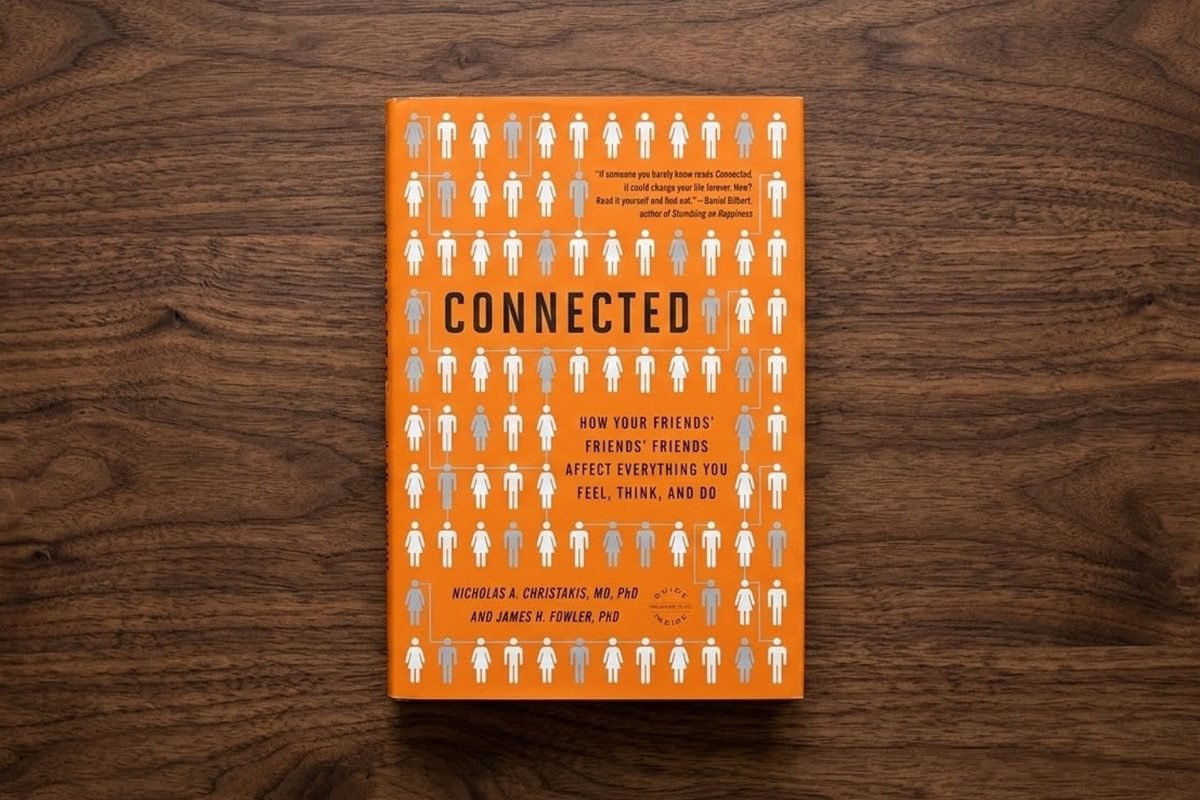
The Surprising Power of Our Social Networks and How They Shape Our Lives - How Your Friends' Friends' Friends Affect Everything You Feel, Think, and Do
By Nicholas A. Christakis MD PhD and James H. Fowler PhD
Genres:
- Social Psychology
- Sociology
The year it was published:
2011
Number of pages:
368

As an Amazon Associate, I earn from qualifying purchases.
Table of contents:
Preface
Chapter 1: In the Thick of it
Chapter 2: When You Smile, the World Smiles with You
Chapter 3: Love the One You’re With
Chapter 4: This Hurts Me As Much As It Hurts You
Chapter 5: The Buck Starts Here
Chapter 6: Politically Connected
Chapter 7: It’s in Our Nature
Chapter 8: Hyperconnected
Chapter 9: The Whole Is Great
Thoughts about the book:
At its core, Connected argues that our lives are far more intertwined than we tend to believe. Not only do our friends influence us, but so do our friends’ friends and even their friends. Behaviors, emotions, and norms ripple outward through networks in ways that are both subtle and profound. Happiness, obesity, smoking habits, and generosity are not merely individual traits but collective phenomena shaped by invisible webs of connection. The book is undeniably informative and is backed by science. Christakis and Fowler draw from epidemiology, sociology, and network theory, presenting empirical studies and data-driven insights throughout. Even though some topics may be complex, the authors manage to translate that complexity into accessible ideas. The science is real, but it is carefully explained. In terms of writing style, Connected strikes a balance between academic rigor and simple readability. The language leans more toward the educated general reader. There are moments where the explanations require concentration, especially when discussing network structures or statistical relationships, but overall, the book remains approachable. I liked that concepts are introduced gradually and reinforced through examples, making the book easy to follow even for readers unfamiliar with network science.
There are also some challenges in the book, such as at times, the authors’ enthusiasm for their findings can lead to claims that feel broader than the evidence fully supports. The idea of “three degrees of influence,” for example, is intriguing but feels far-fetched. Additionally, while the central concept is powerful, it is revisited repeatedly across different domains. This reinforces the message, but it can also create a sense of repetition. Still, what lingers after reading Connected is a shift in perspective. You begin to see social life a bit differently, not as a collection of individuals, but as a living network. Your choices feel less isolated. Your behaviors seem less entirely your own. To sum up, Connected is an ambitious and thought-provoking work. It is a book that expands your sense of how influence works, and once that perspective takes hold, it is difficult to return to a simpler view of human behavior.
Who should read this book:
If you are drawn to questions about how deeply your life is intertwined with others, then Connected by Nicholas A. Christakis and James H. Fowler is the book for you. You should read it if you are interested in the unseen forces that shape behavior, and how your habits, emotions, and even health are influenced not just by friends, but by friends of friends, and even further. This is a work for those who suspect that human life cannot be fully understood in isolation, and who want to explore the architecture of connection that quietly governs societies. What Christakis and Fowler are searching for is nothing less than the mechanics of human interdependence. They ask questions like, ” How do ideas, feelings, and actions spread? Why do clusters of happiness or illness emerge? How far does your influence actually reach?” Their interest lies in mapping these invisible chains of influence and demonstrating that we are nodes in a vast, dynamic network rather than independent actors. This is a book for readers fascinated by psychology, sociology, behavioral science, and the patterns that repeat across human systems. It invites you to reconsider individuality itself, not as a fixed boundary, but as something shaped continuously by the people around you.
Summary of the book:
Preface
In the preface, the authors introduce the book’s central idea, which is that human beings are deeply interconnected, and these connections shape far more of our lives than we realize. Christakis and Fowler argue that social networks are not just abstract webs of relationships instead, they are living systems that influence behavior, emotions, health, and even survival. They propose that traits such as happiness, obesity, smoking, and generosity can spread through networks in ways similar to contagious diseases.
Chapter 1: In the Thick of It
The first chapter asks one simple question and that is “Why do things such as violence, kindness, disease, and money travel from person to person and sometimes keep going far beyond the people who started them?” The authors start with two extreme examples to make the point vivid. The first is a story of murder that spreads like a chain reaction. The second is a story of generosity that does exactly the same thing, but in a beautiful direction instead of a terrible one. This chapter lays the foundation for understanding social networks as structured systems rather than random connections. The authors explain that networks have patterns such as clusters, hubs, and paths that determine how influence flows. Using real-world data, including long-term studies of social ties, they demonstrate that your position in a network matters. Being central or peripheral changes how much influence you have and how much influence you receive. The key idea is that we are embedded in networks that extend beyond our immediate friends, often reaching three degrees of separation, meaning your friends’ friends’ friends can affect your life in measurable ways.
Chapter 2: When You Smile, the World Smiles with You
Chapter Two is about emotions. The central idea is that emotions are not just personal feelings locked inside your head, but they spread from person to person, like a virus, through social networks. You already know this in small ways. You walk into a room where everyone is tense, and you feel tense too. A friend laughs, and you start laughing even if you didn’t hear the joke. A colleague is in a terrible mood, and before long, yours has dropped too. The authors show that this is not just a feeling, this phenomenon is measured and documented. Using decades of data from the Framingham Heart Study, which is a famous medical study that tracked thousands of people in Massachusetts for over 50 years, they mapped the happiness of everyone in the network. The same effect works in reverse with loneliness and depression. Their findings are that the effect is not limited to direct connections. Happiness or sadness can spread across multiple degrees of separation, forming clusters of positive or negative emotion within networks, which means that your emotional state is partly a social phenomenon, shaped by the people around you and the structure of your relationships.
Chapter 3: Love the One You’re With
Chapter Three tackles love and relationships. The big idea in this chapter is that we think finding a romantic partner is a matter of personal chemistry and lucky chance. In reality, our social network is doing most of the work by guiding us toward certain people, filtering out others, and even influencing what we find attractive. A large national survey in the United States, nicknamed the Chicago Sex Survey, asked over 3,000 people how they met their current partners. The results were striking. About 68% of people met their spouse because someone introduced them, a friend, a family member, or a coworker. Only 32% met on their own without any introduction. Even for one-night stands and short-term relationships, more than half were brokered by a mutual connection. The chapter also reveals that our very sense of who is attractive is socially contagious. For example, research showed that men described as “married” were rated as more attractive than identical men described as “single.” Our brains use the opinions of others as a shortcut for deciding what — and who — has value.
Chapter 4: This Hurts Me As Much As It Hurts You
Chapter Four might be one of the most surprising chapters in the book. The authors show backed with data that obesity, smoking, and even loneliness spread through social networks. Not through physical contact, not through shared food or gyms, but through the invisible transmission of norms. To elaborate, what we see our friends doing shapes what feels normal to us. To test this, the authors looked at whether the influence was stronger when the friendship went both ways versus when only one person claimed the other person was their friend. And the answer, yes, it was. Mutual friends had the most influence. People you don’t consider your friends have almost no effect on you, even if they consider you theirs. In this chapter, the authors shared a very interesting study, the Framingham Obesity Study. The Framingham Heart Study had been tracking thousands of people in a Massachusetts town since 1948. What made it uniquely valuable was that for decades, the researchers had kept handwritten records listing each participant’s friends, family, coworkers, and neighbours, so they could contact them for follow-up appointments. Christakis and Fowler realised these records were a secret map of the entire social network of a community, spanning over 30 years. They combined it with weight measurements taken every two to four years. The finding was that if a close mutual friend of yours became obese, your own risk of becoming obese nearly tripled. If a friend-of-a-friend became obese, your risk still rose by 20%. And if a friend-of-a-friend-of-a-friend became obese, your risk went up by 10%, even if you had never met this person. Crucially, the effect worked even between friends who lived hundreds of miles apart and never shared the same gym or restaurant. What spread was not the food but the idea of what a normal body looks like. The same pattern worked for smoking. If a friend stopped smoking, you were much more likely to stop smoking too. The effect rippled out three degrees, just like happiness.
Chapter 5: The Buck Starts Here
Chapter Five moves from health to money. The authors show that financial panics and economic behaviours spread through social networks and that this has been true for as long as humans have traded with each other. The chapter also describes how financial networks are not just about formal economic ties like loans and contracts, they are also about the personal relationships between bankers, traders, and investors who know each other, trust each other, and when they see their friends selling, start selling too. Warren Buffett, the famous investor, said the following quote “In markets, it’s not just whom you sleep with, but also whom they are sleeping with.” In this chapter, the authors share an interesting story on this subject matter. In September 2007, a British bank called Northern Rock ran into financial trouble and had to ask the Bank of England for emergency support. The government quickly announced that all deposits were safe. But the announcement didn’t matter. News spread through neighbourhoods, families, workplaces, and television screens. On Friday morning, long queues formed outside Northern Rock branches at 6 a.m. People who had saved for years came to take their money out. Here is the remarkable part of all of this was that many of the people queuing openly admitted they didn’t actually think the bank would fail. One woman said, “If everyone else does it, it becomes the right thing to do.” The people weren’t responding to the bank’s finances. They were responding to the behaviour of the people around them. When they saw their neighbours panic, they panicked too. The bank run which could have destroyed the institution, was entirely driven by social contagion. The run lasted three days. It only stopped when the government issued an even stronger guarantee. Meanwhile, simply seeing the news caused shares in other unrelated banks to fall sharply, as investors’ fear spread through the financial network.
Chapter 6: Politically Connected
Chapter Six shows that political behaviour, for example, who we vote for, whether we bother to vote at all, and what we believe politically, is deeply shaped by our social networks. Democracy, it turns out, is not just a collection of individual choices. It is a network phenomenon. Research shows that political opinions cluster in social networks in ways that go beyond just choosing friends who agree with us. Our views are genuinely influenced by the views of our friends, who were influenced by their friends. When researchers planted “I voted today” stickers in some Facebook users’ feeds, those users were more likely to vote, and crucially, so were their friends and their friends’ friends. The social signal rippled outward three degrees.
Chapter 7: It’s in Our Nature
In this chapter, the authors try to answer why humans form social networks in the first place. Their answer is that we are genetically predisposed to connect to others in certain ways. The authors present evidence from twin studies comparing identical twins (who share 100% of genes) to fraternal twins (who share about 50%) to show that our networking behaviour has a genetic component. The chapter also examines game theory, which is the mathematical study of how people make decisions when their choices affect others. Experiments repeatedly show that humans will sacrifice their own money to punish someone who behaved unfairly, even if the punished person is a complete stranger they will never meet again. This makes no rational economic sense, as it costs you to punish them and benefits you nothing. But in a network where reputation travels, punishing cheaters protects your community. We evolved to do it automatically.
Chapter 8: Hyperconnected
Chapter Eight enters the digital world and asks the million-dollar question. Does the internet fundamentally change how social networks work? The authors’ answer is no, and yes. The same ancient rules apply, but technology makes networks faster, larger, and reaches people who were never reachable before. The chapter also revisits Milgram’s famous obedience experiment, where ordinary people were convinced to give what they believed were fatal electric shocks to strangers, just because an authority figure told them to. When the experiment was replicated in a virtual reality setting, with participants fully aware that the other subject was a computer animation, the results were nearly identical. Deep social instincts such as obedience, empathy, and conformity operate even in clearly artificial environments. The internet, the authors argue, doesn’t create new human nature. It amplifies and accelerates the old one. The authors share an interesting story about a research that was about the “Proteus Effect,” which is how online avatars can change behavior. In an online environment, researchers randomly assigned people attractive or unattractive avatars, without letting them choose. Then they measured how those people behaved. People with attractive avatars walked closer to others, spoke with more confidence, revealed more about themselves, and were more assertive in negotiation games. People with unattractive avatars stayed further away and accepted worse deals. More remarkably, when the headsets came off, the effect continued. People who had been given attractive avatars felt more confident in real life, including thinking that real attractive strangers would want to date them. This matters because it shows that how we present ourselves, even if artificially and temporarily, changes how we see ourselves and how we behave.
Chapter 9: The Whole Is Great
The final chapter brings everything together and asks, “What does all of this mean for how we live, how we govern ourselves, and what kind of future we build?” The central idea is that human social networks are not just tools or conveniences. They are a kind of living organism with a structure, a function, a memory, and an intelligence of its own that goes beyond any individual within it. In the chapter, the authors make the case that social networks are a public good, something that everyone benefits from, but that no single person owns or controls. Like clean air, a lighthouse, or a public library, the network is most valuable when everyone contributes to it, and no one can monopolise it. The authors close with the following thought. We like to think of ourselves as individual agents making free choices. In reality, we are embedded in a vast network of connections that shapes almost everything we do, be it our weight, our moods, our political views, who we marry, how long we live, and how much we earn. We are not isolated units. We are nodes in a network. And networks, the authors show us, are capable of things that no individual alone could ever achieve.